Is the 748-Episode AI Large Language Model Tutorial on Bilibili Worth Watching? A Full Breakdown of Content Structure and Study Tips

A detailed analysis of Bilibili's 748-episode AI LLM tutorial with honest assessment and study tips.
This article provides a systematic analysis of a 748-episode AI large language model tutorial series on Bilibili, covering its three-part structure (fundamentals, advanced topics like RAG/Agent/fine-tuning, and hands-on projects). While the free course offers comprehensive coverage of in-demand LLM technologies, the article cautions against "7-day mastery" marketing claims and offers practical study advice for maximizing learning efficiency.
Course Overview: A Tutorial Series Claiming to Be the "Most Comprehensive and Detailed" LLM Course
Recently, a massive AI large language model (LLM) application development tutorial series appeared on Bilibili (B站), totaling 748 episodes and covering the complete knowledge path from absolute beginner to RAG and Agent development. The course creator claims to have revisited the entire field from the perspective of an "LLM beginner," spending one month researching various tutorials on the market before taking three months to compile the final product.
The course has a very clear positioning: enabling zero-experience learners to understand the material, follow along with hands-on exercises, and ultimately become job-ready. So how is this course actually structured? Is it worth investing your time in? Let's do a systematic analysis.
Course Structure Breakdown: Three Main Sections + Bonus Content
Fundamentals: Building a Solid Foundation for LLM Development
The fundamentals section focuses on core principles of large language models, development environment setup, and Prompt Engineering. This sequencing makes sense — understanding how models fundamentally work is a prerequisite for everything that follows, and Prompt Engineering, as the most direct way to interact with LLMs, is an essential skill for every practitioner.
Prompt Engineering refers to the technique of carefully designing text instructions (i.e., prompts) fed to large language models to guide them toward desired outputs. This field has rapidly evolved since ChatGPT's widespread adoption in 2023, producing several mature technical paradigms including Zero-shot prompting, Few-shot prompting, Chain-of-Thought (CoT), Self-Consistency, and more. The core value of Prompt Engineering lies in its ability to significantly improve model performance on specific tasks without modifying model parameters — making it the lowest-cost, fastest-to-implement optimization approach for LLMs. Mastering these techniques allows developers to dramatically improve application results without increasing computational costs.
For absolute beginners, environment setup is often the first hurdle. Many people get stuck at steps like configuring a Python environment, installing dependencies, or applying for API keys. If this section provides sufficiently detailed, step-by-step demonstrations, it could genuinely address a major pain point for newcomers.
Advanced Section: Deep Coverage of Core Technology Stack
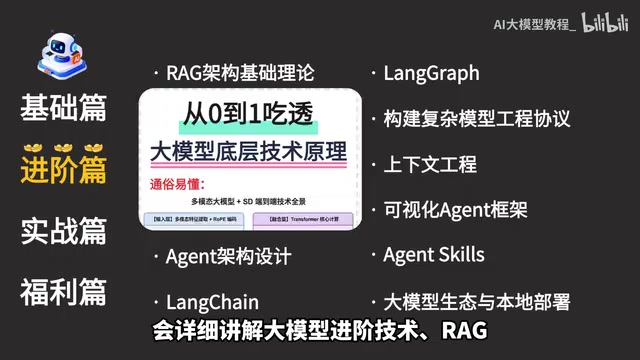
The advanced section is the technical heart of the entire course, covering the three most important directions in current LLM application development:
- RAG (Retrieval-Augmented Generation): Enhancing LLM response accuracy through external knowledge bases — the most common technical approach in enterprise applications
- Agent: Enabling LLMs to autonomously plan, invoke tools, and execute tasks — a cutting-edge direction in current AI applications
- Fine-tuning: Customizing models with domain-specific training to improve performance in vertical fields
Deep Dive into RAG Technology
The core idea behind RAG is combining information retrieval with text generation: when a user asks a question, the system first retrieves relevant document fragments from an external knowledge base, then feeds those fragments as context along with the user's question into the LLM, which generates the final answer. First proposed by Meta AI in 2020, this technology addresses two major LLM pain points — knowledge cutoff date limitations and hallucination (where models generate information that sounds plausible but is factually incorrect).
A typical RAG pipeline includes document chunking, vector embedding, vector database storage and retrieval, and the final generation step. Chunking determines retrieval granularity, embedding converts text into mathematical representations in high-dimensional space for semantic similarity computation, and vector databases handle efficient storage and retrieval of these vectors. Currently popular vector databases include Pinecone, Milvus, Chroma, and Weaviate, each suited to different use cases.
Frontier Analysis of Agent Technology
The concept of AI Agents originates from autonomous agent theory in artificial intelligence, but has taken on entirely new meaning in the LLM era. Modern AI Agents use large language models as their "brain," completing complex tasks through cycles of perceiving the environment, making plans, invoking tools, and executing actions. The viral success of AutoGPT in 2023 brought the Agent concept into the mainstream, followed by the release of frameworks like OpenAI's Function Calling, LangChain's AgentExecutor, and Microsoft's AutoGen.
Core Agent capabilities include: task decomposition (breaking complex goals into executable subtasks), tool use (calling search engines, API endpoints, code executors, databases, and other external tools), memory management (short-term working memory and long-term experience storage), and self-reflection (evaluating execution results and adjusting subsequent strategies). The combination of these capabilities enables Agents to handle complex task scenarios far beyond simple Q&A.
Background on Fine-tuning Technology
Fine-tuning refers to further training a pre-trained LLM using domain-specific or task-specific data to adapt the model to particular application scenarios. Traditional full-parameter fine-tuning requires enormous computational resources (for example, fine-tuning a 7B parameter model might require tens of gigabytes of VRAM), so the industry has developed various Parameter-Efficient Fine-Tuning (PEFT) methods. The most representative is LoRA (Low-Rank Adaptation) — it injects low-rank decomposition matrices into the model's weight matrices, training only a tiny fraction of parameters (typically less than 1% of the original model) while achieving results close to full-parameter fine-tuning. Other methods include QLoRA (quantized LoRA, which further reduces VRAM requirements), Adapter, and Prefix-tuning. Typical fine-tuning applications include: teaching a general model industry-specific terminology, adjusting model output style and format, and improving model accuracy on vertical tasks.
These three directions essentially cover the mainstream technology stack for current LLM application development. RAG and Agent in particular appear with the highest frequency in enterprise job postings over the past two years. From a curriculum design perspective, this technology selection closely tracks market demand.
Project Section: Project-Driven Learning
The project section provides three representative practice projects:
- Enterprise Knowledge Base Q&A System — A classic RAG application scenario
- E-commerce Intelligent Customer Service Assistant — A conversational system integrated with business workflows
- Stock Analysis AI Agent — A real-world Agent technology implementation
These three projects correspond to different technical directions and application scenarios, spanning from information retrieval to customer service to data analysis, offering broad coverage. Project-driven learning is indeed more effective than pure theoretical instruction, as learners can understand the practical boundaries of each technology through hands-on experience.
Among these, the enterprise knowledge base Q&A system is one of the most mature RAG deployment scenarios, with core challenges including how to handle multi-format internal documents (PDF, Word, database records, etc.), how to optimize retrieval precision (avoiding irrelevant results), and how to handle contextual associations in multi-turn conversations. The e-commerce customer service assistant requires integration with order systems, product databases, and other business interfaces, testing the engineering ability to integrate LLM capabilities with existing business systems. The stock analysis agent is a classic demonstration of Agent technology — it needs to autonomously call market data APIs, execute data analysis code, generate visualizations, and ultimately provide investment recommendations.

Honest Assessment: How Valuable Are 748 Episodes Really?
Volume ≠ Quality
The sheer volume of 748 episodes is certainly impressive, but it needs to be viewed rationally. Tutorial videos on Bilibili typically range from 5-15 minutes per episode. At an average of 10 minutes, the total runtime is approximately 125 hours. The claim of "mastery in 7 days" is clearly marketing hype — even studying 18 hours a day, 7 days only gives you 126 hours, leaving virtually no time for digestion and practice.
In reality, systematically learning LLM application development — from understanding principles to independently completing projects — typically requires 1-3 months of sustained effort. This estimate is based on the following considerations: understanding foundational principles like Transformer architecture and attention mechanisms takes 1-2 weeks; becoming familiar with the Python ecosystem and related development tools takes 1-2 weeks; mastering core technologies in either RAG or Agent and completing a hands-on project takes 2-4 weeks; and reaching the level where you can independently design and implement complete applications requires additional project experience. Learners should create realistic study plans based on their own backgrounds rather than being misled by "master it in 7 days" titles.
The Value and Limitations of Free Resources
As a free tutorial on Bilibili, this course's greatest advantage is lowering the barrier to entry. For budget-conscious learners, having systematic access to cutting-edge technologies like RAG and Agent is inherently valuable. By comparison, similar paid courses on the market typically cost anywhere from several hundred to several thousand dollars.
However, free courses have inherent limitations: content updates may not keep pace with technological evolution (the LLM field sees important updates nearly every week), there's no personalized Q&A support, and project examples may be oversimplified. When using such resources, learners are advised to simultaneously follow official documentation (such as docs for LangChain, LlamaIndex, and other frameworks) and stay current with technical community updates, creating multi-dimensional knowledge input.
LangChain and LlamaIndex are currently the two most mainstream open-source frameworks for LLM application development. LangChain, created by Harrison Chase in late 2022, provides modular components including Chains, Agents, and Memory to help developers rapidly build LLM-based applications, with an ecosystem covering everything from simple Prompt templates to complex multi-step reasoning workflows. LlamaIndex (formerly GPT Index) focuses on data connection and index construction, excelling at converting private data in various formats into knowledge bases usable by LLMs — making it the go-to tool for building RAG applications. The two are not competitors; in real projects, they're frequently used together — LlamaIndex handles data processing and retrieval while LangChain orchestrates the overall application logic.
Effective Study Tips: How to Maximize the Value of Tutorials Like This
For those looking to get started with AI LLM application development, the following tips may be helpful:
First, define your learning objectives. You don't need to watch all 748 episodes. Selectively studying based on your chosen direction (e.g., RAG development, Agent development) is far more efficient. In the current market, RAG engineers and Agent development engineers are the two most in-demand roles — the former emphasizes data processing and retrieval optimization, while the latter focuses on system design and tool integration. Learners can choose their focus based on personal interests and background.
Second, prioritize practice over theory. After learning each concept, immediately get hands-on. Running code once is worth more than watching a video ten times. Set up a development environment where you can execute code (such as a local VS Code + Python setup, or cloud-based Google Colab), and implement each technical concept yourself. In RAG development especially, personally experiencing how different chunking strategies affect retrieval quality and how different Embedding models vary in performance — these practical insights simply cannot be replaced by videos.
Third, build a knowledge framework. Don't fall into fragmented learning. First establish an overall cognitive framework for LLM application development, then gradually fill in the details. An effective approach is to draw a technology landscape map: the base layer is the LLMs themselves (GPT, Claude, open-source models, etc.), the middle layer is development frameworks (LangChain, LlamaIndex, etc.), the upper layer is specific application patterns (RAG, Agent, fine-tuning), and the top layer is business scenarios. With this framework, you'll clearly understand where each specific concept fits within the bigger picture.
Fourth, stay current with technological evolution. The LLM field changes extremely fast — some tools and methods covered in the course may already have superior alternatives. Maintaining sensitivity to new technologies is crucial. For example, since 2024, new paradigms like GraphRAG (knowledge graph-based RAG), multimodal RAG, and Agentic RAG have continuously emerged; the Agent field has also evolved from single-Agent to multi-Agent collaboration (with frameworks like CrewAI and LangGraph). It's recommended to regularly follow arXiv papers, technical blogs, and trending GitHub projects to keep your knowledge up to date.
Conclusion: Worth Studying, But Don't Buy Into "Quick Mastery"
This 748-episode LLM tutorial series does achieve fairly comprehensive content coverage, spanning from foundational principles to advanced technologies like RAG, Agent, and fine-tuning, through to hands-on projects, forming a complete learning loop. As a free learning resource, it genuinely delivers value. However, claims of "mastery in 7 days" and "job-ready upon completion" deserve serious skepticism — there are no shortcuts to building technical competence. A solid foundation and consistent practice are the real path to employment.
Looking at the current industry landscape, job postings for LLM application development roles in 2024 typically require: proficiency in at least one LLM development framework, hands-on project experience with RAG or Agent, familiarity with model evaluation and optimization methods, and strong engineering skills (including API design, system architecture, and performance optimization). Watching video tutorials alone is unlikely to meet these requirements — you also need to accumulate experience through real projects, contribute to open-source communities, and continuously track the technological frontier. This course can serve as an excellent starting point, but it is by no means the finish line.
Key Takeaways
Related articles
Sakana AI Launches RSI Lab: The Path to Recursive Self-Improvement Where AI Builds AI
Sakana AI launches RSI Lab for recursive self-improvement, letting AI autonomously improve its own architecture. Explore their four-stage roadmap and key breakthroughs.

The Clotilda: Underwater Archaeological Discovery of America's Last Slave Ship
The Clotilda, America's last slave ship, was discovered by underwater archaeologists in Alabama nearly 160 years after sinking. Learn about the search, key evidence, and other slave trade shipwreck discoveries.
Sakana AI in Practice: Reshaping Banking Lending Operations with AI Agents — Technology and Strategy
Deep dive into how Sakana AI applies AI Agents to banking lending operations, covering end-to-end support from information gathering to approval document generation, plus technical challenges and human-AI collaboration design.