Is Waking Up at 5 AM Performative Discipline? What Night Owl Genetics Reveal
Science shows forced 5 AM wake-ups can harm night owls — true health means honoring your chronotype.
A viral tweet calling 5 AM wake-ups "absurd and performative" sparked debate about self-improvement culture. Science confirms chronotype is genetically determined, with forced early rising causing chronic sleep debt and health risks for night owls. The piece argues for personalized health routines over performative discipline, championing sustainable, tranquil living over social media-driven hustle culture.
"Early Rising Culture" Is Being Reexamined
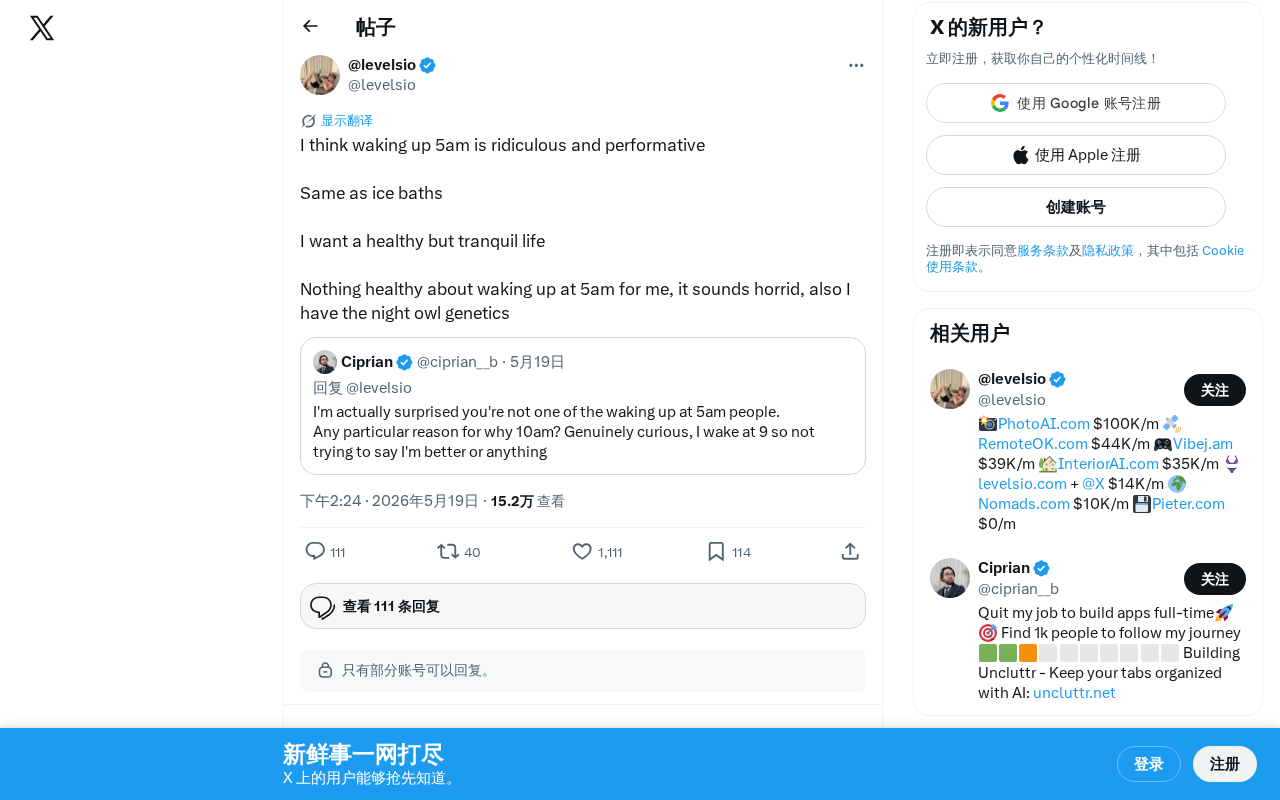
On social media, a tweet about early rising culture struck a widespread chord. The poster stated bluntly: "I think waking up at 5am is absurd and performative and so are ice baths. I want a healthy but tranquil life."
This seemingly simple complaint actually touches on a core contradiction in today's self-improvement culture — are we pursuing genuine health, or a "disciplined persona" we can display to others?
Performative Discipline: A New Anxiety in the Social Media Age
From 5 AM Alarms to Ice Bath Check-ins
In recent years, the "5AM Club" has become a lifestyle label championed by Silicon Valley elites and content creators. The concept was first systematized by leadership expert Robin Sharma in his 2018 bestselling book of the same name. The core assumption: starting work before the world wakes up gives you undisturbed focus time, creating a competitive advantage. Tim Cook's 4:30 AM wake-up, Steve Jobs' morning rituals, and various CEOs' early schedules have been shared repeatedly, as if waking up early itself equals success. Silicon Valley's "hustle culture" further encoded early rising as a moral quality rather than a mere time management strategy, while social media algorithms amplified the effect — content showcasing discipline naturally has motivational appeal, easily earning likes and shares — creating a powerful positive feedback loop.
Similarly, there's the ice bath. Since podcast hosts like Andrew Huberman and the Wim Hof Method gained popularity, ice baths have transformed from an extreme sports recovery tool into a "willpower display." Huberman is a Stanford University neuroscience professor whose podcast Huberman Lab has rapidly become one of the world's most popular health science podcasts since 2021, systematically introducing the effects of cold exposure on neurotransmitters — research shows cold water immersion can elevate dopamine levels by over 250% for several hours. Wim Hof ("The Iceman") is a Dutch extreme athlete famous for his training system combining breathwork and cold exposure, holding 26 world records. However, these methods have strict conditions and limitations in their scientific context, yet in social media dissemination they're often simplified into the narrative of "just soak in ice water every day to get stronger." Social media is flooded with videos of people gritting their teeth in ice water, captioned with "Growth only happens outside your comfort zone."
But the question is: Do these behaviors work for everyone?
When "Healthy Habits" Become Social Currency
The core characteristic of performative discipline is: the purpose of behavior shifts from "beneficial for myself" to "letting others see me trying hard." Its psychological roots trace back to "impression management" theory in social psychology and Erving Goffman's "dramaturgical analysis" — people manage the image they present to others like actors on a stage. Social media has taken this mechanism to extremes: platforms' visibility and quantified feedback (likes, shares) transform originally private health behaviors into public performances.
When someone wakes up at 5 AM not because their body needs it, but to post on social media, the essential nature of that behavior has changed. The "Self-Determination Theory" proposed by psychologists Edward Deci and Richard Ryan reveals the cost of this shift: when behavioral motivation moves from intrinsic (such as genuinely enjoying the quiet of early morning) to extrinsic (such as gaining social approval), both the sustainability and psychological benefits of the behavior decline significantly.
This phenomenon is particularly worth noting today. As productivity tools become increasingly powerful, humans have paradoxically fallen into deeper anxiety about "needing to hustle constantly." Discipline is no longer an internal choice but has become a social currency that must be publicly displayed.
Night Owl Genetics: What Science Says
Chronotype Is Real
The tweet's author mentioned having "night owl genetics," and this isn't an excuse. Scientific research has confirmed that a person's circadian rhythm preference (chronotype) has a significant genetic basis.
Chronotype is controlled by the body's "master clock" — a cluster of approximately 20,000 neurons in the suprachiasmatic nucleus (SCN) of the hypothalamus. These cells generate approximately 24-hour rhythmic oscillations through transcription-translation feedback loops of core clock genes including CLOCK, PER, and CRY. A large-scale genomic study published in Nature Communications (based on data from over 700,000 participants in the UK Biobank) found more than 350 genetic loci associated with individual sleep-wake preferences. Chronotype distribution is roughly normal: approximately 25% of people naturally tend toward late sleeping and waking, about 25% are definite early birds, and the remaining 50% fall in between. Notably, chronotype isn't entirely fixed — it shifts with age (later during adolescence, earlier in old age) — but the genetically determined baseline is very difficult to fundamentally change through willpower alone.
Forcing night owl individuals to wake up at 5 AM not only fails to improve efficiency but may lead to:
- Chronic sleep deprivation — accumulated sleep debt and decreased immunity
- Cognitive decline — impaired attention, memory, and decision-making ability
- Worsened mood issues — increased risk of anxiety and depression
- Increased metabolic disruption risk — problems with weight management and blood sugar regulation
When an individual's biological clock doesn't match socially required schedules, it produces so-called "social jetlag" — a concept proposed by chronobiologist Till Roenneberg at the University of Munich. Research shows that for each additional hour of social jetlag, obesity risk increases by approximately 33%, with cardiovascular disease and depression risks rising correspondingly. For night owl individuals, the traditional 9-to-5 work schedule itself constitutes chronic social jetlag, and a 5 AM wake-up requirement pushes this mismatch to the extreme. This explains why the same early rising habit empowers some people while chronically harming others.
The Definition of Health Should Be Personalized
Truly healthy living isn't about copying some CEO's schedule — it's about finding a routine that matches your biological rhythm. For night owls, waking at 8 or 9 AM and working efficiently late at night may be the optimal solution. Blindly following the early rising trend essentially means measuring your life by someone else's standards.
The Value of a Tranquil Life Is Underestimated
The phrase "healthy but tranquil life" in the tweet deserves deep reflection. In today's efficiency-worship culture, "tranquility" has almost become a pejorative, equated with laziness or lack of ambition.
But a growing body of psychological research shows that sustained high-pressure discipline leads to decision fatigue and willpower depletion. The concept of decision fatigue originates from social psychologist Roy Baumeister's "ego depletion" theory, which posits that willpower functions like a muscle that temporarily depletes after use. Although this theory has faced academic controversy in recent years — a 2016 large-scale replication study involving 23 laboratories failed to fully reproduce the original effect — the current academic consensus still holds that sustained self-control does produce significant psychological costs, especially when behavioral motivation is insufficient or inconsistent with personal values. This means the psychological drain from forcing yourself into an unsuitable schedule is real, even if the mechanism is more complex than the original theory described.
By contrast, a sustainable lifestyle that doesn't require "conquering yourself" every day may be more beneficial for physical and mental health and creativity in the long run.
Tranquility doesn't equal stagnation. It means steadily caring for your physical and mental state without creating additional anxiety. This lifestyle may not be "Instagram-worthy," but it's authentic and sustainable.
Finding Your Own Rhythm
The viral success of this tweet shows that more and more people are questioning the "one-size-fits-all" discipline narrative. The core of healthy living isn't suffering and performance — it's understanding yourself, respecting your biological characteristics, and finding a sustainable life rhythm.
Rather than seeking superiority through 5 AM wake-ups and ice baths, ask yourself more fundamental questions: What does my body need? What rhythm makes me both productive and comfortable? Is my discipline for myself, or for others' eyes?
When these questions receive honest answers, the healthy lifestyle that belongs to you will naturally emerge.
Key Takeaways
Related articles

Claude Code for Test Development in Practice: An AI Programming Workflow That Doubles Your Efficiency
A practical guide to Claude Code for test development: auto-generating test scripts, Plan Mode workflows, MCP + Playwright integration, and Subagent parallel tasks to build systematic AI-assisted workflows.
Hermes Agent Hands-On Review: An AI Efficiency Revolution for Indie Game Developers
Indie game developer reviews Hermes Agent vs OpenClaude: intelligent context compression, real-time Memory, remote control via Telegram, and practical use cases in game dev, social media, and email.
Vibe Coding Beginner's Guide: Tool Selection Across Three Categories with Practical Examples
A comprehensive guide to Vibe Coding's three tool categories: Agent frameworks, CLI Coding, and IDE tools, with practical examples including Snake game and data analysis workbench.