Jeff Dean's Commencement Speech at UW Allen School: A Message to the Next Generation of Engineers in the AI Era
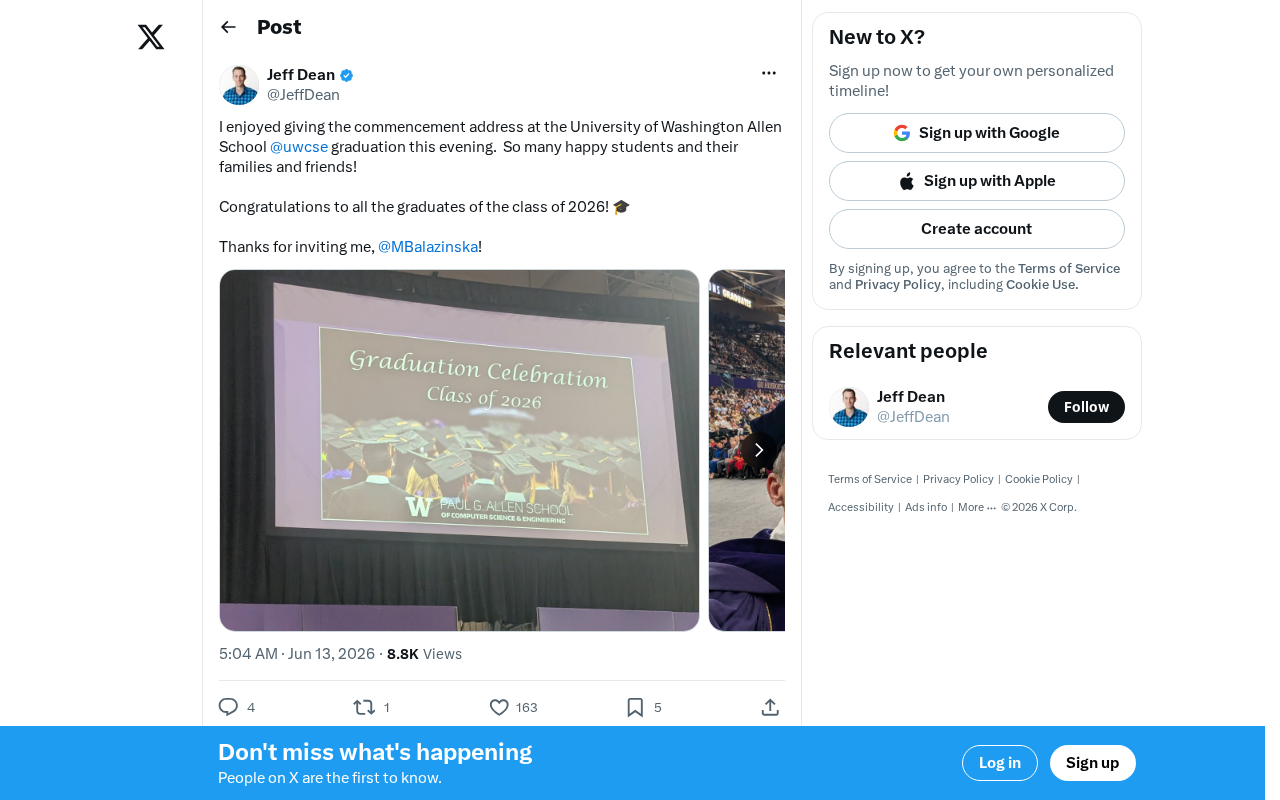
Jeff Dean delivers commencement speech at UW Allen School, inspiring the next generation of AI engineers.
Google DeepMind Chief Scientist Jeff Dean delivered a commencement speech at the University of Washington's Paul G. Allen School of Computer Science & Engineering for the Class of 2026. The article explores the Allen School's prestige, Jeff Dean's transformative contributions to AI infrastructure, and the opportunities and challenges facing new CS graduates in the era of large language models, ethical AI, and interdisciplinary convergence.
Event Overview
Jeff Dean, head of Google DeepMind, recently shared on social media that he was invited to deliver a commencement speech at the University of Washington's Paul G. Allen School of Computer Science & Engineering (UW Allen School) for the Class of 2026. This iconic figure in the AI field offered his congratulations and words of wisdom to the next generation of computer science graduates.
UW Allen School: A Top CS Program in the U.S.
The University of Washington's Allen School of Computer Science & Engineering, named after Microsoft co-founder Paul Allen, is one of the most influential computer science departments in the United States. Paul G. Allen (1953–2018) co-founded Microsoft with Bill Gates in 1975. In 2003, he donated $14 million to UW's computer science department and made several additional contributions over the years, leading the school to be named in his honor. Allen was not only an entrepreneur but also a passionate advocate for science and technology. The Allen Institute he founded encompasses multiple cutting-edge organizations, including the Allen Institute for Artificial Intelligence (AI2) and the Allen Institute for Brain Science, continuously advancing fundamental scientific research.
The school boasts world-class research capabilities across multiple areas including artificial intelligence, systems architecture, and databases. It has consistently ranked among the top ten in the US News national computer science rankings, with particularly outstanding research output in AI subfields such as natural language processing, machine learning, and computer vision, continuously producing top talent for the tech industry.
Located in Seattle, the school neighbors the research centers of tech giants like Google, Microsoft, and Amazon. This exceptional geographic advantage fosters especially close talent exchange between academia and industry.
Jeff Dean's Industry Influence
Jeff Dean is a Google Senior Fellow, Chief Scientist at Google DeepMind, and a key architect of modern AI infrastructure. He played a leading role in projects that reshaped the industry landscape, including MapReduce, BigTable, and TensorFlow — technological achievements that have profoundly shaped the trajectory of today's AI and large-scale computing.
Specifically, MapReduce is a distributed computing programming model published by Google in 2004. It breaks down large-scale data processing tasks into two phases — "Map" and "Reduce" — enabling ordinary server clusters to process petabyte-scale data. It directly gave rise to the Hadoop ecosystem. BigTable is a distributed storage system Google made public in 2006, designed specifically for handling massive volumes of structured data. Its design philosophy profoundly influenced the subsequent NoSQL database movement, including open-source projects like Apache HBase and Cassandra. TensorFlow is a deep learning framework open-sourced by Google in 2015, offering flexible computational graph abstractions and cross-platform deployment capabilities. It became the most widely used AI development tool in the world at one point. Additionally, Jeff Dean co-founded the Google Brain team, spearheading early explorations in large-scale neural network training. Following the merger and reorganization of Google DeepMind in 2023, he assumed the role of Chief Scientist, overseeing Google's most critical AI research directions.
Having such a technology pioneer speak at a computer science commencement ceremony sends a clear signal: the AI field's hunger for fresh talent is stronger than ever.
Implications for Graduates: Opportunities and Challenges in the AI Wave
The Class of 2026 stands at a critical inflection point of explosive growth in the AI industry, facing unprecedented opportunities and challenges:
-
Talent Demand in the Large Model Era: With the widespread adoption of products like ChatGPT, industry demand for AI engineers and researchers continues to surge. Since ChatGPT's release in late 2022, large language model (LLM) technology has triggered a global wave of AI applications. Training and deploying large models involves a complex technology stack: from Transformer-based model design, distributed training on large-scale GPU/TPU clusters, and alignment techniques like RLHF (Reinforcement Learning from Human Feedback), to inference optimization, model compression, and on-device deployment — every stage requires a large pool of specialized talent. According to multiple industry reports, compensation for AI-related positions has continued to rise between 2023 and 2025, with top AI researchers commanding annual salaries of several million dollars. Meanwhile, the global pool of senior talent capable of developing large models is estimated at only a few thousand, while major tech companies, startups, and even traditional industries undergoing digital transformation are all competing for this scarce resource — a supply-demand imbalance unlikely to ease in the near term.
-
Balancing Technology and Ethics: The next generation of engineers must not only drive technological progress but also seriously consider the social responsibilities of technology deployment. The rapid advancement of AI has brought a series of deep ethical issues — algorithmic bias can lead to discriminatory outcomes in hiring, credit approval, and criminal sentencing; the misuse of deepfake technology threatens information authenticity; and the "hallucination" problem in large models (generating content that appears plausible but is factually incorrect) can have severe consequences in high-stakes domains like healthcare and law. On the governance front, the European Union officially passed the EU AI Act in 2024, implementing tiered regulation of AI applications based on risk levels; the United States is advancing AI safety through executive orders and industry self-regulatory frameworks. These developments mean that the next generation of engineers needs not only technical skills but also ethical awareness and policy literacy, proactively considering fairness, transparency, and accountability when designing and deploying AI systems.
-
Interdisciplinary Convergence Trends: AI is permeating every field from healthcare to finance to education, making career paths for computer science graduates increasingly diverse. In healthcare, for example, AI-assisted diagnostics, drug discovery, and personalized treatment plans are reshaping the entire health industry; in finance, algorithmic trading, risk modeling, and intelligent compliance have become standard; and in education, adaptive learning platforms and AI tutoring tools are emerging. This interdisciplinary convergence requires graduates to not only master computer science itself but also develop deep understanding of application domains and the ability to collaborate with teams from diverse professional backgrounds.
A Microcosm of Industry-Academia Collaboration
The frequent appearances of tech giant executives at top university commencement ceremonies reflect the increasingly close collaboration between industry, academia, and research. In his post, Jeff Dean specifically thanked Allen School Director Magdalena Balazinska for the invitation and extended congratulations to the graduates and their families and friends.
Magdalena Balazinska is a renowned scholar in database systems and big data management. She has served as Director of the Allen School since 2019 and is also an ACM Fellow. Under her leadership, the Allen School has continued to expand enrollment to meet the strong demand for computer science education while actively promoting interdisciplinary research between AI and other fields. The school maintains close partnerships with tech companies in the Seattle area through various forms including joint laboratories, corporate-sponsored research projects, and internship-to-employment pipelines, forming an efficient industry-academia-research collaboration ecosystem.
This genuine interaction also reflects tech leaders' commitment to nurturing the next generation of talent. From a broader perspective, the close ties between top universities and tech companies are redefining talent development models — students gain exposure to cutting-edge industrial-scale problems while still in school, and companies can identify and cultivate future technology leaders earlier.
Conclusion
In today's rapidly evolving AI landscape, the words of industry pioneers like Jeff Dean at commencement ceremonies are not only an affirmation of graduates' personal achievements but also a guiding light for the future direction of computer science education. We look forward to seeing this class of graduates find their place in the AI wave and contribute to technological progress and societal development.
Related articles

Xiaomi MIMO vs. Huawei Pangu AI Strategy Comparison: The Android vs. iOS Battle of the Agent Era
Xiaomi releases open-source MIMO Code while Huawei enters the Agent era with Pangu. Compare their AI strategies: Xiaomi's Android-like open ecosystem vs. Huawei's iOS-like vertical integration.
What Is Google WebMCP? A Deep Dive into the New Standard for AI Agents to Directly Invoke Web Functionality
A deep dive into Google WebMCP (Web Model Context Protocol): how it works, its technical implementation, and use cases. Learn how WebMCP lets AI Agents directly invoke web tools.
AI Can't Kill Old-School Programming: Why Fundamentals Are Still a Developer's Moat
Vibe Coding is trending, but can it replace solid fundamentals? A deep analysis of why core principles, systems thinking, and knowledge frameworks remain a developer's moat in the AI era.