LangChain Beginner's Guide: From Environment Setup to RAG — A Complete Hands-On Walkthrough
A complete beginner's guide to LangChain, from environment setup to hands-on RAG implementation.
This article provides a systematic walkthrough of LangChain's core knowledge system for beginners. It covers environment setup, model invocation, Chat Prompt Templates, Output Parsers, LCEL chain expressions, and a full hands-on RAG (Retrieval-Augmented Generation) implementation. The guide also offers a phased learning path and practical advice for developers entering the LLM application development space.
Why You Should Learn LangChain
In the world of LLM application development, LangChain has become an essential framework you simply can't ignore. Whether you're building an intelligent customer service bot, a knowledge base Q&A system, or a complex AI Agent, LangChain provides a mature toolchain to streamline the development process.
LangChain was first released by Harrison Chase in October 2022, initially as a Python library before expanding into the JavaScript/TypeScript ecosystem. It was born out of a core pain point: while LLM APIs from providers like OpenAI are powerful, there's a massive amount of glue code and engineering work required to go from raw API calls to a production-ready application. LangChain abstracts these best practices into reusable components, including model I/O, data connectors, chain-based invocation, memory management, and Agent modules. As of 2024, LangChain has earned over 90,000 stars on GitHub, and its ecosystem tools — LangSmith (a debugging platform) and LangServe (a deployment tool) — have matured significantly, forming a complete develop-debug-deploy loop.
Recently, a well-received beginner-friendly LangChain tutorial series appeared on Bilibili, claiming to take you "from zero to hero in seven days." Marketing hype aside, the tutorial's knowledge framework genuinely covers the full LangChain development pipeline — from basic environment setup, to model invocation, prompt engineering, output parsing, and hands-on RAG implementation — forming a clear learning path.
This article distills the core knowledge points from that tutorial's framework to help readers who want to get started with AI application development build a systematic understanding.
Breaking Down LangChain's Core Knowledge System
Model Invocation and Chat Prompt Template
The first step with LangChain is learning how to "talk" to an LLM. The framework wraps unified calling interfaces for OpenAI, Anthropic, and various Chinese LLM APIs, so developers don't need to worry about underlying HTTP request details — just a few lines of code to invoke a model.
Chat Prompt Template is one of LangChain's most practical features. It allows developers to parameterize and templatize prompts, enabling reuse and dynamic composition. For example, you can define a translation template and simply swap out the target language and source text to quickly generate prompts for different scenarios.
Prompt engineering has evolved from manual tweaking to systematic engineering management. Early developers hardcoded prompt strings directly in their code, making prompts difficult to version-control, A/B test, or collaborate on across teams. The essence of Chat Prompt Template is treating prompts as "configuration" in the software engineering sense, decoupled from business logic. This approach mirrors the design philosophy of template engines in web development (like Jinja2): separating data from presentation. In real production environments, a complex AI application might contain dozens of prompt templates corresponding to different functional modules, and a unified template management mechanism directly impacts system maintainability.
Messages Objects and System Prompt Design
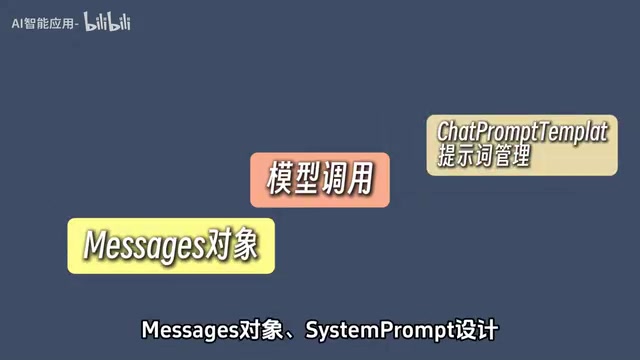
When interacting with LLMs, distinguishing message roles is critical. LangChain's Messages object system explicitly categorizes conversation messages into:
- SystemMessage: System-level instructions that define the AI's role and behavioral boundaries
- HumanMessage: User input
- AIMessage: Model responses
Among these, System Prompt design directly determines the quality ceiling of an AI application. A well-crafted System Prompt should include role definition, task boundaries, output format requirements, and error-handling strategies. This is the critical dividing line between "it works" and "it works well."
Output Parser: Getting Structured Data from LLMs
Raw LLM output is free-form text, but real-world applications often require structured data like JSON or lists. LangChain's Output Parser is the tool designed to solve exactly this problem.
Commonly used Output Parsers include:
- StrOutputParser: The most basic string parser
- JsonOutputParser: Parses output into JSON objects
- PydanticOutputParser: Performs strongly-typed validation using Pydantic models
With Output Parsers, developers can ensure model output conforms to expected formats, significantly reducing the complexity of downstream processing. Notably, PydanticOutputParser doesn't just validate formats — it also automatically generates format instructions that are injected into the prompt, guiding the LLM to output data in the expected structure. This "prompt + parsing" dual-safeguard mechanism significantly improves output reliability.
Chain and LCEL Expressions: LangChain's Core Design Philosophy
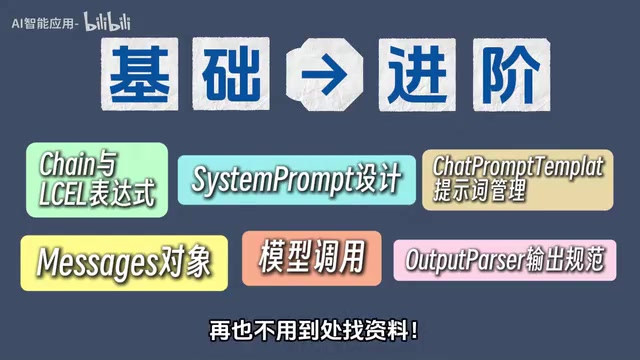
The reason LangChain has "Chain" in its name lies in its chain-based invocation design philosophy. By linking components like Prompt, Model, and Output Parser into chains, developers can build complex processing pipelines.
LCEL (LangChain Expression Language) is LangChain's declarative expression language that uses the pipe operator | to connect components:
chain = prompt | model | output_parser
result = chain.invoke({"input": "your question"})
LCEL's pipe operator design draws inspiration from Unix Shell pipes and the composition concept in functional programming. In Unix, cat file | grep pattern | sort combines multiple simple commands into complex operations; LCEL brings this idea to AI application development. Compared to the earlier SequentialChain and other class-inheritance approaches in LangChain, LCEL offers three core advantages: first, it supports out-of-the-box streaming output, so users don't have to wait for a complete response; second, it natively supports async execution, making it suitable for high-concurrency scenarios; third, every step is automatically logged to LangSmith for easy debugging and performance analysis.
This declarative programming paradigm reduces cognitive overhead — developers only need to focus on "what to do" rather than "how to do it." Mastering LCEL is the landmark milestone in going from a LangChain beginner to a proficient developer.
RAG (Retrieval-Augmented Generation): LangChain's Hottest Use Case

RAG (Retrieval-Augmented Generation) is one of the most mainstream approaches for deploying LLM applications today, and it's the key hands-on focus of this tutorial series.
The Core RAG Workflow
- Document Loading: Use Document Loaders to ingest data from PDFs, web pages, databases, and other sources
- Text Splitting: Use Text Splitters to chunk long documents into appropriately sized segments
- Vectorization and Storage: Use Embedding models to convert text into vectors and store them in a vector database (e.g., FAISS, Chroma)
- Retrieval and Generation: Retrieve relevant document chunks based on the user's question, then combine them with context for the LLM to generate precise answers
The vectorization and storage step involves technology worth understanding in depth. Embedding models (such as OpenAI's text-embedding-ada-002 or open-source BGE series models) map text to points in a high-dimensional vector space, where semantically similar texts are closer together. During retrieval, metrics like cosine similarity or Euclidean distance are used to find the most relevant document chunks. Popular vector databases include open-source options like FAISS (developed by Facebook, ideal for local development), Chroma (lightweight, with tight LangChain integration), and Milvus (supports large-scale distributed deployment), as well as commercial solutions like Pinecone and Weaviate. The choice of vector database depends on data scale, deployment environment, and performance requirements.
Why Is RAG So Important?
LLMs have knowledge cutoff dates and can't directly access proprietary enterprise data. RAG uses a "retrieve first, then generate" approach, enabling LLMs to answer questions based on the latest, domain-specific knowledge. This is the technical foundation for enterprise knowledge bases, intelligent customer service, and similar applications.
When it comes to technical decisions, developers often face the choice between RAG and fine-tuning. Fine-tuning modifies model weights to "internalize" knowledge, with the advantage of faster inference since no additional retrieval step is needed; the downsides are high training costs, the need to retrain when knowledge updates, and the risk of catastrophic forgetting. RAG, on the other hand, acts as an "external" knowledge base — the model itself remains unchanged, and updating knowledge simply means replacing documents, which is low-cost and flexible. The current industry consensus is: most enterprise applications should prioritize RAG, resorting to fine-tuning only when you need to change the model's style or handle extremely high-frequency queries. In some scenarios, both approaches are combined.
Learning Recommendations and Path Planning for LangChain
For developers who want to systematically learn LangChain, here's a recommended path:
- Phase 1 (1–2 days): Environment setup + basic model invocation — get your first Hello World running
- Phase 2 (2–3 days): Dive deep into Prompt Template, Messages, and Output Parser — understand the data flow
- Phase 3 (2–3 days): Master Chain and LCEL — build multi-step processing chains independently
- Phase 4 (ongoing): Hands-on RAG projects — practice repeatedly with real business scenarios
One important note: LangChain iterates extremely fast, with frequent API changes. When learning, always refer to the official documentation as the source of truth, using tutorial videos as supplementary aids for understanding concepts. Also, don't stop at the framework level — developing a deep understanding of the underlying principles of Prompt Engineering and vector retrieval is what will enable you to handle the diverse challenges that arise in real projects.
Conclusion
As the mainstream framework for LLM application development, LangChain's learning value is beyond question. From model invocation to prompt management, from output parsing to hands-on RAG — every component maps to real engineering needs. The key isn't "mastering it in seven days," but rather building a systematic knowledge framework and then continuously deepening your understanding through project practice. For tech professionals aspiring to build AI applications, now is the perfect time to get started.
Related articles
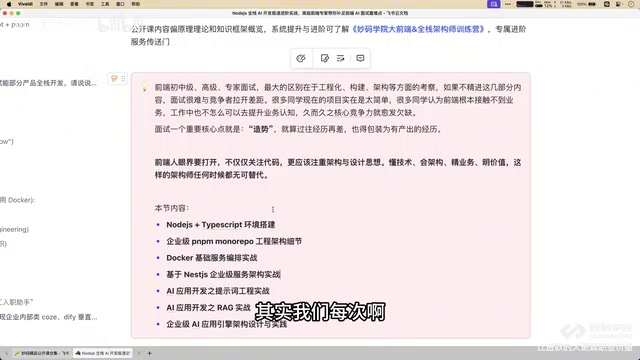
AI Full-Stack Development Architecture: A Three-Layer Progressive Path from Prototype to Production
A detailed guide to AI full-stack development architecture covering Node.js+TypeScript+Monorepo engineering, Docker CI/CD deployment, and AI engine design with interview tips.
The AI Industry's Psychological Warfare: Narrative Manipulation, Ecosystem Lock-In, and the Endgame
Behind the AI industry's relentless product launches and narrative building lie deeper battles over data monopolies, ecosystem lock-in, and expectation management. A deep dive into the psyop phenomenon.
ByteDance Codex Chinese Manual: An In-Depth Guide to AI-Powered Programming
In-depth analysis of the ByteDance Codex Chinese Manual covering multi-language support, prompt standards, context management, and practical templates for AI programming.