LangGraph Multi-Agent Architecture: Core Principles and Enterprise-Level Implementation Guide

LangGraph orchestrates multi-agent collaboration through graph structures as a core advanced AI development framework.
LangGraph is a core component of the LangChain ecosystem that combines large model capabilities with graph structure to solve the architectural challenge of multi-agent collaboration. Its key values include: graph-based decomposition and orchestration of complex tasks, deep MCP protocol integration, Time Travel mechanism for reduced debugging costs, and a complete progression path from single agent to multi-agent systems. Compared to graphical tools, the code approach breaks through capability boundaries and unleashes greater creative potential.
Why LangGraph Is Worth Deep Study
In the AI large model technology stack, the importance of the LangChain framework ecosystem is undeniable. It not only provides rich tools for applying large models to more scenarios, but more importantly helps us accumulate systematic experience in using large models — in the process of transforming large models from a "hobby" into a "skill," there are too many mindset shifts required.
Since its release in late 2022, LangChain has quickly become the de facto standard framework for large model application development. Through core abstractions like Chain (chained calls), Memory (memory management), and Tools (tool integration), it solved the standardization problem of developer interaction with large models. LangGraph, introduced in early 2024, is an advanced component specifically designed for stateful, multi-step, multi-agent complex scenarios. The relationship between the two is similar to Express.js and NestJS — the latter provides higher-level architectural abstractions built on top of the former.
As a core component in the LangChain ecosystem, LangGraph raises both the barrier and capability of large model applications to new heights. If LangChain solves the problem of "how to interact with large models," then LangGraph addresses the architectural question of "how to make multiple agents work together."
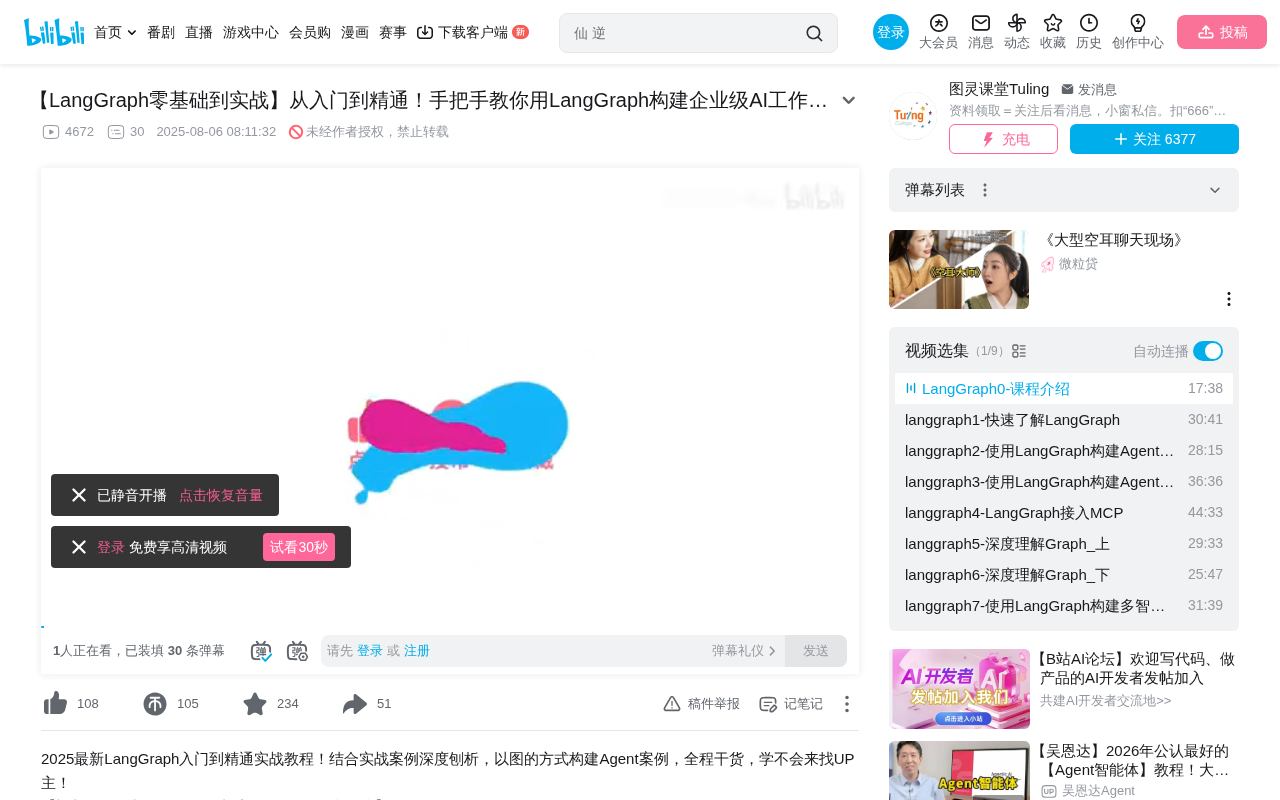
Regarding the importance of multi-agent systems, there's already plenty of discussion online. But LangGraph's value lies in providing a clear blueprint for multi-agent collaboration — not empty hype, but an implementable technical path.
LangGraph Core Architecture: The Design Philosophy of Lang + Graph
Deep Integration of Two Dimensions
The name LangGraph itself reveals its design philosophy. Breaking it down:
- Lang: Represents the ability to interact with large models — something LangChain and other frameworks can also achieve
- Graph: Represents graph structure — this is LangGraph's true core differentiator
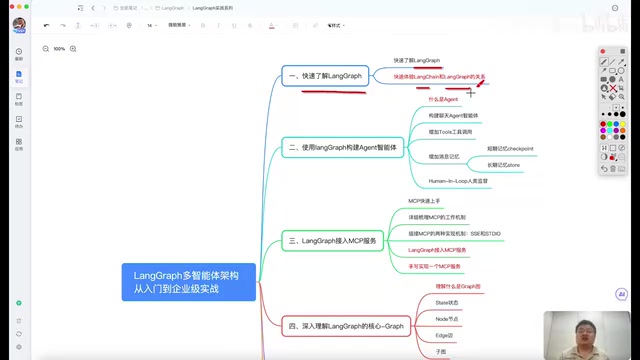
Graph structure is a mathematical model in computer science that describes relationships between Nodes and Edges, widely used in social network analysis, path planning, knowledge graphs, and more. In the AI field, Graph Neural Networks (GNN) and knowledge graphs have already proven the powerful ability of graph structures to express complex relationships. LangGraph brings this concept into agent orchestration: each node represents a processing unit (which can be an LLM call, tool execution, or business logic), and edges represent data flow and control flow, upgrading what was originally a linear AI call chain into a directed graph capable of handling conditional branches, loop iterations, and parallel execution.
Graph structure wasn't invented by LangGraph. In the big data era, knowledge graphs were already a typical application of graph structures. LangGraph's innovation lies in combining large model capabilities with graph structure — through the graph form, complex tasks are progressively abstracted and decomposed into finer-grained units, enabling the design of complex business scenarios.
The Relationship Between LangGraph and LangChain
This is a key point that many tutorials tend to overlook. LangGraph is not a standalone framework — it's a component within the LangChain ecosystem. Discussing LangGraph without LangChain is like discussing Spring MVC without mentioning Spring Framework — it leaves learners without the necessary context.
Understanding the relationship between the two is crucial: LangChain provides the foundational mechanisms for interacting with large models, while LangGraph offers higher-level orchestration capabilities on top of that. With LangChain's "bricks," LangGraph helps you build the "skyscraper."
The Progression Path from Single Agent to Multi-Agent
Single Agent: The Foundation of Multi-Agent Architecture
Although LangGraph's focus is on multi-agent architecture, building multi-agent systems requires reliable individual agents first. It's like building a house — you need solid bricks first. Each Agent should be a well-encapsulated capability unit that external callers can use without worrying about internal implementation details.
This design philosophy allows us to abstract away from implementation details, develop better architectural thinking, and solve a wider variety of problems.
Deep Integration with MCP Services
MCP (Model Context Protocol) is a standardized protocol proposed and open-sourced by Anthropic in late 2024, aimed at solving the fragmentation problem of integrating large models with external tools and data sources. Before MCP, every AI application needed custom integration code for different tools, resulting in extremely high maintenance costs. MCP draws inspiration from LSP (Language Server Protocol) — just as LSP unified communication between IDEs and language servers, MCP unifies the communication protocol between AI models and external capability providers. MCP uses JSON-RPC 2.0 as its underlying communication format and defines three core capability exposure methods: Resources, Tools, and Prompts, enabling any service to become a standardized capability provider in the AI ecosystem by implementing the MCP server interface.
Currently, thousands of MCP services are emerging in the AI field, but quality varies widely. As programmers, we need a deeper understanding of MCP.
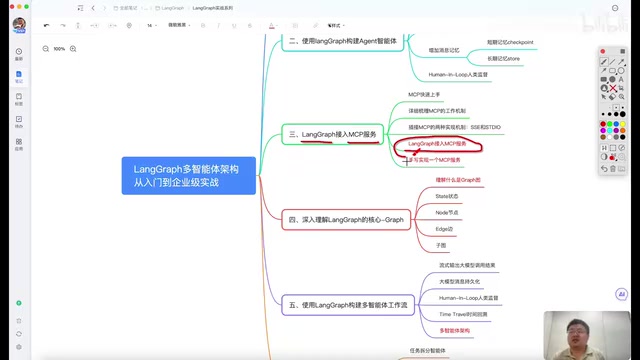
Unlike the graphical drag-and-drop approach offered by platforms like Alibaba Cloud Bailian, deep understanding of MCP means:
- Client side: Understanding how LangGraph connects to MCP services
- Server side: Mastering how to implement your own MCP services, exposing private data and capabilities through the MCP protocol
MCP is a universal protocol, and many people have provided ready-made tools. But for programmers, MCP is also a powerful extension point — in the future, you'll inevitably need to expose your own private services through the MCP protocol.
Graph Structure: The Soul of LangGraph
Architectural Advantages of Graph Structure
A procedural approach — asking the large model a question, then deciding what to do with the answer — can certainly get things done. But when facing large projects and cross-team collaboration, this approach falls short.
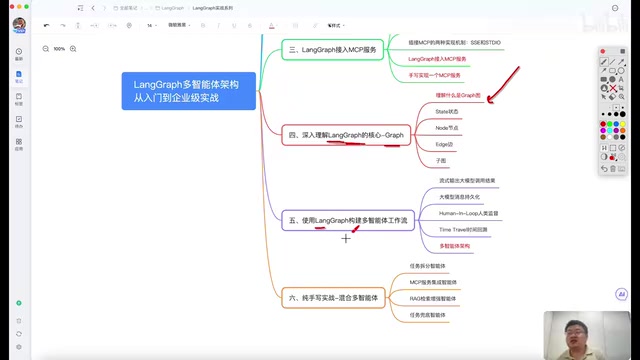
This aligns with our experience in Java/Python development: a single main method can technically "do everything," but why do we need Spring Boot, microservices, and other architectures? Because we need to decompose complex tasks properly. LangGraph provides this decomposition and organization capability through graph structure.
More importantly, once the graph structure is formed, each node can contain anything — LangChain code, LlamaIndex code, or even your own business code. What graph structure provides is a well-organized architectural composition approach, and this is LangGraph's most core value.
Time Travel Mechanism: A Debugging Powerhouse for Complex Applications
LangGraph's Time Travel mechanism fundamentally relies on its built-in persistent Checkpoint system. Every time the graph executes a node, LangGraph serializes and saves the complete current State to a storage backend (supporting memory, SQLite, PostgreSQL, etc.). This design draws from the Event Sourcing architectural pattern — the system saves not just the final state, but state snapshots at every step, enabling state replay and recovery at any point in time.
The Time Travel mechanism solves a critical pain point: in complex multi-step large model interactions, if one step goes wrong (e.g., the large model doesn't follow the prompt), does the entire process need to restart? The answer is no. In practice, developers can use the LangGraph Studio visual interface to intuitively see the input and output of each node, and leverage Time Travel to:
- View the complete execution process and results at each step
- Locate the problematic node
- Select any historical checkpoint, inject modified data, and continue execution from that breakpoint
This is equivalent to time-traveling through the entire task execution process without re-running the entire costly LLM call chain, dramatically reducing debugging and operational costs for complex applications.
Enterprise Implementation: A Complete Multi-Agent Architecture Landing Solution
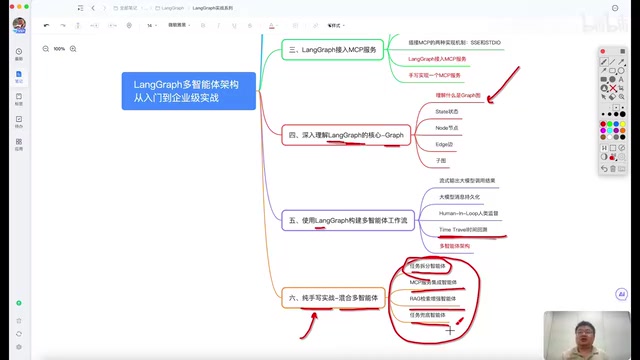
The enterprise-level project adopts a supervised, task-dispatching multi-agent architecture, covering typical scenarios for using large models in enterprises:
- MCP Service Agent: Integrates MCP services to provide specific business capabilities
- RAG Retrieval-Augmented Agent: Based on Retrieval-Augmented Generation (RAG) technology, solving enterprise private domain knowledge Q&A. RAG's core approach is to retrieve relevant document fragments from an external knowledge base before generating answers, inject these fragments as context into the prompt, and then have the large model generate answers based on real information — effectively addressing the large model's "hallucination" problem and private domain knowledge gaps.
- Fallback Agent: Handles general tasks that the large model can complete on its own
- Task Routing Agent: Acts as the "supervisor," intelligently distributing and integrating tasks
The advantage of this architectural design lies in clear responsibilities and strong extensibility — each agent focuses on its area of expertise, with unified scheduling through the supervisor.
Code Development vs. Graphical Tools: How to Choose
A question worth pondering: since graphical tools like Coze and Dify are already quite capable, why bother learning the code approach?
The answer lies in the boundaries of imagination. Graphical tools lower the barrier to entry through plugins, but simultaneously draw a "box" around what's possible. When you want to:
- Implement a feature but the platform has no corresponding plugin
- Design a workflow but the graphical tool doesn't support it
- Handle an edge case the tool didn't anticipate
At that point, code is the only way to break through limitations. You may not have noticed, but even platforms like Coze and Dify support writing code within their graphical frameworks — this itself demonstrates the limitations of a purely graphical approach.
Writing scattered code snippets within graphical tools versus thinking through a problem entirely in code produces completely different levels of understanding. Thinking entirely in code allows you to approach problems from their fundamentals, giving you better control over whatever new challenges emerge down the road.
Key Takeaways
- LangGraph is a core component of the LangChain ecosystem and cannot be understood in isolation. Its core value lies in combining large model capabilities with graph structure
- The learning path should start with single agent construction, gradually transitioning to multi-agent collaborative architecture, including deep integration of MCP services on both client and server sides
- Graph structure is the soul of LangGraph, providing architectural capabilities for decomposing and organizing complex tasks, with each node flexibly accommodating code from different frameworks
- The Time Travel mechanism is based on a persistent Checkpoint system, supporting time-travel debugging in complex multi-step interactions — locating problematic nodes and resuming execution from that point, dramatically reducing debugging costs
- Compared to graphical tools like Coze and Dify, the code approach has a higher barrier to entry but can break through tool capability boundaries, unleashing greater creative potential
Related articles
 Tutorials
Cursor + Codex Dual-IDE Collaboration: A Practical Methodology for Open-Source Project Customization
A complete methodology for open-source project customization based on real-world experience, detailing the Cursor+Codex dual-IDE workflow, seven-stage process, MVP validation, and AI source code reading techniques.
 Tutorials
Cursor Multi-Agent in Practice: Building a Full-Stack Next.js Blog in 50 Minutes
Build a full-stack blog in 50 minutes using Cursor IDE's multi-Agent mode with Next.js, Clerk auth, and Supabase. Learn the 4-phase AI Agent workflow and key integration pitfalls.
 Tutorials
Building an AI Software Factory from Scratch: A Cursor Engineer's Hands-On Experience with Multi-Agent Collaboration
Cursor engineer Eric shares practical insights on building an AI software factory: automation levels, guardrail design, parallel Agent management, and scaling to 1000+ Agents for 24/7 development.