LangGraph Multi-Agent Architecture: Graph Structure Principles and Enterprise-Level Implementation Guide
LangGraph extends LangChain with graph structures to orchestrate complex multi-agent AI workflows
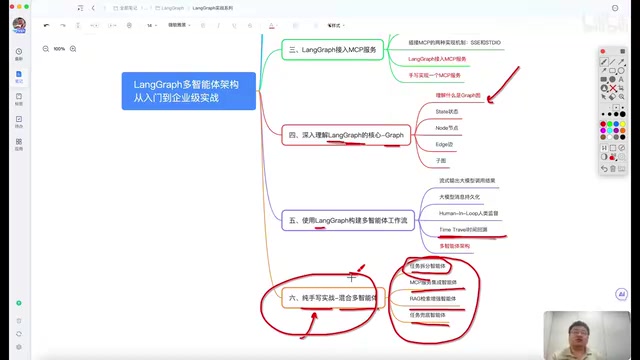
LangGraph is an extension of the LangChain ecosystem, built around directed graph structures to overcome LangChain's limitations in complex scenarios. It modularizes tasks into nodes and edges, supporting cycles, branching, and parallel execution, while providing a Time Travel state rollback mechanism to reduce debugging costs. Combined with MCP protocol integration for external services and RAG capabilities, LangGraph powers enterprise-level multi-agent collaborative architectures, serving as the critical framework for evolving AI applications from single interactions to complex workflows.
Why Do We Need LangGraph After LangChain?
In the era of large language models, the LangChain framework series is practically a required course for every AI developer. It provides a rich set of tools for applying LLMs to more scenarios and has helped developers accumulate extensive experience and mental models for working with large models.
LangChain emerged in late 2022 alongside the ChatGPT wave, quickly becoming the de facto standard framework for AI application development. Through core abstractions like Chains, Prompt Templates, and Memory management, it enabled developers to rapidly build Q&A systems, document summarization, code generation, and other applications. However, LangChain's design philosophy is fundamentally linear — tasks flow from input to output through a series of predefined steps. When handling complex scenarios that require conditional branching, iterative loops, parallel execution, or multi-agent negotiation, this linear architecture leads to extremely bloated and hard-to-maintain code. This is precisely the context in which LangGraph was born.
As a core component within the LangChain ecosystem, LangGraph elevates the capabilities of LLM applications to new heights. If LangChain solves the problem of "how to interact with large models," then LangGraph solves the problem of "how to make multiple agents work together."
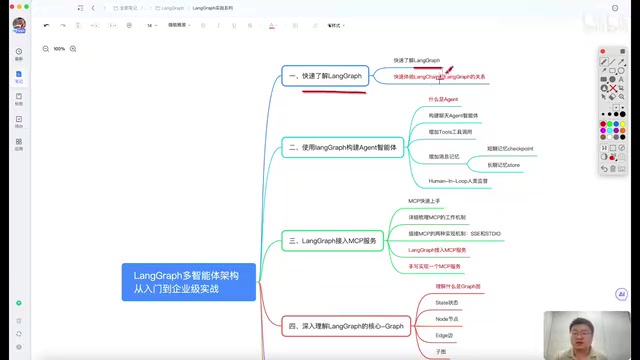
A key insight is: LangGraph is not a standalone framework, but an extension of the LangChain ecosystem. Discussing LangGraph without LangChain is incomplete. While the two may seem to overlap in functionality, they actually solve problems at different levels — LangChain optimizes single interactions, while LangGraph orchestrates complex workflows.
The Core of LangGraph: Graph Structure Explained
Deconstructing LangGraph's Design Philosophy from Its Name
The name LangGraph can be broken into two parts: Lang (interacting with large models) and Graph (graph structure). It's the Graph that is the true soul of this framework.
A Graph is one of the most fundamental data structures in computer science, composed of Nodes (Vertices) and Edges. Depending on whether edges have direction, graphs are classified as directed or undirected. LangGraph uses a variant of directed graphs — it supports cyclic graphs, which is the key to implementing iterative reasoning and feedback mechanisms. Graph structures are widely used in engineering: Apache Airflow uses DAGs to orchestrate data pipelines, Kubernetes uses graphs to manage container dependencies, and knowledge graphs use graphs to express entity relationships. LangGraph brings this mature paradigm into AI application development, making workflow state transitions visual and traceable.
Graph structures were not invented by LangGraph. In the big data era, knowledge graphs were already a classic application of graph structures. LangGraph's innovation lies in combining graph structures with LLM interactions, allowing developers to abstract complex tasks into individual nodes and organize business logic through graphs.
The benefits of this design are obvious:
- Modularity: Each node can be developed and tested independently
- Flexibility: Graphs can embed LangChain code, LlamaIndex code, or even custom business logic
- Scalability: Adding new functionality only requires adding nodes and edges without affecting existing flows
Graph Structure vs. Procedural Approach: Why Can't We Just Call Things Step by Step?
Some might ask: can't we achieve the same functionality by calling the LLM step by step? Indeed we can, but that's like writing all business logic in a single main method — fine for small projects, but inadequate for large projects and cross-team collaboration.
This is the same reason we need Spring Boot and microservice architectures. The graph structure provided by LangGraph is essentially an architectural philosophy designed for AI applications.
From Single Agent to Multi-Agent Collaboration
Single Agent: The Building Block of Multi-Agent Architecture
The prerequisite for building multi-agent architectures is having reliable single agents. Just as building a house requires solid bricks, LangGraph first provides a complete approach for constructing individual Agents.
The core concept of an Agent is: encapsulating the fundamental capabilities of a large model so that we can confidently delegate tasks to the Agent without worrying about internal implementation details. This abstraction allows developers to step away from implementation details and focus on higher-level system design.
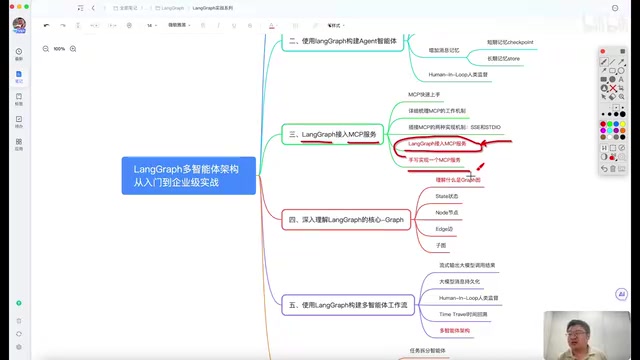
MCP Protocol Integration: From Calling to Building Your Own Services
In single-agent construction, MCP (Model Context Protocol) services are one of the hottest technical directions in the AI field today. MCP is an open standard protocol proposed by Anthropic in late 2024, designed to solve interoperability issues between large models and external tools and data sources. It draws inspiration from LSP (Language Server Protocol) — just as LSP unified the communication protocol between code editors and language servers, MCP unifies the communication protocol between AI models and context providers. MCP servers can expose three types of capabilities: Resources (data resources), Tools (executable tools), and Prompts (prompt templates). Clients call these through a standardized JSON-RPC protocol, achieving true "develop once, use everywhere."
Thousands of MCP services have already emerged globally, but their quality varies significantly. As developers, we cannot stay at the level of drag-and-drop GUI calls to MCP services. We need to deeply understand two key dimensions:
- Client-side integration: How to connect to existing MCP services through LangGraph
- Server-side development: How to expose your own private services and data based on the MCP protocol
MCP is a universal protocol, and understanding its underlying implementation is essential for navigating complex scenarios with ease.
Time Travel Mechanism: A Fault-Tolerance Tool for Complex Workflows
When an application needs to interact with a large model multiple times and execute different business logic based on different responses, any error in an intermediate step could require the entire process to restart. For large-scale business scenarios, this cost is unacceptable.
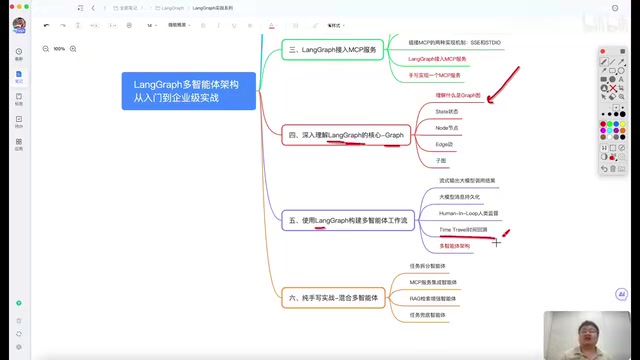
LangGraph's Time Travel mechanism is built on its core state management system. LangGraph persists the entire workflow execution state as a series of snapshots (Checkpoints), saving complete state snapshots to persistent storage (supporting memory, SQLite, PostgreSQL, and other backends) before and after each node execution. This design is similar to a database's WAL (Write-Ahead Logging) mechanism or Git's commit history — every operation has a complete record and can be rolled back at any time. In terms of technical implementation, LangGraph maintains an immutable state object through StateGraph. Each state change generates a new state version rather than modifying in place. This functional programming approach ensures the completeness and traceability of state history.
Specifically, the Time Travel mechanism provides an elegant solution:
- After graph execution completes, you can inspect the execution process and results of each node
- If a step produces unsatisfactory results, you can rewind to the problematic node
- After manual adjustment, continue execution from that node onward
This is equivalent to time-traveling through the entire task execution process. It's particularly critical for enterprise scenarios requiring human review (Human-in-the-Loop), significantly reducing the debugging and operational costs of complex AI applications.
Enterprise Implementation: Hybrid Multi-Agent Architecture Design
The architectural design of multi-agent systems draws from various classic patterns in software engineering. The main orchestration patterns supported by LangGraph include: Supervisor Pattern, where a central dispatching agent handles task decomposition and result integration; Peer-to-Peer Pattern, where agents communicate and negotiate directly with each other; and Hierarchical Pattern, where multiple layers of supervisors form a tree-like management structure. These patterns closely correspond to the concepts of service Orchestration and service Choreography in microservice architectures.
A complete enterprise-level multi-agent project typically contains the following typical components:
- Task Allocation Agent: Responsible for task decomposition and integration, serving as the scheduling center for the entire system
- MCP Business Agent: Integrates MCP services to handle specific business capabilities
- RAG Retrieval Agent: Based on Retrieval-Augmented Generation technology, solving enterprise private knowledge Q&A problems. The core idea of RAG (Retrieval-Augmented Generation) is to retrieve relevant document fragments from a vector database as context before the model generates an answer, guiding the model to generate responses based on real materials, effectively addressing the "hallucination" problem and knowledge timeliness issues of large models
- Fallback Agent: Handles routine tasks that don't require LLM involvement
Enterprise scenarios typically adopt the Supervisor Pattern because it provides the clearest responsibility boundaries and the most debuggable execution traces. This multi-agent architecture with supervision and task allocation covers the mainstream scenarios for enterprise LLM usage and represents the most common production deployment pattern for LangGraph.
Code Development vs. GUI Tools: How to Choose?
This is a question worth pondering. GUI tools like Cursor and Devin certainly lower the barrier to entry, but they essentially draw a box around users — your capabilities are limited to the plugins and workflows the tool provides.
What do you do when you want to implement a feature but the tool doesn't have a corresponding plugin? What do you do when a graphical workflow can't express your business logic?
The core advantage of code is unleashing imagination. Even platforms like Cursor support writing code within their graphical frameworks, which precisely demonstrates the inherent limitations of purely graphical approaches. Thinking through problems entirely in code allows you to start from fundamental issues and maintain complete control over the entire system.
If you're just treating LLMs as a hobby, GUI tools are sufficient. But if you want to turn this into a professional skill, mastering code development capabilities with frameworks like LangGraph is the key to breaking through your ceiling.
Key Takeaways
- LangGraph is an extension of the LangChain ecosystem that orchestrates complex AI workflows through Graph structures — it cannot be understood in isolation from LangChain
- The Graph structure is LangGraph's core soul, modularizing complex tasks into nodes, supporting embedded code from various frameworks, and providing an architectural philosophy for AI applications
- The Time Travel mechanism, based on a Checkpoint state snapshot system, allows developers to rewind to any node in the workflow for adjustments, dramatically reducing debugging costs for complex AI applications
- MCP protocol, as an open standard for AI tool interoperability, unifies communication between large models and external services, serving as critical infrastructure for building reusable AI capabilities
- Enterprise multi-agent architectures typically include task allocation, MCP business processing, RAG retrieval, and fallback task agents, with the Supervisor Pattern being the most common orchestration approach
- Compared to GUI tools, code-based development better unleashes developer imagination without being constrained by tool capability boundaries
Related articles
 Tutorials
Cursor + Codex Dual-IDE Collaboration: A Practical Methodology for Open-Source Project Customization
A complete methodology for open-source project customization based on real-world experience, detailing the Cursor+Codex dual-IDE workflow, seven-stage process, MVP validation, and AI source code reading techniques.
 Tutorials
Cursor Multi-Agent in Practice: Building a Full-Stack Next.js Blog in 50 Minutes
Build a full-stack blog in 50 minutes using Cursor IDE's multi-Agent mode with Next.js, Clerk auth, and Supabase. Learn the 4-phase AI Agent workflow and key integration pitfalls.
 Tutorials
Building an AI Software Factory from Scratch: A Cursor Engineer's Hands-On Experience with Multi-Agent Collaboration
Cursor engineer Eric shares practical insights on building an AI software factory: automation levels, guardrail design, parallel Agent management, and scaling to 1000+ Agents for 24/7 development.