LangGraph Multi-Agent in Practice: Building a Medical Agent System from Scratch
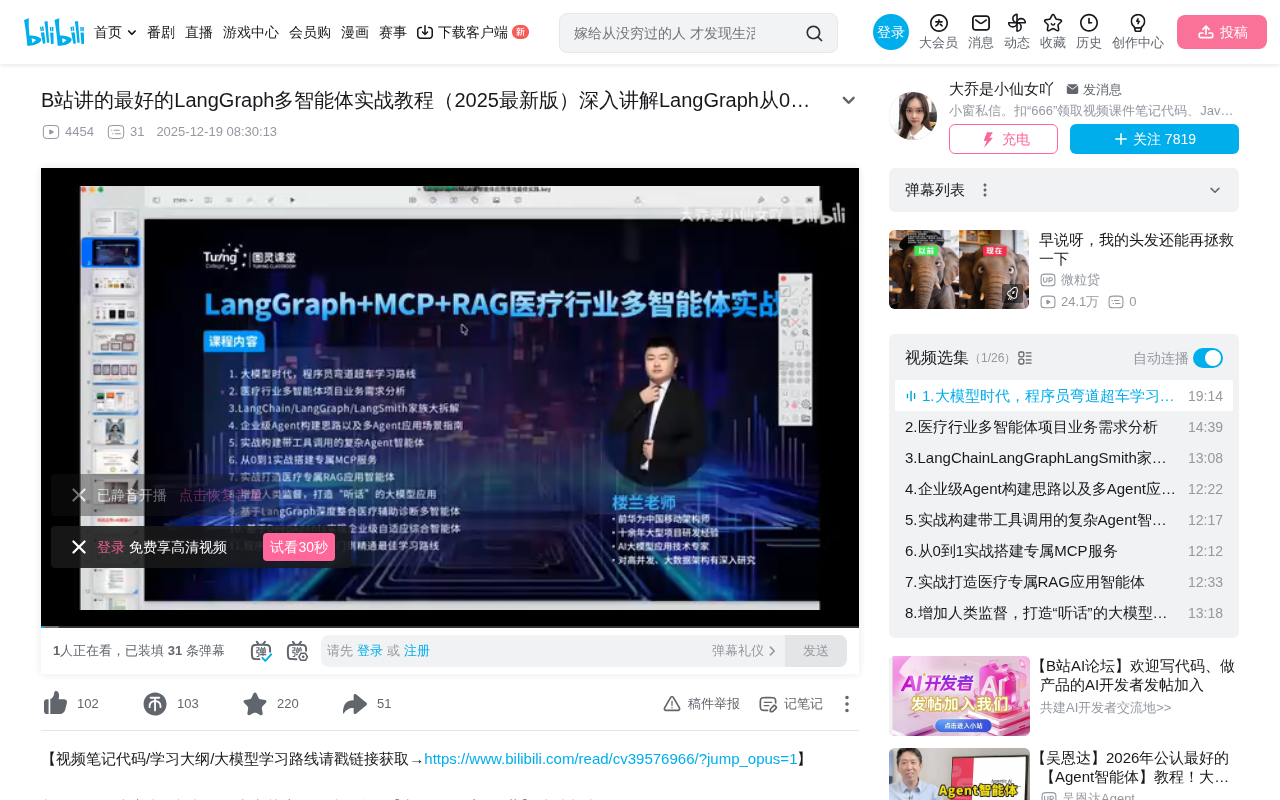
Enterprise multi-agent systems are key to LLM adoption; requirements and architecture matter more than code.
Using a healthcare multi-agent project as an example, this article explains the essence of enterprise-grade Agents — possessing independent reasoning, execution, and problem-solving capabilities far beyond ordinary chatbots. Technically, it requires LangGraph (workflow orchestration), RAG (domain knowledge), and MCP (tool invocation) working in concert. The author emphasizes that in the LLM era, requirements management and architecture design account for 70%–80% of project workload, understanding framework design philosophy matters more than memorizing APIs, and the integration of technology, business, and architecture is the true core competency.
Why Enterprise-Grade Agents Are Key to LLM Adoption
The explosive growth of large language model technology has made "agents" an unavoidable topic in the industry. Whether you're a technical practitioner or a business decision-maker, everyone is exploring how to put LLMs to real use through agents. But honestly, truly understanding what an enterprise-grade multi-agent system is and how to build a working Agent project from scratch remains a tough nut to crack for most people.
This article is based on a real-world multi-agent project in the healthcare industry. It breaks down how mainstream technologies like LangGraph, LangChain, MCP, and RAG work together, helping you build a complete cognitive framework for enterprise-grade Agent development.
Redefining Agents: Far More Than Chatbots
What Is the True Nature of an Agent?
Many people's understanding of agents remains superficial. Take the "AI agents" on platforms like Doubao — they're essentially just adding a persona layer on top of an LLM. You set a background, assign a role, and the model responds according to that persona during conversations. Strictly speaking, this doesn't qualify as a real Agent.
A true agent needs three core capabilities:
- Independent reasoning: Autonomously deciding what to do next based on context
- Execution ability: Calling tools and accessing external systems to complete specific tasks
- Problem-solving ability: Independently solving specific business problems, rather than simple Q&A
Put simply, the core value of an Agent lies in whether it can independently solve a concrete business problem based on the LLM's reasoning capabilities. This is the fundamental difference between enterprise-grade Agents and ordinary chatbots.
From Single Agent to Multi-Agent Collaboration
In enterprise scenarios, a single Agent can rarely cover complex business processes. Take the healthcare industry as an example — a complete diagnostic assistance system might require this division of labor:
- Consultation Agent: Responsible for collecting patient symptoms and basic information
- Diagnosis Agent: Responsible for analyzing conditions and providing preliminary assessments
- Prescription Agent: Responsible for generating treatment plans and medication recommendations
- Follow-up Agent: Responsible for subsequent tracking and health management
These Agents each have their own responsibilities while needing to collaborate closely — this is precisely where multi-agent architecture delivers its value.
Tech Stack Analysis: Why LangGraph Is the Top Choice
The Evolution Path of the LangChain Ecosystem
As the mainstream framework for LLM application development, LangChain has already formed a fairly complete ecosystem. However, as Agent application scenarios have grown increasingly complex, LangChain's chain-based invocation pattern has started to struggle with complex workflows.
LangGraph was born in this context. It abstracts Agent workflows into directed graphs — each node represents a processing step, and edges represent transition logic. This design naturally supports branching, loops, and parallel processing, making it far more flexible than linear Chains.
The Core Technology Stack for Enterprise Agents
Building a usable enterprise-grade multi-agent system typically requires the following technologies working in concert:
| Technology Component | Core Responsibility | Problem It Solves |
|---|---|---|
| LangGraph | Orchestrating multi-Agent collaboration workflows, defining state machines and workflows | Flexible scheduling of complex processes |
| LangChain | Providing foundational capabilities for interacting with LLMs, including Prompt management and Chain construction | Standardization of model invocations |
| RAG | Enabling Agents to access enterprise private knowledge bases | Accuracy of domain-specific knowledge |
| MCP | Standardizing the interaction protocol between models and external tools | Connecting Agents with external systems |
The logic of this combination is clear: LangGraph handles workflow orchestration, RAG handles domain knowledge, and MCP handles external tool invocation. Only when these three come together can they support a truly usable enterprise-grade Agent system.
Enterprise Thinking: What Matters More Than Writing Code
Requirements Management Is the Real Core Competency
This point is easily overlooked but extremely important: In the LLM era, the value of writing code is continuously declining. AI programming tools can already handle a large amount of coding work, but there's one thing AI cannot replace — managing requirements.
You can't just tell an LLM "build me a multi-agent project for the healthcare industry" and expect satisfactory results. You need to think through:
- Where are the responsibility boundaries for each Agent?
- How do Agents collaborate and how does data flow between them?
- How do you handle exceptions and implement graceful degradation?
- How will the system scale and be maintained going forward?
In real projects, requirements analysis and architecture design often account for 70%–80% of the workload, while coding implementation takes up a relatively small portion. In the LLM era, this ratio will only become more skewed.
Understanding Framework Philosophy Is More Valuable Than Memorizing APIs
When learning LangGraph or LangChain, don't just stay at the API level. What's more worth your time is understanding the design logic behind the frameworks:
- Why does LangGraph use graph structures to orchestrate Agents? Because graph structures naturally support complex branching and loops — something linear Chains cannot do
- Why is state management needed? Because multi-Agent collaboration requires sharing and passing context information
- Why does RAG need to be combined with Agents? Because an LLM's general knowledge cannot support the precision demands of vertical domains
Once you understand these "whys," you'll be able to make sound technology choices and architecture decisions when facing new business scenarios.
Key Practices for a Healthcare Multi-Agent Project
Why Healthcare Is a Textbook Scenario for Multi-Agent Deployment
The healthcare industry's business processes naturally involve multi-step, multi-role collaboration. From patient consultation, condition analysis, and treatment plan formulation to medication guidance, each step requires specialized knowledge support. This aligns perfectly with the multi-agent architecture's design philosophy of "each Agent focusing on a specific task."
However, healthcare scenarios also have their unique characteristics. When building multi-Agent systems, you must pay special attention to:
- Knowledge base construction and maintenance: Medical knowledge updates rapidly and is highly specialized; the retrieval accuracy of the RAG system directly determines Agent output quality
- Process rigor: Healthcare scenarios have extremely low tolerance for errors; collaboration workflows between Agents must undergo rigorous validation
- Compliance requirements: Privacy protection and compliant use of medical data are non-negotiable red lines
The Build Path from Zero to One
Building an enterprise-grade multi-agent project generally follows this path:
Step 1: Business Process Mapping
Identify what roles exist in the business scenario, what each role is responsible for, and how roles coordinate with each other. This step determines the skeleton of the entire system.
Step 2: Agent Design
Map each business role to an Agent, clearly defining its inputs/outputs, available tool sets, and connected knowledge bases.
Step 3: LangGraph Workflow Orchestration
Use LangGraph to define the collaboration workflow between Agents — which steps are sequential, which require conditional branching, and which can be processed in parallel.
Step 4: Integration and End-to-End Testing
Integrate all Agents into a unified system, run through the complete business pipeline, and focus on validating data transfer between Agents and exception handling.
Step 5: Continuous Iteration and Optimization
Based on actual operational results, continuously adjust Prompt strategies, tool configurations, and collaboration workflows. Optimizing a multi-Agent system is an ongoing process.
Practical Advice for Developers
Technical Transition Doesn't Require Starting Over
Many Java developers transitioning to the LLM space struggle with whether to switch entirely to Python. There's really no need to worry — the programming concepts behind languages are universal. Once you've mastered the core paradigms of one language, switching languages isn't difficult. What truly deserves your energy are the core capabilities of LLM application development: Prompt engineering, RAG architecture design, and Agent orchestration thinking — these are the hard skills that transcend languages.
Hands-On Projects Are the Most Efficient Way to Learn
In the LLM era, memorizing interview questions or watching other people's project demos is far from enough. The performance gap between someone who has actually built a project and someone who has only heard about it is enormous — both in interviews and actual work. Even without real enterprise project opportunities, you should go through the complete process from requirements analysis to system construction on your own.
Building Differentiated Competitiveness
In today's world where foundational technologies are increasingly homogenized, differentiated competitiveness becomes especially important. This includes:
- Depth and breadth of project experience
- Ability to understand industry scenarios
- System architecture design capability
- Comprehensive ability to combine technology with business
The value of these "soft skills" in the LLM era likely far exceeds pure coding ability.
Conclusion
Building enterprise-grade multi-agent systems is fundamentally an engineering effort that integrates technology, business, and architecture. Frameworks like LangGraph provide a powerful technical foundation, but what truly determines project success is your deep understanding of business requirements and your sound system architecture design.
In the LLM era, mastering the ability to determine "what to do" and "why to do it this way" is far more critical than "how to write the code." Rather than chasing API changes in every new framework, it's better to take the time to thoroughly understand the underlying logic of requirements analysis, architecture design, and Agent orchestration — that's the core competency that won't depreciate over time.
Related articles
 Tutorials
Cursor + Codex Dual-IDE Collaboration: A Practical Methodology for Open-Source Project Customization
A complete methodology for open-source project customization based on real-world experience, detailing the Cursor+Codex dual-IDE workflow, seven-stage process, MVP validation, and AI source code reading techniques.
 Tutorials
Cursor Multi-Agent in Practice: Building a Full-Stack Next.js Blog in 50 Minutes
Build a full-stack blog in 50 minutes using Cursor IDE's multi-Agent mode with Next.js, Clerk auth, and Supabase. Learn the 4-phase AI Agent workflow and key integration pitfalls.
 Tutorials
Building an AI Software Factory from Scratch: A Cursor Engineer's Hands-On Experience with Multi-Agent Collaboration
Cursor engineer Eric shares practical insights on building an AI software factory: automation levels, guardrail design, parallel Agent management, and scaling to 1000+ Agents for 24/7 development.