LlamaFactory: A Comprehensive Guide to the Open-Source Framework for Unified Fine-Tuning of 100+ LLMs
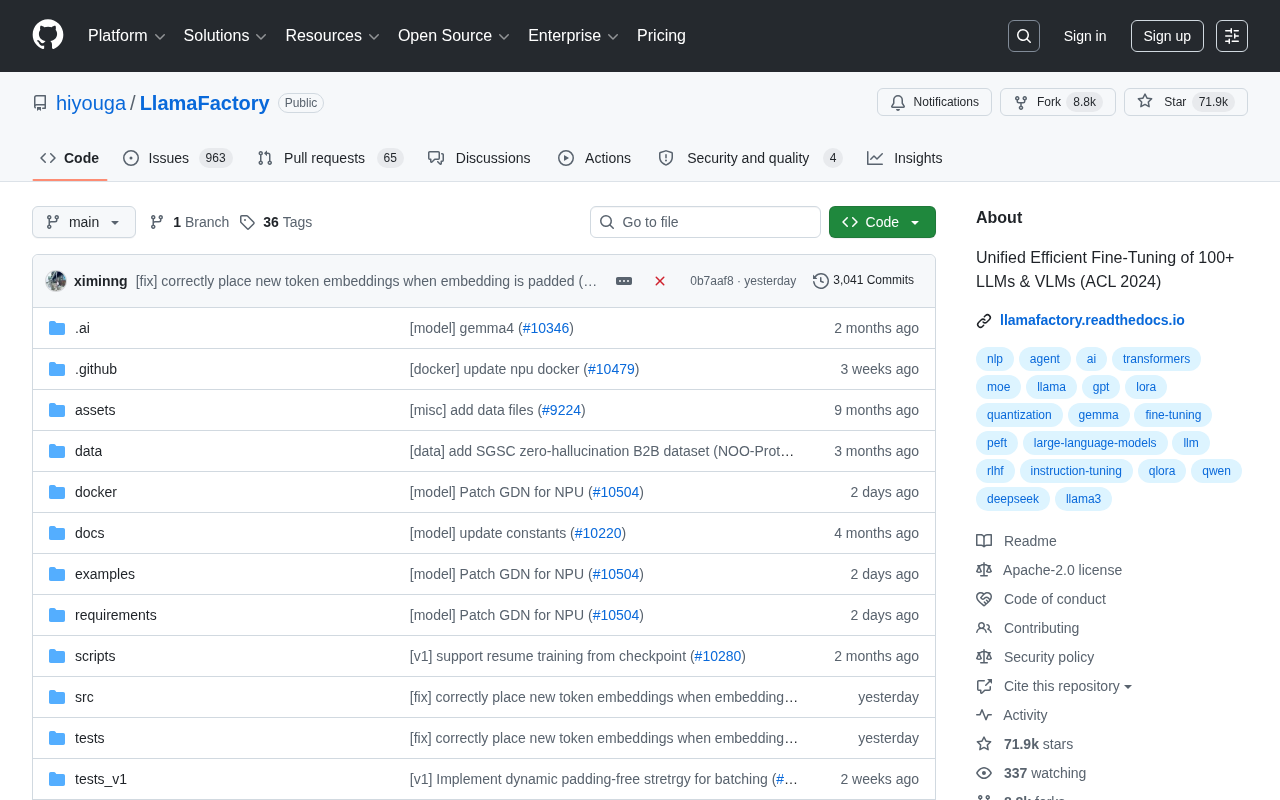
LlamaFactory is an open-source framework for unified fine-tuning of 100+ LLMs with 71K+ GitHub Stars.
LlamaFactory is a highly popular open-source project (71K+ GitHub Stars, ACL 2024 accepted) that provides a unified fine-tuning framework for over 100 large language models and vision-language models. It integrates efficient methods like LoRA, QLoRA, RLHF, and DPO, and offers a user-friendly Web UI called LlamaBoard, making LLM fine-tuning accessible to developers, researchers, and enterprises alike.
Project Overview
LlamaFactory is an open-source project with over 71,000 Stars on GitHub, dedicated to providing a unified and efficient fine-tuning framework for more than 100 large language models (LLMs) and vision-language models (VLMs). The project has been accepted at ACL 2024 (the top conference in computational linguistics), fully demonstrating its academic value and technical strength.
ACL (Association for Computational Linguistics) is the most prestigious academic conference in the field of natural language processing and computational linguistics, alongside EMNLP and NAACL as the three top NLP conferences, with ACL having the highest academic impact. ACL 2024 typically has an acceptance rate of 20%-25%, making it extremely competitive. LlamaFactory's acceptance at ACL means it is not merely an engineering tool but also possesses academic innovation at the methodological level, with peer-recognized contributions in areas such as unified fine-tuning framework design and efficient training strategies.
Why LlamaFactory Is Needed
Common Pain Points in LLM Fine-Tuning
In the era of rapidly evolving large models, fine-tuning is the critical step for adapting general-purpose LLMs to specific business scenarios. Fine-tuning is essentially one of the core paradigms of transfer learning — pre-trained large models learn general language representation capabilities from massive corpora, but their performance in specific domains (such as medical consultation or legal advisory) is often insufficiently precise. By continuing training on domain-specific data, model parameters can be adjusted to adapt to particular tasks. However, traditional full-parameter fine-tuning requires updating all model weights. For models with tens of billions of parameters, this means hundreds of gigabytes of GPU memory and substantial computational resources, making costs prohibitively high.
What makes things even more challenging is that different models have varying architectures, diverse training frameworks, and complex parameter configurations. Developers often need to write different fine-tuning code for each model, significantly increasing development costs and the learning curve.
LlamaFactory's Unified Solution
LlamaFactory standardizes the fine-tuning workflow for over 100 mainstream large models through a unified interface and framework. Whether it's LLaMA, Qwen, ChatGLM, Mistral, or multimodal vision-language models, developers can complete fine-tuning tasks using the same toolchain, dramatically lowering the technical barrier.
Core Features and Technical Highlights
Extensive Model Support
LlamaFactory supports over 100 large language models and vision-language models, covering the current mainstream open-source model ecosystem. Vision-Language Models (VLMs) are multimodal models that combine visual understanding with language generation capabilities, with representative works including LLaVA, Qwen-VL, InternVL, and others. These models typically consist of three components: a visual encoder (such as ViT), a projection layer, and a language model. Fine-tuning them requires handling additional steps like image-text alignment, multimodal data format conversion, and visual feature extraction. LlamaFactory encapsulates these complex processes in a unified manner, enabling developers to train multimodal models using the same workflow as text model fine-tuning, without switching between different frameworks.
Integration of Efficient Fine-Tuning Methods
The project integrates multiple efficient fine-tuning techniques, including:
-
LoRA / QLoRA: LoRA (Low-Rank Adaptation) was proposed by Microsoft Research in 2021. Its core insight is that the weight change matrix during model fine-tuning exhibits low-rank properties, so it can be decomposed into the product of two smaller matrices. For example, for a d×d weight matrix, LoRA only needs to train two matrices of size d×r and r×d (where r is much smaller than d), reducing trainable parameters from d² to 2dr and significantly decreasing memory requirements. QLoRA builds on this by introducing 4-bit quantization, compressing base model weights to 4-bit precision storage, combined with paged optimizers and double quantization strategies, making it possible to fine-tune 65B parameter models on a single consumer-grade GPU (e.g., 24GB VRAM).
-
Full-Parameter Fine-Tuning: Suitable for deep customization in resource-rich scenarios, updating all model parameters for optimal domain adaptation
-
RLHF / DPO: RLHF (Reinforcement Learning from Human Feedback) is one of the key technologies behind ChatGPT's success. Its pipeline includes three stages: first supervised fine-tuning (SFT), then training a Reward Model to simulate human preference judgments, and finally using the PPO (Proximal Policy Optimization) algorithm to optimize the language model so its outputs better align with human expectations. DPO (Direct Preference Optimization), proposed by Stanford in 2023, is a simplified approach that bypasses the explicit reward model training step, directly optimizing the policy model from human preference data. It offers more stable training at lower computational cost and has become one of the mainstream choices for alignment training.
-
Pre-training and Instruction Tuning: Covers the complete pipeline from pre-training to conversational optimization, allowing developers to intervene at different stages based on their needs
User-Friendly Web UI Design
LlamaFactory provides a Web UI interface called LlamaBoard, enabling users unfamiliar with command-line tools to complete the entire model fine-tuning configuration through a graphical interface, including dataset selection, hyperparameter tuning, training monitoring, and model export. Additionally, the project is developed in Python with a clear code structure, making it convenient for secondary development and customization.
Community Impact and Key Metrics
Key Data
- 71,934 Stars: Over 70,000 stars on GitHub, ranking among the top AI fine-tuning tool projects
- 8,792 Forks: Nearly 9,000 forks indicate widespread adoption in real-world projects
- ACL 2024 Acceptance: Recognized by a top academic conference, combining engineering practicality with academic rigor
Use Cases and Target Users
LlamaFactory is suitable for the following user groups:
- AI Application Developers: Quickly adapt open-source LLMs to vertical domains (healthcare, legal, finance, etc.)
- Researchers: Conveniently conduct model comparison experiments and ablation studies
- Enterprise Teams: Build private LLM services at low cost, avoiding uploading sensitive data to third-party APIs
- AI Enthusiasts: Experience the complete LLM fine-tuning workflow with zero barriers to entry
Quick Start Guide
For developers who want to try LlamaFactory, here are the recommended steps:
- Clone the project repository and install dependencies (Python 3.10+ and PyTorch 2.0+ environment recommended)
- Prepare training datasets in the required format (the project supports mainstream data formats like Alpaca and ShareGPT)
- Select the target model and fine-tuning method (beginners are recommended to start with LoRA, which only requires a single consumer-grade GPU)
- Launch training via LlamaBoard Web UI or command line
- Evaluate model performance and export for deployment (supports exporting to HuggingFace format or merging LoRA weights)
Conclusion
LlamaFactory represents the trend toward standardization and democratization of LLM toolchains. It encapsulates complex model fine-tuning processes into a unified, user-friendly framework, enabling more developers to participate in LLM customization and application. As the open-source LLM ecosystem continues to flourish, the value of unified fine-tuning tools like LlamaFactory will become increasingly prominent — not only lowering technical barriers but also driving the entire industry's paradigm shift from "only able to call APIs" to "autonomously controlling models."
Key Takeaways
Related articles

Claude Code for Test Development in Practice: An AI Programming Workflow That Doubles Your Efficiency
A practical guide to Claude Code for test development: auto-generating test scripts, Plan Mode workflows, MCP + Playwright integration, and Subagent parallel tasks to build systematic AI-assisted workflows.

Hermes Agent Hands-On Review: An AI Efficiency Revolution for Indie Game Developers
Indie game developer reviews Hermes Agent vs OpenClaude: intelligent context compression, real-time Memory, remote control via Telegram, and practical use cases in game dev, social media, and email.
Vibe Coding Beginner's Guide: Tool Selection Across Three Categories with Practical Examples
A comprehensive guide to Vibe Coding's three tool categories: Agent frameworks, CLI Coding, and IDE tools, with practical examples including Snake game and data analysis workbench.