Loop Engineering Explained: Agent Loop Mechanisms and the New Paradigm of AI Agent Development
Loop Engineering systematizes the design and optimization of iterative loop mechanisms in AI agents.
Loop Engineering focuses on designing and optimizing the cyclical think-act-observe mechanisms in AI agents. This article traces the evolution from simple While loops to Graph-based architectures like LangGraph, explores key challenges including loop efficiency, termination strategies, state management, and error recovery, and explains how Loop Engineering complements Prompt Engineering and Context Engineering in modern AI development.
What is Loop Engineering?
Loop Engineering is an emerging engineering concept. While the name sounds new, its core ideas have actually existed in AI development practice for quite some time. Simply put, Loop Engineering focuses on how to design and optimize the loop mechanisms within intelligent agents (Agents)—the engineering practices around the iterative process where an Agent thinks, acts, thinks again, and acts again.
To truly understand Loop Engineering, we need to start with its foundational concept—the Agent Loop—and then examine why it has been singled out as an independent engineering discipline.
Agent Loop: The Core Mechanism of Intelligent Agents
The Fundamental Difference Between Agents and Large Models
Before discussing Loop Engineering, we must clarify the key distinction between Agents and Large Language Models (LLMs). Many people confuse these two concepts, but they differ fundamentally in how they work.
The essence of a Large Language Model (LLM) is an autoregressive text generation system based on the Transformer architecture. Through training on massive text corpora, it acquires powerful language understanding and reasoning capabilities, but its core working mode is "input text, output text"—a stateless, single-pass inference process. Even top-tier models like GPT-4 and Claude can only complete single-turn text generation tasks without external system support.
The concept of an Agent has a much longer history in AI. As early as the 1990s, researchers proposed the BDI (Belief-Desire-Intention) architecture to describe autonomous agent behavior patterns. Modern LLM-based Agents use large models as their "brain" while building perception, memory, tool invocation, and planning modules around them, upgrading from a passive text generator to a system capable of autonomously completing complex tasks.
Specifically, the differences between the two are reflected in:
- Different tool invocation methods: LLMs can reason about which tool to call, but require manual execution of the invocation process; Agents can autonomously invoke tools and, after obtaining results, independently decide whether to continue calling other tools.
- Different memory management: Agents possess contextual memory capabilities, maintaining state across multiple interaction rounds; while LLMs can also manage memory, it requires manual maintenance.
- Different decision-making autonomy: Agents can independently determine when to terminate the loop and when to provide a final answer, whereas an LLM's decision chain requires external orchestration.
How the Agent Loop Works
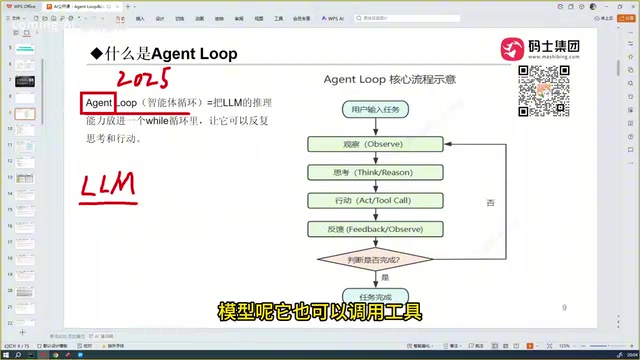
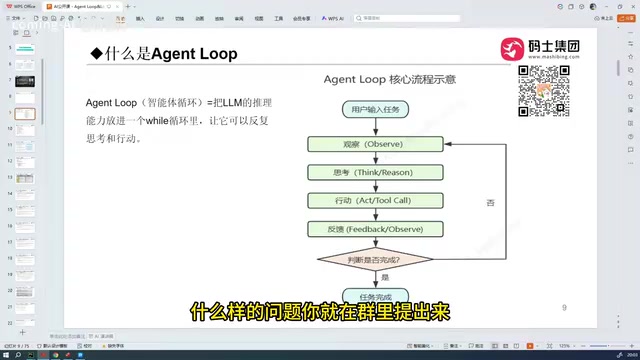
The Agent Loop refers to the "Think → Act → Observe → Think Again" cycle that an agent goes through when processing user requests. The most classic theoretical framework for this pattern is the ReAct (Reasoning + Acting) paradigm, formally proposed by Yao et al. in their 2022 paper. ReAct's core insight is: interleave reasoning and acting, letting the model first think and reason at each step, then decide what action to take, and then observe the action's results, forming a closed feedback loop.
This "observe-think-act" loop pattern actually has precedents in engineering and military domains. U.S. Air Force Colonel John Boyd proposed the OODA Loop (Observe-Orient-Decide-Act Loop) in the 1970s with a similar philosophy—emphasizing rapid iterative decision cycles to cope with complex, changing environments. The Agent Loop can be seen as a modern implementation of the OODA Loop in AI systems.
Specifically, when a user poses a question, the Agent goes through the following steps:
- Observe input: Receive the user's question and current environment state information
- Think and decide: Determine whether to answer the user directly or call external tools for more information
- Execute action: If tools are needed, invoke the appropriate tool and obtain results; if a direct answer is possible, generate the response
- Check termination conditions: Determine whether the user has received a satisfactory result
- Loop or terminate: If termination conditions are not met, return to step 2 and continue looping; otherwise, end the conversation
In early implementations, this process was essentially a while loop. Within the loop body, the large model is continuously called for reasoning, and the next action is determined based on the reasoning results, until termination conditions are met.
From While Loops to Graphs: The Technical Evolution of Loop Engineering
Early Implementation: Simple While Loops
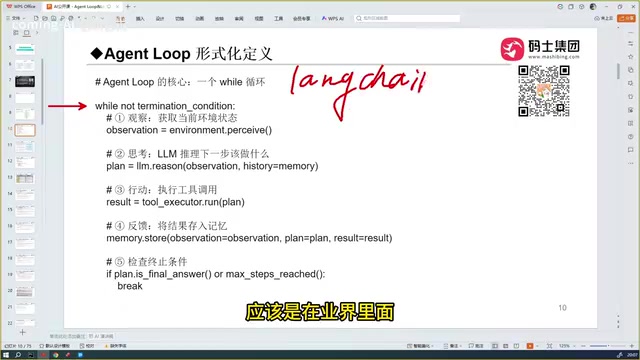
Early agent frameworks represented by LangChain implemented the Agent Loop in a very straightforward way—a while True loop.
LangChain was an open-source framework created by Harrison Chase in late 2022, with its original design philosophy of chaining multiple LLM calls and tool uses together through "Chain" invocations. Its AgentExecutor component was the core implementation of the Agent Loop—it maintains a loop that calls the LLM in each iteration to decide the next action, executes that action, then feeds the result back to the LLM for the next round of decision-making.
During the same period, other notable Agent frameworks adopted similar loop mechanisms: AutoGPT (March 2023) used a continuously running loop to let GPT-4 autonomously complete tasks, while BabyAGI used task queues and loop execution to achieve task decomposition and completion. Although these early implementations had different architectures, they were all based on the same While loop paradigm underneath.
The pseudocode looks roughly like this:
while True:
    # 1. Observe user input and environment state
    observation = get_current_state()

    # 2. Think: Call the large model to decide the next action
    action = llm.think(observation, memory)

    # 3. Execute action
    if action.type == "tool_call":
        result = execute_tool(action.tool, action.params)
        memory.add(result)
    elif action.type == "final_answer":
        return action.response

    # 4. Check termination conditions
    if should_terminate(memory):
        break
This implementation is simple and clear, but has obvious limitations: the loop is linear, making it difficult to handle complex branching logic and parallel tasks. For example, when a task requires querying multiple data sources simultaneously, a linear loop can only execute them one by one; when different conditions require completely different processing paths, a simple While loop falls short.
Modern Implementation: Graph Structures
Current versions of LangChain no longer use simple while loops to implement the Agent Loop, but have shifted to Graph structures. The specific product of this transition is LangGraph—the next-generation Agent orchestration framework released by the LangChain team in 2024.
In LangGraph, an agent's execution flow is modeled as a stateful directed graph. Here we need to distinguish between two important concepts: Directed Acyclic Graphs (DAGs) and directed cyclic graphs. Traditional workflow orchestration (like Airflow) typically uses DAGs, where tasks can only flow in one direction without loops. But the essential characteristic of an Agent is precisely the need for loops—it needs to repeatedly jump between "thinking" and "acting." Therefore, LangGraph uses directed cyclic graphs, allowing circular paths between nodes.
From a computer science perspective, this effectively models the Agent Loop as a Finite State Machine (FSM). Each node represents a state (such as "waiting for user input," "calling tool," "generating answer"), and edges represent state transition conditions (such as "tool returned result," "model decided to terminate"). The advantage of state machines is that they can clearly express complex control flows, including conditional branching, parallel execution, sub-state machine nesting, etc.—all things that are difficult to implement elegantly with simple While loops.
This evolution reflects the industry's deepening understanding of Agent loop mechanisms—real-world agent behavior is far more complex than simple loops and requires support for conditional branching, parallel execution, subtask orchestration, and more.
Core Value and Key Problems of Loop Engineering
Why Does Loop Engineering Need to Be Addressed Separately?
Loop Engineering has been singled out because, as agent applications have matured, developers have discovered that the quality of loop mechanism design directly determines an Agent's performance ceiling. Specifically, Loop Engineering needs to solve the following key problems:
- Loop efficiency: How to reduce unnecessary loop iterations and prevent Agents from falling into meaningless repetitive thinking. In practice, a poorly designed Agent might repeatedly call tools on the same problem without obtaining useful information, with each loop consuming API call costs and response time. Optimizing loop efficiency means enabling the Agent to complete tasks in fewer iterations.
- Termination strategy: How to accurately determine when to stop looping and provide a final answer. This is one of the most challenging problems in Loop Engineering—terminating too early leads to incomplete answers, while terminating too late wastes resources. Common termination strategies include: setting maximum loop counts, letting the model autonomously judge whether it has obtained sufficient information, and terminating based on confidence thresholds.
- State management: How to effectively manage context memory and intermediate states during the loop process. As loop iterations increase, accumulated context information may exceed the model's context window limit, requiring effective information compression and filtering strategies.
- Error recovery: How to gracefully handle failures when a tool call fails during a loop iteration. This includes retry strategies, fallback plans, and effective propagation of error information.
The Relationship Between Loop Engineering and Prompt Engineering
If Prompt Engineering focuses on the quality of a single interaction with a large model, then Loop Engineering focuses on the overall orchestration quality of multiple iterative interactions. The two are not contradictory but complementary—good Prompt Engineering improves the quality of single-step reasoning in each loop iteration, while good Loop Engineering ensures the entire loop process is efficient and controllable.
It's worth noting that in recent years, a series of similar "Engineering" concepts have emerged in the AI engineering field, collectively forming a complete methodology for AI application development:
- Prompt Engineering (emerged 2022-2023): Focuses on designing effective prompts to make models produce high-quality results in a single call. Techniques include Few-shot, Chain-of-Thought, role-setting, etc.
- Context Engineering (popularized in 2024 by Shopify CEO Tobi Lütke and others): Focuses on constructing optimal contextual information for models, including Retrieval-Augmented Generation (RAG), dynamic context assembly, etc. It emphasizes "what information to show the model."
- Flow Engineering (proposed by multiple research teams in 2024): Focuses on designing multi-step workflows, emphasizing decomposing complex tasks into multiple clearly defined steps.
- Loop Engineering: Focuses on designing loop iteration mechanisms, emphasizing efficiency and controllability during an Agent's repeated execution process.
These concepts approach the engineering challenges of AI application development from different dimensions, with Loop Engineering specifically focusing on loop control problems in Agent-specific scenarios.
Practical Significance of Loop Engineering for Developers
You're Probably Already Doing Loop Engineering
An interesting fact: if you're already doing development work related to large models, you're very likely already practicing Loop Engineering—you just might not realize it. Every time you design an Agent's execution flow, adjust loop termination conditions, or optimize tool invocation strategies, you're essentially doing Loop Engineering.
For example, when developing a customer service Agent, you need to decide: How many consecutive times can the Agent query the knowledge base? If a user's question involves multiple topics, should the Agent handle them sequentially or in parallel? When the Agent fails to retrieve relevant information from the knowledge base two consecutive times, should it switch retrieval strategies or directly inform the user it cannot answer? These decisions are all fundamentally within the scope of Loop Engineering.
Future Development Directions
As a concept, Loop Engineering represents the engineering advancement of AI development from "functional" to "excellent." As Agent application scenarios continue to expand, fine-grained management of loop mechanisms will become an essential skill for every AI developer.
Future development directions for Loop Engineering may include: adaptive loop strategies (dynamically adjusting loop depth based on task complexity), loop synchronization mechanisms in multi-Agent collaboration, observability and debugging tools for loop processes, and automatic optimization of loop strategies based on reinforcement learning.
Summary
Loop Engineering is not a concept that appeared out of thin air, but rather an engineering discipline that naturally evolved from agent development practice. Its core is the systematic design and optimization of Agent loop mechanisms. For developers, understanding Loop Engineering comes down to three key points: understanding the basic principles of the Agent Loop, mastering the technical evolution from simple While loops to Graph structures, and consciously optimizing loop strategies in actual projects. This is not an entirely new field that needs to be learned from scratch, but rather a conceptual refinement and systematic summary of existing Agent development practices.
Key Takeaways
Related articles

AI Programming Learning Roadmap: A Complete Six-Stage Guide from Beginner to Expert
A systematic breakdown of the six-stage AI programming learning roadmap, from zero-code start to mastering Cursor and professional tools, methodology frameworks, advanced patterns, and project practice.
Deep Dive into Devin's Background Agent Architecture: Behind the 80% AI-Committed Code
Deep analysis of Devin's background agent architecture: brain-sandbox separation, environment setup, MCP integration, memory systems, and multi-agent collaboration challenges.

Claude Code in Practice: An In-Depth Efficiency Comparison Between Claude and DeepSeek for Programming
A hands-on comparison of Claude vs DeepSeek V4 for AI programming: code quality, development efficiency, and cost differences. DeepSeek costs 1/6 to 1/10 of Claude but requires 1-2x more time.