macOS 27 Named Golden Gate: The Deeper Meaning Behind the Name and What Lies Ahead
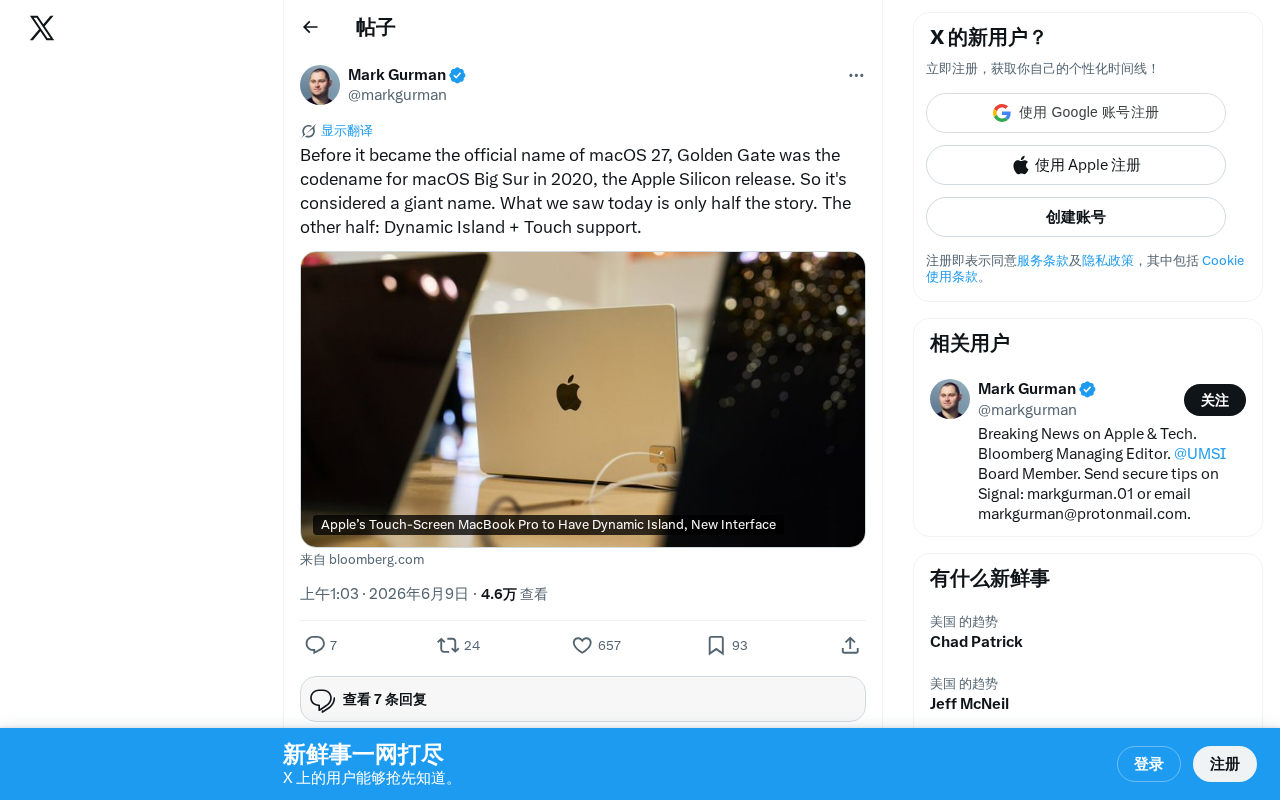
macOS 27 "Golden Gate" revives a historic codename, hinting at touch support and Dynamic Island for Mac.
Apple has officially named macOS 27 "Golden Gate" — a name first used internally during the 2020 Apple Silicon transition. Leakers suggest WWDC only revealed half the story, with Dynamic Island on Mac and touch support still to come. The naming choice signals a transformation on par with the Intel-to-Apple Silicon shift, with major implications for the PC industry and developer ecosystem.
Golden Gate: A Five-Year Journey from Codename to Official Name
In Apple's naming history, few names have undergone such a dramatic transformation. According to well-known leakers, "Golden Gate" was used as early as 2020 as the internal development codename for macOS Big Sur — the historic moment when Apple transitioned from Intel to its custom Apple Silicon chips.
Five years later, Apple has officially named macOS 27 "Golden Gate." This is far from a random choice. Internally at Apple, Golden Gate was considered a "giant name" — one that was originally tied to Apple's most significant architectural transition. Now elevated to an official product name, it signals that this version of macOS carries equally transformative significance.
What We've Seen Is Only the Tip of the Iceberg
The most striking line from the leak is: "What we saw today is only half the story."
This implies that the macOS Golden Gate features Apple showcased at WWDC may represent only a portion of the full release. According to the leaked information, the other half of the story includes two blockbuster features:
Dynamic Island Comes to Mac
Since the iPhone 14 Pro, Dynamic Island has become an iconic element of the iOS interaction experience. Bringing this feature to macOS signals Apple's continued effort to unify its cross-platform interaction language.
On the Mac, Dynamic Island could appear as a reimagined element in the menu bar or notification center, offering real-time activity tracking, background task visualization, and more. This would represent a major paradigm shift in macOS interaction design, giving the desktop system the same information presentation approach found on mobile.
Touch Support: The Final Piece of the Mac Puzzle
Even more disruptive is the addition of touch support. For years, Apple maintained that "Mac doesn't need a touchscreen." The late Steve Jobs even publicly stated that using touch on a vertical screen would make "your arm want to fall off."
However, as iPad and Mac continue to converge at both the hardware and software levels, that line has become increasingly blurred. Apple Silicon's unified architecture already makes it possible to run iPad apps on Mac, and touch support would complete this experience loop. This also explains why Apple chose "Golden Gate" — a name once synonymous with architectural transformation — because touch support may be the biggest platform shift for the Mac since Apple Silicon itself.
Why Golden Gate Is a "Giant Name"
From a naming strategy perspective, Apple's choice of Golden Gate carries multiple layers of meaning:
Historical symbolism: The Golden Gate Bridge is an iconic engineering marvel connecting two sides of San Francisco, symbolizing "bridging" and "connection." This perfectly mirrors the mission macOS Golden Gate may serve — bridging touch and traditional desktop interaction, bridging the experience gap between Mac and iPhone/iPad.
Continuation of internal prestige: As the codename for the Apple Silicon transition period in 2020, Golden Gate was already synonymous with "epoch-defining change" within Apple. Promoting it from codename to official name is Apple's highest endorsement of this version's importance.
Geographic and cultural identity: The Golden Gate Bridge sits in the San Francisco Bay Area, home to Apple's headquarters. The name carries deep emotional significance tied to Apple's roots.
Potential Industry Impact
If Dynamic Island and touch support ultimately land in macOS Golden Gate, the impact will extend far beyond Apple's ecosystem:
- Reshaping the PC competitive landscape: Microsoft's Surface lineup has long used touch-plus-desktop fusion as a key selling point. Apple's entry would directly challenge this differentiator.
- Developer ecosystem transformation: Touch support means Mac app interaction design will need to be rethought, sparking a new wave of app adaptation.
- Hardware lineup adjustments: The arrival of touch-enabled Macs could further blur the line between MacBook and iPad Pro positioning, forcing Apple to redefine the boundaries between these two product lines.
Final Thoughts
From internal codename in 2020 to official product name, Golden Gate has come full circle over five years. During that time, Apple Silicon completely transformed the Mac's performance landscape. Now, Golden Gate's return as an official version name signals that another transformation of equal magnitude is brewing.
Just like the bridge that spans the Golden Gate Strait, macOS Golden Gate may become the critical link between the Mac's past and its future. What we've seen today truly is only half the story — and the other half may be the part that truly changes the game.
Related articles

GPT-5.6 Pro Hands-On Review: In-Depth Evaluation of Game Development, 3D Modeling, and SVG Design Capabilities
Comprehensive hands-on review of GPT-5.6 Pro covering SVG vector design, 3D modeling, game generation, and image-to-web conversion. Detailed analysis of breakthroughs in spatial understanding, code reasoning, and One-Shot generation.
Claude Code Source Leak Revealed: The 5-Step AI Coding Agent Mechanism & Practical Pitfall Guide
Deep dive into Claude Code's leaked source revealing the 5-step AI coding Agent mechanism: progressive disclosure, precise indexing, surgical edits, auto-verification & graceful termination.

Deep Dive into the 198-Page Codex Chinese Manual: A Complete Guide from Beginner to Advanced
Deep breakdown of ByteDance's internal 198-page Codex Chinese manual covering installation, Commands, MCP workflows, Skills templates, multi-Agent collaboration, and background task scheduling.