Major Shakeup in Apple's Vision Product Line: Vision Air Canceled, AR Glasses Delayed to Late 2027
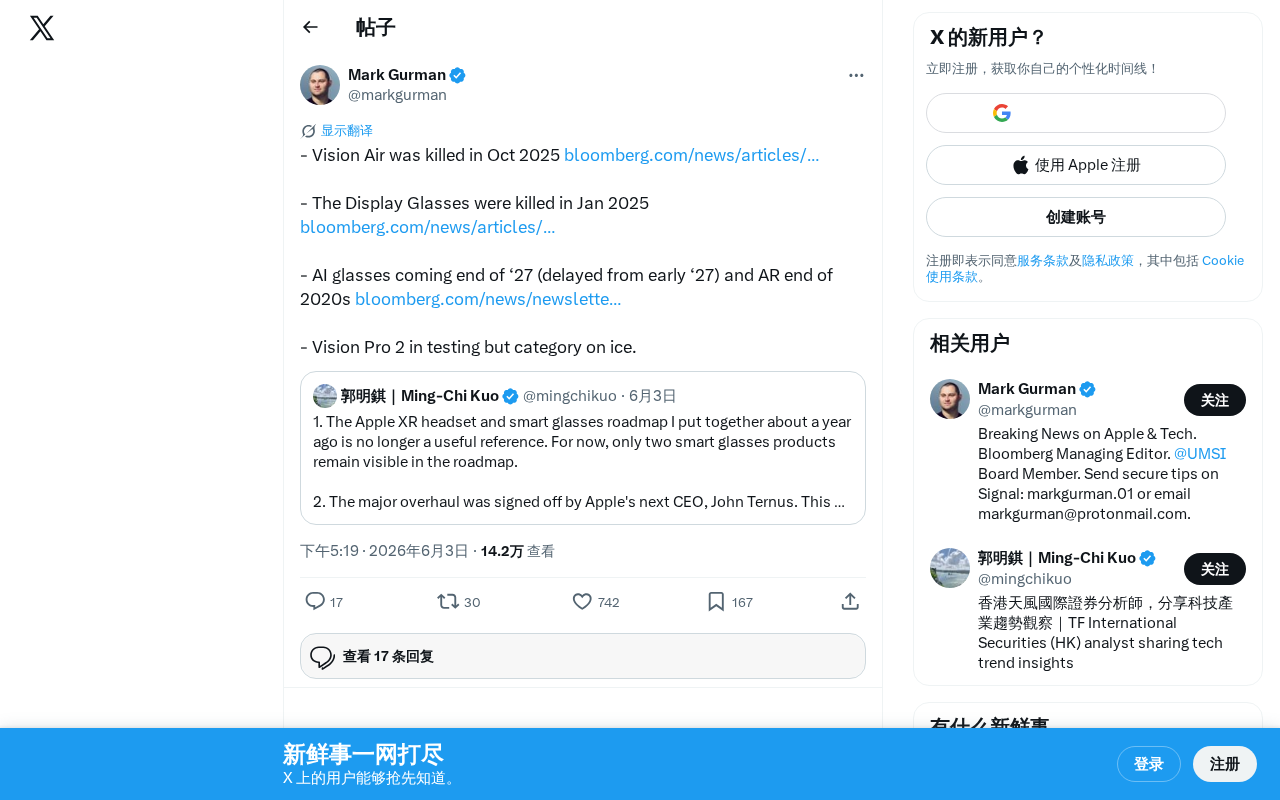
Apple cancels Vision Air, delays AI glasses to late 2027 and AR glasses to 2029 in major spatial computing shakeup.
Apple is dramatically restructuring its Vision product line, canceling both Vision Air (October 2025) and Display Glasses (January 2025). AI glasses are delayed from early to late 2027, while true AR glasses won't arrive until around 2029. Vision Pro 2 remains in testing but the category is frozen, reflecting market underperformance, unresolved technical bottlenecks, and a strategic pivot toward AI capabilities.
Apple's Spatial Computing Strategy Suffers Major Setback
Recent tech leaks reveal that Apple is undertaking a massive restructuring of its Vision product line. Multiple devices already in development have been canceled, while the highly anticipated AI glasses and AR glasses face delays. The entire spatial computing category appears to have been "frozen." These developments indicate that Apple's XR strategy is undergoing a profound reassessment.
Spatial Computing refers to a computing paradigm that merges digital information with physical space, allowing users to naturally interact with virtual content in three-dimensional environments. This concept encompasses multiple technology forms including VR (Virtual Reality), AR (Augmented Reality), and MR (Mixed Reality). When Apple launched Vision Pro in 2023, it deliberately avoided traditional "VR/AR" labels, instead using "spatial computing" to define its product vision — attempting to position it as the next-generation general computing platform after Mac, iPhone, and iPad, rather than a mere entertainment device. Now this grand vision is facing a harsh reality check.
Vision Air and Display Glasses Both Canceled
According to leaked information, two important products Apple had planned to launch have been canceled:
- Vision Air: Officially killed in October 2025. This device was previously believed to be a lighter, lower-priced version of Vision Pro, aimed at lowering the entry barrier to spatial computing.
- Display Glasses: Canceled even earlier, in January 2025. This product was positioned as a simple display output device, similar to extending an iPhone or Mac screen into an eyeglass form factor.
The successive cancellation of both products means Apple won't have any new headset or glasses products hitting the market in the near term. Vision Pro will remain the only product for sale in this category for a considerable period.
AI Glasses Delayed, AR Glasses Nowhere in Sight
While canceling existing projects, Apple has retained two future product lines, though the timelines for both are far from optimistic:
- Apple AI Glasses: Originally planned for early 2027, now delayed to late 2027. This product may be similar to Meta's Ray-Ban smart glasses collaboration, focusing on AI assistant functionality rather than immersive visual experiences.
- Apple AR Glasses: Truly lightweight glasses with augmented reality display capabilities are currently not expected until around 2029.
Looking at the timeline, Apple needs at least 2 to 4 more years before it can deliver another consumer-grade product in the wearable display space — a remarkably slow pace for a category that has already consumed billions of dollars in R&D investment.
Vision Pro 2 Still in Testing but Category Frozen
Another notable signal is that while Vision Pro 2 is still undergoing internal testing, the entire category has been put "on ice." This means Apple hasn't completely abandoned its iteration plans but hasn't provided a clear release timeline either.
This state likely reflects several real-world issues:
-
Market feedback below expectations: Vision Pro's $3,499 price tag severely limited its user base, making it difficult for the ecosystem to achieve a positive feedback loop. According to industry analysts, Vision Pro shipped approximately 500,000-600,000 units throughout 2024 — far below the millions of units Apple typically expects in the first year of a new product category. By comparison, Meta Quest 3 is priced at just $499, a 7x price difference. While the high price ensures profit margins, it severely constrains developer willingness to invest — without a sufficient user base, developers lack the economic incentive to build dedicated apps for the platform, creating a vicious cycle of "no content - no users - no developers."
-
Technical bottlenecks remain unbroken: The supply chain technology needed to dramatically reduce cost and weight while maintaining experience quality is not yet mature. Current XR headset technical bottlenecks are concentrated in several areas: Micro-OLED and Micro-LED display technology must achieve high resolution in extremely small areas (Vision Pro uses Sony's custom Micro-OLED panels with single-eye resolution exceeding 4K), with extremely high costs and limited yields; Pancake lenses, while thinner than traditional Fresnel lenses, still have significant volume and weight; the high computational density of the M2+R1 dual-chip architecture creates thermal management challenges, requiring an external battery pack; and the integration precision requirements of eye tracking, hand gesture recognition, and other sensors pose enormous miniaturization challenges. Solving these problems requires coordinated breakthroughs across the entire supply chain — not something Apple can accelerate unilaterally.
-
Strategic priority shift: Apple may be redirecting more resources toward building foundational AI capabilities, creating technical reserves for future AI glasses products. The launch of Apple Intelligence at WWDC 2024 marked a clear strategic pivot. Amid the large language model and generative AI wave, Apple needs to concentrate its limited top engineering resources on on-device model optimization, Private Cloud Compute architecture, and cross-device AI experience integration. "Freezing" the spatial computing category may be a pragmatic resource allocation decision: rather than forcing out experience-compromised products under current technical conditions, it's better to wait for AI capabilities to mature and use them as the core differentiator for AI glasses.
Industry Implications: The Reality vs. Ideal of Spatial Computing
Apple's series of adjustments actually confirms the common dilemma facing the entire XR industry. Even Apple, with its top-tier supply chain integration capabilities and abundant cash flow, cannot solve the core challenges of headset weight, battery life, and content ecosystem in the short term.
Meanwhile, Meta has chosen a distinctly different path — entering the market first through Ray-Ban smart glasses in a lightweight form factor combining AI with cameras, then gradually layering in display capabilities. The second-generation smart glasses produced through Meta's collaboration with eyewear brand Ray-Ban (owned by EssilorLuxottica) weigh only about 50 grams, look virtually identical to regular sunglasses, and integrate cameras, microphones, speakers, and Meta AI assistant — but have no display screen whatsoever. This product achieved surprising market success, reportedly selling over a million units. Meta's strategy is to first get users accustomed to wearing smart glasses, establish usage habits and AI interaction patterns, then gradually add micro-displays in subsequent iterations to ultimately achieve a complete AR experience. This "light first, heavy later" incremental approach avoids the weight, battery life, and cost problems that come with trying to do everything at once.
Apple's decision to release AI glasses before AR glasses represents, to some degree, a convergence toward this incremental approach. This creates an interesting contrast with Apple's historical product strategy — Apple typically prefers to deliver a complete experience in one shot when technology is mature (like the original iPhone), but in spatial computing, reality has forced it to accept a step-by-step path.
The future of spatial computing may still be worth anticipating, but the road to get there is longer than anyone expected. For developers and consumers, there won't be any major new products from Apple in this space until at least 2027. And when Apple finally returns to market with AI glasses, the competitive landscape may have already been profoundly reshaped by first movers like Meta and Google.
Key Takeaways
Related articles

Claude Code for Test Development in Practice: An AI Programming Workflow That Doubles Your Efficiency
A practical guide to Claude Code for test development: auto-generating test scripts, Plan Mode workflows, MCP + Playwright integration, and Subagent parallel tasks to build systematic AI-assisted workflows.

Hermes Agent Hands-On Review: An AI Efficiency Revolution for Indie Game Developers
Indie game developer reviews Hermes Agent vs OpenClaude: intelligent context compression, real-time Memory, remote control via Telegram, and practical use cases in game dev, social media, and email.

Vibe Coding Beginner's Guide: Tool Selection Across Three Categories with Practical Examples
A comprehensive guide to Vibe Coding's three tool categories: Agent frameworks, CLI Coding, and IDE tools, with practical examples including Snake game and data analysis workbench.