Making Games from Scratch with Claude Code: A Wild Snake + Shooter Mashup
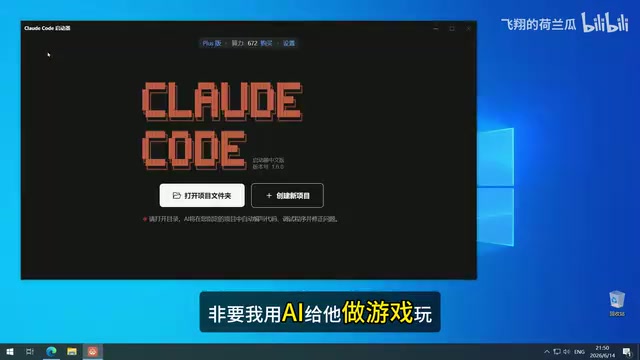
Zero-code game dev with Claude Code: building a wild Snake + shoot-'em-up mashup from scratch.
A YouTuber with zero programming experience uses Claude Code to build web games entirely through voice and natural language input. Starting with a basic shoot-'em-up, he iterates into a creative Snake + shooter mashup where growing stronger makes you more vulnerable. The video demonstrates AI task scheduling, iterative development, and how creativity becomes the real differentiator when coding barriers disappear.
The Origin Story: Brother's School Network Went Down
It all started simply enough — YouTuber 荷兰瓜 (HeLanGua)'s younger brother lost internet access in the school computer lab, couldn't play online games anymore, and kept bugging his older brother for something to play. And just like that, a hands-on tutorial about building web games from scratch with Claude Code was born.
What makes this video so interesting isn't the technical complexity — it's watching someone with zero programming experience turn a wild idea into a playable game using AI coding tools. And not just any game — a mind-bending mashup of Snake and a shoot-'em-up.
Getting Started: One-Click Setup with the Claude Code Launcher
HeLanGua used the desktop version of the Claude Code launcher, which he called a "lazy person's dream." Claude Code is an AI programming tool from Anthropic, and its core positioning differs from tools like GitHub Copilot or Cursor. While those primarily offer line-level or function-level code completion within code editors, Claude Code emphasizes building complete projects through natural language conversation. Users don't need to understand code syntax — they just describe "what I want," and the AI automatically generates the full project file structure, writes the code, and debugs it. This shift from "helping you write code" to "writing code for you" represents the core direction of AI programming tool evolution.
The setup process was dead simple:
- Download the launcher: Grab it from the official site, click to open
- Create a new AI project: The launcher supports all kinds of scenarios — editing papers, writing lab reports, making games
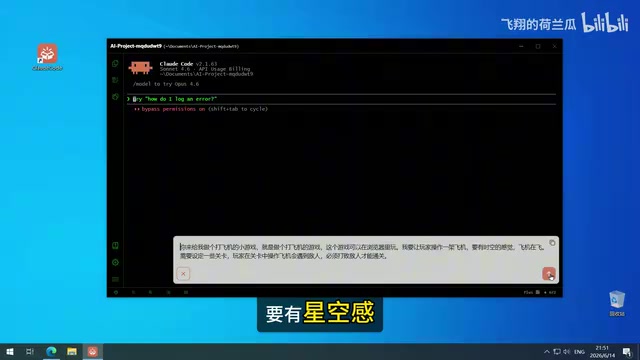
- Voice input your requirements: Click the microphone icon in the bottom right and describe what you want using voice
Here's a noteworthy tip: before sending the requirements to the AI, HeLanGua first added "common prompt snippets" from the toolbar. This relates to the core principles of Prompt Engineering. The output quality of large language models is highly dependent on the precision and structure of input instructions. These "common prompt snippets" are essentially preset system-level instructions that tell the AI to analyze requirements before executing tasks and to proactively ask users for clarification when encountering ambiguity, rather than generating code based on guesswork. It's like giving the AI a "think before you act" work habit. In practice, the difference this makes is enormous — without preset instructions, the AI tends to barrel ahead based on its own interpretation, often producing results that require extensive rework.
Version One: A Starfield Shoot-'Em-Up
HeLanGua's first request to the AI was:
"Make me a web-based shoot-'em-up game with a starfield aesthetic, with levels where you have to defeat enemies to advance."
The AI's Task Scheduling Mechanism
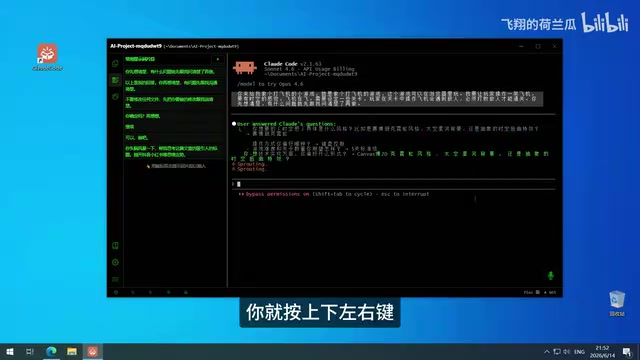
After receiving the requirements, Claude Code didn't jump straight into writing code. Instead, it displayed a refined task scheduling workflow (hardness mechanism): the AI listed out questions that needed confirmation one by one, letting the user select options using arrow keys. HeLanGua described the process as "just like picking toppings when ordering bubble tea" — make your selections, hit enter, and the AI starts planning and coding.
The design philosophy behind this mechanism deserves deeper understanding. In traditional software development, a product manager writes a detailed Product Requirements Document (PRD), developers create a technical design based on it, and only then does coding begin. Claude Code's task scheduling essentially simulates this workflow: it first breaks down vague natural language requirements into multiple specific technical decision points — such as "Should the ship move with keyboard or mouse?" "Are there boss fights between levels?" "Are bullets single-shot or spread?" — then has the user confirm each one. This "align on requirements first, then build" approach dramatically reduces rework costs caused by AI misunderstandings. For users without programming experience, these options also serve as "requirement guides," helping them crystallize vague ideas into concrete specifications.
A few minutes later, a complete web-based shoot-'em-up was ready. Just open it in a browser and play — the art style was dripping with nostalgic flash-game vibes. The reason it could "open directly in a browser" is that the entire game was built on a pure front-end tech stack — HTML5 provides the page structure, CSS handles visual styling, JavaScript manages game logic, and the core rendering relies on the HTML5 Canvas API. Canvas is a powerful 2D drawing interface introduced in HTML5 that allows developers to draw graphics frame by frame, handle collision detection, and create animations through JavaScript — perfect for building lightweight 2D games. Web games require no software installation and don't depend on backend servers, making them an ideal practice scenario for AI programming — generated code can be previewed instantly with an extremely short feedback loop.
Version Two: The Wild Evolution of Snake × Shoot-'Em-Up
After building the basic version, HeLanGua decided his brother needed more of a challenge, and the real creative fun began. He gave Claude Code an incredibly inventive follow-up request:
"Add Snake into this. When the ship destroys enemies, they drop power-ups that get automatically attracted to the ship, and then the ship grows a tail segment. The more you collect, the longer the tail gets. Whether it's the ship or the tail, getting hit by bullets costs a life."
This design cleverly fused the core mechanics of two classic games:
- Shoot-'em-up combat mechanics: Control a ship to dodge bullet patterns and destroy enemies
- Snake growth mechanics: Eating power-ups makes your body longer, but harder to maneuver
- The core contradiction: The stronger you get (longer tail), the easier you die (larger hitbox for bullet patterns)
From a game design perspective, this "risk scales with reward" mechanism isn't uncommon in classic games. For example, in Vampire Survivors, the stronger your character becomes, the higher the enemy density on screen; Celeste's strawberry collection system follows a similar "high risk, high reward" logic. But what makes the "Snake + shoot-'em-up" combo interesting is that it directly binds the punishment mechanism of "increasing collision volume" to "kill rewards." Players must make real-time trade-offs between "pursuing higher scores" and "maintaining survivability" — giving a simple little game unexpected strategic depth.

From the actual gameplay footage, the mashup worked surprisingly well. HeLanGua kept exclaiming during his playtest: "I'm growing a tail!" "My tail!" "I'm making my tail stand up!" — the tail swayed following the ship's movement trajectory, and dodging bullets while accounting for the tail's position sent the difficulty through the roof. Technically speaking, the tail-following effect typically uses a "trajectory recording" algorithm: the program continuously records the ship's coordinates each frame, and each tail segment follows the position of the segment ahead of it with a delay of several frames, creating a visual effect similar to a snake's slithering body. Additionally, each tail segment needs independent collision detection, meaning the longer the tail, the more collision calculations are needed per frame — a significant test of the logical rigor of AI-generated code.
Key Takeaways from Making Games with Claude Code
1. The Zero-Experience Barrier Is Truly Disappearing
Throughout the entire process, HeLanGua didn't write a single line of code. He interacted with the AI entirely through natural language (and even voice). From requirement description to finished game, the core time investment was just a few minutes. This shows that Claude Code has become quite mature in understanding complex game logic.
This "natural language programming" capability didn't appear overnight. Looking at the evolution of AI programming tools: in 2021, GitHub Copilot first brought AI code completion into the mainstream developer spotlight, but it was essentially still "a programmer's assistant" — users needed to understand code context to use it effectively. Starting in 2023, large language models like ChatGPT and Claude began supporting generation of complete code files, but users typically had to manually copy-paste, debug, and run the code. With this generation of products like Claude Code, the AI can not only generate code but also automatically create files, manage project structures, and even execute terminal commands — the entire development workflow is encapsulated in a single conversation. This means the very definition of "programming" is being rewritten: it's no longer "communicating with computers in programming languages" but "telling AI what you want in human language."
2. Iterative Development Works Better
Build a basic version first, confirm it runs, then add creative requirements — this incremental development approach works exceptionally well with AI-assisted programming. Describing overly complex requirements all at once tends to make the AI "go off track," while step-by-step iteration produces better results.
There are deep technical reasons behind this insight. Although the context window of large language models keeps expanding, models still tend to experience "attention dilution" when processing extremely long and complex instructions — meaning their focus on certain details in the requirements decreases, leading to omissions or misunderstandings. The benefit of step-by-step iteration is that the complexity of each conversation round stays manageable, allowing the AI to concentrate its "attention" on the current task. Meanwhile, code generated in the previous round becomes the contextual foundation for the next, enabling the AI to make incremental modifications on existing code rather than re-understanding the entire project from scratch. This aligns perfectly with the philosophy of Agile Development in software engineering — small steps, fast validation, continuous iteration.
3. Creativity Is the Real Competitive Advantage
Once the technical barrier drops, what truly sets people apart is creativity. The "Snake + shoot-'em-up" concept itself is inherently fun, and the contradictory design where getting stronger makes you more fragile gives the game unique strategic depth. As HeLanGua put it: "As long as your imagination is big enough, AI is ready to go all out."
Conclusion: AI Programming Brings Ideas to Life in Minutes
While this video was lighthearted and entertaining, it showcased an important trend in AI programming tools: the shift from "assisting programmers" to "replacing the programming process." For non-technical users, tools like Claude Code are compressing the distance from "idea to product" down to just minutes.
The implications of this trend extend far beyond "making a little game to entertain your brother." On a broader level, it's giving rise to an entirely new class of creators — they might be designers, teachers, product managers, or even middle school students. They have ideas but lack programming skills, and AI programming tools are becoming their gateway to "technological equity." Gartner predicts that by 2028, 75% of enterprise software engineers will use AI code assistants, and in the realm of individual developers and non-technical creators, this adoption rate may arrive even faster. When "knowing how to code" is no longer the bottleneck for bringing ideas to life, the truly scarce resource becomes imagination itself.
Of course, these tools are currently best suited for small projects and prototype validation. But for quickly realizing creative ideas, building teaching demos, or even keeping your little brother entertained — they're more than enough.
Related articles
Anjney Midha: The Rise from Singapore to Helm of a16z's AI Investment Empire
Deep dive into Anjney Midha, the key figure behind a16z's AMP fund, covering investments in Anthropic, Mistral, and Black Forest Labs, and his Outputmaxxing philosophy.
Pi: A Lightweight AI Coding Agent Framework — Setup & Hands-On Guide
A deep dive into Pi, a minimalist AI coding Agent framework covering multi-model support, extensions, skill loading, and hands-on custom extension building with model mixing strategies.

Why the Mayor of Los Angeles Has No Real Power: A City Designed to Be the Anti-New York
Why does LA's mayor seem powerless during crises like wildfires? It's not about competence — it's a century-old system designed to prevent corruption by radically decentralizing power.