MCP vs Function Calling: Core Differences and Selection Guide
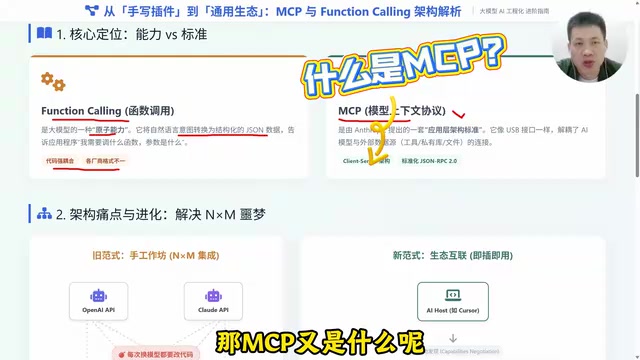
MCP standardizes AI tool integration as a protocol; Function Calling is just an atomic model capability.
This article explores the fundamental differences between MCP (Model Context Protocol) and Function Calling. While Function Calling lets LLMs express intent via structured JSON, it suffers from tight coupling and the N×M integration nightmare. MCP, as a standardized protocol with Client-Host-Server architecture, offers full decoupling, three-in-one capabilities (Tools, Resources, Prompts), and enterprise-grade security through sandbox isolation. The guide helps developers choose the right approach based on their scenario.
Introduction: A Question That Puzzles Developers
Large language models can already call external tools through Function Calling — so why is the industry going through the trouble of introducing MCP (Model Context Protocol)? Isn't that redundant?
This seemingly simple question actually touches on a critical turning point in AI application development: the shift from "cottage industry" to "industrial-scale production." Today, we'll take a deep dive into the fundamental differences between MCP and Function Calling, along with their respective use cases.
Function Calling: The Model's "Intent Translator"
What It Really Is
Function Calling is essentially an atomic capability of large language models. Models can only generate text — they can't directly operate databases or send emails. Function Calling enables the model to translate a user's natural language into a standardized, machine-readable JSON instruction.
Put simply, it's the model's "mouth and hands" — allowing it to express intent and trigger external actions.
From a technical implementation perspective, Function Calling works through several key steps: developers first define available functions using JSON Schema format — specifying function names, parameter types, and descriptions — then send these definitions along with the user's message to the LLM API. During inference, the model determines whether the user's intent requires calling a function. If so, instead of returning a natural language response, the model returns a structured JSON object containing the function name and corresponding parameters. The application layer then parses this JSON, executes the actual function call, retrieves the result, and passes it back to the model to generate the final natural language response. This capability was first officially introduced by OpenAI in June 2023 with the GPT-3.5/GPT-4 API update. Google's Gemini, Anthropic's Claude, and numerous open-source models subsequently implemented similar functionality, though each vendor's API format and parameter definition approach differs significantly.
The Pain Points of Function Calling
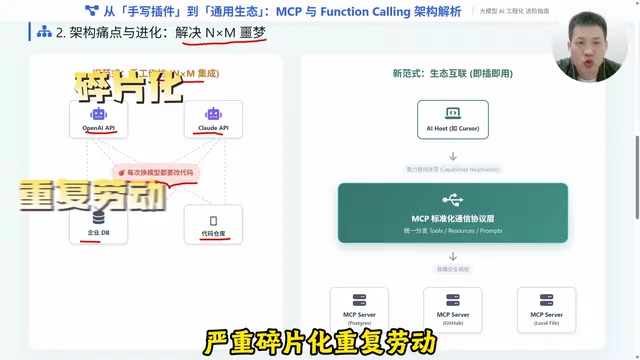
The problem is that using Function Calling requires hard-coding tool definitions in your code. Integrating with OpenAI requires one format, switching to Claude requires another, and moving to Gemini means rewriting again. This is a classic tight coupling problem.
Even more critical is the so-called "N×M nightmare": there are N large models on the market (OpenAI, Claude, Gemini, various open-source models) and M tools (databases, GitHub, Slack, local file systems). Under the Function Calling paradigm, if you want every model to call every tool, you theoretically need to write N×M pieces of adapter code.
This problem is nothing new in software engineering — it's essentially the classic "integration complexity explosion" problem. In enterprise IT history, similar dilemmas have appeared repeatedly: early database connections required dedicated drivers for each database type, a problem that wasn't resolved until ODBC/JDBC standards emerged; the web services domain similarly evolved from proprietary RPC protocols to standardized REST/GraphQL. Introducing an intermediate abstraction layer to reduce N×M complexity to N+M is a time-tested strategy in software architecture design. However, in the AI tool-calling domain, because LLM vendors iterate extremely fast and the tool ecosystem is growing explosively, this integration pain is dramatically amplified — a mid-sized AI application might need to interface with 3-5 models and 10-20 external tools simultaneously, making the cost of manually maintaining dozens of adapter codebases unacceptably high.
This cottage-industry approach to development is clearly unsustainable in today's AI application boom.
MCP Protocol: The "USB Port" of the AI World
From Capability to Architecture
MCP (Model Context Protocol) is no longer just a capability — it's a standardized architecture. It defines how model clients and servers communicate, fully standardizing the question of "how to call tools."
Here's a helpful analogy: before USB ports existed, connecting a mouse, keyboard, or printer each required a dedicated interface. With USB, one port handles everything. That's exactly what MCP does — it provides a unified "interface standard" for AI tool calling.
The MCP protocol was officially released and open-sourced by Anthropic in November 2024, with the design goal of becoming a universal connection standard between AI applications and external data sources/tools. At the protocol level, MCP is built on the JSON-RPC 2.0 specification — a lightweight remote procedure call protocol that uses JSON to encode requests and responses, supporting both request-response and one-way notification communication patterns. At the transport layer, MCP provides two primary communication methods: stdio (standard input/output) is suited for local inter-process communication, offering fast startup and low latency, making it ideal for desktop application scenarios (such as Cursor and Claude Desktop); HTTP + SSE (Server-Sent Events) is suited for remote service deployment, supporting cross-network access and better fitting enterprise and cloud scenarios. This layered design allows MCP to run lightweight locally while scaling flexibly in distributed environments.
MCP's Client-Host-Server Architecture
MCP adopts a Client-Host-Server architecture. Developers only need to write a single, universal MCP Server (for example, a service connecting to a PostgreSQL database), and any application that supports the MCP protocol — whether it's Cursor, Claude Desktop, or Windsurf — can directly "plug in" and use it without any redundant development.
Specifically, each of the three layers has clearly defined responsibilities. The Host is the application the user directly interacts with — such as Claude Desktop, Cursor IDE, or any AI application with MCP integration — responsible for managing the entire session lifecycle, enforcing security policies, and coordinating the work of multiple Clients. The Client is created and managed internally by the Host; each Client establishes a one-to-one connection with a specific MCP Server, handling protocol-level message exchange and capability negotiation — when a connection is established, the Client and Server exchange their supported protocol versions and capability lists, a process called "Capability Negotiation." The Server is the service process that actually exposes tools, resources, and prompts; it can be a local script connecting to a database or a microservice deployed in the cloud. The elegance of this layered design lies in the fact that a single Host can simultaneously connect to multiple Servers (e.g., a GitHub Server, a database Server, and a file system Server), while each Server can be reused by multiple different Hosts, truly achieving flexible many-to-many composition.
This means: write once, run everywhere.
Three Fundamental Differences Between MCP and Function Calling
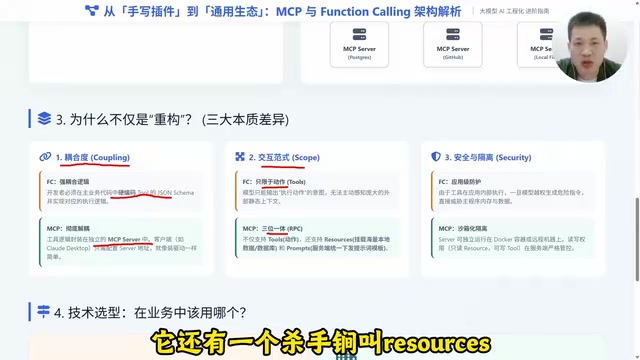
Difference 1: Degree of Coupling
Function Calling "welds" tool logic into your business code. Want to add a new tool? Stop the service, modify the code, update the Schema.
MCP, on the other hand, is fully decoupled: Servers run independently, and Hosts discover them dynamically. This plug-and-play flexibility is the standard for industrial-grade development.
Difference 2: Interaction Breadth — MCP's Three-in-One Capability
Many people assume MCP can only call tools. In reality, MCP delivers a three-in-one capability:
- Tools: Execute actions — this is the part that overlaps with Function Calling
- Resources: Mount static context. For example, tens of thousands of lines of code or massive PDF documents are difficult for Function Calling to handle directly, but MCP's Resource mechanism lets the model subscribe to and load context on demand, like reading from an external hard drive
- Prompts: The server can distribute standardized prompt templates, making prompt management standardized as well
The Resources mechanism is particularly elegant in its design. Each resource is addressed via a URI (Uniform Resource Identifier) — for example, file:///workspace/src/main.py represents a local file, and postgres://database/users/schema represents a database table schema. Resources come in two types: Direct Resources are proactively exposed by the Server, and Clients can directly list and read them; Resource Templates are dynamic URI templates that support parameterized queries — for instance, github://repos/{owner}/{repo}/issues can dynamically fetch issue lists for different repositories. More importantly, Resources support a subscription mechanism — Clients can subscribe to change notifications for a resource, and when the content changes (e.g., a database record is updated or a file is modified), the Server proactively pushes updates, allowing the model to refresh its context accordingly. This capability transforms LLMs from "one-time read, static inference" to continuously sensing changes in external data.
The Prompts mechanism addresses another long-standing developer pain point: fragmented prompt management. In traditional development, prompts are often scattered across various parts of the codebase, making unified maintenance and version control difficult. MCP allows the Server to define standardized Prompt templates — including name, description, parameter list, and template content — which Clients can dynamically discover and invoke. For example, a code review MCP Server could provide a Prompt template named code_review that accepts a programming language and code snippet as parameters and returns a carefully crafted review prompt. This transforms prompt management from "everyone for themselves" to "centralized governance."
The combination of these three dimensions gives MCP a capability boundary that far exceeds Function Calling.
Difference 3: Security Architecture
In enterprise applications, security is paramount.
With Function Calling, tool logic executes inside the application. Once the model generates a dangerous instruction, the defense chain is very short.
MCP, with its Server architecture, can be deployed in Docker containers or remote sandboxes, configured with strict read-only permissions, and even isolated at the network layer. This defense-in-depth is difficult to achieve with native Function Calling.
This security design philosophy aligns closely with the Zero Trust Architecture prevalent in enterprise security today. The core principle of Zero Trust is "never trust, always verify" — never default to trusting a request just because it originates from the internal network; every access must undergo identity verification and permission checks. MCP's Server architecture naturally supports this model: each MCP Server can independently set access control policies — for example, a database Server only opens read-only query permissions, a file system Server restricts access to specific directories, and an API Server requires secondary confirmation for sensitive operations. By deploying Servers in Docker containers, you can also leverage container Namespace Isolation and resource limitation (cgroups) mechanisms to ensure that even if a Server is maliciously exploited, the attack surface is strictly confined within the container boundary, without affecting the host system or other services. Additionally, the MCP protocol emphasizes the Human-in-the-Loop principle by design — for high-risk operations (such as deleting data or executing system commands), the Host application should request explicit user authorization before execution, rather than letting the model make autonomous decisions. This adds a critical human review layer to the security defense.
How to Choose: Let the Scenario Decide
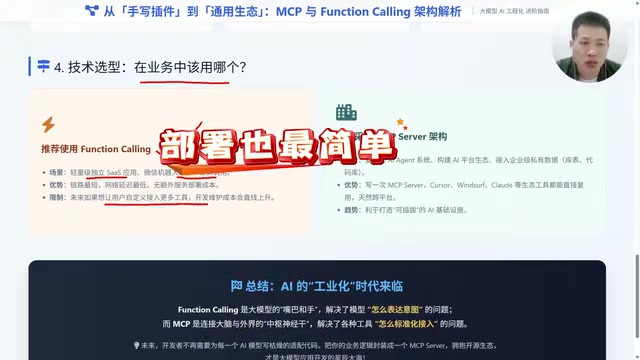
Scenarios Where Function Calling Is the Better Fit
- Simple SaaS applications with a fixed set of tools
- Lightweight chatbots (e.g., WeChat bots)
- Scenarios extremely sensitive to latency
Reason: shorter call chain, no additional protocol overhead, simpler deployment. There's no need to set up an entire MCP service for a simple API call.
Scenarios Where MCP Is the Better Fit
- Building complex AI Agent systems
- Tools that need to be shared across different AI platforms (Cursor, Windsurf, Claude)
- Integrating with enterprise internal private databases and code repositories
- Prioritizing ecosystem reusability and long-term maintainability
It's worth noting that AI Agents are rapidly evolving from simple "dialogue-response" patterns into complex systems involving multi-step, multi-tool collaboration. Modern AI Agents often need to chain multiple tools in a single task — for example, first querying a database for user information, then calling an internal API to generate a report, and finally sending the result via an email service. In such scenarios, Agents need a unified protocol to discover, negotiate, and invoke various heterogeneous tools, rather than hard-coding call logic for each one. MCP is precisely the infrastructure built for these complex collaboration scenarios. As Agent frameworks like LangChain, AutoGen, and CrewAI have announced support for or plans to integrate the MCP protocol, MCP is becoming the "connectivity layer standard" of the AI Agent ecosystem. Looking ahead, AI Agent development will increasingly resemble building with blocks — developers select the tool modules they need from the MCP Server ecosystem, assemble them into complete agent systems via the standard protocol, rather than writing every integration from scratch.
Summary: From Cottage Industry to Industrial Production
| Dimension | Function Calling | MCP Protocol |
|---|---|---|
| Essence | Atomic capability | Standard protocol |
| Coupling | Tight coupling | Fully decoupled |
| Interaction scope | Tool calling | Tools + Resources + Prompts |
| Security | In-app execution | Sandbox isolation |
| Use case | Simple applications | Complex Agent systems |
In one sentence: Function Calling solves the problem of "how the model expresses intent," while MCP solves the problem of "how tools are standardized for integration."
The former is the mouth and hands; the latter is the central nervous system and universal interface. From hand-written plugins to a universal protocol — this is the critical step in LLM application development's leap from cottage industry to industrial production.
In the future, developers may no longer need to write tedious adapter logic for each model. Instead, they'll simply publish individual MCP Servers, letting the AI ecosystem connect like building blocks. This isn't redundant — it's the inevitable direction of evolution.
Related articles
Claude Code Installation Guide & The Five Stages of AI Programming Tools Explained
Complete Claude Code installation guide with the five stages of AI programming tools, from manual coding to agents. Learn 0-to-1 project building and 1-to-100 iteration challenges.
Enterprise-Level AI Project Rules Files: 5 Hard Rules + 6 Writing Techniques
AI keeps messing up your code? Learn 5 hard rules and 6 writing techniques for enterprise-level Rules files in Claude Code, Cursor & more, with templates.
Building Cloud Computing Clusters from Old Phones: Google and UCSD Explore a New Path to Sustainable Computing
Google and UCSD explore building cloud clusters from old phones, leveraging ARM chip efficiency to cut e-waste and data center carbon footprints.