MCP vs Skills: Understanding the Key to AI Testing Efficiency

MCP is the connection protocol; Skills are the capability modules — together they enable full AI test automation.
This article explains the fundamental differences between MCP (Model Context Protocol) and Skills in AI-driven testing. MCP acts as a standardized communication layer (like a USB port) connecting AI to external tools, while Skills are encapsulated functional modules (like apps) that perform specific testing tasks. Together, they enable end-to-end automated testing workflows from test case generation to report creation.
As AI tools become increasingly prevalent, the concepts of MCP and Skills frequently appear in the field of view of developers and test engineers. Many people tend to confuse them, but in reality, they solve problems at completely different levels. This article uses accessible analogies and practical application scenarios to help you thoroughly understand the differences between MCP and Skills, and how they work together.
What is MCP? The "USB Port" Between AI and External Tools
MCP, short for Model Context Protocol, is essentially a standardized communication protocol that solves the problem of "how AI communicates with external tools."
MCP was officially proposed and open-sourced by Anthropic in late 2024, with its design inspired by the Language Server Protocol (LSP). LSP defines a standard communication method between editors and language services, enabling any editor to support intelligent code completion, navigation, and other features for any programming language. MCP migrates this approach to the AI domain: defining a standard interaction method between large language models and external tools and data sources. In terms of technical implementation, MCP adopts a client-server architecture where AI applications serve as MCP clients, external tools expose their capabilities through MCP servers, and communication is based on the JSON-RPC 2.0 protocol, supporting both local inter-process communication (stdio) and remote HTTP communication (SSE/Streamable HTTP) as transport methods.
The most intuitive analogy is a USB port. Whether you're using a flash drive, external hard drive, or phone, it works as soon as you plug it into the USB port because all devices follow the same standard. MCP works exactly the same way — whether you're using Selenium, Postman, or Jenkins, as long as the tool supports the MCP protocol, AI can call it directly.
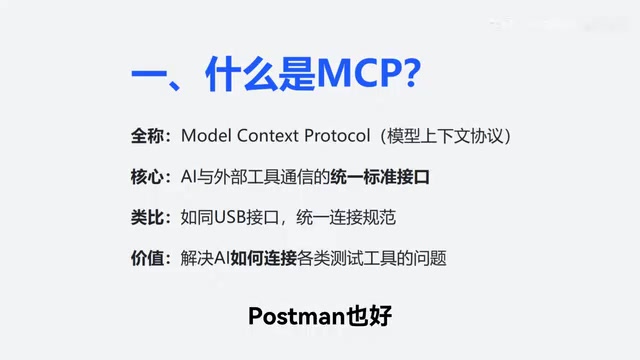
This is the core value of MCP: It doesn't care what specific work gets done — it's only responsible for opening up the pathway. Before MCP emerged, the industry commonly used the Function Calling mechanism proposed by OpenAI. However, Function Calling is a vendor-specific implementation where different model providers have different interface definitions, meaning developers needed to write a dedicated set of adapter code for every new tool integration, creating an N×M complexity problem. With the MCP protocol, all tool integration methods are unified, reducing integration complexity from N×M to N+M and significantly lowering integration costs.
What are Skills? The "App Store" of the AI Era
Skills are independent functional modules that encapsulate AI capabilities, with each module dedicated to handling one specific task.
The concept of Skills was first widely used in the smart assistant domain — for example, Amazon Alexa's Skills Kit allows third-party developers to create independent functional modules for the voice assistant. In the AI Agent domain, Skills typically refer to predefined and encapsulated capability units that include clear input/output specifications, execution logic, and error handling mechanisms. Unlike simple prompt templates, Skills often contain multi-step workflow orchestration that may involve multiple model calls, tool invocations, and conditional logic. Current mainstream AI Agent frameworks like LangChain, AutoGen, and CrewAI all provide similar capability encapsulation mechanisms — they just use different names: some call them Tools, others call them Actions, and still others call them Chains.
Common Skills modules include:
- Test Case Generation Skill: Automatically generates test cases based on requirement documents
- Test Report Generation Skill: Aggregates test results and outputs structured reports
- Test Data Preparation Skill: Automatically constructs various types of data needed for testing
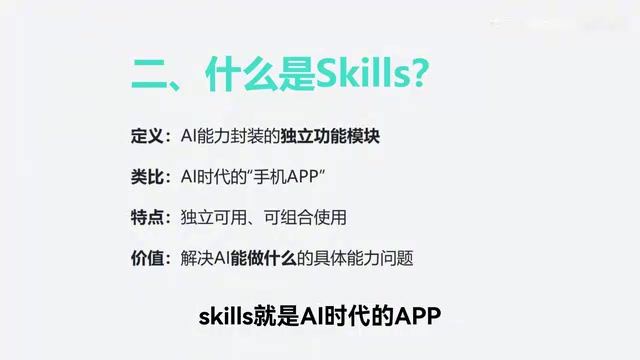
You can think of Skills as apps on your phone — each app has its own independent functionality, can be used individually, or combined to accomplish more complex tasks. Skills are the apps of the AI era, solving the problem of "what AI can do for you." In the testing domain, the value of Skills lies in solidifying the experience and methodologies of senior test engineers into reusable modules, enabling every team member to leverage AI for expert-level testing capabilities.
The Core Difference Between MCP and Skills: Pipeline vs Tool
After understanding their respective definitions, the difference can be summarized in one sentence:
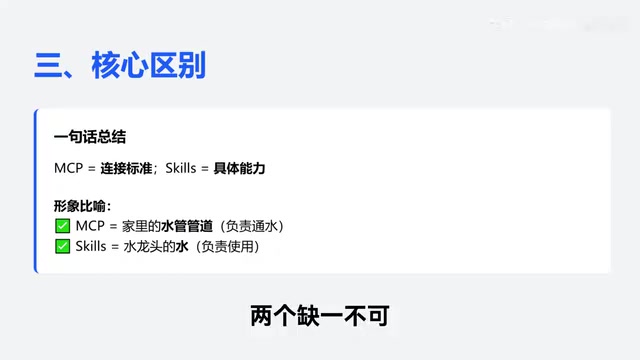
MCP is the pipeline, Skills are the tools. The pipeline handles connections; the tools do the work.
More vividly, MCP is like the plumbing in your house, and Skills are like the faucets. The plumbing brings water from the source into your home, and the faucets let you actually use the water. Both are indispensable — without plumbing, faucets are just decorations; without faucets, you can't use the water in the pipes.
From the overall architecture of an AI Agent, MCP and Skills correspond to two key layers in the Agent system. A typical AI Agent architecture contains four layers: the perception layer (receiving user input), the planning layer (task decomposition and decision-making), the execution layer (calling tools to complete tasks), and the memory layer (storing context and history). Skills primarily work between the planning and execution layers, decomposing complex testing tasks into executable step sequences and orchestrating their execution order. MCP works at the lowest level of the execution layer, handling actual communication with external systems. The benefit of this layered design is decoupling — when underlying tools change (e.g., migrating from Selenium to Playwright), you only need to swap the MCP Server while the Skills layer's business logic remains unchanged. Conversely, when testing strategies are adjusted (e.g., changing test case generation rules), you only need to update the Skills while the MCP layer's connection configuration stays the same.
| Dimension | MCP | Skills |
|---|---|---|
| Problem Solved | How to connect | What can be done |
| Essence | Communication protocol/standard | Functional module/capability encapsulation |
| Analogy | USB port, plumbing | Apps, faucets |
| Focus | Tool integration and invocation | Specific task execution |
| Architecture Layer | Low-level communication in execution layer | Orchestration between planning and execution layers |
| Change Impact | Modified when tools are replaced | Modified when business strategies are adjusted |
Practical Applications in Testing: How MCP and Skills Work Together
With the theory covered, let's look at how MCP and Skills collaborate in the daily work of test engineers.
MCP Application Scenarios in Testing
MCP primarily serves as the "connector" in testing, with typical scenarios including:
-
Connecting Automation Testing Tools: AI calls tools like Selenium and Playwright through the MCP protocol to directly operate browsers for UI testing, eliminating the need to manually write tedious driver code. Selenium is a veteran tool in web automation testing, born in 2004, interacting with browsers through the WebDriver protocol with an extremely mature ecosystem. Playwright is a next-generation framework released by Microsoft in 2020, natively supporting Chromium, Firefox, and WebKit browser engines, with built-in modern features like auto-waiting and network interception, offering significant improvements in execution speed and stability. In the MCP ecosystem, both already have corresponding MCP Server implementations — for example, the Playwright MCP Server allows AI to directly control browsers through natural language commands to perform page navigation, element interaction, screenshot verification, and other operations.
-
Integrating with CI/CD Systems: AI connects to continuous integration platforms like Jenkins and GitHub Actions through MCP, enabling automated deployment and triggering/monitoring of test pipelines. Jenkins, as the most widely used open-source CI/CD tool, defines complete build, test, and deployment processes through Pipeline scripts; GitHub Actions is GitHub's native CI/CD solution that defines workflows in YAML files with deep integration into code repositories. In traditional mode, test engineers need to manually write Pipeline scripts to orchestrate test tasks. Through the MCP protocol, AI can directly interact with CI/CD platforms — querying build status, triggering specific pipelines, retrieving test execution logs, analyzing failure causes — accomplishing with natural language commands what previously required logging into multiple platforms and performing multiple manual steps.
-
Connecting to Test Management Platforms: AI connects to project management tools like Jira through MCP to automatically update test status and synchronize defect information, reducing manual operations.
Skills Application Scenarios in Testing
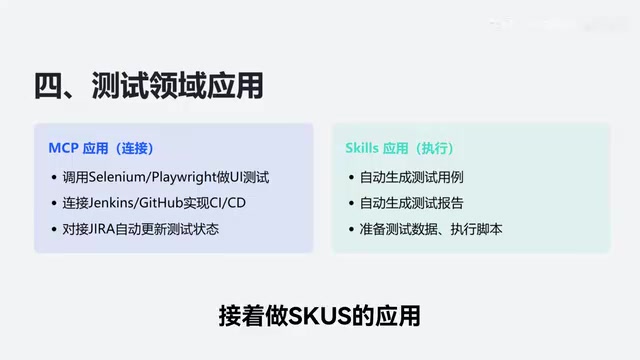
Building on the connection channels established by MCP, Skills handle specific testing tasks:
-
Automatic Test Case Generation: Analyzes requirement documents or API definitions to intelligently generate test cases covering various scenarios.
-
Test Report Generation: Aggregates results from multiple test rounds and automatically generates reports containing key metrics like pass rates and defect distribution.
-
Test Data Preparation: Automatically constructs boundary values, exception values, and other test data based on test scenarios. This involves classic software testing methodologies — Boundary Value Analysis is based on an empirical rule that software defects tend to concentrate near the boundaries of input domains. For example, for an input field accepting integers from 1-100, boundary value testing focuses on verifying values like 0, 1, 2, 99, 100, and 101. Equivalence Partitioning divides the input domain into several equivalence classes, taking one representative value from each class for testing to reduce the number of test cases while maintaining coverage. AI-driven test data preparation skills can automatically analyze parameter constraints in API definitions (such as types, ranges, regular expressions, etc.), apply these classic methodologies to automatically generate test datasets covering normal values, boundary values, and exception values, and can even combine historical defect data for intelligent recommendations to generate more targeted test data.
-
Test Script Execution: Schedules and runs automated test scripts while collecting execution results.
MCP and Skills Collaboration Workflow Example
A complete AI-assisted automated testing workflow might look like this:
- The "Test Case Generation Skill" in Skills automatically generates cases based on requirements
- MCP synchronizes the cases to management platforms like Jira
- The "Test Data Preparation Skill" in Skills constructs the required data
- MCP calls Selenium to execute automated tests
- The "Test Report Generation Skill" in Skills aggregates results and outputs a report
- MCP writes the report and defect information back to the management platform
Throughout this process, MCP and Skills alternate in coordination, forming a complete automated testing chain. This alternating collaboration pattern is a typical manifestation of layered design in AI Agent architecture: Skills handle business logic orchestration and decision-making at the upper layer, MCP handles standardized communication with external systems at the lower layer, each performing its own role in loosely-coupled collaboration.
Final Thoughts
For test engineers, understanding the difference between MCP and Skills is not just a conceptual upgrade but a practical efficiency breakthrough. The MCP protocol lowers the barrier to tool integration, Skills encapsulate reusable testing capabilities, and together they enable AI to truly evolve from a "chat assistant" to a "testing partner."
As more testing tools begin supporting the MCP protocol and the Skills ecosystem continues to grow, AI applications in software testing will move from point-specific assistance to full-process automation. It's worth noting that the MCP protocol has already gained support from mainstream development tool vendors including Microsoft, JetBrains, and Cursor, and the number of MCP Servers in the open-source community is growing rapidly, covering databases, cloud services, development tools, and many other domains. For test engineers, now is the perfect time to embrace this transformation — not only learning to use existing Skills, but also developing the ability to customize Skills based on your team's actual needs, while staying informed about MCP ecosystem developments to promptly incorporate new tool connections into your testing workflow.
Related articles

6 Practical Prompt Techniques to 10x the Quality of AI Responses
6 proven prompt techniques — role-playing, deep questioning, adversarial critique, failure pre-mortem, reverse engineering, and dual-version explanation — to dramatically improve AI output quality.

KV Cache Saves 20x on Costs: The Underlying Principles and Practical Tips for LLM Inference Optimization
Deep dive into how KV Cache reduces LLM API costs by 20x. From Transformer attention matrix multiplication overhead to prompt caching best practices, understand the fundamentals of AI inference cost optimization.
Complete Guide to Connecting Codex with DeepSeek: Low-Cost AI Programming with Codex++
Learn how to connect DeepSeek to Codex using the open-source tool Codex++. Complete setup guide covering provider config, connection testing, and launch steps to slash AI coding costs.