Nemotron 3 Ultra Arrives on Perplexity: How Strong Is NVIDIA's Open-Source Model?
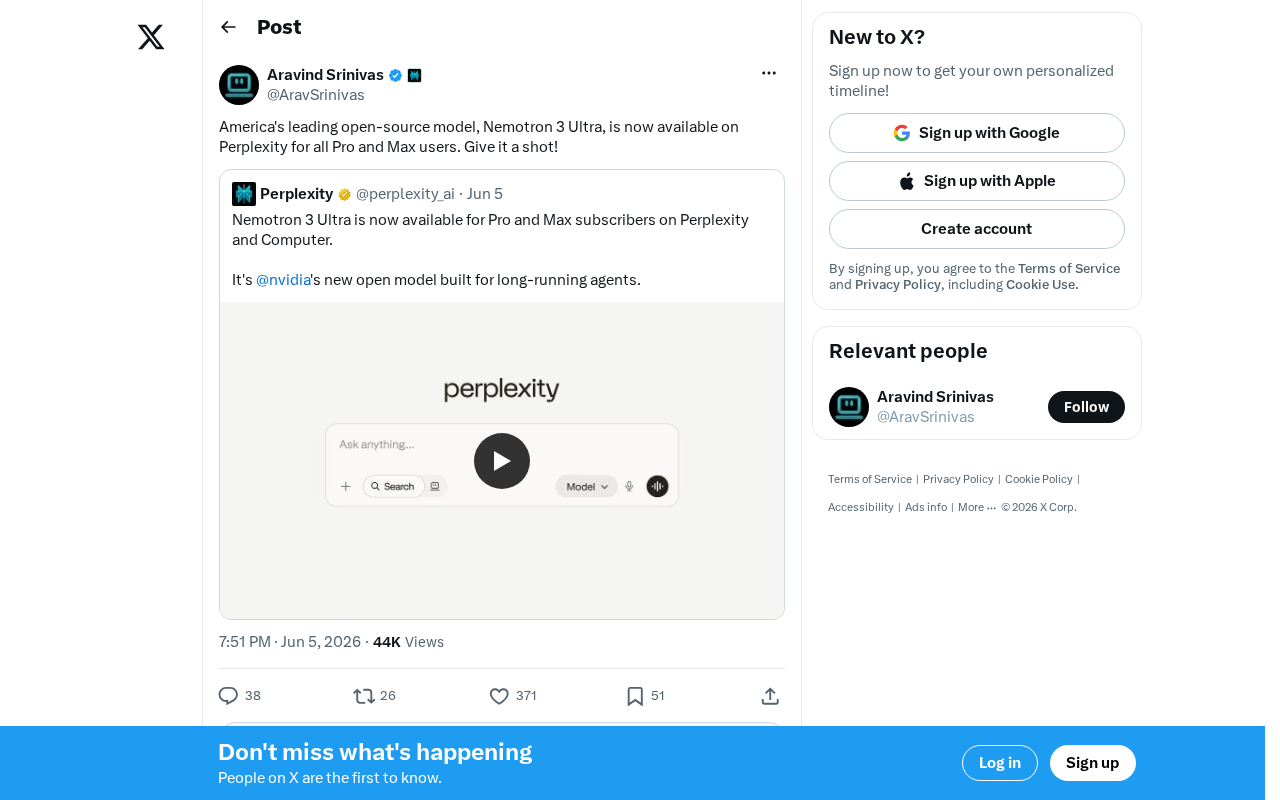
NVIDIA's Nemotron 3 Ultra open-source model goes live on Perplexity for Pro and Max subscribers.
NVIDIA's flagship open-source model Nemotron 3 Ultra is now available on Perplexity's AI search platform for Pro and Max users. The model leverages NVIDIA's Megatron-LM and NeMo toolkit for deep hardware-software optimization. This launch highlights Perplexity's model aggregation strategy, the geopolitical framing of American open-source AI, and an emerging commercialization model where infrastructure providers, platforms, and users all benefit.
NVIDIA's Open-Source Model Nemotron 3 Ultra Officially Launches on Perplexity
Perplexity recently announced that NVIDIA's open-source large language model Nemotron 3 Ultra is now live on its platform, available to all Pro and Max subscribers. This marks another step in the penetration of top-tier open-source models into mainstream AI search products, giving users access to yet another high-quality model option.
In its announcement, Perplexity described Nemotron 3 Ultra as "America's leading open-source model" — a positioning that carries significant weight. It's not just an endorsement of the model's capabilities but also an implicit emphasis on "American open-source strength" amid the current AI geopolitical landscape. This framing is closely tied to the competitive dynamics in the AI space: since 2024, Chinese open-source models like DeepSeek and Alibaba's Qwen have performed impressively on multiple benchmarks, sparking debates about whether the US is losing its leadership in open-source AI. The US government has also been considering export controls on advanced AI models. Against this backdrop, highlighting the "American identity" of NVIDIA's model serves as both a marketing strategy and a reflection of the industry's anxieties around technological sovereignty.
Technical Breakdown of Nemotron 3 Ultra: NVIDIA's Open-Source Ambitions
Background and Positioning
Nemotron 3 Ultra is NVIDIA's high-performance open-source large language model and the flagship of the Nemotron series. As the undisputed leader in AI compute infrastructure, NVIDIA has been making aggressive moves in the model layer in recent years. The Nemotron series represents NVIDIA's strategic shift from "selling shovels" to a full-stack play of "shovels plus gold mines."
Architecturally, the Nemotron series is built on the Transformer framework, but NVIDIA deeply integrates its proprietary Megatron-LM distributed training framework and NeMo toolkit throughout the training process. Megatron-LM is specifically designed for large-scale parallel model training, supporting flexible combinations of tensor parallelism, pipeline parallelism, and data parallelism. This enables NVIDIA to efficiently train models with massive parameter counts across thousands of GPUs. NeMo provides a complete workflow from data preprocessing to model fine-tuning, lowering the deployment barrier for enterprise users. This deep hardware-software co-optimization during training is a key technical differentiator for the Nemotron series compared to other open-source models.
Compared to well-known open-source models like Meta's Llama series and Mistral, Nemotron 3 Ultra's core advantage lies in NVIDIA's deep control over training infrastructure and optimization toolchains. Leveraging its own GPU clusters and the natural advantages of the CUDA ecosystem, NVIDIA can achieve more granular optimization of both training efficiency and inference performance.
Why Nemotron 3 Ultra Deserves Attention
The competitive landscape for open-source models is evolving rapidly. Meta's Llama 3 series and DeepSeek have already demonstrated that open-source models can approach or even match proprietary commercial models on many tasks. Nemotron 3 Ultra's entry further enriches this ecosystem:
- Diversified options: Users are no longer limited to a handful of models and can choose the best open-source solution based on specific task requirements
- Competition drives progress: More top-tier players entering the field will accelerate overall improvements in open-source model quality
- Ecosystem synergy: The combination of NVIDIA's hardware advantages and model capabilities could spawn more efficient deployment solutions
It's worth noting that the concept of "open-source" in AI differs subtly from traditional software open source. Different models adopt different licensing agreements: Meta's Llama series uses a custom Llama Community License with monthly active user limits for commercial use; Mistral uses the Apache 2.0 license with minimal restrictions; and NVIDIA's open-source models typically use the NVIDIA Open Model License, which permits commercial use but includes specific terms. These licensing differences directly impact enterprise selection decisions and downstream application compliance — users should pay attention to the specific terms when adopting these models.
Perplexity's Model Aggregation Strategy: Why Integrate Rather Than Build In-House
As a star product in the AI search space, Perplexity has consistently pursued a "model aggregation" strategy — rather than betting on a single model, the platform continuously integrates the best models available for users to choose from. Previously, Perplexity already supported Claude, GPT-4o, Llama, and several other models.
Understanding this strategy requires knowledge of Perplexity's underlying technical architecture. Founded in 2022 by former OpenAI researcher Aravind Srinivas, Perplexity's core product is an AI search engine that combines large language models with real-time web retrieval. Unlike traditional search engines, Perplexity employs a RAG (Retrieval-Augmented Generation) architecture — it first retrieves relevant web information through search engines, then feeds those results as context into a large language model for summarization and answering. This architecture leverages both the reasoning capabilities of LLMs and ensures information timeliness and traceability. Because its core competitive advantage lies in the retrieval and orchestration layer rather than the model itself, aggregating multiple models becomes a natural strategy for Perplexity.
The introduction of Nemotron 3 Ultra continues this approach. For Pro and Max users, this means they can directly compare the performance of different models within the same search and conversation interface, finding the tool that best fits their needs. This "model marketplace" positioning helps Perplexity maintain a unique differentiating advantage in the fiercely competitive AI product landscape.
Commercialization Paths for Open-Source Models: A Multi-Party Win-Win Value Chain
It's worth considering that while Nemotron 3 Ultra is an open-source model, reaching users through commercial platforms like Perplexity creates a clear value chain:
- NVIDIA promotes its hardware ecosystem through open-source models, strengthening its full-pipeline influence from training to inference
- Perplexity enhances product competitiveness through a rich model selection, attracting paying subscribers
- Users gain convenient access to more high-quality models without needing to deploy them independently
This multi-party win-win model may become one of the dominant paradigms for open-source AI model commercialization in the future.
Conclusion: The Open-Source AI Ecosystem Is Maturing Fast
Nemotron 3 Ultra's arrival on Perplexity might appear to be a routine model integration on the surface, but it reflects the accelerating maturation of the open-source AI ecosystem. When infrastructure giants like NVIDIA begin seriously competing in the open-source model space, the dynamics of the entire industry shift accordingly. For everyday users, the most immediate benefit is straightforward — there are more and more high-quality AI tools to choose from.
Related articles

Compile First: Using AI to Revive the Dormant Files on Your Hard Drive
Explore how the open-source LLM Wiki project uses a compile-first paradigm to turn dormant local files into a searchable AI knowledge base, compared with traditional RAG approaches.

Replicating Slay the Spire with AI and Zero Code: A Complete Walkthrough from Architecture to Art
A Bilibili creator used Godot and AI tools to replicate Slay the Spire with zero hand-written code. Full walkthrough of architecture-first AI coding and batch art generation.
Claude Generates 10 Web Games from One-Line Prompts: Zero-Code AI Programming in Action
Use Claude Code to generate 10 web games like 2048, Gomoku, and Tetris from one-line prompts — zero manual coding. A full walkthrough of AI programming in practice.