New Siri Mac Experience: Earning Rave Reviews Even at the Beta 1 Stage
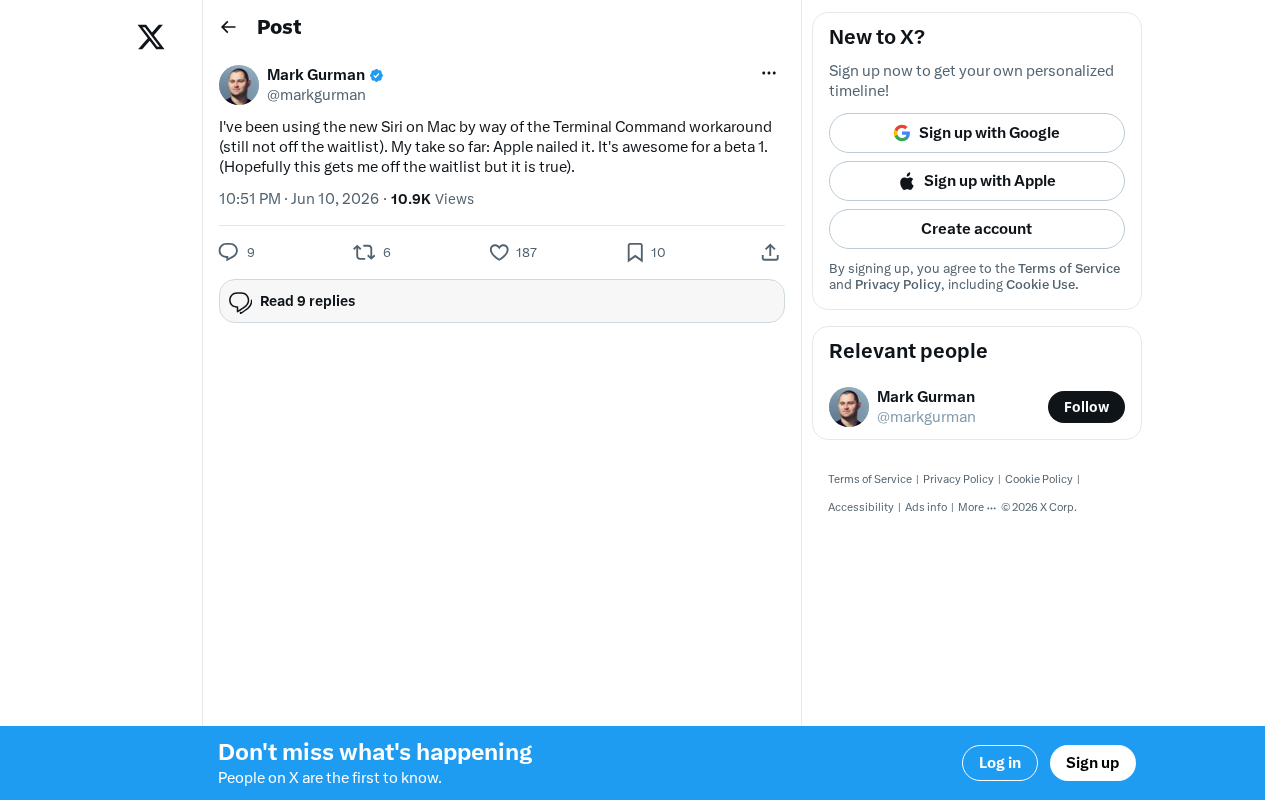
New Siri on Mac earns "Apple nailed it" praise even at the Beta 1 stage.
A tech user bypassed Apple's waitlist using a Terminal command to try the new Siri on Mac early. Despite being only at the Beta 1 stage, the experience earned rave reviews and a verdict of "Apple nailed it." The new Siri shows major improvements in natural language understanding, system integration, and contextual awareness — signaling Apple Intelligence is on track to transform Apple's AI capabilities.
Early Access to the New Siri via Terminal Command
Recently, a tech user shared on Twitter his experience of bypassing the waitlist to try the new Siri on Mac early using a Terminal Command. Terminal is macOS's built-in command-line interface tool that allows users to interact directly with the operating system's underlying layers through text commands, bypassing the limitations of the graphical user interface. In macOS, many system-level features can be enabled or disabled by modifying the system preferences plist files using the defaults write command — a technique frequently used by developers and power users to activate hidden or experimental features. In this case, the user most likely modified a system feature flag to tell the system that the device had been approved through the waitlist, thereby bypassing the server-side access check.
Although he hadn't received an official waitlist approval notification, that didn't stop him from giving the new Siri an extremely positive review.
His core takeaway was summed up in a single sentence: "Apple nailed it."
Impressive Even at the Beta 1 Stage
What makes this particularly interesting is that the user was only experiencing the Beta 1 version — the very earliest test build of the new Siri. In Apple's software release pipeline, versions typically progress through Internal Build → Developer Preview → Public Beta → Release Candidate → General Release. Beta 1 is the earliest public test version available to developers, usually months away from the official release. Looking at iOS history, the gap between a WWDC Beta 1 launch and the fall general release typically spans 8–10 beta iterations.
In the software development cycle, Beta 1 usually means incomplete features, numerous bugs, and a rough experience. Yet even at this early stage, the new Siri has already earned an "awesome" rating. When a product receives positive feedback at the Beta 1 stage, it signals that the underlying architecture and core experience are already quite solid, with subsequent iterations mainly focused on bug fixes and detail refinements — an undeniably encouraging sign.
A Critical Step in Apple's AI Strategy
For a long time, Siri has been considered Apple's weak spot in the AI race. Traditional Siri was built on an Intent Classification architecture, where every user utterance needed to be mapped to a predefined intent category before it could be executed. This meant Siri could only handle command patterns that engineers had designed in advance. In contrast, assistants based on large language models like ChatGPT use a generative architecture capable of understanding open-ended natural language and flexibly combining capabilities. Compared to competitors like ChatGPT and Google Assistant, Siri had noticeable gaps in natural language understanding, contextual conversation ability, and task execution flexibility.
Apple's Apple Intelligence strategy announced at WWDC has the thorough reinvention of Siri's capabilities as one of its core objectives. Apple Intelligence is the AI strategy framework Apple unveiled at WWDC 2024, built around a three-tier design philosophy: an on-device model (approximately 3 billion parameters) handles simple tasks and protects privacy-sensitive data; Private Cloud Compute (cloud-based inference powered by Apple's custom silicon, where data is never stored or exposed to Apple) processes more complex requests; and third-party model integration (such as ChatGPT) tackles the most demanding tasks. This layered architecture ensures both privacy protection and the ability to call upon more powerful model capabilities when needed.
As the user interaction gateway for Apple Intelligence, the new Siri plays the central role of understanding user intent, orchestrating system capabilities, and coordinating multi-app collaboration. Its innovation likely lies in deeply combining the comprehension capabilities of large language models with system-level APIs across the Apple ecosystem — possessing both the language understanding flexibility of an LLM and the ability to directly control device functions like traditional Siri, an advantage that purely cloud-based AI assistants struggle to achieve.
Based on this early adopter's feedback, Apple appears to be delivering on this promise. The new Siri has likely achieved qualitative leaps in several areas:
- Stronger natural language understanding: Able to handle more complex and ambiguous commands, no longer limited to predefined intent templates
- Deeper system integration: More seamless interaction with apps and system features on Mac, capable of executing complex multi-step tasks across applications
- Smarter contextual awareness: Significantly improved conversational coherence and scene understanding, with the ability to remember conversation history and resolve references
What Bypassing the Waitlist via Terminal Command Tells Us
The user mentioned that he activated the new Siri through a "Terminal Command workaround," which reveals that Apple's AI features are actually already built into the system — they're simply gated by a server-side waitlist mechanism to control the rollout pace.
This approach is extremely common in the gradual rollout of major AI features. Gradual Rollout is a standard deployment strategy for large-scale internet services, where new features are progressively opened to users in stages rather than pushed to everyone at once. A waitlist is one user-facing manifestation of this gradual rollout. Multiple technical considerations drive this mechanism: first, large language model inference requires substantial GPU compute, and server-side resources are finite; second, Apple needs to monitor model performance in real-world scenarios and collect feedback promptly; finally, in the event of serious issues, the blast radius can be quickly contained. OpenAI's ChatGPT and Google's Bard both employed similar waitlist strategies in their early days. Apple's Apple Intelligence also involves coordination between on-device models and cloud-based Private Cloud Compute, making capacity planning even more complex and necessitating a gradual user base expansion to keep server load and user experience within manageable bounds.
What This Means for Regular Users
While getting early access via Terminal commands sounds tempting, waiting for the official rollout remains the safer choice for regular users. Beta versions may have stability issues, and Apple is likely to implement extensive optimizations before the general release. Additionally, features activated through unofficial methods may not receive full server-side support, potentially resulting in a less stable experience compared to the official launch. That said, this early feedback gives us at least one more reason to look forward to the new Siri's official release.
The Future of Apple's AI Assistant
If Beta 1 has already reached an "awesome" level of quality, then with continued iteration and optimization, the official release of the new Siri could very well become one of the most transformative updates in the Apple ecosystem. Apple's longstanding strategy has been to polish products to sufficient maturity before rolling them out at scale, and this waitlist mechanism is consistent with that approach.
For the AI assistant market as a whole, Apple's entry will further intensify competition. With its massive device ecosystem (over 2 billion active devices worldwide) and commitment to privacy protection (on-device processing first, Private Cloud Compute's zero-trust architecture), Apple has the opportunity to carve out a differentiated path in the AI assistant space. Unlike Google and OpenAI's reliance on cloud-based large models, Apple's hybrid architecture may be better suited for privacy-conscious user segments while also providing basic AI capabilities in offline scenarios.
And based on the early feedback so far, this path is off to an exciting start.
Related articles

Getting Started with Claude Code: An AI Programming Tool Anyone Can Learn Quickly
A complete guide to Claude Code: installation, setup, natural language programming, CLAUDE.md configuration, real-world use cases, and pricing plans for beginners.
5 Ways to Deploy LLMs Locally: From Getting Started to Production
A complete guide to 5 local LLM deployment methods: LlamaCPP, Ollama, LM Studio, vLLM/SGLang, and MLX-LM — from personal dev to production environments.
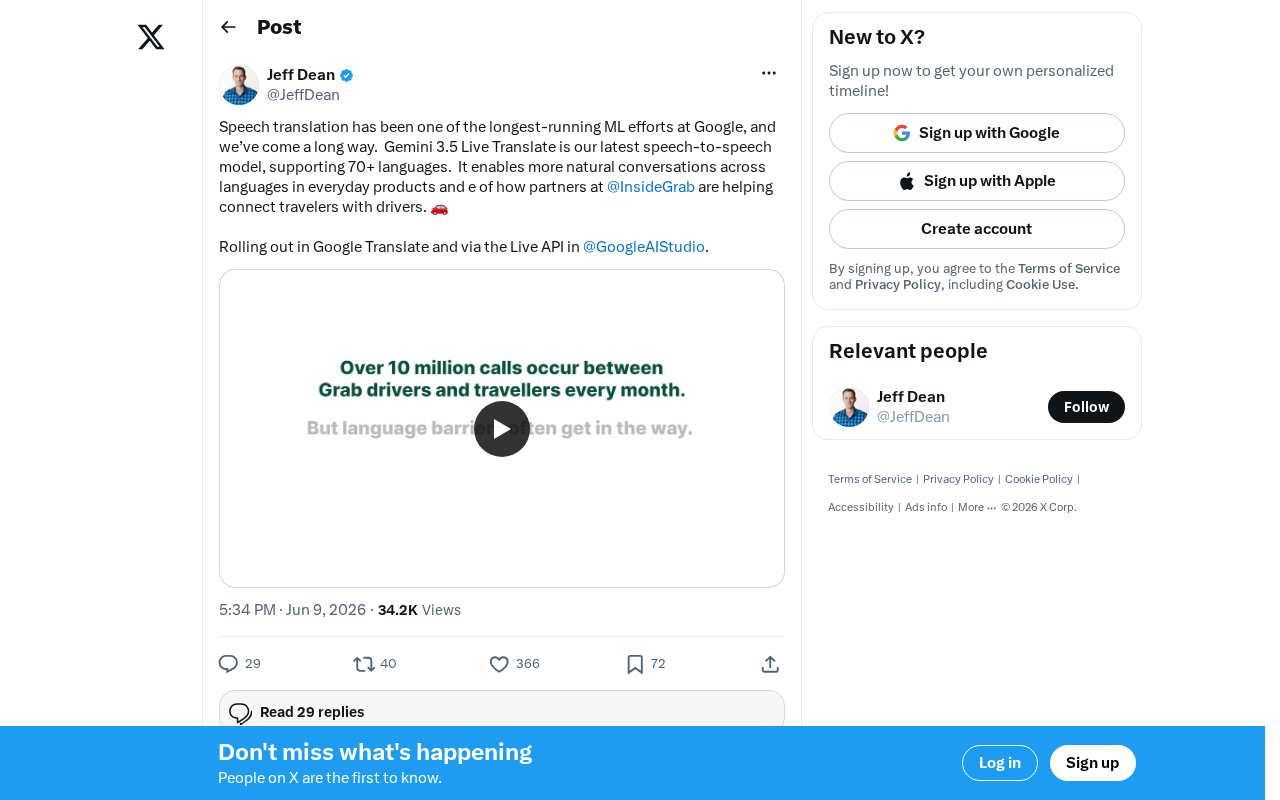
Gemini 3.5 Live Translate Launch: A Deep Dive into the Speech-to-Speech Translation Model Supporting 70+ Languages
Google launches Gemini 3.5 Live Translate, a speech-to-speech translation model supporting 70+ languages. Learn about its end-to-end architecture, Grab partnership, and developer access via Live API.