New v0 Feature: Automatically Detects Secrets in Prompts and Converts Them to Environment Variables

v0 now auto-detects secrets in prompts and converts them to environment variables for safer code generation.
Vercel's v0 AI coding tool has launched a new security feature that automatically detects API keys, tokens, and other sensitive information in user prompts, converting them into environment variables. Using pattern matching and entropy analysis, v0 intercepts secrets before they enter the code generation pipeline, embodying shift-left security principles and 12-Factor App best practices.
Overview
v0, Vercel's AI code generation tool, recently introduced a practical security feature: when users accidentally include API keys, tokens, or other sensitive information in their prompts, v0 automatically detects these secrets and converts them into environment variables, preventing the security risk of key exposure.
Why This Feature Matters
Secret Leakage Is a Common Pain Point for Developers
When using AI coding tools, developers frequently paste API keys, database connection strings, or third-party service tokens directly into their prompts. This practice poses serious security risks:
- Keys may be recorded in chat history
- Generated code may hardcode sensitive information directly
- If the code is pushed to a public repository, keys become fully exposed
According to GitHub statistics, millions of secrets are accidentally leaked through code commits every year, causing countless security incidents. The severity of secret leakage far exceeds what most people imagine. A 2023 GitGuardian report revealed that over 10 million new hardcoded secrets were detected in GitHub public repositories alone — a 67% year-over-year increase. The types of leaked secrets include cloud service credentials, database passwords, OAuth tokens, private key certificates, and more. Once secrets are obtained by malicious actors, the consequences can range from cloud resources being hijacked for cryptocurrency mining, to user data being stolen in bulk, to entire infrastructures being taken over. In Uber's major security incident in 2022, attackers achieved lateral movement precisely through hardcoded credentials found in internal code repositories. For AI coding tool scenarios, the risk is further amplified — user prompts may undergo cloud processing and logging, giving secrets a broader exposure surface than in traditional development.
Automated Security Protection
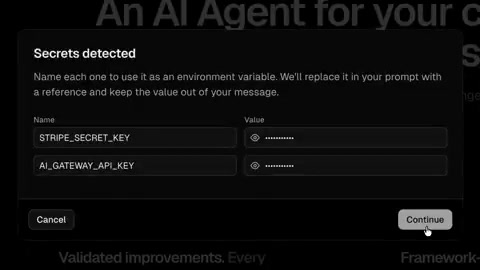
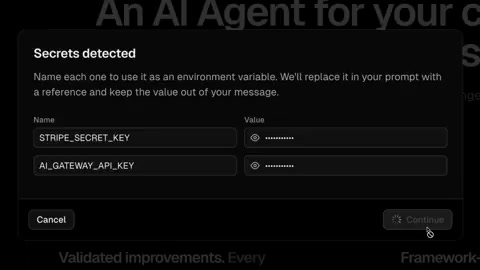
This v0 feature essentially adds a security barrier to the AI code generation workflow. Here's how it works:
- Detection Phase: When a user inputs a prompt, the system uses pattern matching to identify potential secret formats (such as OpenAI keys starting with
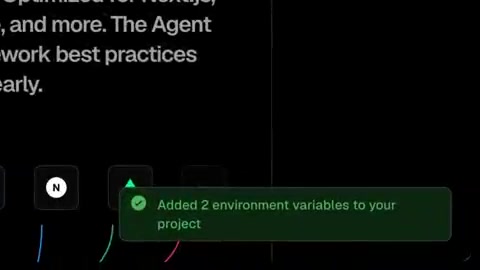
sk-, AWS Access Keys, etc.) - Conversion Phase: Detected secrets are automatically extracted and stored as project environment variables
- Reference Phase: Generated code references these variables using
process.env.XXXinstead of hardcoding them
In the detection phase, the pattern matching technology used by v0 is essentially a combination strategy based on regular expressions and heuristic rules. API keys from different service providers typically have recognizable format characteristics: OpenAI keys are prefixed with sk-, AWS Access Keys start with AKIA and are fixed at 20 characters, GitHub Personal Access Tokens start with ghp_, and Stripe keys start with sk_live_ or sk_test_. Beyond prefix matching, the system also analyzes a string's entropy — randomly generated secrets typically have very high information entropy, which differs significantly from ordinary English words or variable names. Shannon entropy calculation is a classic method in secret detection; when a string's entropy exceeds a specific threshold (typically 4.5–5.0 bits/character), there's a high probability it's a secret or token. This multi-dimensional detection strategy maintains a high recall rate while reducing false positives.
Practical Implications for Developers
Lowering the Barrier to Security Best Practices
This feature is especially friendly to beginner developers. Many newcomers building projects with AI tools don't understand environment variable best practices and tend to write keys directly into code. v0's automatic conversion mechanism is essentially a built-in security advisor that improves code security without adding usage complexity.
It's worth noting that environment variables are an OS-level key-value storage mechanism — processes read these values from the runtime environment at startup. In the Node.js ecosystem, environment variables are accessed via the process.env object; in Python, through os.environ. In practice, developers typically manage environment variables locally using .env files with the dotenv library, and add .env to .gitignore to prevent it from being committed to version control. In production environments, platforms like Vercel, AWS Lambda, and Heroku all provide dedicated environment variable management interfaces with encrypted storage and access control. As part of the Vercel ecosystem, v0 can write detected secrets directly into a Vercel project's environment variable configuration, achieving a complete closed loop from detection to deployment — a clear advantage of its platform integration.
Aligning with 12-Factor App Industry Best Practices
Separating sensitive configuration from code is one of the fundamental principles of software engineering (the 12-Factor App methodology). v0 helps developers follow this principle through automation, so generated code inherently has better security and portability.
The 12-Factor App is a set of modern web application development principles proposed by Heroku co-founder Adam Wiggins in 2011, summarizing 12 core principles for building SaaS applications. The third factor, "Config," explicitly requires storing configuration in the environment rather than hardcoding it in code. The core idea behind this principle is that code and configuration have fundamentally different change frequencies and security requirements — the same codebase should be able to run across development, testing, and production environments, adapting solely through differences in environment variables. This isn't just a security consideration; it also concerns portability and maintainability. Code that violates this principle causes serious problems in team collaboration: different developers need to modify configuration in the code to run it locally, and every deployment requires manually replacing production credentials. The 12-Factor methodology remains a cornerstone of cloud-native application development and has been widely adopted by modern infrastructure tools like Kubernetes and Docker.
Industry Trend: The Security Evolution of AI Coding Tools
The release of this feature reflects how AI coding tools are evolving from pure "code generation" toward "responsible code generation." Similar security-conscious features are appearing in other tools as well:
- GitHub Copilot has built-in filters to prevent generating known secret patterns
- AI IDEs like Cursor are also exploring similar security protection mechanisms
- Specialized tools like GitGuardian provide secret scanning services
Security protection for AI coding tools is forming a multi-layered ecosystem. At the code generation layer, GitHub Copilot uses an AI-based filtering system that can identify and block generation of content matching known leaked secrets in public code repositories, while also filtering code suggestions that might contain personally identifiable information. At the code review layer, tools like GitGuardian, TruffleHog, and detect-secrets provide pre-commit hooks and CI/CD integrations that can scan for potential secret leaks before code is committed or merged. At the runtime layer, secret management services like HashiCorp Vault and AWS Secrets Manager provide dynamic secret distribution and automatic rotation capabilities.
What makes v0 unique is that it doesn't just detect and block — it proactively completes the conversion to the "correct approach" by automatically configuring secrets as environment variables. This is a more user-friendly design philosophy. From a security perspective, this is a concrete implementation of "shift-left security" in the AI coding domain — pushing security protection forward to the user input stage, intercepting and converting secrets before they enter the code generation pipeline, rather than waiting until code review or deployment to discover the problem.
Conclusion
While this v0 update may seem like a small feature, it represents an important advancement in the security of AI development tools. As more and more non-professional developers build applications with AI tools, these kinds of built-in security protections will become increasingly critical. Going forward, we can expect more AI coding tools to automatically follow security best practices while generating code.
Key Takeaways
Related articles
Codex VS Claude Code: The Token Economics Behind a 10x Price Gap
Same coding task: Codex costs $15, Claude Code costs $155. Deep dive into the real reasons behind the 10x gap — it's not pricing, it's token volume, output style, and context strategy.
Gemma 4 Open-Source Model Local Deployment Guide: Ollama Installation & Mobile Setup
Step-by-step guide to deploying Google's Gemma 4 open-source model locally with Ollama and running the lightweight version on mobile with tool calling support.

The Decline of Tokenmaxxing: Why Selling Outcomes Matters More Than Selling Tokens
The Tokenmaxxing craze is fading as enterprise AI procurement shifts from chasing Token counts to focusing on actual business outcomes. Learn why outcome-based AI evaluation is the right approach.