Nexent Open-Source Platform: Zero-Code Auto-Generation of Production-Grade AI Agents
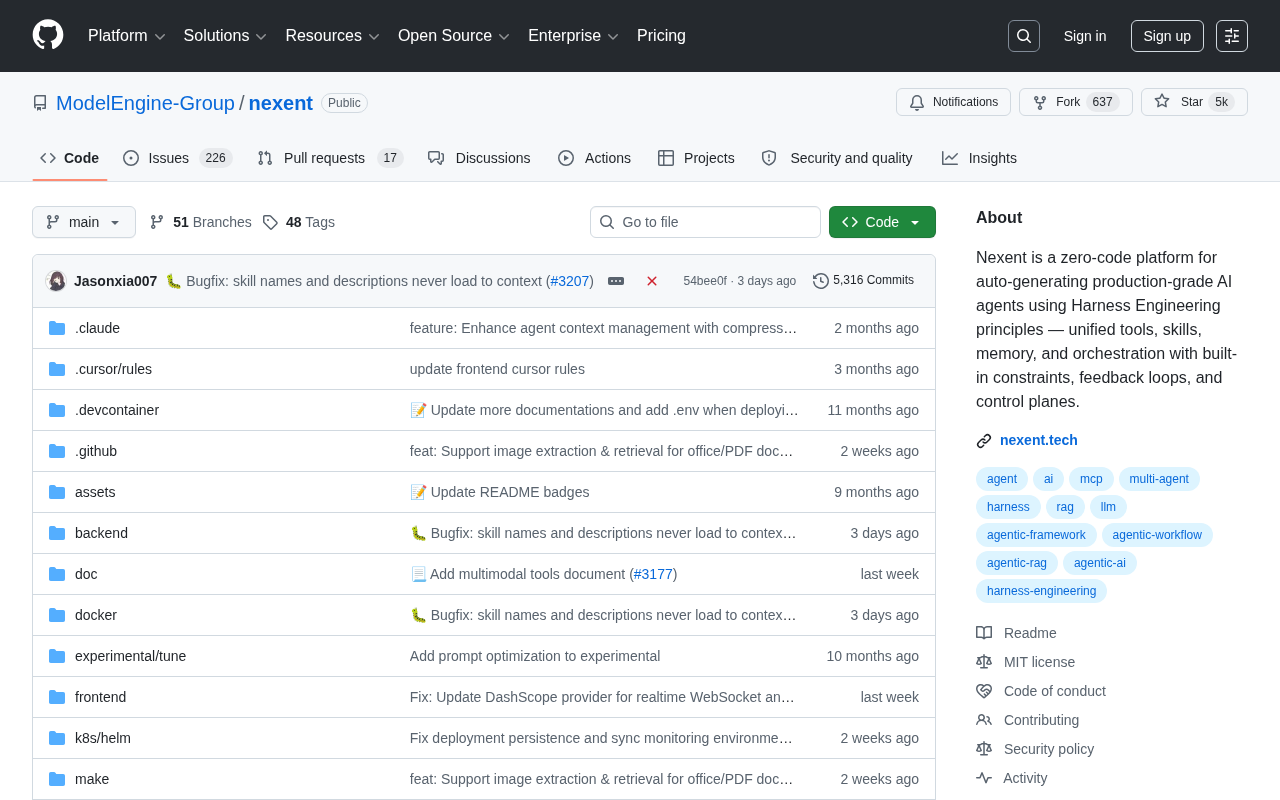
Nexent is a zero-code open-source platform that auto-generates production-grade AI Agents using Harness Engineering principles.
Nexent is an open-source zero-code platform built on Harness Engineering principles for auto-generating production-grade AI Agents. It features unified tools, a skills system, memory management, and orchestration, along with built-in constraints, feedback loops, and control planes for enterprise-level reliability. Compared to AutoGen, CrewAI, and LangGraph, Nexent uniquely combines engineering rigor with zero-code accessibility.
Project Overview
Nexent is a zero-code platform built on "Harness Engineering" principles, designed to auto-generate production-grade AI Agents. Developed by the ModelEngine-Group team, the project has already garnered nearly 5,000 Stars on GitHub, reflecting strong community demand for zero-code AI Agent development tools.
The core philosophy of the project is to simplify the AI Agent building process from complex coding work into a configurable, controllable engineering workflow, enabling developers and even non-technical users to rapidly deploy intelligent agent systems with production-level quality. "Production-grade" means the system must not only run in demo environments but also deliver high availability, observability, error recovery, and stable performance under real business workloads — precisely the qualities that most current AI Agent prototyping tools lack.
Nexent Core Architecture and Design Philosophy
Harness Engineering Principles
Nexent introduces "Harness Engineering" as an engineering methodology whose core idea is to "harness" the complexity of AI Agents through a unified framework. This concept draws from the core principles of Control Engineering: for any complex system, simply making it "work" isn't enough — the key is making it operate within predictable, constrained boundaries. In traditional software engineering, we achieve this controllability through type systems, unit tests, and CI/CD pipelines. In the AI Agent domain, however, the non-deterministic output characteristics of large language models often render traditional software quality assurance methods ineffective, necessitating an engineering framework specifically designed for AI Agent characteristics. Harness Engineering is the methodology proposed to fill this gap.
Specifically, the platform integrates the following key components:
-
Unified Tools: Provides standardized tool interfaces that allow Agents to call various external services and APIs. Technically, this involves the Function Calling mechanism — where large language models automatically select and invoke predefined external tools based on user intent. Current mainstream models like GPT-4, Claude, and Gemini all support native function calling capabilities, but their interface specifications are not unified. Nexent's unified tool layer abstracts away these differences through an adaptation layer, enabling the same set of tool definitions to seamlessly switch between different model backends — a critical capability for model migration and multi-model strategies in enterprise deployments.
-
Skills: Modularizes complex capabilities, supporting skill composition and reuse. The skills system design philosophy is similar to "service orchestration" in microservices architecture — each skill encapsulates specific business capabilities (such as data querying, document generation, code execution, etc.) and can be combined like LEGO blocks into more complex workflows. This modular design not only improves reuse rates but also allows individual skills to be independently tested and optimized.
-
Memory: Built-in context memory mechanisms ensure Agent consistency across multi-turn interactions. AI Agent memory systems are typically divided into three levels: short-term memory (corresponding to the current conversation's context window, limited by the model's token length), working memory (intermediate states and reasoning chains during current task execution), and long-term memory (cross-session persistent knowledge and user preferences, typically implemented via vector databases). Nexent's memory management module handles read/write operations across all three levels, automatically performing memory compression, retrieval, and expiration cleanup, so developers don't need to manually manage complex context window strategies.
-
Orchestration: Automated task orchestration capabilities that coordinate the execution of multiple Agents or subtasks. The orchestration engine addresses the core challenges of multi-step task decomposition and multi-Agent collaboration — when a complex task requires multiple specialized Agents to work together, determining execution order, handling dependencies, managing concurrent execution, and aggregating final results are all key challenges the orchestration engine must handle.
Built-in Control Mechanisms
Unlike many open-source Agent frameworks, Nexent places special emphasis on controllability in production environments, with three built-in control mechanisms:
-
Constraints: Sets boundaries for Agent behavior, preventing unexpected outputs or dangerous operations. This design is highly aligned with the "Guardrails" concept in the current AI Safety field. Guardrails technology sets checkpoints on both the input and output sides of the model, performing compliance validation, sensitive information filtering, and behavioral boundary detection. In enterprise scenarios, the constraint system can prevent Agents from executing unauthorized database operations, leaking sensitive customer information, or generating content that doesn't align with brand tone. Nexent's constraint system supports declarative rule definitions, allowing behavioral boundaries to be dynamically adjusted without modifying the Agent's core logic.
-
Feedback Loops: Supports runtime self-correction and continuous optimization. The feedback loop mechanism draws from closed-loop control thinking in cybernetics — every Agent output is examined by an Evaluator, and if the output doesn't meet preset quality standards or constraint conditions, the system automatically triggers retry or correction workflows. In practice, this manifests as: Agents can detect their own reasoning errors and self-correct, or gradually adjust behavioral strategies based on implicit user feedback.
-
Control Planes: Provides a unified monitoring and management interface for real-time intervention in Agent behavior. The control plane concept originates from Service Mesh in cloud-native architecture — in systems like Kubernetes, the control plane manages and configures data plane behavior. Nexent brings this concept to AI Agent management, allowing operations personnel to view Agent reasoning processes, tool call records, and token consumption in real time through the control plane, and to perform manual intervention or emergency stops when necessary.
In-Depth Analysis of Nexent's Technical Features
The Practical Significance of Zero-Code AI Agent Development
"Zero-code" holds special value in the AI Agent domain. Traditional Agent development typically requires developers to manually write prompt engineering, tool calling logic, state management, and error handling code. Nexent abstracts these steps into configurable modules, where users define Agent capabilities and behaviors declaratively, and the platform automatically generates the underlying implementation.
The core difference between Declarative Programming and Imperative Programming is that the former describes "what you want" while the latter describes "how to do it." In the AI Agent domain, a declarative approach means users only need to define what capabilities an Agent should have, what constraints to follow, and what behaviors to trigger under what conditions — without worrying about underlying prompt assembly, API call chains, exception retry strategies, and other implementation details. This elevation in abstraction level is similar to SQL for database operations or Terraform for infrastructure management — users declare the desired end state, and the system automatically plans the implementation path.
The advantages of this zero-code approach include:
- Dramatically lowering the development barrier for AI Agents, enabling non-technical roles such as product managers and business analysts to participate in Agent design and configuration
- Reducing bugs introduced by manual coding, especially boundary condition omissions and context contamination issues common in prompt engineering
- Standardized architecture that's easier to maintain and extend — when underlying models are upgraded or APIs change, only the platform's adaptation layer needs updating rather than each Agent's code
- Built-in best practices ensure that even Agents created by beginners meet basic production quality standards
Python Ecosystem Integration
The project uses Python as its primary development language, meaning it can seamlessly integrate with the rich AI/ML libraries in the Python ecosystem, including mainstream frameworks like LangChain and LlamaIndex, as well as SDKs for various large language models. Python's dominant position in the AI field enables Nexent to directly leverage tens of thousands of existing packages — from data processing (Pandas, NumPy) to machine learning (scikit-learn, PyTorch) to domain-specific libraries (financial data interfaces, scientific computing tools, etc.) — all of which can be directly integrated as Agent tools, greatly expanding the Agent's capability boundaries.
Nexent vs. Competitors: Market Positioning Analysis
The AI Agent development framework space is fiercely competitive, with projects like AutoGen, CrewAI, and LangGraph each having their own focus. Nexent's differentiated advantages include:
- Production-oriented: Not just a prototyping tool, but directly targeting production deployment scenarios
- Engineering mindset: Emphasizing constraints, feedback, and control rather than purely pursuing Agent autonomy
- Zero-code positioning: Lowering the barrier to entry and expanding the potential user base
From a technical roadmap perspective, competitors have significantly different design philosophies: AutoGen (open-sourced by Microsoft) adopts a multi-Agent conversation paradigm, emphasizing collaboration through natural language dialogue between Agents, with a design more oriented toward research and exploration; CrewAI introduces a "role-playing" mechanism, defining clear roles, goals, and backstories for each Agent, achieving task division through role-driven approaches; LangGraph (from the LangChain team) is based on a directed acyclic graph (DAG) state machine model, offering the most granular process control capabilities, but correspondingly requiring developers to have strong programming skills to define graph structures. In contrast, Nexent has chosen a unique positioning of "engineering + zero-code" — it doesn't pursue maximum flexibility or cutting-edge research capabilities, but instead focuses on making AI Agents run reliably, controllably, and maintainably in enterprise production environments.
The 635 forks indicate that a significant number of developers are already conducting secondary development or customized deployments based on the project. In open-source project health assessments, the Fork/Star ratio is approximately 12.7%, which falls within a healthy range, indicating that the project has attracted not only attention but also actual usage and contribution activity.
Nexent Use Cases
Nexent is suitable for the following scenarios:
-
Enterprises needing rapid AI assistant deployment but lacking specialized AI engineering teams: Many traditional enterprises want to leverage AI Agents to improve efficiency, but building a specialized AI engineering team is costly and hiring is difficult. Nexent's zero-code features allow existing IT teams to get started with deployment after brief training.
-
Compliance scenarios requiring strict control over Agent behavior: Regulated industries such as finance, healthcare, and legal have strict compliance requirements for AI system outputs. Nexent's constraint system and control plane ensure that Agent behavior always stays within compliance boundaries and provide complete audit logs.
-
Complex business process automation with multi-Agent collaboration: For example, multi-tier processing workflows in customer service (screening Agent → specialist consultation Agent → escalation Agent), or content production pipelines (research Agent → writing Agent → review Agent).
-
Long-running Agent systems requiring continuous iterative optimization: Thanks to the feedback loop mechanism and control plane monitoring capabilities, operations teams can continuously optimize Agent performance based on real operational data without having to redevelop from scratch each time.
Conclusion
Nexent represents the evolution of AI Agent development tools from "functional" to "user-friendly and controllable." Its Harness Engineering philosophy brings engineering best practices into the Agent development domain, making it an open-source option worth watching for teams looking to safely and efficiently deploy AI Agents in production environments.
From a broader perspective, the AI Agent field is undergoing an evolution similar to early web development: from hand-written HTML to visual website builders, from manual deployment to containerized orchestration — each elevation in abstraction level has brought an order-of-magnitude expansion of the user base. The zero-code + engineering direction that Nexent represents is likely to be one of the key driving forces behind large-scale enterprise adoption of AI Agents.
Related articles
Musk's Never Give Up Philosophy: From Near Bankruptcy to Industry Disruption
Decoding the real stories behind Musk's 'I don't ever give up' — from SpaceX's three failed launches to Tesla's production hell, and what his extreme persistence means for tech entrepreneurs.
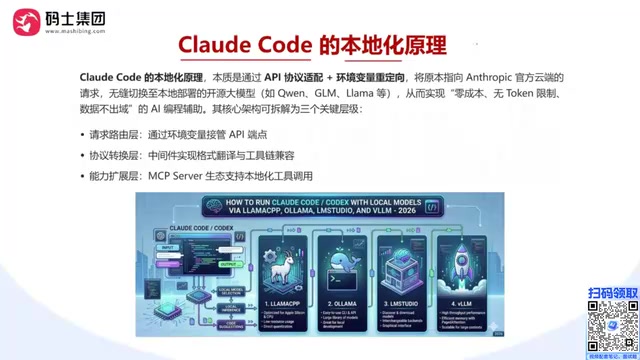
Claude Code with Local LLMs: Token-Free Deployment Guide & Configuration
Learn how to connect Claude Code to local LLMs for token-free AI coding. Covers three-layer architecture, Ollama/LM Studio/vLLM setup, protocol translation, and hardware selection.
Inventory-Free Game Design and Godot Sprite Occlusion Sorting: A Practical Tutorial
Explore inventory-free game design with mouse-drag interactions. Learn Godot sprite occlusion sorting pitfalls and solutions, plus AI-generated shader tips.