NVIDIA RTX PRO 4500 Accelerates Genomics and Protein Folding Workloads
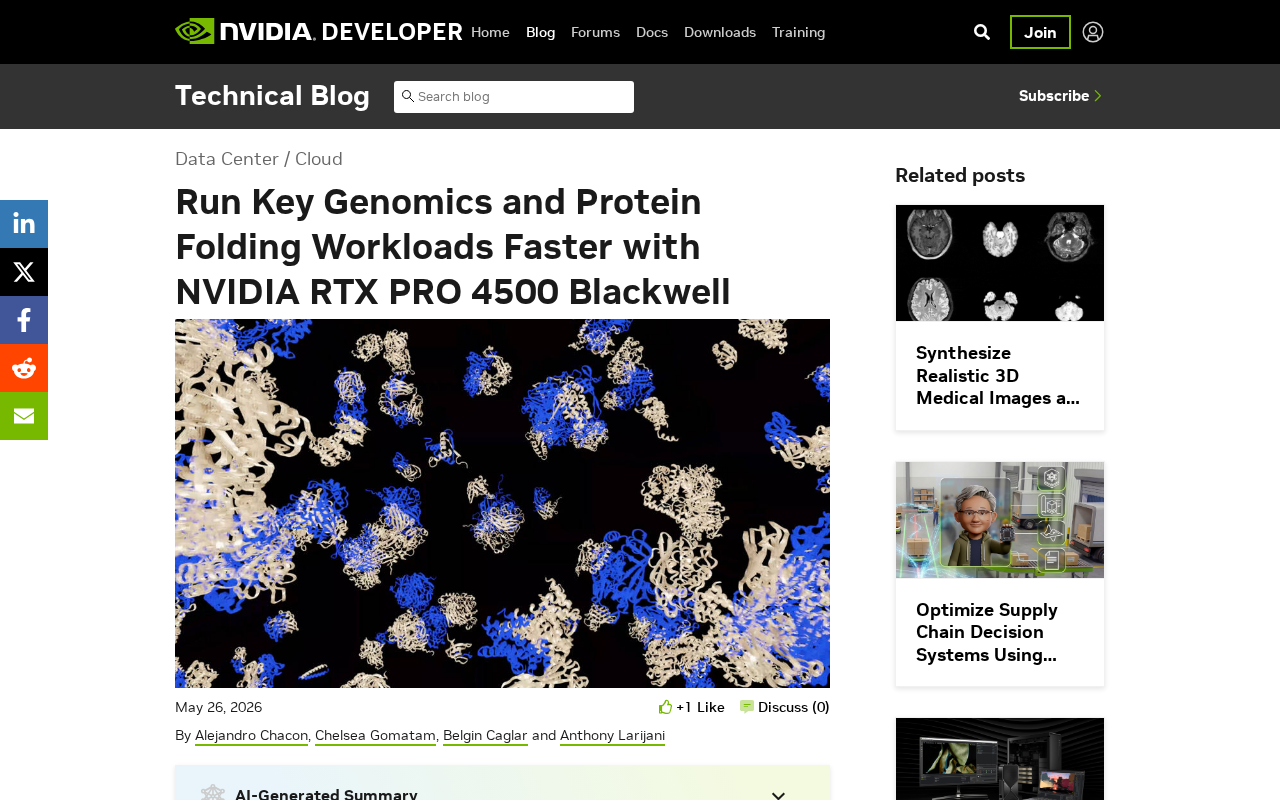
NVIDIA RTX PRO 4500 Blackwell brings data center-grade genomics and protein folding acceleration to the workstation.
NVIDIA's RTX PRO 4500, built on the Blackwell architecture, delivers significant computational acceleration for genomics analysis and protein folding prediction workloads. With enhanced Tensor Cores, larger memory capacity, and improved power efficiency, it enables researchers to run tools like Parabricks and AlphaFold locally, reducing turnaround times from days to minutes while maintaining data privacy compliance — democratizing precision medicine and drug discovery for labs of all sizes.
The advancement of precision medicine depends on two foundational capabilities: understanding disease at the genomic level and identifying therapeutic solutions at the molecular level. NVIDIA's newly released RTX PRO 4500 Blackwell workstation GPU is delivering significant performance improvements in both of these critical areas.
The Computational Bottleneck Facing Precision Medicine
Precision Medicine is one of the most important directions in contemporary biomedical development. Its core philosophy is to tailor diagnosis and treatment plans based on each patient's genomic profile. The concept can be traced back to a 2011 report by the U.S. National Research Council titled Toward Precision Medicine, and gained global attention after President Obama officially launched the "Precision Medicine Initiative" in 2015. Unlike the traditional "one-size-fits-all" treatment model, precision medicine takes into account an individual's genomic information, environmental factors, and lifestyle to provide personalized prevention and treatment strategies. The rapid growth of this field has been driven by three major technological breakthroughs: next-generation sequencing (NGS) technology has reduced the cost of genome sequencing from $2.7 billion in 2003 to just a few hundred dollars today; the establishment of large-scale biological databases (such as UK Biobank and TCGA) has provided rich training data; and the successful application of deep learning and other AI technologies in biological data analysis. However, realizing this vision still faces enormous computational challenges.
Genomic analysis requires processing massive volumes of sequencing data, and every step from raw read alignment to variant calling demands substantial computational resources. Specifically, whole-genome sequencing generates raw data typically ranging from 100–300GB (stored in FASTQ format). The standard analysis pipeline includes quality control (removing low-quality reads and adapter sequences), sequence alignment (mapping reads to a reference genome using tools like BWA-MEM2), sorting and deduplication, variant calling (SNV/InDel detection using tools like GATK HaplotypeCaller, structural variant detection using Manta, etc.), and variant annotation and filtering. A traditional CPU pipeline typically takes 24–48 hours to process a single 30x coverage whole-genome sample, while GPU-accelerated solutions can compress this to just tens of minutes.
Protein folding prediction — understanding the three-dimensional structure of proteins to design targeted drugs — is a quintessential computationally intensive task. The protein folding problem is considered one of the most important unsolved challenges in biology. Its core difficulty lies in predicting a protein's 3D spatial structure from its amino acid sequence alone. For a protein composed of 300 amino acids, the possible conformational space is astronomically large (the famous Levinthal's paradox). In 2020, DeepMind's AlphaFold2 achieved a breakthrough at the CASP14 competition, with prediction accuracy approaching experimental methods (X-ray crystallography, cryo-EM). AlphaFold3, released in 2024, further expanded to predicting complex structures involving proteins with DNA, RNA, and small molecule ligands. These models rely on extensive attention mechanism computations and multiple sequence alignment (MSA) processing, placing extremely high demands on GPU memory capacity and tensor computation capabilities.
Traditionally, these types of workloads have required data center-grade GPU clusters to run efficiently. For many research institutions and small-to-medium biotech companies, this has meant high infrastructure costs and long queue wait times.
Technical Advantages of the RTX PRO 4500 Blackwell Architecture
Core Upgrades in the Blackwell Architecture
The NVIDIA RTX PRO 4500 is based on the latest Blackwell architecture, representing a significant iteration in NVIDIA's professional workstation GPU lineup. Blackwell is NVIDIA's next-generation GPU architecture following Hopper (data center) and Ada Lovelace (consumer/professional). Its key technical innovations include: fifth-generation Tensor Cores supporting FP4 precision computation, delivering several times the performance improvement over the previous generation in AI inference scenarios; a new Transformer Engine with hardware-level optimizations for the Transformer architecture widely used in large language models and scientific computing; and upgraded NVLink interconnect technology that significantly increases communication bandwidth for multi-GPU collaborative workloads.
Within the professional workstation product line, the RTX PRO series inherits these architectural advantages while adapting to workstation power and thermal constraints, and supports ECC memory to ensure data reliability in scientific computing. Specifically for bioinformatics workloads, the Blackwell architecture delivers key improvements in the following areas:
- Enhanced AI Inference Performance: The new-generation Tensor Cores are deeply optimized for mixed-precision computation, which is critical for running protein folding AI models like AlphaFold. Mixed-precision computing allows models to maintain prediction accuracy while significantly boosting computational throughput by using lower-precision data formats (such as FP16, BF16, or even FP4)
- Greater Memory Capacity and Bandwidth: Both genomic analysis and protein structure prediction involve processing large-scale datasets, and sufficient memory is key to avoiding performance bottlenecks. This is especially important when predicting large protein complex structures, where attention matrix memory usage grows quadratically with sequence length
- Improved Power Efficiency: As a workstation-grade GPU, the RTX PRO 4500's power optimization enables stable operation within standard workstation chassis without requiring data center-level cooling infrastructure
The Significance of Workstation-Level Deployment for Biomedical Research
Bringing data center-level computing power down to the workstation platform is profoundly meaningful for biomedical researchers. Scientists can run complete genomic analysis pipelines and protein folding predictions right at their desks, without waiting for shared cluster resource scheduling. This not only shortens research cycles but also reduces data security risks — sensitive patient genomic data can be processed locally without being uploaded to the cloud.
This point is particularly important in the current data privacy regulatory environment. Data protection regulations for healthcare data are becoming increasingly stringent worldwide (such as the EU's GDPR and the U.S. HIPAA), and cross-border transfer and cloud storage of patient genomic data face growing compliance requirements. Local high-performance computing solutions provide research institutions with a path that balances computational efficiency and data compliance.
Key Application Scenarios
Accelerating Genomics Analysis
In the genomics field, variant calling from whole-genome sequencing (WGS) data is one of the most critical analysis workflows. NVIDIA's Parabricks toolkit has become the industry standard for GPU-accelerated genomic analysis. Parabricks is a GPU-accelerated software suite developed by NVIDIA specifically for genomics analysis. It ports the traditional GATK Best Practices Pipeline to run on GPUs, supporting analysis modules including fq2bam (from FASTQ to sorted, deduplicated BAM files), HaplotypeCaller (germline variant calling), Mutect2 (somatic mutation detection), DeepVariant (deep learning-based variant calling), and more. In terms of clinical certification, Parabricks analysis results have been demonstrated to be highly consistent with CPU-based GATK (>99.9%) and have been validated and adopted by multiple clinical laboratories.
The architectural upgrades in the RTX PRO 4500 Blackwell will further reduce the processing time from raw sequencing data to clinically actionable variant reports. For clinical genomics laboratories, faster turnaround times directly impact whether patients can receive accurate diagnostic results in a timely manner. This acceleration is especially critical in time-sensitive applications like tumor genomics — cancer patients often have limited treatment windows, and rapidly identifying targetable driver mutations (such as EGFR, ALK, BRAF, etc.) is essential for developing optimal treatment plans.
Protein Folding Prediction and Drug Discovery
Protein folding prediction is a critical step in the drug discovery pipeline. Understanding the three-dimensional structure of target proteins is the foundation for designing effective, low-toxicity drug molecules. In traditional drug discovery workflows, obtaining protein structures typically relies on experimental methods such as X-ray crystallography or cryo-EM, which can take months or even years, and not all proteins can be successfully crystallized. AI-driven structure prediction has fundamentally changed this landscape, enabling researchers to obtain high-confidence structural models within hours.
The performance improvements of the RTX PRO 4500 Blackwell in AI inference enable researchers to run protein structure prediction models like AlphaFold2/3 more rapidly and screen a larger number of candidate targets. This enhanced capability directly benefits small molecule drug design (structure-based virtual screening and lead compound optimization), antibody engineering (predicting antibody-antigen binding interfaces to optimize affinity), and protein-protein interaction studies (identifying druggable hotspot residues at protein interfaces).
Industry Impact and Future Outlook
From a broader perspective, NVIDIA's introduction of the Blackwell architecture into its professional workstation GPU product line reflects an important trend: AI-driven biomedical computing is expanding from centralized data centers to distributed edge nodes.
The traditional biomedical high-performance computing model relies on centralized data centers or cloud computing platforms (such as AWS and Google Cloud genomics services), but this model faces challenges including data privacy compliance, network transmission latency, and bandwidth costs. The edge computing model deploys computing power at the source of data generation — hospitals, sequencing centers, or research laboratories — allowing sensitive patient data to be analyzed without leaving the institution. This trend, combined with privacy-preserving technologies like Federated Learning, enables multi-center collaborative research to conduct model training without sharing raw data, providing a new paradigm for large-scale precision medicine research.
As genome sequencing costs continue to decline, the volume of genomic data generated globally each year is growing exponentially. Simultaneously, AI applications in protein structure prediction, drug molecule design, and other fields are rapidly proliferating. These trends collectively drive the demand for high-performance local computing resources.
The launch of the RTX PRO 4500 Blackwell provides research institutions, clinical laboratories, and biotech companies with a solution that combines both performance and accessibility. It enables more research teams to independently conduct cutting-edge genomics and structural biology research without relying on large computing clusters.
Looking ahead, as multi-omics integrated analysis (jointly analyzing multi-layered data including genomics, transcriptomics, proteomics, metabolomics, etc.) and AI-assisted drug design continue to advance, the role of workstation-grade GPUs in the biomedical field will become increasingly important. NVIDIA's continued investment in this direction is paving the way for the large-scale implementation of precision medicine.
Key Takeaways
Related articles

Conductor CEO Demo: Multi-AI Agent Programming Workflow Explained
Conductor co-founder Charlie Holtz demos his AI coding workflow, showing how to orchestrate multiple AI agents in parallel with insights on model selection and human-AI collaboration.
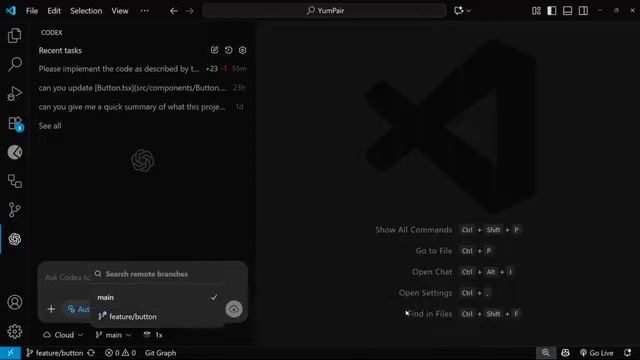
OpenAI Codex Cloud Task Delegation: The Complete Workflow from VS Code to PR
A detailed guide to OpenAI Codex extension's cloud task delegation, covering the complete workflow from initiating cloud coding tasks in VS Code to reviewing changes and creating Pull Requests.

Coze Workflow in Practice: Complete Tutorial for AI One-Click Product Promo Video Generation
Step-by-step guide to building a Coze workflow for AI product promo videos, integrating HappyHours and Jimeng across 12 nodes with nine-grid storyboards and polling loops.