NVIDIA XR AI Platform Explained: Full-Stack AI Agent Development for AR Glasses
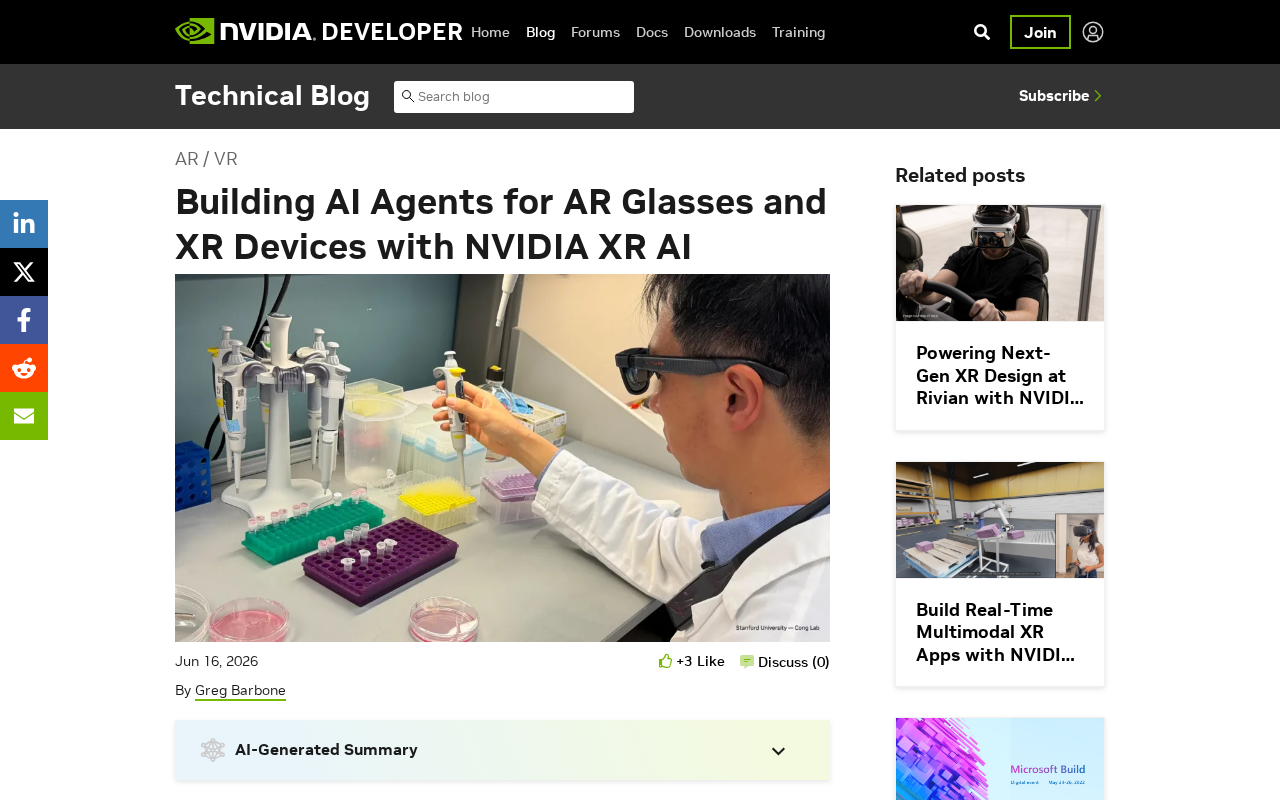
NVIDIA XR AI platform provides full-stack cloud-edge infrastructure for building AI Agents on AR glasses.
NVIDIA's XR AI platform addresses the fundamental compute gap between AR glasses and AI model requirements through a cloud-edge collaborative architecture. It provides developers with standardized capabilities for visual understanding, multimodal fusion, natural language interaction, and tool calling, enabling the creation of intelligent AI Agents for enterprise and consumer XR applications.
Introduction: AR Hardware Is Ready, AI Infrastructure Is the Bottleneck
The hardware capabilities of AR glasses and wearable XR devices are maturing rapidly, but developers face a critical infrastructure gap—how do you build truly intelligent AI experiences on these lightweight devices? Real-time visual perception, voice interaction, environmental understanding, multimodal reasoning... each capability requires complex AI pipelines, while the computational power and power consumption constraints of AR glasses make local deployment of large models virtually impossible.
Current mainstream large language models (GPT-4 class) typically have parameters ranging from tens of billions to trillions. Even quantized and compressed versions require tens of gigabytes of VRAM and hundreds of TOPS of compute to run. AR glasses, constrained by size, weight, and thermal dissipation, typically carry chips with single-digit TOPS of compute—a gap of two to three orders of magnitude from what large models demand. Even Qualcomm's latest XR-dedicated chip, the Snapdragon XR2+ Gen 2, offers only about 12 TOPS of AI compute, capable of running only lightweight models with fewer than 1 billion parameters. This is the fundamental reason why cloud-based inference is the mandatory architecture for XR AI.
NVIDIA's XR AI platform was created precisely to fill this gap, providing developers with a complete AI Agent development framework spanning cloud to edge.
Core Positioning of XR AI: Bridging AI Capabilities and XR Devices
Infrastructure-Level Challenges
Building AI Agents for AR glasses isn't simply porting a chatbot to a head-worn device. Developers must simultaneously address multiple technical dimensions:
- Real-time visual stream processing: AR glasses' cameras continuously capture the surrounding environment, and AI needs to understand scene content in real time
- Multimodal input fusion: Voice, gestures, eye tracking, environmental sensors, and other inputs need coordinated processing
- Low-latency response: Users expect millisecond-level interaction feedback; any noticeable delay breaks immersion
- Contextual continuity: AI Agents need to maintain ongoing understanding of the user's environment and tasks
In traditional AI development workflows, developers often need to build these pipelines themselves—from video stream encoding/decoding and model inference scheduling to result rendering—each link requiring significant engineering effort. NVIDIA XR AI aims to standardize and platformize these foundational capabilities.
Cloud-Edge Collaborative Architecture Design
The core architectural approach of NVIDIA XR AI is cloud-edge collaboration. Lightweight devices like AR glasses handle sensor data collection and result presentation, while heavy AI inference tasks are offloaded to NVIDIA GPU clusters on cloud or edge servers.
The systematic application of Cloud-Edge Collaboration architecture in the XR domain represents a milestone. The core challenge of this architecture lies in network latency—the entire chain from AR glasses collecting data, uploading to the cloud, completing inference, and returning results needs to be controlled within 100 milliseconds; otherwise, users will perceive noticeable interaction lag. To address this, NVIDIA introduced the concept of edge computing nodes in its infrastructure—deploying GPU servers at the network edge close to users to compress end-to-end latency to an acceptable range. Additionally, efficient video stream encoding/decoding is a critical technical component—AR glasses typically capture video at 30-60fps, and directly uploading raw video streams demands extremely high bandwidth. Therefore, intelligent frame selection and compression encoding must be performed on-device, transmitting only key frames or changed regions to the cloud for inference.
This architectural design brings several significant advantages:
- Models unconstrained by device compute: The most advanced large language models and vision models can be used
- Continuous upgrade capability: Cloud models can be updated and iterated independently of devices
- Reduced device power consumption and cost: The glasses only need to perform lightweight preprocessing
Key Capability Modules of AI Agents
Visual Understanding and Scene Perception
For AI Agents on AR glasses, "seeing" and "understanding" the real-world environment the user inhabits is the most fundamental and critical capability. This involves the coordinated operation of multiple visual AI tasks including real-time object detection, scene segmentation, OCR (Optical Character Recognition), and spatial localization.
NVIDIA's deep expertise in visual AI—from computer vision models to video analytics pipelines—provides a natural technical foundation for XR scenarios. Developers can leverage pre-trained vision models provided by the platform to quickly build scene understanding capabilities without training from scratch.
Natural Language Interaction and Multimodal Fusion
Voice is the most natural interaction modality for AR glasses. AI Agents need fluent ASR (Automatic Speech Recognition), NLU (Natural Language Understanding), and TTS (Text-to-Speech) capabilities. More importantly, these language capabilities need to be deeply fused with visual understanding—when a user points at an object and asks "What is this?", the Agent needs to simultaneously understand the voice command and visual context.
Multimodal Fusion refers to AI systems simultaneously processing and correlating information from different perceptual channels (vision, speech, text, sensors, etc.) to form unified semantic understanding. This field experienced rapid breakthroughs in 2023-2024, represented by multimodal large models like GPT-4V and Gemini, which can understand both images and text within a single model architecture. However, XR scenarios impose higher requirements on multimodal fusion: not only understanding static images but also processing temporal information in continuous video streams; not only understanding language content but also combining spatial information like user gesture direction and gaze direction for disambiguation. For example, when a user says "put that over here," the system needs to simultaneously parse the referential pronouns in speech, the target object indicated by gesture, and the target location of gaze fixation. This kind of Cross-modal Reference Resolution remains an active research direction in both academia and industry.
This type of multimodal fusion reasoning is at the frontier of current large model technology and represents NVIDIA's core competitive advantage at the AI infrastructure level.
Tool Calling and Task Execution
Truly useful AI Agents can not only "see" and "hear" but also need to execute actual tasks. In XR scenarios, this might mean:
- Identifying faulty components on equipment and retrieving repair manuals
- Real-time annotation of routes and points of interest in navigation scenarios
- Sharing perspectives with remote experts and receiving guidance in collaborative scenarios
These capabilities require Agents to have Function Calling and external system integration abilities, rather than merely staying at the conversational level. Function Calling is one of the core capabilities in current AI Agent architectures—it allows large language models to proactively call external APIs, database queries, or specialized tools during inference to complete specific tasks, rather than relying solely on the model's parametric knowledge. In XR scenarios, the complexity of Function Calling increases significantly: an Agent may need to simultaneously call visual recognition APIs (identifying the device model in front of them), enterprise knowledge bases (retrieving repair manuals for that model), AR rendering engines (overlaying repair steps onto the real device), and other tools, completing orchestration within milliseconds. The reliability and latency control of such multi-tool coordinated calling is a key engineering challenge for XR AI Agents transitioning from lab to production environments. NVIDIA's NIM (NVIDIA Inference Microservices) and Agent frameworks are infrastructure components designed precisely to solve these orchestration problems.
Industry Impact and Application Prospects
Enterprise Applications Leading the Way
XR AI Agents are most likely to generate value first in enterprise scenarios. Remote assistance in industrial manufacturing, surgical navigation aids in healthcare, intelligent picking guidance in warehousing and logistics—these scenarios demand extremely high AI accuracy and real-time performance, while also having clear ROI metrics.
NVIDIA's timing in launching the XR AI platform coincides with the wave of AR glasses consumerization driven by Meta, Apple, Qualcomm, and others. The 2024-2025 period is viewed by the industry as a critical inflection point for AR glasses transitioning from enterprise-only to consumer markets. Meta's Ray-Ban Meta smart glasses have sold millions of units, proving the consumer market potential of lightweight AR glasses; Apple Vision Pro, while positioned as premium, is reshaping the industry's perception of XR interaction through its spatial computing philosophy; Qualcomm provides hardware reference designs for numerous ODM manufacturers through its Snapdragon AR chip series. Meanwhile, the maturation of display technologies like Micro-LED and optical waveguides is solving the core optical challenges of AR glasses, making all-day wearable lightweight AR glasses possible within the next 2-3 years. Against this backdrop of rapidly maturing hardware ecosystems, the completeness of AI infrastructure will directly determine whether AR glasses can evolve from "smart accessories" to "AI Agent terminals."
As the hardware ecosystem gradually matures, the readiness of AI infrastructure will determine how quickly the application ecosystem flourishes.
The Criticality of Developer Ecosystems
The success of any platform ultimately depends on its developer ecosystem. NVIDIA needs to provide sufficiently low development barriers, rich sample applications, and clear documentation to attract developers to invest in XR AI Agent development. Based on current information, the XR AI platform is working toward providing an end-to-end development toolchain, covering model selection, pipeline orchestration, testing, and debugging.
Summary and Outlook
The launch of NVIDIA XR AI marks a paradigm shift in the XR domain from "hardware-driven" to "AI-driven." When AR glasses are no longer just display devices but carriers of AI Agents with environmental understanding, natural interaction, and task execution capabilities, their application value will undergo a qualitative leap.
For developers, the key question is no longer "can we run AI on AR glasses" but rather "how do we design truly useful AI Agent experiences." NVIDIA has provided an answer at the infrastructure level, but the birth of killer applications still requires collective exploration by the entire ecosystem.
Key Takeaways
Related articles

The Clotilda: Underwater Archaeological Discovery of America's Last Slave Ship
The Clotilda, America's last slave ship, was discovered by underwater archaeologists in Alabama nearly 160 years after sinking. Learn about the search, key evidence, and other slave trade shipwreck discoveries.
Sakana AI in Practice: Reshaping Banking Lending Operations with AI Agents — Technology and Strategy
Deep dive into how Sakana AI applies AI Agents to banking lending operations, covering end-to-end support from information gathering to approval document generation, plus technical challenges and human-AI collaboration design.
Instagram Enters the Living Room: Long-Form Video, Series, and Live Streaming Challenge Netflix
Instagram is building a TV app with long-form video, episodic series, and live streaming to challenge Netflix. Deep analysis of its living room strategy and industry impact.