OpenAI Codex Beginner's Guide: From Environment Setup to Enterprise-Level Practice

A complete learning roadmap for OpenAI Codex and AI large models, from basics to enterprise projects.
This guide provides a systematic learning path for OpenAI Codex and AI large models, covering Transformer architecture fundamentals, development environment setup, prompt engineering, RAG (Retrieval-Augmented Generation) private deployment, LoRA fine-tuning techniques, and AI Agent development. It includes a recommended 12-week study plan and honest advice for beginners navigating the AI development landscape.
Overview: Why You Should Pay Attention to Codex
With the rapid advancement of AI large language model (LLM) technology, OpenAI Codex — a powerful AI programming assistant — is profoundly changing the way developers work. Recently, a Bilibili content creator released what they call the "most comprehensive" AI LLM tutorial series, covering a complete learning path from absolute beginner to hands-on projects. This article distills the key knowledge points for learning Codex and AI large models based on the core framework of that tutorial, helping you quickly build a systematic understanding.
It's worth noting that while the video is titled as a "Codex tutorial," the actual content leans more toward a systematic study plan for AI large models, covering a knowledge base far beyond Codex itself. Let's break down each core module.
Fundamentals: Core LLM Principles and Development Environment Setup
Transformer Architecture and Pre-training Basics
Any study of AI large models inevitably starts with the Transformer architecture — the foundational technology behind GPT, Codex, and similar models. The tutorial starts from the most basic concepts and explains the following key points in an accessible way:
- Transformer Architecture: Understanding how the Self-Attention mechanism enables models to capture long-range dependencies in text
- Pre-training and Fine-tuning: Large models acquire general capabilities through pre-training on massive datasets, then adapt to specific tasks through fine-tuning
- Tokens and Context Windows: Understanding how models process inputs and outputs, which directly affects your efficiency when using tools like Codex
The Transformer architecture was first introduced by a Google team in the 2017 paper Attention Is All You Need, originally designed for machine translation tasks. Before this, the NLP field primarily relied on Recurrent Neural Networks (RNNs) and Long Short-Term Memory networks (LSTMs), which suffered from severe parallel computation bottlenecks and long-sequence information decay. By adopting a design based entirely on attention mechanisms, Transformer completely eliminated the constraints of sequential computation, allowing models to attend to information at any position in the input sequence simultaneously. This innovation directly gave rise to BERT, the GPT series, Codex, and other groundbreaking models. Simply put, without the Transformer, there would be no AI large model revolution today.
These foundational concepts may seem abstract, but they determine whether you can truly understand the capability boundaries of AI tools — rather than just staying at the "I know how to use it" level.
AI Development Environment Setup Steps
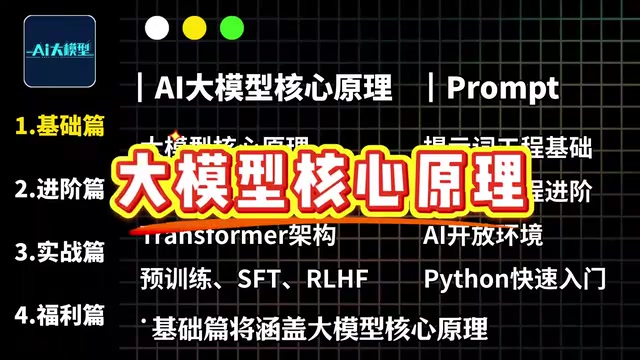
Environment setup is the first hurdle many beginners encounter. Key steps mentioned in the tutorial include:
- Python Environment Configuration: Using Anaconda or venv to manage virtual environments is recommended to avoid dependency conflicts
- API Key Acquisition and Configuration: Using OpenAI Codex requires API access; properly configuring environment variables is a fundamental skill
- Development Tool Selection: VS Code paired with AI plugins is currently the most popular development setup
Prompt Engineering
Prompt engineering is one of the highest-ROI skills in current AI applications. Whether you're using Codex to generate code or ChatGPT for other tasks, mastering the core principles of prompt design is crucial:
- Clear Task Descriptions: Tell the model what you want, not what you don't want
- Provide Context and Examples: Few-shot prompting can significantly improve output quality
- Iterative Optimization: Good prompts often require multiple rounds of refinement to achieve ideal results
Intermediate: RAG Private Deployment and Model Fine-tuning
RAG (Retrieval-Augmented Generation) and Private Deployment
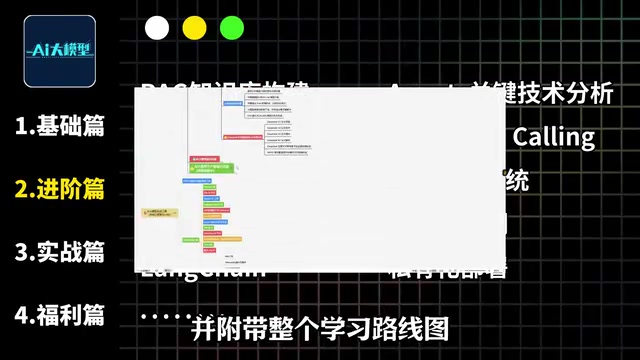
The intermediate section of the tutorial covers core technologies for enterprise-level AI applications.
RAG (Retrieval-Augmented Generation) is one of the most practical enterprise AI deployment solutions today. By combining external knowledge bases with large models, it effectively addresses model "hallucination" and knowledge timeliness issues.
The RAG concept was first proposed by Meta AI's research team in 2020. Its core idea is to combine information retrieval with text generation, allowing large models to reference external knowledge sources when generating answers rather than relying solely on parameterized knowledge memorized during pre-training. By 2024-2025, RAG has become the de facto standard for enterprise AI deployment. According to multiple consulting firms, over 70% of enterprise AI applications use some form of RAG architecture. Its popularity stems from three reasons: first, it doesn't require retraining the model, keeping deployment costs low; second, knowledge bases can be updated in real-time, solving the model's knowledge cutoff date problem; third, answers can be traced back to specific document sources, enhancing credibility and compliance.
The specific workflow is as follows:
- Vectorize enterprise documents and store them in a vector database
- When a user asks a question, first retrieve relevant document fragments
- Feed the retrieved results as context into the large model to generate an answer
Vector databases are indispensable infrastructure in RAG architecture. They work by using Embedding models (such as OpenAI's text-embedding-3 or the open-source BGE series) to convert text into high-dimensional vectors (typically 768-3072 dimensions). The distance relationships between these vectors in mathematical space reflect semantic similarity between texts. When a user asks a question, the query is also converted into a vector, and an Approximate Nearest Neighbor (ANN) search is performed in the database to find the most semantically relevant document fragments. Currently, mainstream vector databases include Milvus (Chinese open-source), Pinecone (cloud service), Chroma (lightweight), and Weaviate.
Private deployment is a hard requirement for many enterprises concerned about data security. Using tools like Ollama and vLLM, you can run open-source large models on local servers, keeping data within your own infrastructure.
LoRA Model Fine-tuning in Practice
When general-purpose models can't meet domain-specific needs, fine-tuning becomes essential. The efficient fine-tuning methods mentioned in the tutorial include:
- LoRA/QLoRA: Dramatically reduces the computational resources needed for fine-tuning through low-rank decomposition, making it possible to fine-tune models on consumer-grade GPUs
- Data Preparation: High-quality training data matters more than model architecture; data cleaning and annotation are key to successful fine-tuning
LoRA (Low-Rank Adaptation) was proposed by Microsoft Research in 2021. Its core insight is that during fine-tuning, the change matrix of model parameters is actually low-rank — meaning most of the information can be expressed with far fewer variables than the original parameter count. Based on this finding, LoRA freezes all original model parameters and only injects trainable low-rank decomposition matrices at each layer (typically decomposing a d×d matrix into d×r and r×d matrices, where r is much smaller than d). The results are remarkable: a 70B model that would normally require hundreds of GB of VRAM for full-parameter fine-tuning can be fine-tuned on a single consumer GPU (e.g., RTX 4090 with 24GB VRAM) using LoRA, reducing trainable parameters to 0.1%-1% of the original while achieving results comparable to full-parameter fine-tuning. QLoRA goes even further by using 4-bit quantization to further compress the base model's memory footprint.
Hands-on: Enterprise-Level AI Project Implementation
Core Project Directions
The tutorial outlines several enterprise-level practical projects, representing the mainstream AI application scenarios today:
| Project Type | Core Technology | Application Scenario |
|---|---|---|
| AI Agent | Tool calling + Planning | Automated workflows |
| Digital Human | TTS + Digital human rendering | Customer service, live streaming |
| Enterprise Knowledge Base Q&A | RAG + Vector retrieval | Internal knowledge management |
| Medical LLM | Domain fine-tuning + Safety alignment | Diagnostic assistance |
Among these, AI Agent is one of the hottest directions right now. It transforms large models from mere "chatbots" into intelligent assistants capable of calling tools and executing multi-step tasks. OpenAI Codex itself can be seen as an Agent specialized in the programming domain.
The concept of AI Agents experienced explosive growth between 2023 and 2025. Unlike traditional conversational AI, Agents possess three core capabilities: perception (understanding task requirements), planning (breaking complex tasks into executable steps), and action (calling external tools to complete specific operations). Currently, mainstream Agent frameworks include LangChain, AutoGPT, and CrewAI, all based on the ReAct (Reasoning + Acting) paradigm — the model first reasons and thinks, then decides on the next action, observes the results, and continues reasoning. OpenAI's Codex Agent, released in 2025, is a concrete implementation of this concept in the programming domain: it can understand a developer's requirements, automatically plan an implementation approach, invoke tools like code editors and terminals, and ultimately deliver runnable code. This marks a paradigm shift in AI from "answering questions" to "completing tasks."
Recommended Learning Path
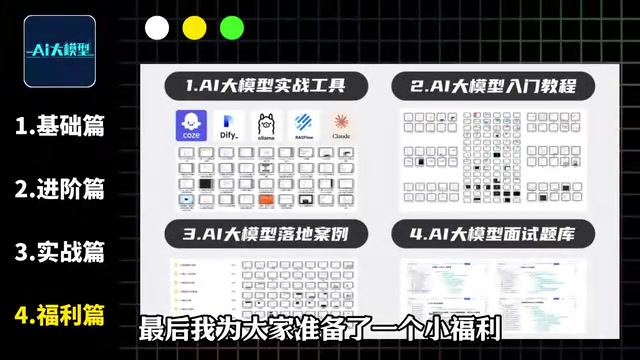
Based on the tutorial's overall framework, the following progressive learning path is recommended:
- Weeks 1-2: Master Python basics and core AI concepts; set up your development environment
- Weeks 3-4: Dive deep into prompt engineering; become proficient with the Codex and ChatGPT APIs
- Weeks 5-8: Study advanced techniques like RAG and fine-tuning; complete at least one small project
- Weeks 9-12: Take on enterprise-level projects; build a complete portfolio
Honest Assessment and Learning Advice
This tutorial is positioned as a "zero-to-one systematic introduction," and its comprehensive curriculum planning deserves recognition — the full-chain coverage from theory to practice is something many fragmented tutorials lack.
However, a few things to keep in mind:
- Title-Content Alignment: The video title emphasizes "Codex tutorial," but the actual content covers a much broader AI large model learning system, with Codex being just one tool among many
- How to Access Free Resources: The tutorial mentions leaving comments to receive the full resource package — this is a common engagement tactic on Bilibili, and the actual quality of materials should be judged on your own
- Depth vs. Breadth Trade-off: "Speed-running" such a vast knowledge system in 60 minutes is inevitably an overview-level treatment; true mastery still requires extensive hands-on practice
Overall, for beginners who want a systematic understanding of the AI large model learning path, tutorials like this serve as a solid "learning roadmap" to help you see the big picture. But real growth comes from writing code, running models, and building projects yourself.
Related articles
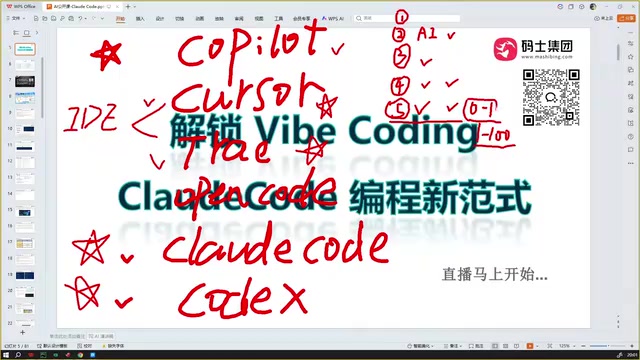
Claude Code Installation Guide & The Five Stages of AI Programming Tools Explained
Complete Claude Code installation guide with the five stages of AI programming tools, from manual coding to agents. Learn 0-to-1 project building and 1-to-100 iteration challenges.

Enterprise-Level AI Project Rules Files: 5 Hard Rules + 6 Writing Techniques
AI keeps messing up your code? Learn 5 hard rules and 6 writing techniques for enterprise-level Rules files in Claude Code, Cursor & more, with templates.
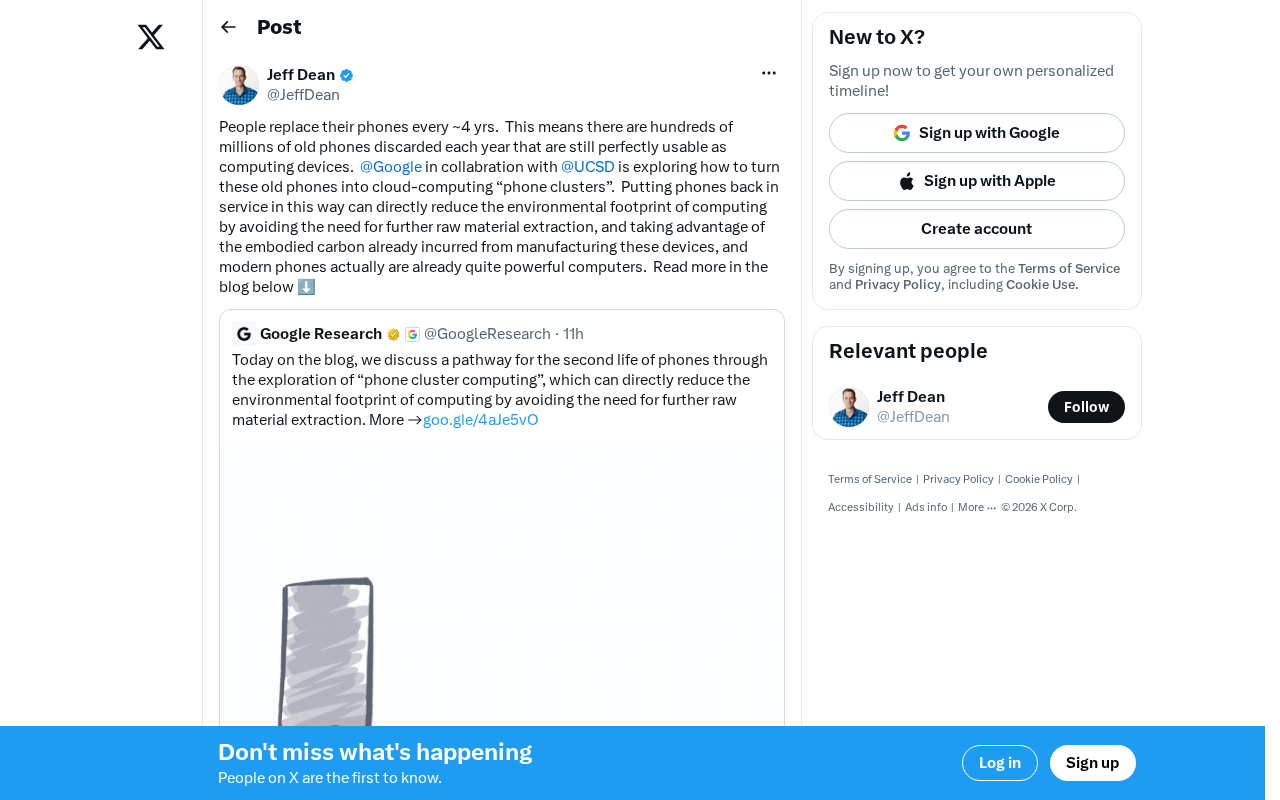
Building Cloud Computing Clusters from Old Phones: Google and UCSD Explore a New Path to Sustainable Computing
Google and UCSD explore building cloud clusters from old phones, leveraging ARM chip efficiency to cut e-waste and data center carbon footprints.