OpenAI Codex Deep Dive: Core Capabilities and Engineering Design Philosophy
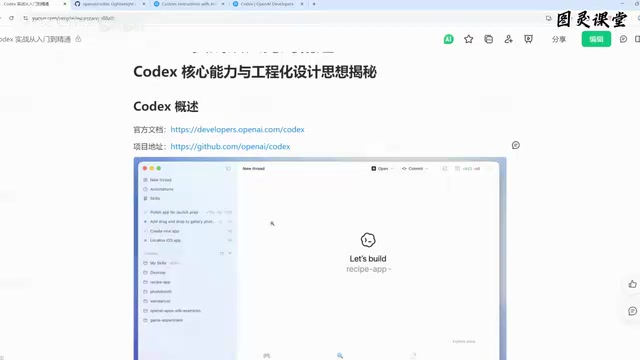
A systematic analysis of OpenAI Codex's core capabilities and three key engineering design paradigm shifts.
This article provides a comprehensive analysis of OpenAI Codex, covering its three usage modes (App, CLI, IDE plugin), core capabilities including multi-task parallel processing and five key application scenarios, plus three fundamental engineering design shifts: Spec-Driven Development (SDD) replacing prompt engineering, Agent Loop simulating human developer workflows, and precise context engineering using RAG and AST awareness.
Introduction: Codex Is More Than an AI Coding Assistant
OpenAI's Codex is evolving from a simple AI coding assistant into a "full-stack development partner." It doesn't just write code—it can review code, troubleshoot production bugs, handle multiple tasks in parallel, and even operate browsers, generate images, and build enterprise-level skill systems. This article provides a systematic understanding of Codex from two dimensions: its complete core capabilities and its engineering design philosophy.
Three Ways to Use Codex
Currently, Codex comes in three forms, each suited to different development preferences:
- Standalone App: An independent application released by OpenAI with a user-friendly interface, ideal for independent project development
- CLI (Command Line): The earliest usage method—simply type
codexin the terminal to enter the AI programming environment, perfect for developers who prefer command-line operations - IDE Plugin: Supports installation in Cursor or VS Code, seamlessly integrating with your coding environment and eliminating the need to switch windows
All three methods can be used in combination. If you need to both edit code and get Codex assistance, the IDE plugin offers the most convenient switching experience. For independent project development or remote control scenarios, the App and CLI are more flexible.
Complete Overview of Codex Core Capabilities
Many people's understanding of Codex stops at "help me write code," but its capabilities extend far beyond that. Only by building a holistic understanding can you truly connect all features into a complete workflow.
Multi-Task Parallel Processing
Codex operates on a multi-threaded mechanism. You can have it work on three projects simultaneously—it will launch independent threads for each, process them in parallel, and produce merged output. For example, you can ask it to analyze the architectural details of three projects at once, and after analysis, it will automatically summarize and output a comparison table.

Even more noteworthy is Codex's built-in Git WorkTree mechanism. In traditional development, multi-person collaboration requires creating different branches and merging them. WorkTree allows mounting multiple working trees under a single branch, enabling parallel development with code isolation—no need to frequently create branches for collaborative work.
Git WorkTree is an advanced feature introduced in Git 2.5 that allows developers to check out multiple working directories simultaneously within the same repository, each corresponding to a different branch or commit. In traditional Git workflows, if you want to work on two branches' code simultaneously, you either frequently switch branches (stashing current modifications) or clone multiple repository copies. WorkTree solves this pain point: you can create multiple subsidiary working trees outside the main working directory, each running independently without interference. Codex leverages this mechanism by creating independent WorkTrees for each parallel task, allowing multiple AI threads to modify code simultaneously without conflicts, then integrating results through merge strategies.
Five Core Application Scenarios
1. Code Generation and Project Scaffolding
Through conversational interaction, build project architectures from scratch and generate complete functional modules, dramatically shortening project startup cycles.
2. Code Reading and Learning
Hand open-source projects or legacy company projects to Codex for analysis—it can quickly map out project structure, clarify module relationships, and help you understand the team's development logic. This is extremely practical for developers taking over historical projects.
3. Code Review
The built-in /review slash command can analyze uncommitted code changes or submitted PRs, automatically detect vulnerabilities, and provide modification suggestions, significantly reducing the cost of manual code review.
4. Production Issue Troubleshooting
Provide Codex with production bug logs and the identified code lines, and it can quickly locate root causes and offer fix solutions.
5. Automated End-to-End Development
From requirements analysis, feature decomposition, core development, testing to debugging—the entire pipeline is automated.
Additional Extended Capabilities
Beyond core programming scenarios, Codex also supports the following extended features:
- Remote Connection: Control Codex on your computer remotely from your phone
- Application Operations: Invoke various applications on macOS, operate browsers, manage Chrome extensions
- Image Generation and Editing: Leveraging OpenAI's own image models, Codex can function directly as an AI drawing tool
- Powerful Plugin System: Greatly expands capability boundaries, even supporting video generation
- Skill (Scale) Building: Supports building enterprise-level skills from scratch for customized development
Key Mindset: Don't view each feature in isolation—connect them into a complete workflow. When you integrate code generation, review, testing, and deployment together, Codex's true value is unleashed.
Engineering Design Philosophy: Three Core Paradigm Shifts
The fundamental difference between Codex and traditional AI programming tools lies in its upgraded engineering design philosophy. Understanding these design principles is key to using it more effectively.
Spec Engineering Replaces Prompt Engineering
This is Codex's most important conceptual shift. The industry is embracing a concept called SDD (Spec-Driven Development)—write the specifications first, then let AI generate the code.
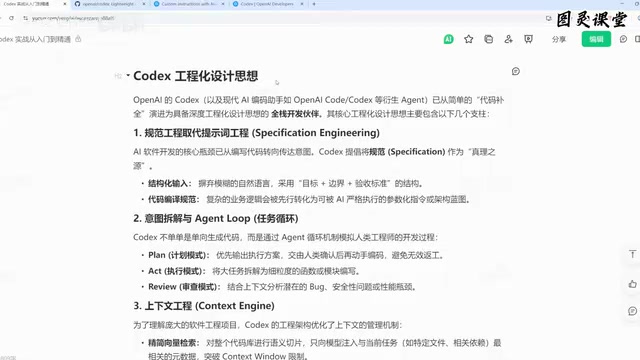
SDD's core philosophy originates from Design by Contract and Behavior-Driven Development (BDD) in traditional software engineering. In conventional development, requirements documents are often vague natural language descriptions, requiring extensive communication for developers to understand the true intent. SDD requires that before coding begins, structured specification files clearly define system behavior, interface constraints, boundary conditions, and acceptance criteria. These specification files serve both as precise instructions for AI code generation and as benchmarks for subsequent code quality verification.
Specifically, Codex requires developers to first write agents.md and Rules files, defining clear goals + boundaries + acceptance criteria. This is fundamentally different from casually describing requirements in natural language. The benefit of having standards is that code can be "accepted with quality assurance." The agents.md file is essentially a behavioral specification for AI Agents—it defines the Agent's role, capability boundaries, output format, and quality standards, making AI behavior predictable and auditable.
OpenAI practices this philosophy internally as well. According to public information, they once used three people over five to six months to generate over one million lines of code entirely through Harness Engineering, successfully deploying it to production—humans only defined specifications without writing a single line of code. This fully demonstrates the power of specification-driven programming.
Agent Loop: Simulating a Human Engineer's Development Process
Traditional AI programming tools simply "write some code and call it done," regardless of whether it actually runs. Codex's Agent Loop mechanism is entirely different—it simulates a human engineer's complete development workflow:
- Plan Phase: First, create a detailed development plan
- Confirm Phase: The engineer confirms the approach (supports confirmation mode and fully autonomous YOLO mode)
- Execute Phase: Break large tasks down to individual functions and modules, writing them step by step
- Review Phase: Analyze potential bugs, security issues, and performance bottlenecks based on context
- Auto-fix: Upon discovering issues, automatically read logs, locate causes, and apply fixes
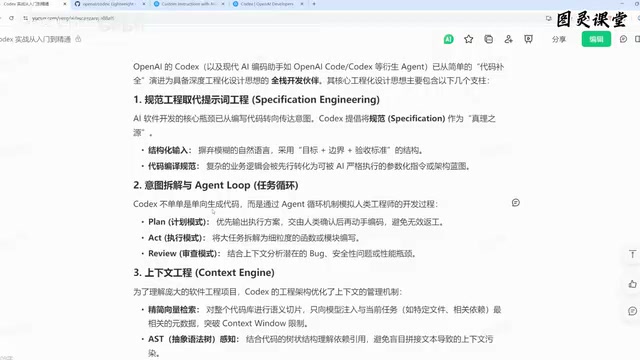
This architecture is known in academia as the ReAct (Reasoning + Acting) paradigm, proposed by Google's research team in 2022. The core idea is to have language models alternate between reasoning and environment interaction, rather than outputting a final answer in one shot. Traditional AI programming tools (like early GitHub Copilot) use a single-inference mode: receive input, generate output, end interaction. In this mode, AI cannot verify whether its generated code is correct, nor can it iteratively fix issues based on execution results. The Agent Loop draws from the Observation-Action-Feedback Loop in reinforcement learning, giving AI the ability to make autonomous decisions and self-correct.
It's precisely because of this complete internal loop that Codex's final output is essentially ready to run. Before delivering code to you, it has already completed multiple rounds of self-inspection and repair internally. This is the core reason why current AI programming tools have dramatically improved in quality.
Context Engineering: Precise, Not Brute-Force
Codex implements three layers of optimization in context management to ensure the accuracy and reliability of generated code.
A large language model's Context Window refers to the maximum number of tokens the model can process in a single pass. Even the most advanced models have context window limits (such as 128K or 200K tokens). A medium-scale enterprise project might contain hundreds of thousands of lines of code, far exceeding the model's processing capacity. If all files are loaded by brute force, it not only exceeds limits but also degrades generation quality due to irrelevant information interference—this is academically known as the "Lost in the Middle" problem. Therefore, precise context management becomes the critical differentiator for AI programming tool quality.
Streamlined Route Retrieval
The entire codebase undergoes semantic segmentation, injecting only files and dependencies relevant to the current task rather than loading the entire project indiscriminately, effectively avoiding context overflow. Codex's streamlined route retrieval adopts the RAG (Retrieval-Augmented Generation) approach, combining semantic similarity with code dependency graphs to extract only code snippets highly relevant to the current task for context injection, achieving a balance between precision and efficiency.
AST (Abstract Syntax Tree) Awareness
This combines the tree structure of code to understand dependency and reference relationships. Early AI programming tools frequently produced compilation errors and missing module issues—the root cause was insufficient analysis of inter-code dependencies. Codex thoroughly solves this problem through AST awareness.
The Abstract Syntax Tree is a core concept in compiler theory that parses source code into a tree-shaped data structure according to grammar rules. Each node in the tree represents a syntactic construct in the code, such as function declarations, variable assignments, conditional statements, etc. Unlike pure text analysis, AST can precisely understand the structured semantics of code: which function calls which module, where a variable is defined and referenced, and how classes inherit from each other. Modern IDE features like code navigation, refactoring, and error detection all rely on AST analysis. Codex's integration of AST awareness into context management means it doesn't simply treat code as text—it truly understands code's structural relationships, thereby avoiding common errors like missing import statements or referencing undefined variables.
External Tool Collaboration
Codex is not a text generator—it's an autonomous execution entity with powerful environment interaction capabilities. In Bypass mode, it has full control over the terminal environment and can directly invoke compilers, debuggers, and package managers, automatically reading logs and applying fixes when issues are discovered. This capability allows Codex to verify code and troubleshoot errors in real runtime environments, just like a real developer, rather than merely reasoning at the text level.
Recommended Learning Resources
To dive deeper into Codex, two official resources are recommended:
- OpenAI Developer Documentation: A detailed guide for developers covering all concepts and usage specifications
- Codex Open-Source Repository: Modules like CLI are open-sourced, including detailed documentation on agents.md, suitable for developers interested in underlying principles
Conclusion
Codex represents an important evolutionary direction for AI programming tools: from "helping you write code" to "developing like a human engineer." Its core competitive advantage lies not in any single feature, but in the systematic implementation of three engineering design philosophies: spec-driven development, Agent Loop, and precise context management. Mastering these underlying principles is what it takes to truly leverage Codex effectively, rather than merely using it as an advanced code completion tool.
Related articles
Codex vs Claude Code in Practice: A Complete Guide to AI-Engineered Programming for Enterprise Projects
In-depth comparison of Codex and Claude Code for enterprise AI development, covering Vibe Coding limitations, multi-Agent workflows, OpenRouter platform architecture, and programmer learning paths.
Anjney Midha: The Rise from Singapore to Helm of a16z's AI Investment Empire
Deep dive into Anjney Midha, the key figure behind a16z's AMP fund, covering investments in Anthropic, Mistral, and Black Forest Labs, and his Outputmaxxing philosophy.
Pi: A Lightweight AI Coding Agent Framework — Setup & Hands-On Guide
A deep dive into Pi, a minimalist AI coding Agent framework covering multi-model support, extensions, skill loading, and hands-on custom extension building with model mixing strategies.