OpenAI Codex Pixel Identicons: A Visual Identification Solution for Multi-Agent Collaboration
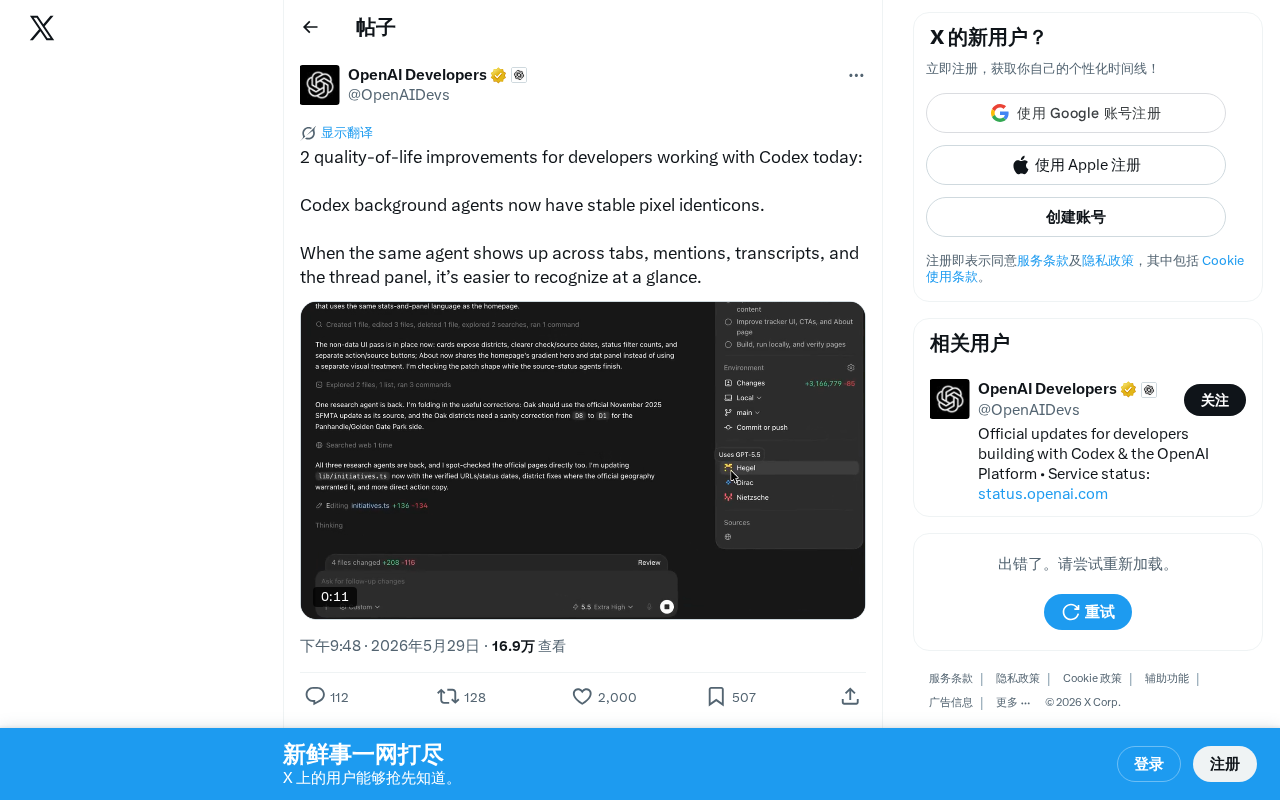
OpenAI adds stable pixel identicons to Codex agents for easier visual identification in multi-agent workflows.
OpenAI introduced pixel identicons for Codex background agents—stable, hash-generated visual patterns that help developers instantly distinguish between multiple concurrent agents. This QoL improvement reduces cognitive load during multi-task management and reflects the broader trend toward multi-agent collaboration in AI programming tools.
Overview
OpenAI recently introduced two developer experience improvements for Codex background agents, with one notable update being the assignment of stable pixel-style identicons to each agent. While seemingly minor, this change addresses a real pain point in multi-agent collaboration scenarios.
Pixel Identicons: Solving Multi-Agent Identification Challenges
What Are Pixel Identicons?
Pixel Identicons are automatically generated visual patterns based on unique identifiers, similar to the mosaic avatars GitHub displays for users who haven't set a profile picture. Each Codex background agent now has a unique and stable pixel icon that remains consistent regardless of where the agent appears in the interface.
The Identicon concept was first proposed by Don Park in 2007, with the core idea of mapping a hash value (such as a hash of an IP address or user ID) into a symmetrical geometric pattern. GitHub adopted this approach for default user avatars in 2013, making it widely known. Identicon generation algorithms typically perform MD5 or SHA hashing on the input string, then use different bit segments of the hash to determine the pattern's color, shape, and symmetry. Specifically, a typical 5×5 pixel Identicon only needs to compute 15 pixels (using vertical axis symmetry, mirroring the left half to generate the right), with the first 15 bits of the hash determining each pixel's on/off state, while subsequent bit segments map to the hue value in HSL color space. The choice of vertical axis symmetry isn't arbitrary—cognitive science research shows that the human visual system recognizes vertically symmetric patterns fastest, related to our evolutionary sensitivity to faces (naturally vertically symmetric structures). Due to the deterministic nature of hash functions, the same input always produces the same pattern—this is the mathematical guarantee of "stability." Pixel-style Identicons are the most classic variant, constraining patterns to a low-resolution grid that creates pixel art-like visual effects. This low-resolution design actually becomes an advantage: according to the "Global Precedence Effect" in visual psychology, the eye prioritizes overall contours over details during rapid scanning, and coarse pixel blocks reinforce the overall pattern's recognizability, making it clearly distinguishable even at 16×16 pixel icon sizes with minimal computational overhead.
Why Is Multi-Agent Identification So Important?
In real development workflows, developers frequently run multiple Codex agents simultaneously to handle different tasks. Codex background agents are asynchronous AI programming assistants introduced by OpenAI in 2025, running in cloud-based sandbox environments capable of independently executing code writing, test running, bug fixing, and other tasks without requiring real-time developer monitoring. From a technical architecture perspective, each Codex agent instance runs in an independent containerized sandbox containing a complete Linux environment, pre-installed development toolchains, and a full clone of the project repository. The agent's execution engine is based on OpenAI's o3 or o4-mini reasoning models, with multi-step reasoning and tool-calling capabilities. A typical task lifecycle includes: receiving natural language instructions from the developer, analyzing the project codebase, formulating an execution plan, writing or modifying code, running test suites for verification, and ultimately delivering results as Pull Requests or code patches. The entire process may take anywhere from minutes to tens of minutes, during which the developer need not intervene at all.
Unlike traditional synchronous AI conversations, background agents adopt a "dispatch task-execute in background-notify results" asynchronous model, meaning developers can launch multiple agents simultaneously to handle different code branches or feature modules. Each agent has an independent execution context, including filesystem snapshots, terminal sessions, and Git branches, without interfering with each other. This architectural design draws from the "Actor Model" in distributed systems—each agent is an independent computational unit with its own state, interacting with the outside world through message passing, naturally avoiding concurrency issues from shared state.
These agents appear in multiple locations:
- Tabs: Multiple agent tasks running in parallel
- Mentions: Agents referenced in conversations
- Transcripts: Viewing an agent's historical operations
- Thread Panel: Tracking an agent's discussion context
Without visual identifiers, developers must read agent names or IDs to distinguish between agents, creating cognitive burden during rapid context switching. Cognitive Load Theory, proposed by educational psychologist John Sweller in 1988, was later widely applied to human-computer interaction design. The theory categorizes cognitive load into three types: intrinsic load (task complexity itself), extraneous load (additional burden from information presentation), and germane load (effort to integrate new information into existing knowledge structures). Agent identification is a classic example of extraneous cognitive load—it's unrelated to the programming task itself, purely extra mental consumption caused by interface design. The theory posits that human working memory has limited capacity; according to Miller's Law, approximately 7±2 information chunks can be processed simultaneously (later research revised this to 4±1). In multi-agent scenarios, each agent's text name or ID occupies one "information chunk," while visual icons leverage the brain's rapid pattern recognition for images—MIT neuroscience research shows the brain can recognize previously seen images in as little as 13 milliseconds, far faster than text processing. By encoding agent identity as unique visual patterns, developers can simplify agent recognition from a serial "read-understand-match" cognitive process to a parallel "glance and know" visual process, minimizing extraneous cognitive load and freeing precious working memory resources for more important programming decisions. Stable pixel identicons enable developers to "recognize at a glance" specific agents, dramatically reducing the mental cost of multi-task management.
The Philosophy of Developer Experience Details
Evolving from "Functional" to "Delightful"
This type of update is typically called a "Quality of Life (QoL) improvement"—they don't add new features but significantly enhance daily usage fluidity. The QoL improvement term originated in the gaming industry, first popularized in MMORPG communities, referring to subtle optimizations that don't change core gameplay but significantly improve player experience, such as automatic inventory sorting or one-click looting. In developer tools, the strategic value of QoL improvements is often underestimated. JetBrains' annual developer survey shows that "daily usage fluidity" ranks second only to "core feature completeness" when developers choose tools. GitHub's success is largely attributable to its continuous polishing of developer experience details—from syntax highlighting color schemes to Pull Request review flows, every interaction detail is carefully designed. Stripe's developer platform is similarly a QoL philosophy exemplar: interactive code examples in API documentation, real-time request logs, and fix suggestions directly embedded in error messages—these details built extremely high developer loyalty in the payment API market.
In the current competitive landscape of AI programming tools, products like Cursor, Windsurf, GitHub Copilot, and Codex are converging in core capabilities. Cursor rose rapidly with its deep VS Code integration and fluid Tab key auto-completion; Windsurf (formerly Codeium) focuses on "Cascade" agent workflows; GitHub Copilot leverages its massive user base and GitHub ecosystem; while Codex differentiates with asynchronous background execution and powerful reasoning models. When these tools all connect to similarly capable large language models under the hood, competitive differentiation is shifting toward product experience refinement. OpenAI's choice to release such improvements at this point indicates that Codex's user base has moved from the early-adopter phase into deep usage, and its product strategy is transitioning from "feature-driven" to "experience-driven" maturity.
When developers begin using AI programming agents for extended periods at high frequency, every friction point in the interface gets amplified. An agent identifier requiring an extra 0.5 seconds to recognize, accumulated across hundreds of daily interactions, becomes significant efficiency loss. This cumulative effect is called "Micro-friction Accumulation" in human factors engineering—delays nearly imperceptible in isolation produce notable fatigue and efficiency decline in high-frequency repeated operations. Google's HEART framework (Happiness, Engagement, Adoption, Retention, Task success) specifically incorporates such micro-interaction metrics into product evaluation because they're often hidden determinants of user retention.
Stability Is a Key Design Decision
A notable detail: OpenAI emphasizes these identicons are "stable." This means the same agent displays the same icon across different sessions and time points, rather than being randomly generated each time. This design enables developers to build visual memory for specific agents, as naturally as remembering team members' avatars. From a technical implementation perspective, stability relies on deterministic hash algorithms—as long as the agent's unique identifier remains unchanged, passing through the same hash function and pattern mapping rules always produces an identical pixel pattern. This "deterministic input yields deterministic output" property is one of the fundamental characteristics of cryptographic hash functions.
Notably, the stability design also involves a deeper psychological mechanism—the "Mere Exposure Effect." Psychologist Robert Zajonc demonstrated in his classic 1968 experiments that people develop preferences for stimuli simply through repeated exposure. Stable visual identifiers allow developers to gradually develop familiarity and trust toward specific agent icons through repeated interaction, and this unconscious emotional connection helps build more natural human-machine collaboration. If icons changed randomly each time, it would not only destroy recognition efficiency but also create a subconscious sense of "unpredictability," undermining developer confidence in agent behavioral consistency.
Future Trends in Multi-Agent Collaboration
This update also reflects the development direction of AI programming tools: moving from single-agent interaction toward parallel multi-agent collaboration. When developers need visual means to distinguish between agents, it indicates that multiple agents working simultaneously has become a standard usage pattern.
Multi-Agent Orchestration is one of the most active research directions in AI engineering during 2024-2025. Microsoft's AutoGen framework, LangChain's LangGraph, and open-source projects like CrewAI are all exploring how multiple AI agents can collaboratively complete complex tasks. In programming, typical multi-agent patterns include: one agent writing code, another performing code review, and a third writing test cases, collaborating through message passing or shared workspaces. Anthropic's research also shows that decomposing complex tasks among multiple agents focused on subtasks often yields better results than having a single agent handle the entire task.
However, multi-agent collaboration faces a series of non-trivial technical challenges. State consistency is the primary difficulty: when multiple agents simultaneously modify different files in the same codebase, how do you ensure they're working from a consistent code snapshot? The current mainstream approach creates independent Git branches for each agent, ultimately resolving conflicts through merge strategies, but this can still produce semantic conflicts when agent modifications have logical dependencies. Resource scheduling is another key issue: each agent instance requires computational resources (GPU inference, container runtime), and balancing cost against response speed requires sophisticated scheduling algorithms. Task decomposition and dependency management involves higher-level orchestration logic: how to automatically split complex development requirements into parallelizable subtasks, identify dependencies between subtasks, and gracefully degrade or retry when an agent fails. OpenAI's Codex currently employs a relatively simple "independent parallel" mode—each agent handles independent tasks—but the industry is actively exploring more complex collaboration topologies, including hierarchical (a "supervisor" agent coordinating multiple "worker" agents), pipeline (agents processing different stages of a task sequentially), and debate-style (multiple agents proposing solutions to the same problem and reviewing each other) patterns.
In the future, we may see more features around multi-agent management, such as agent grouping, task priority visualization, and inter-agent dependency graphs. Pixel identicons are just the first step in this direction, but they lay the foundation for more complex multi-agent interaction interfaces. As agent numbers grow, visual identifiers alone will no longer suffice—developers may need something like an "agent dashboard" management interface showing real-time status (queued/executing/completed/failed), resource consumption, task progress, and output quality scores for each agent. OpenAI's introduction of a visual identity system for Codex is a product-level response to this trend of multi-agent normalization, and an infrastructure investment in building a more complete agent management experience.
Summary
While pixel identicons may appear to be just a small UI change, they reflect OpenAI's deep understanding of developer workflows. As competition in AI programming tools intensifies, refined product experience polishing is often the key factor in retaining power users. When the gap in core AI capabilities gradually narrows, what truly determines whether developers stay or leave may be precisely these seemingly insignificant details—a stable pixel icon, one fewer cognitive switch, a smoother multi-task workflow. This also reminds us that in AI product design, while breakthroughs in technical capability are certainly important, respect for human cognitive characteristics and deep empathy for usage scenarios are the last mile in converting technology into real productivity.
Related articles

Claude Code for Test Development in Practice: An AI Programming Workflow That Doubles Your Efficiency
A practical guide to Claude Code for test development: auto-generating test scripts, Plan Mode workflows, MCP + Playwright integration, and Subagent parallel tasks to build systematic AI-assisted workflows.

Hermes Agent Hands-On Review: An AI Efficiency Revolution for Indie Game Developers
Indie game developer reviews Hermes Agent vs OpenClaude: intelligent context compression, real-time Memory, remote control via Telegram, and practical use cases in game dev, social media, and email.
Vibe Coding Beginner's Guide: Tool Selection Across Three Categories with Practical Examples
A comprehensive guide to Vibe Coding's three tool categories: Agent frameworks, CLI Coding, and IDE tools, with practical examples including Snake game and data analysis workbench.