OpenAI Codex Surpasses 5 Million Weekly Active Users: The Transformation from Code Tool to Knowledge Work Platform
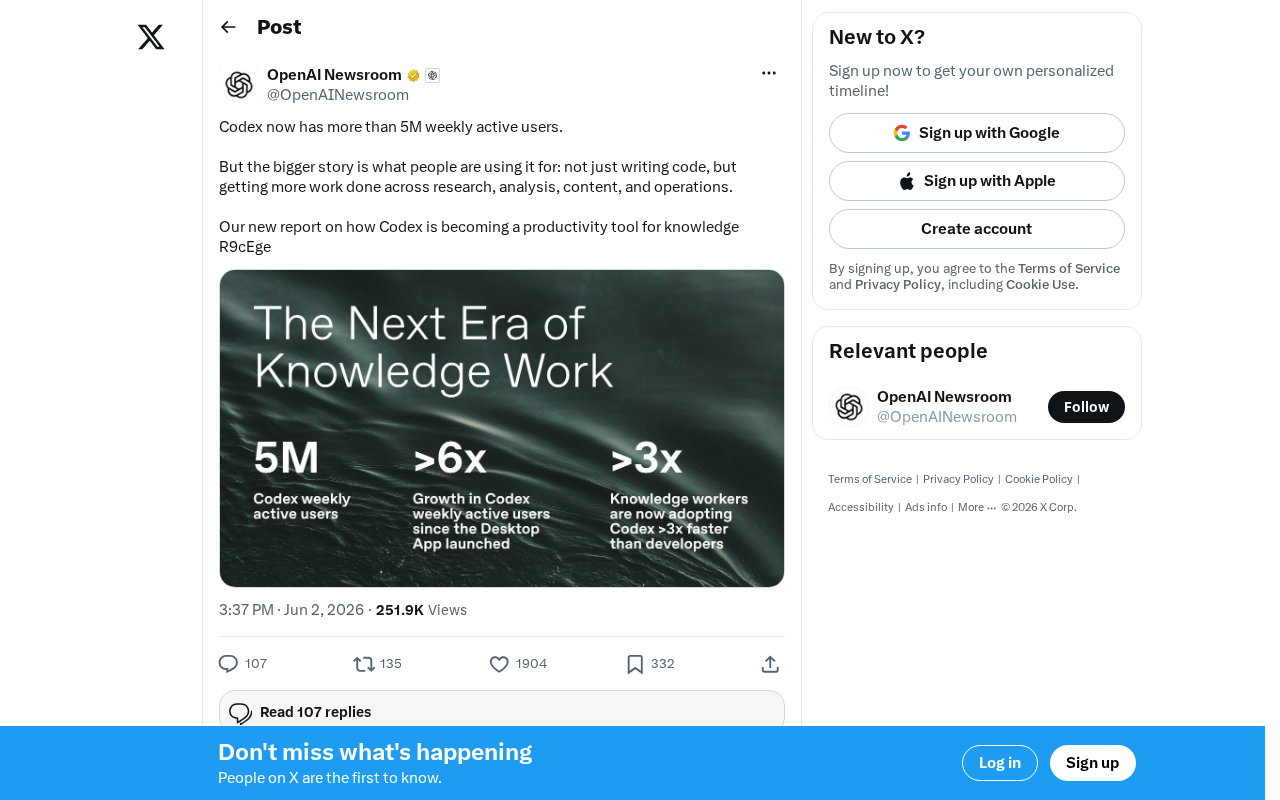
OpenAI Codex surpasses 5M WAU, evolving from a coding tool into a broad knowledge work platform.
OpenAI's Codex has crossed 5 million weekly active users, but the real story is its transformation from a code generation tool into a comprehensive knowledge work platform. Users now leverage Codex for research, data analysis, content creation, and operations management. This shift signals a paradigm change in AI productivity tools, blurring the lines between programming and general knowledge work, reshaping competitive dynamics across the AI tools market.
Codex's Milestone Moment
OpenAI recently announced that its AI programming tool Codex has surpassed the 5 million weekly active users mark. However, what's even more noteworthy than the number itself is the fundamental shift in how users are engaging with Codex — it's no longer just a coding assistant, but is evolving into a comprehensive knowledge work productivity tool spanning research, analysis, content creation, and operations management.
This transformation marks a significant identity leap for AI programming tools: from an exclusive power tool for developers to a platform serving the broader knowledge worker community.
From Code Generation to Knowledge Work: Codex's Expanding Use Cases
More Than Just Writing Code
Codex was initially known as the core engine behind GitHub Copilot, primarily serving software developers' code completion and generation needs. From a technical evolution perspective, OpenAI Codex was first released in 2021 as a code generation model fine-tuned from GPT-3, trained on billions of lines of publicly available source code. With the release of more powerful models like GPT-4, Codex's capabilities have far exceeded its original code completion functionality — its deep understanding of natural language enables it to handle a much broader range of knowledge work tasks. In 2025, OpenAI repositioned Codex as a programming and knowledge work agent within the ChatGPT ecosystem, supporting asynchronous task execution and multi-step reasoning.
According to OpenAI's latest report, users are applying Codex to scenarios well beyond the scope of programming:
- Research & Analysis: Using Codex for data analysis tasks, literature reviews, and information retrieval
- Content Creation: Assisting with writing documents, reports, and various text content
- Operations Management: Automating routine workflows and improving operational efficiency
This expansion of use cases is no accident. When a tool is powerful enough and easy to use, users naturally explore its boundaries, applying it to domains its original designers never envisioned. From a technical standpoint, the reason large language models can bridge the gap between programming and general knowledge work lies in the Transformer architecture's universal ability to process sequential data. Code is essentially a structured language, while natural language text, data analysis logic, and research reports are all different forms of sequential information. When a model is trained on massive multimodal datasets, it learns to translate and reason across these different "languages" — which explains why a system originally designed for code generation can naturally extend to document writing, data interpretation, and other tasks.
The Signal Behind 5 Million WAU
The figure of 5 million weekly active users is already quite impressive — it means millions of people are integrating Codex into their daily workflows every week, rather than just trying it out occasionally. This high-frequency usage indicates that Codex has transitioned from an "experimental tool" to "indispensable productivity infrastructure."
It's worth noting that Weekly Active Users (WAU) is a key metric for measuring product stickiness, and compared to Monthly Active Users (MAU), it better reflects users' actual usage frequency and dependency. In the SaaS industry, a WAU/MAU ratio (commonly known as the "stickiness ratio") above 40% is considered excellent. Five million WAU means Codex has reached the user scale that mature productivity tools like Slack and Figma achieved in their early stages — and these users are engaging consistently every week, indicating the product has become deeply embedded in users' core workflows.
By comparison, many SaaS products take years of development to reach this user scale, while Codex achieved this breakthrough in a relatively short period, reflecting the market's strong demand for AI-assisted knowledge work.
A Paradigm Shift in AI Productivity Tools
Redefining Knowledge Work
Codex's evolution reflects a broader macro trend: AI tools are redefining the boundaries of "knowledge work." Traditionally, programming, writing, and data analysis were viewed as relatively independent skill domains requiring different specialized tools. Codex is blurring these boundaries — the same AI assistant can help you write a Python script and assist you in completing a market analysis report.
The implications of this convergence are profound:
- Lower Skill Barriers: Knowledge workers without technical backgrounds can now leverage AI to accomplish tasks that previously required specialized skills
- Workflow Integration: No more switching between multiple specialized tools — a single AI platform can cover diverse needs
- Multiplied Productivity: When research, analysis, coding, and content creation can seamlessly connect within the same environment, overall efficiency improves dramatically
Shifting Competitive Landscape
Codex's expansion is also reshaping the competitive landscape of the AI tools market. It's no longer competing solely with programming tools like GitHub Copilot and Cursor, but is beginning to compete with a broader range of AI productivity tools such as Notion AI and various AI writing assistants.
The current AI programming tools market features a multi-polar competitive dynamic: GitHub Copilot leverages the Microsoft ecosystem and VS Code's massive user base for a first-mover advantage; Cursor, as an AI-native IDE, attracts professional developers with its deeply integrated editing experience; Replit and Windsurf target full-stack development and AI agent directions. In the broader AI productivity tools space, products like Notion AI, Jasper, and Copy.ai each occupy their respective niches. Codex's cross-domain expansion means these previously independent markets are converging, potentially giving rise to a "super AI work platform" competitive landscape in the future. This cross-boundary competition will accelerate innovation across the entire industry.
Looking Ahead: Where AI Tools Go Next
Codex's transformation from a programming tool to a general-purpose knowledge work platform may be just a microcosm of AI tool evolution. As large language model capabilities continue to improve, we'll likely see more AI tools originally positioned for vertical domains begin to "break out" and expand into broader application scenarios.
For both enterprise and individual users, now is a good time to reassess AI tool strategies. Rather than viewing AI tools as assistants for specific tasks, it's better to treat them as platform-level infrastructure for enhancing overall knowledge work efficiency.
Five million weekly active users is just the beginning. When AI truly integrates into every aspect of knowledge work, our very understanding of "productivity" will be rewritten.
Related articles

OpenAI CFO Sarah Fryer on How AI Is Reshaping Finance
OpenAI CFO Sarah Fryer shares real-world AI applications in finance teams, including investor relations GPTs, full-coverage auditing, tax automation, and career advice for the AI era.
GDScript Beginner's Guide: Learning Godot Game Development with AI Assistance
GDScript is Godot's native scripting language with clean syntax and broad platform support. Learn GDScript basics, Cursor AI setup, and effective AI-assisted game development workflows.

Three Forms of AI: From Chat Windows to Collaborative Work to Command Line
AI isn't just a chat window. This article explains AI's three forms: Chatbox, Cowork, and CLI, with selection advice for Claude, Codex, Kimi, and DeepSeek.