OpenAI Content Moderation API Upgrade: Technical Analysis of Unified Generation and Moderation

OpenAI embeds content moderation scores directly into its generation APIs, eliminating the need for separate safety calls.
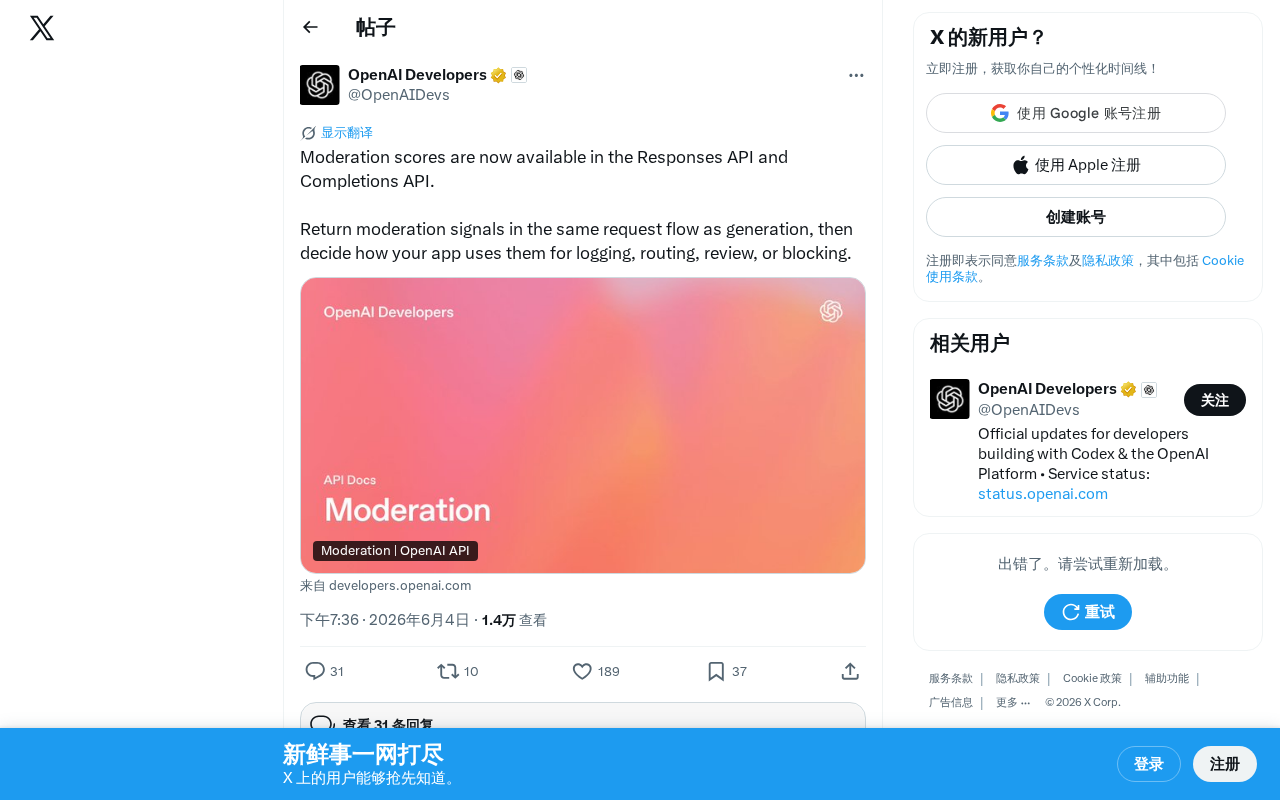
OpenAI now returns moderation scores directly within Responses API and Completions API responses, allowing developers to generate content and assess safety risks in a single call. This eliminates the latency and complexity of separate moderation requests, enables granular risk strategies through continuous scoring, and signals a broader industry shift toward embedding AI safety as a native infrastructure component.
The Core Change: Moderation Signals Returned Alongside Generation
OpenAI recently announced that its Responses API and Completions API now support Moderation Scores. This means developers no longer need to make separate moderation calls — they can obtain both generation results and moderation signals within a single request flow.
This change may seem simple on the surface, but its implications for AI application security architecture are profound.
Why Unified Content Moderation Matters
The End of Two-Call Workflows
Previously, developers who wanted to safety-check AI-generated content typically had to follow a two-step process: first call the generation API to get the text, then call the standalone Moderation API to scan the output. OpenAI's Moderation API was originally launched in 2022 as an independent endpoint designed to help developers detect harmful content such as hate speech, self-harm, violence, and sexual content. Built on a purpose-trained classification model, it provides probability scores across multiple category dimensions for input text. Before its introduction, developers typically relied on keyword filtering or third-party content moderation services (such as Google's Perspective API or Amazon Comprehend) — solutions that either lacked precision or carried high integration costs. The Moderation API lowered the barrier for basic content screening, but its architecture as a standalone endpoint meant every moderation check required an additional API call.
This two-step pattern had clear drawbacks:
- Increased request latency (two network round-trips)
- Higher architectural complexity
- Doubled costs in high-concurrency scenarios
Now, moderation scores are embedded directly in the generation response, completing the full generate + moderate workflow in a single call.
It's worth noting that this moderation scoring feature covers both the Responses API and the Completions API. The Completions API is OpenAI's earliest text generation interface, using a simple prompt-in, completion-out pattern. The Responses API, introduced in early 2025, is the next-generation interface with native support for tool use, file search, code interpreter, and more structured output management. The fact that both interfaces received moderation capabilities simultaneously signals OpenAI's intent to provide consistent safety features across legacy and modern APIs, while also guiding developers toward the more modern Responses API.
Flexible Moderation Strategy Implementation
According to the official documentation, developers can decide their own handling logic based on the returned moderation signals. Key use cases include:
- Logging: Store moderation scores for subsequent analysis and compliance auditing
- Routing: Direct requests to different processing pipelines based on risk level
- Review: Flag medium-risk content for human review and intervention
- Blocking: Immediately block high-risk content from reaching end users
This "provide signals, don't make decisions" design philosophy gives developers maximum flexibility. A key design choice here is the use of continuous scores rather than binary judgments. Traditional content moderation systems typically operate in a black-and-white mode — content either passes or gets blocked. But different business contexts have vastly different risk tolerances; for example, a children's education platform and an adult social platform have entirely different standards. Continuous scores return probability values between 0 and 1, indicating the degree of risk across various dimensions. Developers can set different thresholds according to their business needs: for instance, auto-approve below 0.3, queue for human review between 0.3 and 0.7, and block outright above 0.7. This tiered mechanism allows a single moderation system to serve applications with different risk appetites, significantly improving the granularity of moderation strategies.
Technical Significance and Industry Trends
AI Safety: From Standalone Module to Embedded Component
This update reflects a clear trend: AI content safety is evolving from a standalone module into an embedded component of the generation pipeline. It's analogous to the evolution of security middleware in modern web frameworks — from bolt-on firewalls to built-in request interceptors.
This analogy maps to an important chapter in web security architecture history. Early web application security primarily relied on independently deployed Web Application Firewalls (WAFs), which acted as reverse proxies to intercept malicious requests but were completely decoupled from application logic and unable to understand business context. As modern web frameworks like Express.js and Django gained popularity, security features gradually became embedded in application frameworks as middleware — CSRF protection, XSS filtering, rate limiting all became built-in framework components. This evolution brought lower integration costs, better context awareness, and finer-grained control. AI content safety is undergoing a similar paradigm shift — from standalone moderation API calls to embedded signals within the generation flow, safety capabilities are becoming a native part of AI infrastructure.
Practical Impact on AI Application Developers
For teams building AI applications, this means:
- Lower safety compliance barriers: No need to integrate additional third-party moderation services
- Real-time risk control becomes standard: Moderation latency drops to negligible levels
- Granular strategies become possible: Design tiered response policies based on continuous scores rather than binary judgments
Key Considerations Before Integration
Of course, there are aspects of this unified approach worth monitoring: How tightly coupled are the moderation and generation models? Are the scoring dimensions and granularity sufficient? How does it perform in streaming output scenarios? These are critical questions developers need to evaluate during actual integration.
Among these, moderation in streaming output scenarios deserves deeper discussion. Streaming output refers to model-generated tokens being returned to the client incrementally rather than waiting for the complete response. This pattern is widely used in chat applications because it significantly reduces perceived Time to First Token (TTFT), creating an experience similar to someone typing in real time. However, streaming introduces unique challenges for content moderation: partially generated text may be semantically incomplete, making it difficult for moderation models to judge accurately; harmful content may be distributed across multiple chunks, and moderating each chunk individually could produce numerous false positives. Common industry solutions include sliding window moderation (periodically checking accumulated text) and post-hoc moderation (performing a final check on complete text after streaming finishes and deciding whether to retract). How OpenAI balances moderation accuracy with real-time performance in streaming scenarios will be an important consideration for developers evaluating this feature.
Conclusion
OpenAI's direct integration of content moderation capabilities into its generation APIs marks a milestone in the maturation of AI application security infrastructure. It lowers the barrier for developers building safe AI applications while preserving enough flexibility for teams to customize their moderation strategies. For any user-facing AI product, this is a feature update worth immediate attention and evaluation.
Related articles

Complete Guide to Codex Installation & DeepSeek Integration Troubleshooting
Complete troubleshooting guide for Codex installation and DeepSeek API integration, covering 401/402/502 errors, model display issues, startup failures, and a universal fix.

Anthropic Sales Rep Builds AI Tools with Claude, Transforms from Account Executive to GTM Architect
Anthropic account exec Jared built Clasps, an AI email tool using Claude and RAG architecture, saving 2-3 hours daily and transforming into a GTM Architect.

v0 Snowflake Integration Enters Public Preview: Generate Data Dashboards with Natural Language
Vercel's v0 announces public preview of Snowflake integration, enabling users to connect data sources and auto-generate professional dashboards using natural language prompts.