OpenAI Launches Daybreak: Core Capabilities of the AI Cyber Defense Platform

OpenAI launches Daybreak, an AI-powered cybersecurity platform to accelerate defense response from days to minutes.
OpenAI has officially unveiled Daybreak, a cybersecurity defense platform integrating its most powerful AI models, the Codex programming agent, and a security partner ecosystem. The platform aims to address the critical attack-defense speed asymmetry by compressing response times from days to minutes through automated alert triage, intelligent threat correlation, and response orchestration. Daybreak signals OpenAI's strategic push into vertical industries and intensifies AI competition in cybersecurity alongside Google, Microsoft, and traditional security vendors.
OpenAI Enters Cybersecurity: Daybreak Platform Officially Unveiled
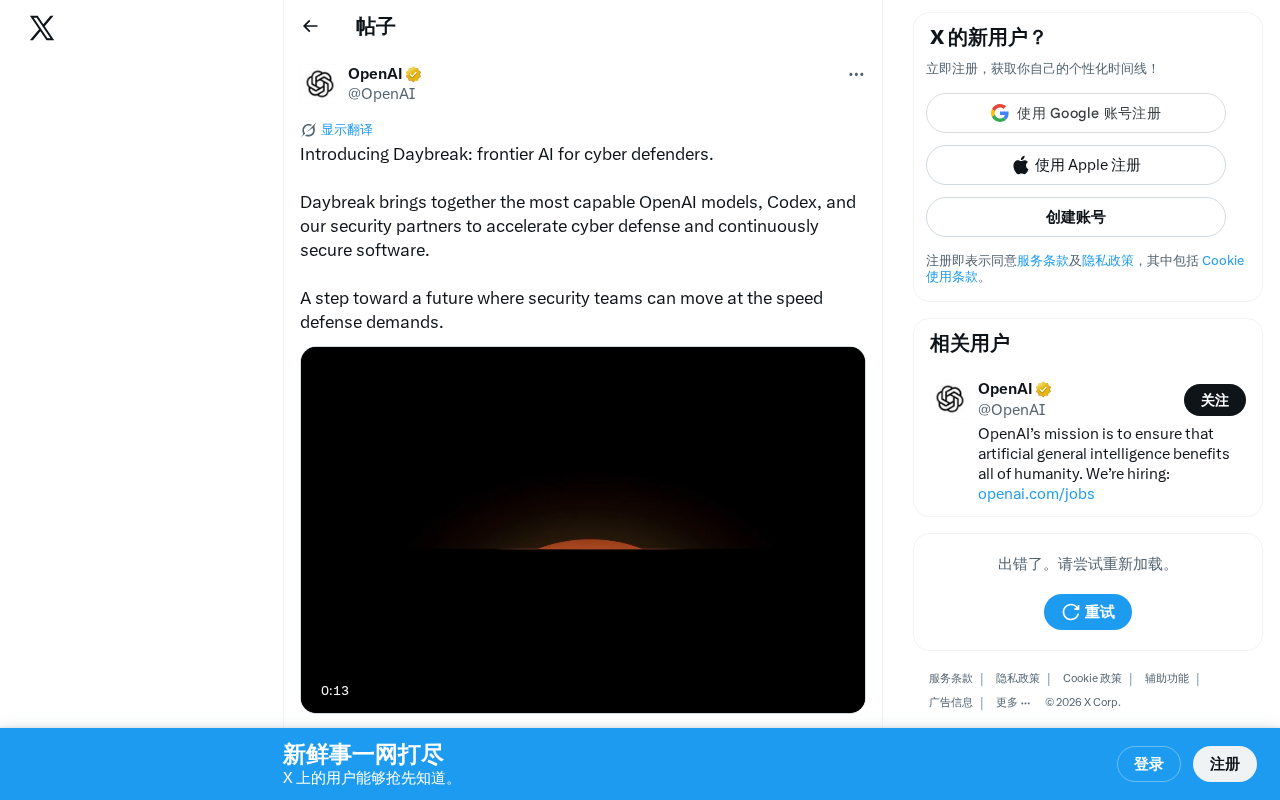
OpenAI has officially launched a new platform called Daybreak, an AI tool built specifically for cybersecurity defenders. Daybreak integrates OpenAI's most powerful model capabilities, the Codex programming agent, and resources from security partners, with the goal of accelerating cyber defense response and continuously securing software.
This move marks a significant shift for OpenAI from being a general-purpose AI tool provider to deeply investing in vertical industries, with cybersecurity as one of its key breakthrough areas.
Daybreak's Core Architecture and Capabilities Breakdown
Three Pillars: Models + Tools + Ecosystem
Daybreak's architecture is built on three core pillars:
- Most Powerful AI Models: Integrates OpenAI's most advanced large language models, providing robust reasoning and comprehension capabilities for security analysis
- Codex Programming Agent: Leverages Codex's code generation and analysis capabilities to enable automated vulnerability detection, code auditing, and security patch generation
- Security Partner Ecosystem: Deep collaboration with industry security vendors to ensure the platform covers real-world threat scenarios
This "models + tools + ecosystem" trinity architecture makes Daybreak more than just a point solution—it's a complete cyber defense acceleration platform.
It's worth diving deeper into Codex, which is far from an ordinary code tool. Codex is an AI system that OpenAI fine-tuned specifically for code comprehension and generation based on the GPT series of models. It first gained widespread recognition in 2021 as the underlying engine powering GitHub Copilot. Codex can understand dozens of programming languages and not only generates code from natural language descriptions but also performs semantic-level analysis, refactoring, and vulnerability identification on existing code. In cybersecurity scenarios, Codex's value lies in its ability to "read" code like an experienced security engineer, identifying common vulnerability patterns such as buffer overflows, SQL injection, and cross-site scripting attacks, and automatically generating remediation patches. As OpenAI has upgraded Codex into an "agent" with autonomous execution capabilities, it has evolved from a passive code completion tool into an autonomous system capable of proactively executing multi-step security audit tasks.
Addressing Security Teams' Core Pain Points
In its release announcement, OpenAI mentioned a key vision: enabling security teams to operate at the speed defense requires. This statement precisely identifies the core contradiction in today's cybersecurity industry—the severe asymmetry in attack-defense speed.
In the traditional model, attackers can leverage automated tools to launch attacks within minutes, while defenders often need hours or even days to complete threat identification, analysis, and response. This attack-defense speed asymmetry is a long-standing structural challenge in cybersecurity. According to IBM's 2024 Cost of a Data Breach Report, organizations take an average of approximately 194 days to identify a data breach, while attackers' window from discovering a vulnerability to launching an exploit may be just hours. This asymmetry stems from multiple factors: attackers only need to find one entry point, while defenders must protect all of them; security teams face massive alert volumes (large enterprises may receive tens of thousands of security alerts daily), many of which are false positives, making manual analysis extremely inefficient; additionally, the global cybersecurity talent gap exceeds 4 million professionals, further intensifying pressure on the defense side.
With AI intervention, Daybreak has the potential to compress defense response time from "days" to "minutes," fundamentally narrowing the time gap between attack and defense through automated alert triage, intelligent threat correlation analysis, and automated response orchestration.
Industry Landscape Impact and Strategic Significance
The AI Security Track Enters Fierce Competition
Daybreak's launch is not an isolated event but rather a microcosm of AI giants collectively entering the cybersecurity space. Before Daybreak's release, the AI security track had already attracted multiple heavyweight players. Google launched its Google Threat Intelligence platform in 2024, integrating Mandiant's threat intelligence capabilities with Gemini model analytics, and open-sourced the Magika file type identification tool. Microsoft's Copilot for Security became commercially available in April 2024, built on GPT-4 and Microsoft's massive security telemetry data (processing over 78 trillion security signals daily), providing security analysts with natural language-driven threat investigation and incident response capabilities. Additionally, traditional security vendors like CrowdStrike with Charlotte AI and Palo Alto Networks with Cortex XSIAM are actively integrating generative AI into their products.
OpenAI's entry means that AI competition in cybersecurity has officially escalated. Compared to competitors, OpenAI's unique advantages lie in two areas: first, the leading edge of its model capabilities, and second, Codex's deep expertise in code comprehension. Cybersecurity is inherently highly dependent on code analysis and logical reasoning, which happens to be exactly where large language models excel. However, OpenAI lacks the massive first-party security telemetry data that Microsoft and Google possess, which is a key reason it chose to build a security partner ecosystem to compensate for this gap through external data sources.
From Passive Defense to Continuous Security Assurance
Notably, OpenAI used the phrase "continuously secure software" when describing Daybreak. This suggests that Daybreak's design philosophy is not the traditional passive model of "find vulnerability, fix vulnerability," but rather a continuous security assurance mechanism embedded throughout the entire software development lifecycle.
This "shift-left security" philosophy aligns closely with the industry trend of DevSecOps. DevSecOps is a methodology that deeply embeds security practices into DevOps (Development and Operations integration) workflows, with the core principle of moving security detection and protection from the traditional post-deployment phase forward to the development and build phases. In traditional software development models, security testing is typically performed only when a product is about to go live, at which point the cost of fixing discovered vulnerabilities is extremely high and they are often overlooked due to launch pressure. Shift-left security requires embedding automated security checks at every stage—code writing, code commits, continuous integration (CI), and continuous deployment (CD). CI/CD pipelines are the core infrastructure of modern software engineering, where the entire process from code commit to deployment is completed through automated pipelines. If Daybreak can serve as an automated security checkpoint within CI/CD pipelines, it means every code change would undergo AI-driven security review, achieving true "continuous security"—which would have a profound impact on the entire software security industry.
Outlook and Action Recommendations for Security Practitioners
Information disclosed about Daybreak remains limited, with several key questions yet to be answered: What specific security scenarios does it support? What's the pricing model? How does it integrate with existing security tool chains? These details will determine whether Daybreak can move from concept to large-scale deployment.
But one thing is already crystal clear: AI is redefining the rules of the cybersecurity game. When attackers are already using AI to generate phishing emails and write malicious code, defenders who don't embrace AI will face an ever-widening capability gap. In fact, attackers' use of AI technology has already moved from theory to practice. Since 2023, security research institutions have observed a significant increase in attack cases using large language models to generate highly personalized phishing emails that can mimic specific individuals' writing styles, making them difficult for traditional template-matching anti-phishing systems to detect. Even more concerning, AI is lowering the barrier to malware development—even attackers without deep programming skills can use AI tools to generate fully functional ransomware or remote access trojans. Tools specifically designed for cybercriminals, such as WormGPT and FraudGPT, are already circulating on the dark web. In this context, if defenders continue to rely on purely manual security operations models, they will face an increasingly widening capability gap.
Daybreak's emergence provides security teams with a noteworthy new option. For security practitioners, it's time to seriously consider how to integrate AI into daily security operations workflows—this is no longer a question of "whether to use it" but "how quickly to implement it."
Key Takeaways
Related articles

Claude Code for Test Development in Practice: An AI Programming Workflow That Doubles Your Efficiency
A practical guide to Claude Code for test development: auto-generating test scripts, Plan Mode workflows, MCP + Playwright integration, and Subagent parallel tasks to build systematic AI-assisted workflows.

Hermes Agent Hands-On Review: An AI Efficiency Revolution for Indie Game Developers
Indie game developer reviews Hermes Agent vs OpenClaude: intelligent context compression, real-time Memory, remote control via Telegram, and practical use cases in game dev, social media, and email.
Vibe Coding Beginner's Guide: Tool Selection Across Three Categories with Practical Examples
A comprehensive guide to Vibe Coding's three tool categories: Agent frameworks, CLI Coding, and IDE tools, with practical examples including Snake game and data analysis workbench.