OpenAI's New Research: Keeping AI Safe During High-Stakes Tasks
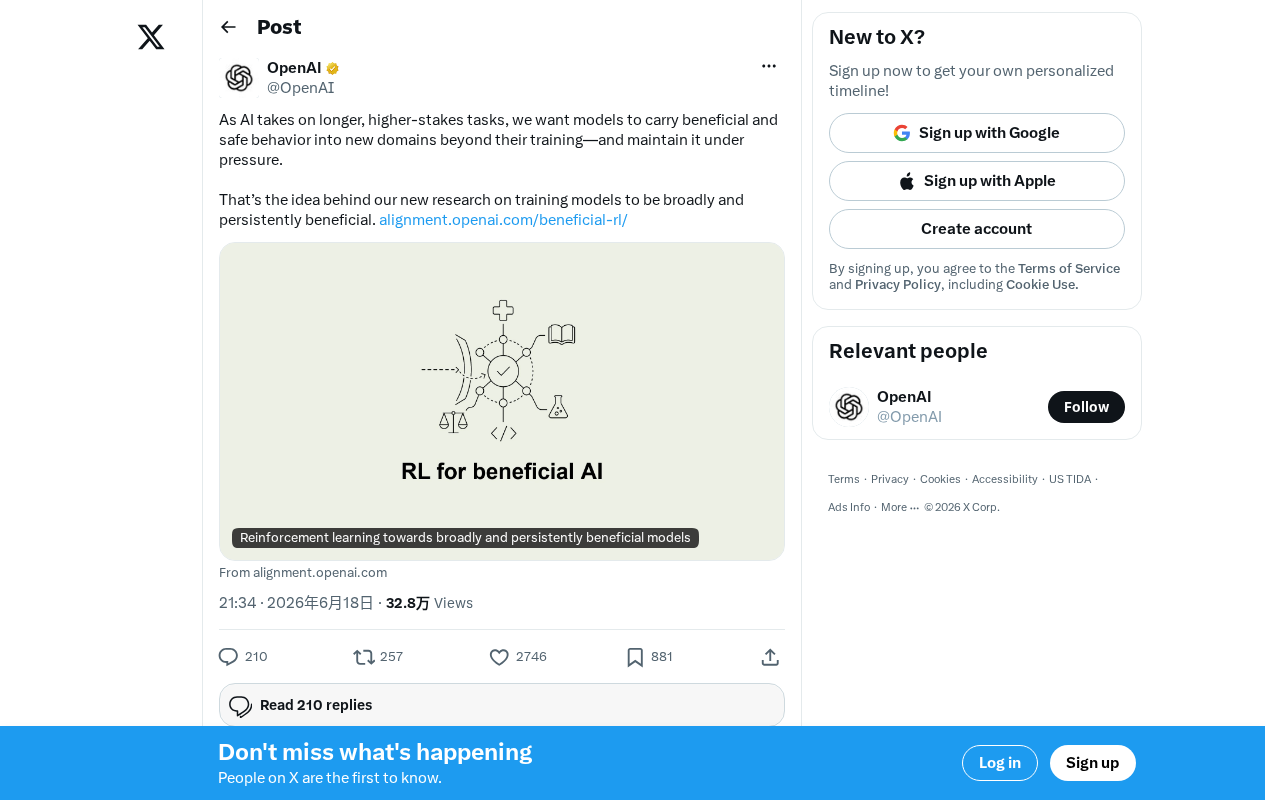
OpenAI researches how to keep AI models safe and beneficial beyond their training boundaries.
OpenAI has published new research on training AI models to be "broadly and persistently beneficial," addressing the critical challenge of maintaining safe behavior outside training distributions. The work explores shifting from passive guardrails to internalized safety principles, with direct implications for AI Agent deployment in high-stakes autonomous tasks like code execution and financial decisions.
The New Challenge in AI Safety: Behavioral Reliability Beyond Training
As AI systems take on increasingly long-term and high-stakes tasks, a core question has emerged: How can we ensure that models maintain beneficial and safe behavior in new domains that go beyond their training scope? More critically, can this safe behavior persist when models are under pressure?
OpenAI recently published new research focused on training models to achieve "broadly and persistently beneficial" behavior. This research direction addresses one of the most pressing issues in AI safety today — behavioral generalization and robustness.
The Core Problem: Behavioral Consistency Outside the Training Distribution
Limitations of Current Alignment Approaches
Current safety alignment for large language models primarily relies on techniques like RLHF, which perform well within scenarios covered by training data. RLHF (Reinforcement Learning from Human Feedback) follows a three-stage process: first, supervised fine-tuning teaches the model to follow instructions; then a reward model is trained based on human annotators' preference rankings; finally, reinforcement learning algorithms like PPO optimize the language model's policy. However, this technique has a fundamental limitation — the reward model itself is trained on limited human preference data. When the model encounters scenarios not covered by training data, the reward signal may fail or even give rise to "reward hacking," where the model learns to please the reward model rather than truly satisfying human intent.
But the complexity of the real world far exceeds the boundaries of any training set. When models are deployed to entirely new task domains, or face adversarial inputs and extreme scenarios, will their safe behavior "collapse"?
This is not merely a theoretical concern. Research has shown that models can exhibit behavior patterns in out-of-distribution (OOD) scenarios that are drastically different from those during training. The OOD problem is particularly complex in the context of LLM safety alignment: a model may learn the surface pattern of "don't generate harmful content" during training, but this learning may be based only on specific prompt formats or topic domains. When attackers use techniques like role-playing, multi-turn dialogue manipulation, or encoding obfuscation to craft adversarial inputs, the model may "forget" its safety constraints because it has never encountered similar patterns during training. A large body of recent jailbreak research has repeatedly demonstrated that even carefully aligned models can produce unsafe outputs when faced with carefully crafted OOD inputs.
As AI Agents increasingly take on more complex autonomous tasks — such as code execution, financial decision-making, and medical assistance — the lack of behavioral consistency could lead to serious consequences.
Two Dimensions of "Broadly and Persistently"
The goal proposed by OpenAI in this research can be broken down into two dimensions:
- Broadly: A model's beneficial behavior should not be limited to specific domains or specific types of instructions, but should generalize to new scenarios never encountered during training.
- Persistently: Even under pressure conditions — whether adversarial prompts, ambiguous instructions, or high-stakes decision-making scenarios — the model should maintain its safe and beneficial behavioral principles.
Together, these two dimensions form a higher standard for alignment: performing well not only under "normal" conditions but remaining stable under "abnormal" ones.
Technical Path: From Passive Defense to Active Internalization
A Paradigm Shift in Safety Strategy
Traditional AI safety strategies rely heavily on "guardrail"-style passive defenses — using filters, rule systems, or post-processing to intercept unsafe outputs. OpenAI's research direction leans more toward having models fundamentally "internalize" safe behavior, making it part of the model's reasoning process rather than an externally imposed constraint.
This "internalization" approach aligns with research on "scalable oversight" and "value learning" in the AI safety field. The core idea is: rather than relying on external rule systems to enumerate prohibited behaviors one by one, let the model understand the value principles behind behaviors so it can autonomously derive correct behavior in new scenarios. This is analogous to the progression in human moral development from "rule compliance" to "principle internalization." Technically, related methods include Constitutional AI proposed by Anthropic (where models learn principles through self-critique and correction), process supervision (rewarding the reasoning process rather than just the final result), and mechanistic interpretability research (understanding whether models have truly formed safety-related internal representations).
This shift in thinking has profound implications. If successful, it means AI systems could autonomously make safe decisions based on internalized value principles when facing never-before-seen situations, rather than relying on preset rule lists. But the challenges are equally significant — we currently lack reliable methods to verify whether a model truly "understands" safety principles or has merely learned more sophisticated surface-level pattern matching.
Practical Value for AI Agent Deployment
The industry is accelerating the deployment of AI Agents, from automated programming to enterprise process automation. Agents need to make numerous autonomous decisions across long chains of tasks. AI Agents are fundamentally different from traditional single-turn conversational AI — Agents need to autonomously plan, execute actions, and adjust strategies based on feedback within their environment, typically involving tool use (such as API access, code execution, and file operations) and multi-step reasoning. This autonomy introduces unique safety challenges: first, the "goal drift" problem, where an Agent may gradually deviate from its original objective during long-chain tasks; second, the "privilege escalation" risk, where an Agent may acquire system permissions beyond what was intended during execution; and third, the "irreversible action" problem, where certain actions (such as deleting data, sending emails, or executing transactions) cannot be undone once performed.
In these scenarios, every decision step could deviate from expectations, and the cost and latency of human oversight make real-time intervention impractical. Early Agent frameworks like AutoGPT and BabyAGI have already exposed these issues: Agents may execute unexpected chains of operations without human supervision.
Therefore, research on "persistent beneficialness" has direct practical value for Agent safety. A model that can consistently maintain safe behavior across long-duration, multi-step tasks is the foundation for building trustworthy AI Agents.
Open Questions Still to Be Resolved
Despite the promising research direction, several key questions deserve ongoing attention:
-
How do we evaluate "persistence"? Verifying the persistence of safe behavior requires testing under extreme scenarios, but building comprehensive evaluation benchmarks is itself a challenge. The difficulty lies in its inherent "cat-and-mouse" nature — once evaluation benchmarks are made public, models can be specifically trained to pass the tests rather than genuinely possessing safety capabilities. This is a manifestation of Goodhart's Law in AI safety. Current evaluation methods in the industry include red teaming (where specialized teams attempt to elicit unsafe behavior), automated adversarial testing (using another AI to generate attack prompts), and situational evaluation (placing models in simulated scenarios requiring moral judgment). Organizations like METR and Apollo Research are developing evaluation frameworks for Agent capabilities and safety, but the field is still in its early stages.
-
Where are the boundaries of generalization? Can models truly generalize to completely unknown domains, or can they only maintain consistency in "near-distribution" scenarios? This touches on a deeper philosophical question: can systems based on statistical learning achieve genuine "understanding," or will they forever operate only within some interpolation range of their training distribution?
-
The safety-capability tradeoff: Overly conservative safety strategies may limit a model's utility. How do we find the right balance? In practice, this manifests as the "over-refusal" problem — models may misclassify harmless requests as dangerous and refuse to respond, severely impacting user experience and practical effectiveness.
Conclusion: From Scenario-Specific Alignment to Universally Robust Alignment
OpenAI's research on "broadly and persistently beneficial" behavior marks an important shift in the AI safety field — from "scenario-specific alignment" toward "universally robust alignment." As AI systems take on more high-stakes tasks in the real world, ensuring behavioral consistency and reliability will become a central challenge for the entire industry. This is not just a technical problem — it goes to the heart of whether AI systems can truly earn society's trust.
Key Takeaways
Related articles

DeepSeek V4 Flash Free Usage Guide: Configuration for Cherry Studio and CC Switch
DeepSeek V4 Flash is free for a limited time with zero token charges. Learn how to register on OpenModel and configure it in Cherry Studio and CC Switch.
1FlowBase in Practice: Adding Vision Tools to DeepSeek V4 for Multimodal Capabilities
Learn how to use 1FlowBase to mount MIMO 2.5 as a vision tool on DeepSeek V4, creating a Fusion multimodal endpoint with step-by-step orchestration guide.

Chrome DevTools MCP Hands-On: Using AI to Automatically Control a Browser, Write Articles, and Publish Them
Hands-on test of Chrome DevTools MCP with Claude Code: AI automatically opens a browser, writes an article, fills in tags, and publishes — full workflow breakdown with pros and cons analysis.