OpenAI Sites Explained: Codex One-Click Generation of Shareable Interactive Apps
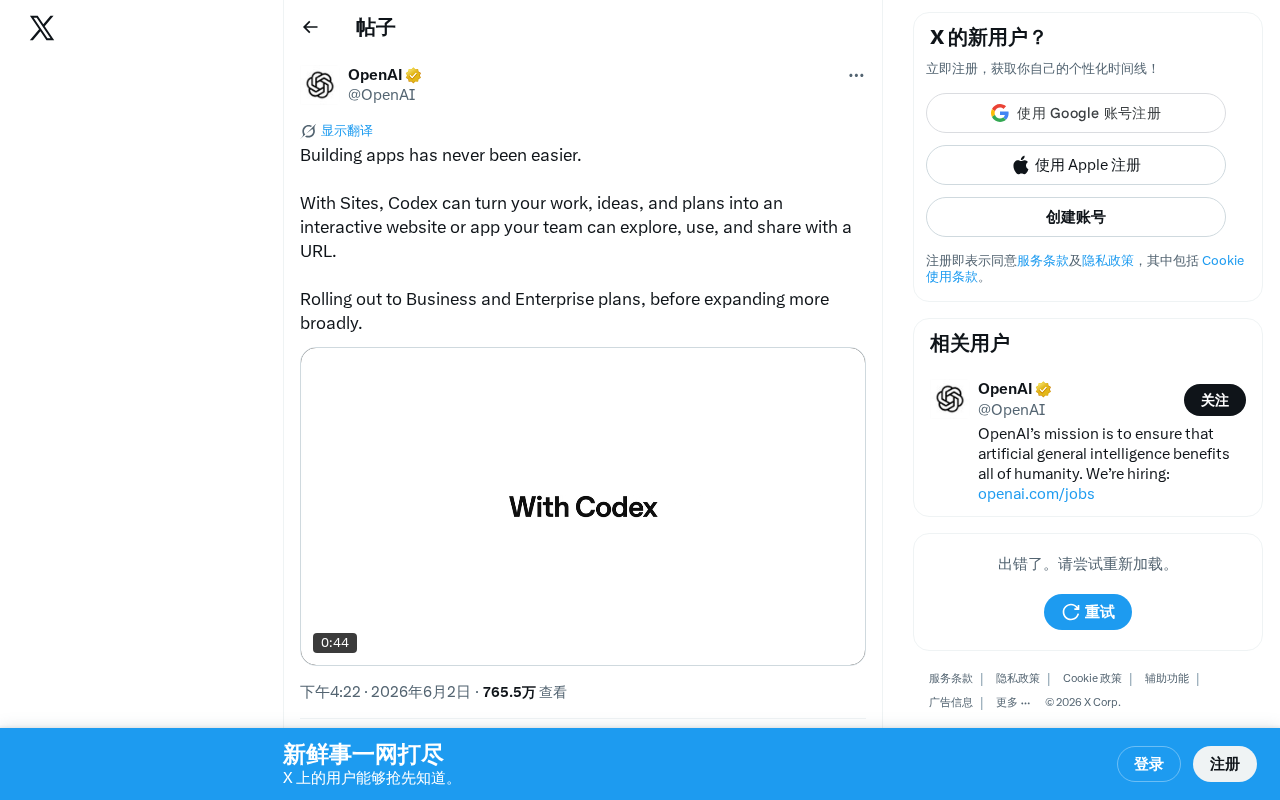
OpenAI Sites lets Codex generate deployable interactive apps from natural language, shareable via URL.
OpenAI launched Sites, a new feature that enables Codex to transform natural language descriptions into fully functional interactive websites and applications, shareable via URL. Initially available to Business and Enterprise users, Sites eliminates the technical barrier between ideas and deployed products, competing with tools like Cursor, Bolt.new, and Replit while leveraging OpenAI's massive user base and ChatGPT integration as key differentiators.
Overview
OpenAI recently announced the launch of its new Sites feature, enabling Codex to transform users' work outputs, ideas, and plans directly into interactive websites or applications that can be shared with team members via URL. This feature is being gradually rolled out to Business and Enterprise plan users, with broader availability to follow.
Codex Technical Background
OpenAI Codex was originally a code generation system fine-tuned from GPT models, first launched in 2021 as the core engine behind GitHub Copilot. In 2025, OpenAI significantly upgraded Codex, repositioning it as a Cloud Software Engineering Agent capable of autonomously completing code writing, debugging, testing, and other full development workflows in sandboxed environments. Unlike the earlier version that only provided code completion suggestions, the new Codex can understand complex natural language instructions, autonomously plan task steps, and execute multi-step development work in isolated cloud environments. The Sites feature is built on top of this upgraded Codex agent capability, extending its output from code repositories to directly accessible deployed products.
Core Value of Sites
Zero-Barrier Transformation from Idea to Application
OpenAI stated in its official tweet: "Building apps has never been easier." The core positioning of Sites is to eliminate the technical gap between creative ideas and usable products. Users don't need programming backgrounds—they simply describe their needs to Codex, whether it's a workflow, business plan, or creative concept, and the system automatically generates a fully functional interactive website or application.
This means product managers can quickly turn prototype ideas into demonstrable products, marketing teams can instantly create campaign pages, and data analysts can transform reports into interactive dashboards. From a technical implementation perspective, such tools typically generate frontend code (HTML, CSS, JavaScript) combined with lightweight backend logic, then automatically deploy to cloud hosting environments—the entire process completely transparent to users.
Team Collaboration and Instant Sharing
Another major highlight of Sites is its collaboration capabilities. Generated applications come with URLs that team members can directly access, explore, and use without additional deployment processes or technical configuration. This dramatically reduces the cost of internal tool development and prototype validation.
Traditional internal tool development typically requires requirement submission, scheduling, development, testing, and deployment—cycles often measured in weeks or months. Sites compresses this to minutes, driving the cost of "idea validation" toward zero and encouraging more experimentation and iteration.
Business Strategy Analysis
Enterprise Users First
OpenAI's decision to open Sites to Business and Enterprise plan users first reflects several considerations:
- Monetization priority: Enterprise users are OpenAI's core revenue source, prioritizing the customer segment with the strongest paying capacity
- Use case validation: Enterprise environments have clearer application scenarios, helping collect high-quality feedback
- Security and compliance: Enterprise users have higher requirements for data security and access control, making it prudent to validate in controlled environments first
On the security front, enterprise users face multiple challenges when adopting AI-generated tools. Business requirement descriptions input into AI systems may contain sensitive commercial information, generated code may have unaudited security vulnerabilities, and URL-shared applications need to ensure only authorized personnel can access them. OpenAI's Business and Enterprise plans typically provide SOC 2 compliance certification, commitments that data won't be used for model training, SSO integration, and admin audit logs—these safeguards are important prerequisites for Sites deployment in enterprise environments.
Differentiation from Competitors
The market already has multiple AI code generation tools—Cursor, Bolt.new, Replit, and others—all attempting to lower the application development barrier. This space is in rapid expansion: Cursor is an AI-enhanced code editor that accelerates professional developer efficiency through deep LLM integration; Bolt.new, launched by StackBlitz, allows users to generate full-stack web applications directly in the browser via natural language prompts; Replit provides a cloud IDE environment whose AI assistant can help users build and deploy applications from scratch. Additionally, Vercel's v0, Lovable, and other products are competing in this space.
OpenAI's Sites feature is directly integrated into the Codex ecosystem, with differentiated advantages including: deep integration with ChatGPT (users can seamlessly trigger app generation during everyday conversations), OpenAI's model code generation quality (benefiting from continuous optimization in GPT-4 and subsequent models), and enterprise-grade security guarantees. More importantly, OpenAI has the largest paid user base, and Sites can directly reach millions of existing users—a distribution advantage that standalone startups cannot match.
Industry Impact and Future Outlook
This launch further confirms an important industry trend: AI is moving from "assisting programming" to "replacing programming". AI programming tools have evolved through several distinct phases: Phase 1 was code completion (like early TabNine), only predicting the next line of code; Phase 2 was conversational programming assistants (like ChatGPT, Claude), generating code snippets from descriptions but requiring manual integration; Phase 3 was agentic development (like Devin, Codex Agent), where AI autonomously completes multi-file, multi-step development tasks; and Phase 4, represented by Sites, is end-to-end product delivery—from requirement description directly to an accessible deployed product, with users never needing to touch code. The core driver of this evolution is the improvement in LLM reasoning capabilities and the maturation of Tool Use abilities.
The traditional software development process—requirements analysis, design, coding, testing, deployment—is being compressed by AI into a single-step operation from natural language description to usable product.
For non-technical knowledge workers, this means they can directly transform domain expertise into digital products without the intermediary of development teams. This will profoundly change enterprise collaboration models and the supply-demand dynamics of software development. From a broader perspective, this may catalyze an era of "citizen developers"—when everyone can build their own digital tools, software supply will shift from centralized development teams to distributed individual creation, and enterprise IT departments will transform from "requirement executors" to "platform governors."
However, it remains unclear what level of complexity, performance, and customizability Sites-generated applications can achieve. For simple internal tools and prototype demonstrations, this is undoubtedly an attractive solution; but for enterprise applications requiring complex backend logic, database transactions, third-party API integration, and large-scale concurrent access, its applicability boundaries remain to be observed. Additionally, the long-term maintenance of AI-generated applications—how to iterate when requirements change, how to debug when bugs appear—is also a key factor in determining whether such tools can truly replace traditional development workflows.
Key Takeaways
Related articles

Claude Code for Test Development in Practice: An AI Programming Workflow That Doubles Your Efficiency
A practical guide to Claude Code for test development: auto-generating test scripts, Plan Mode workflows, MCP + Playwright integration, and Subagent parallel tasks to build systematic AI-assisted workflows.

Hermes Agent Hands-On Review: An AI Efficiency Revolution for Indie Game Developers
Indie game developer reviews Hermes Agent vs OpenClaude: intelligent context compression, real-time Memory, remote control via Telegram, and practical use cases in game dev, social media, and email.
Vibe Coding Beginner's Guide: Tool Selection Across Three Categories with Practical Examples
A comprehensive guide to Vibe Coding's three tool categories: Agent frameworks, CLI Coding, and IDE tools, with practical examples including Snake game and data analysis workbench.