OpenCode + DeepSeek Zero-Code CAE Simulation Software Development: Building a Complete Engineering Platform for $7

AI Agent builds functional CAE simulation software with zero code for just $7 in total cost
A Bilibili creator used OpenCode (an open-source AI programming Agent) with DeepSeek LLM to develop a CAE simulation software featuring geometry rendering and post-processing visualization — entirely through zero-code methods during spare time, costing under $7. The software uses the OCC geometry kernel and VTK visualization framework with professional-grade technology choices, and plans to integrate a solver to form a complete simulation loop, showcasing AI programming's enormous potential in professional engineering software.
Introduction: AI Zero-Code Development of Professional Engineering Software
When we talk about AI programming, most people think of generating simple scripts or web pages. But what if someone is using an AI Agent to develop CAE (Computer-Aided Engineering) simulation software with zero code — a professional engineering application involving geometric modeling, mesh generation, numerical solving, and post-processing?
CAE is an indispensable technology in modern industrial design and manufacturing, widely used in aerospace, automotive, civil engineering, electronic thermal management, and more. A complete CAE software suite typically includes three major modules: pre-processing (geometric modeling and mesh generation), solver (solving partial differential equations using numerical methods like finite element or finite volume), and post-processing (result visualization and analysis). Commercial CAE software such as ANSYS, Abaqus, and COMSOL have been developed and iterated over decades, typically containing millions of lines of code with development teams of hundreds of people, and single license fees ranging from tens of thousands to hundreds of thousands of dollars per year. This is why developing such software through AI zero-code methods is so impactful.
A Bilibili content creator recently shared an impressive project update: using OpenCode (an open-source AI programming Agent) paired with the DeepSeek large language model, they developed a CAE software with basic functionality entirely through zero-code methods during their spare time, with total costs not exceeding 50 RMB (approximately $7 USD).
OpenCode is an open-source terminal-based AI programming Agent tool, similar to a command-line version of Cursor or GitHub Copilot Workspace. It can understand project context, generate and modify code across multiple files, execute commands, and iteratively fix issues based on feedback. Unlike simple code completion, Agent mode means the AI can autonomously plan tasks, decompose sub-goals, handle errors, and continuously push project progress forward — making complex multi-module project development possible. Users only need to describe requirements in natural language, and the Agent automatically handles code architecture design, file creation, dependency management, and all other work.
Current Project Progress: Core Modules Taking Shape
Software Interface and Overall Architecture
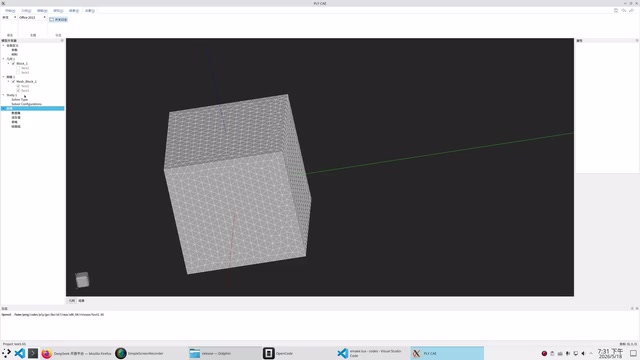
From the demo, this AI-developed CAE software already has the basic framework of professional software:
- Menu bar: Standard file operations and function entry points
- Model browser (left side): Tree navigation for project structure
- View window (center): 3D geometry and result visualization
- Properties window: Parameter configuration panel
- Log and status bar (bottom): Runtime status feedback
This layout is highly consistent with the interface logic of commercial CAE software (such as ANSYS, Abaqus), demonstrating that DeepSeek has considerable capability in understanding professional software architecture. DeepSeek is a large language model series developed by DeepSeek AI, with programming capabilities that perform excellently across multiple benchmarks. DeepSeek's training data covers extensive open-source code repositories, technical documentation, and academic papers, giving it deep understanding of technology stacks, design patterns, and best practices in professional engineering domains. In this case, DeepSeek not only generates correct code but also makes reasonable architectural decisions and technology selections — reflecting implicit knowledge learned from massive engineering practices that typically requires senior engineers years of accumulation to possess.
Geometry Rendering and Post-Processing Features
Core features currently implemented include:
Geometry module: Uses the OpenCASCADE (OCC) kernel for geometry rendering — an industrial-grade geometry engine commonly used in CAD/CAE software, capable of handling complex 3D geometries.
OpenCASCADE is an open-source industrial-grade geometric modeling kernel, originally developed by the French company Matra Datavision and later open-sourced. It provides complete B-Rep (Boundary Representation) geometric modeling capabilities, supporting Boolean operations, chamfers, fillets, surface modeling, and other complex operations. OCC is widely used in the open-source CAD software FreeCAD and numerous commercial CAE pre-processors. Choosing OCC as the geometry kernel means the software has the potential to handle industrial-grade complex geometries, rather than being limited to simple cubes or spheres.
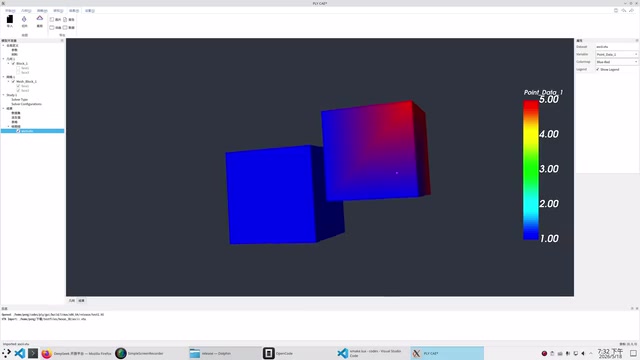
Post-processing module: Implements simulation result visualization based on VTK (Visualization Toolkit), supporting:
- Loading external VTU format result files
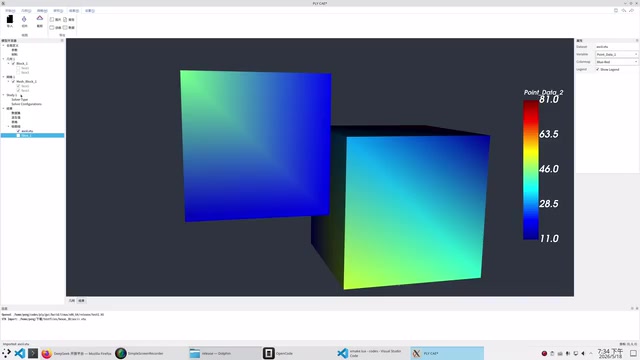
- Colorbar display with different colors corresponding to different values
- Multi-variable switching display
- Multiple colormap scheme switching
- Slice operations (cross-section viewing)
VTK is an open-source scientific data visualization library developed and maintained by Kitware, and is one of the most widely used visualization frameworks in scientific computing and engineering simulation. The well-known open-source post-processing software ParaView is built on VTK. VTK supports multiple visualization methods for scalar fields, vector fields, and tensor fields, including isosurface extraction, streamline tracing, volume rendering, slicing, and more. VTU is VTK's unstructured mesh data format, using XML encoding, capable of storing node coordinates, element connectivity, and physical field data attached to nodes or elements (such as temperature, stress, velocity, etc.).
Known Issues and Areas for Improvement
The author candidly pointed out the shortcomings of the current version:
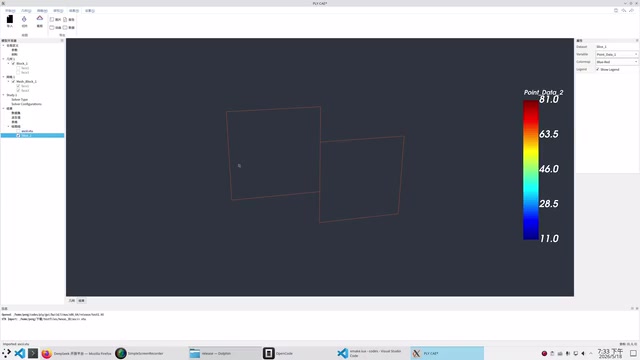
- Slice operations cannot correctly display the cutting plane
- For shell models, only boundaries are displayed after slicing, with abnormal colorbar display
- Current test data is surface data only; volume data processing still needs verification
These issues are not uncommon in CAE software development — slice operations involve the coordination of geometric clipping, data interpolation, and rendering pipelines, and are functional modules prone to edge cases even in mature commercial software.
Next Steps: Integrating a Solver to Complete the CAE Loop
MFiX-Based Heat Conduction Solver Integration
The author revealed a clear subsequent development roadmap: planning to integrate MFiX (an open-source finite element software) as the solver backend, first implementing heat conduction equation solving.
MFiX (Multiphase Flow with Interphase eXchanges) was originally developed by the U.S. National Energy Technology Laboratory (NETL), primarily for multiphase flow simulation. In the broader open-source finite element ecosystem, it represents a class of computational engines that can be integrated as backend solvers. The heat conduction equation (∂T/∂t = α∇²T) is one of the most fundamental partial differential equations. Through the finite element method, the continuous domain is discretized into mesh elements, and the partial differential equation is transformed into a system of linear algebraic equations for solving. Choosing heat conduction as the first physical field to implement is because its mathematical form is simple and boundary conditions are intuitive, making it an ideal starting point for verifying the completeness of the CAE workflow. Subsequently, this can be gradually extended to structural mechanics, fluid dynamics, and other more complex physical fields.
Once completed, the entire software will form a complete CAE simulation workflow loop:
- Geometric modeling → Create or import geometric models
- Mesh generation → Discretize geometry into finite element meshes
- Numerical solving → Heat conduction equation computation
- Post-processing → Result visualization and analysis
This means a single person using AI programming tools can build a simple but functionally complete CAE simulation platform.
Cost and Efficiency Analysis: Building Engineering Simulation Software for $7
Development Investment Breakdown
The development cost of this project is astonishing:
- Time cost: Only spare time after work and on weekends
- Financial cost: 100 RMB charged to DeepSeek API (which also includes other work usage), estimated project consumption of approximately 50 RMB or less
- Code writing: Completely zero-code, all code automatically generated by AI
For comparison, under traditional development models, even a simplified CAE software prototype would typically require a team of 3-5 people working for several months, involving talent across multiple specialized areas including C++/Python programming, computer graphics, and numerical computation, with development costs easily reaching hundreds of thousands of RMB.
Technology Stack Choices Reflect AI's Professional Judgment
You might not have noticed, but DeepSeek demonstrated professional-level expertise in technology selection:
- OCC for the geometry kernel — an industry standard used by mainstream open-source CAE platforms like FreeCAD and Salome
- VTK for visualization — the de facto standard for scientific computing visualization and the underlying engine of ParaView
- VTU for data format — VTK's native format with good compatibility, supported for output by the vast majority of open-source solvers
- Open-source solutions for the solver — reducing integration difficulty and avoiding licensing issues
These choices are not arbitrary but represent best practices in the CAE field, demonstrating that DeepSeek has considerable depth of understanding in professional engineering domain knowledge. This technology selection capability typically requires engineers who have worked in the CAE industry for many years, yet the large model has internalized this domain knowledge by learning from massive amounts of technical documentation, open-source projects, and community discussions.
Industry Implications: AI Programming Capability Boundaries Are Expanding
Breaking the "AI Can Only Write Simple Code" Perception
This case breaks the stereotype that "AI can only write simple code." CAE software involves the intersection of multiple complex fields including computational geometry, numerical methods, and graphics rendering. Being able to drive AI to complete this type of development using natural language demonstrates that:
- Large models' professional knowledge reserves already cover engineering domains at considerable depth
- Agent mode (such as OpenCode) can handle complex projects with multiple files and modules, autonomously performing error diagnosis and repair
- Cost barriers have dropped to levels completely affordable for individual developers
Impact on Professional Software Development Models
Although this project is still far from commercial-grade CAE software (commercial software has decades of accumulation in solver accuracy, large-scale parallel computing, complex boundary condition handling, software stability, and user experience), it demonstrates an entirely new possibility: domain experts (rather than professional programmers) can rapidly prototype their ideas with the help of AI. For researchers and engineers, this means being able to quickly build customized simulation tools without relying on expensive commercial software or lengthy development cycles.
This trend may give rise to a new software development paradigm: domain experts provide professional knowledge and requirement descriptions, AI Agents handle code implementation, and the two collaborate to complete engineering software development that previously required large teams.
Conclusion
Although this project is still in its early stages, it has already demonstrated the enormous potential of AI-assisted development in professional engineering software. $7 cost, spare time, zero code — these three keywords combined constitute a powerful proof of AI programming capabilities. As the capabilities of large models like DeepSeek continue to improve, and AI Agent tools like OpenCode continue to mature, it will become increasingly feasible for individual developers to build professional engineering software with AI. We look forward to the author's complete demonstration after integrating the solver.
Related articles
 Tutorials
Cursor + Codex Dual-IDE Collaboration: A Practical Methodology for Open-Source Project Customization
A complete methodology for open-source project customization based on real-world experience, detailing the Cursor+Codex dual-IDE workflow, seven-stage process, MVP validation, and AI source code reading techniques.
 Tutorials
Cursor Multi-Agent in Practice: Building a Full-Stack Next.js Blog in 50 Minutes
Build a full-stack blog in 50 minutes using Cursor IDE's multi-Agent mode with Next.js, Clerk auth, and Supabase. Learn the 4-phase AI Agent workflow and key integration pitfalls.
 Tutorials
Building an AI Software Factory from Scratch: A Cursor Engineer's Hands-On Experience with Multi-Agent Collaboration
Cursor engineer Eric shares practical insights on building an AI software factory: automation levels, guardrail design, parallel Agent management, and scaling to 1000+ Agents for 24/7 development.