OpenFugu: An Open-Source Experiment Reimplementing Sakana AI's Fugu Ultra Model in Zig
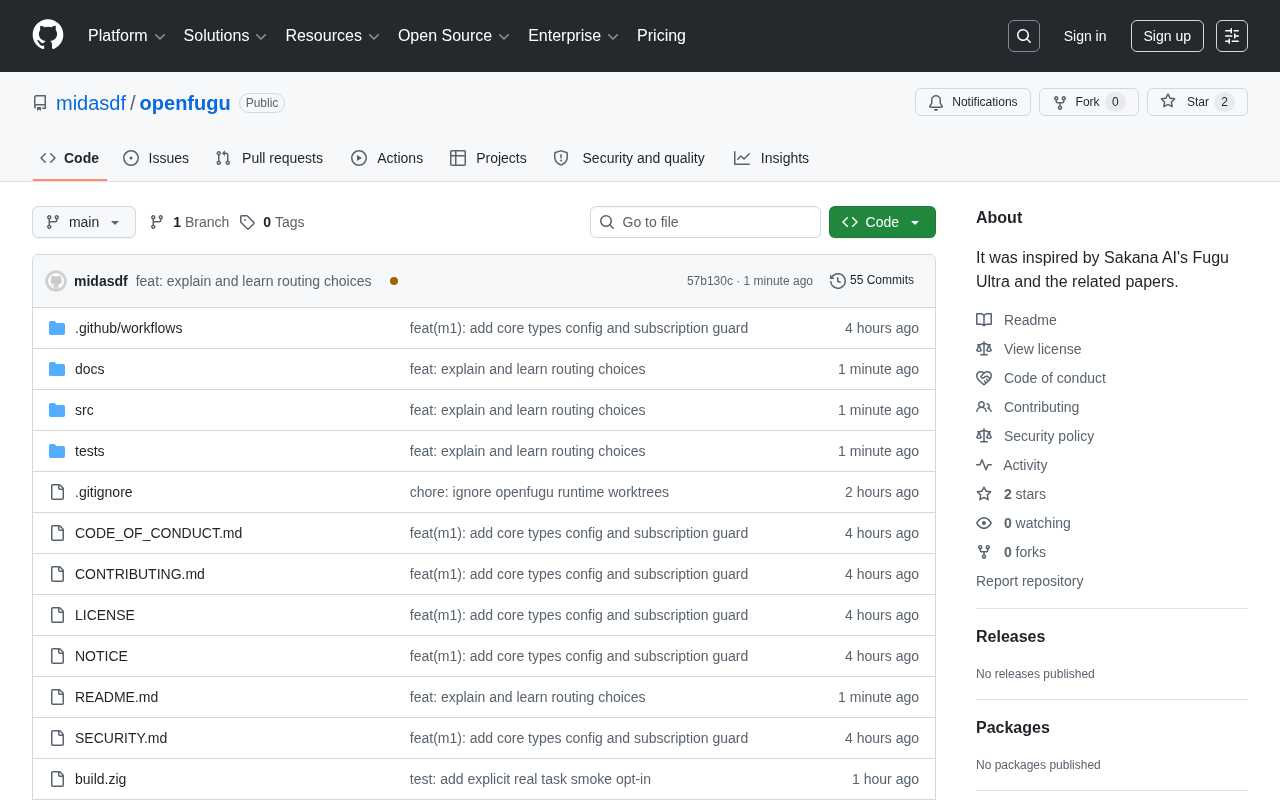
An open-source project reimplements Sakana AI's Fugu Ultra model using Zig language.
OpenFugu is an early-stage open-source project that attempts to reimplement Sakana AI's Fugu Ultra model using the Zig programming language. While unconventional for AI/ML work, Zig offers potential advantages like zero-cost abstractions, compile-time computation, and precise memory control. The project highlights growing trends in open-source reproduction of commercial AI research and exploration of non-mainstream languages in the AI space.
Project Overview: What Is OpenFugu
A new open-source project called OpenFugu has appeared on GitHub, created by developer midasdf and inspired by Sakana AI's Fugu Ultra model and its associated research paper. The project uses Zig as its implementation language — a rather unconventional technical choice in the AI/ML space.
Background: Sakana AI and Fugu Ultra
Introduction to the Fugu Ultra Model
Sakana AI is a Japan-based company focused on nature-inspired AI research. Their Fugu series of models has demonstrated impressive capabilities in Japanese language processing and multimodal tasks. Fugu Ultra, the high-end version of the series, incorporates several cutting-edge techniques including model merging and evolutionary algorithm optimization.
Sakana AI's research philosophy emphasizes optimizing neural network architectures and parameters through evolutionary mechanisms found in nature — an approach that has attracted significant attention in academia. The OpenFugu project aims to reproduce or draw from these ideas in an open-source manner, providing the community with a foundation for research and experimentation.
Why OpenFugu Is Worth Watching
Although the project currently has only 1 star and is in a very early stage, it represents several noteworthy trends:
- Open-source reproduction of cutting-edge research: Community developers proactively creating open-source implementations of commercial companies' research outputs
- Exploration of non-mainstream languages in AI: Using Zig instead of Python/C++ challenges the conventional language choices in AI development
- International spread of Japan's AI ecosystem: Sakana AI's work is attracting attention from developers worldwide
Technical Analysis: Zig for AI Development
Potential Advantages of Zig in AI/ML
Zig is a systems programming language focused on performance and safety, often viewed as a modern alternative to C. Choosing Zig for AI/ML development offers several potential advantages:
- Zero-cost abstractions: Zig provides near-hardware-level control, making it suitable for implementing high-performance numerical computation
- Compile-time computation (comptime): Zig's powerful comptime feature can perform tensor shape checking and similar tasks at compile time
- No implicit memory allocation: This is a critical feature for inference engines that require precise memory control
- Seamless C interoperability: Zig can directly call existing low-level libraries like BLAS and CUDA
Challenges of Using Zig for AI Development
Implementing AI models in Zig also comes with significant practical difficulties:
- Lack of a mature tensor computation ecosystem
- Small community size with limited AI-related reference code available
- Debugging and visualization tools far less developed than Python's ecosystem
- High implementation complexity for automatic differentiation during training
Current Status and Future Outlook
OpenFugu is currently in a very early stage. Based on GitHub metrics (1 star, 0 forks), it appears to be more of a personal research experiment. However, the value of projects like this often lies not in direct production use, but rather in:
- Validating the feasibility of implementing AI models with non-mainstream tech stacks
- Accumulating practical experience for Zig in the scientific computing domain
- Helping the community gain deeper understanding of the technical principles behind Fugu Ultra
For developers interested in AI infrastructure diversity and system-level optimization, OpenFugu is a project worth keeping an eye on. As the Zig language ecosystem gradually matures and AI inference demands ever-higher performance, these "non-mainstream" implementations may find their own unique niche.
Related articles
Sakana AI Launches RSI Lab: The Path to Recursive Self-Improvement Where AI Builds AI
Sakana AI launches RSI Lab for recursive self-improvement, letting AI autonomously improve its own architecture. Explore their four-stage roadmap and key breakthroughs.

The Clotilda: Underwater Archaeological Discovery of America's Last Slave Ship
The Clotilda, America's last slave ship, was discovered by underwater archaeologists in Alabama nearly 160 years after sinking. Learn about the search, key evidence, and other slave trade shipwreck discoveries.
Sakana AI in Practice: Reshaping Banking Lending Operations with AI Agents — Technology and Strategy
Deep dive into how Sakana AI applies AI Agents to banking lending operations, covering end-to-end support from information gathering to approval document generation, plus technical challenges and human-AI collaboration design.