Pi Agent: When Every AI Coding Framework Is Adding More, It Chose to Subtract
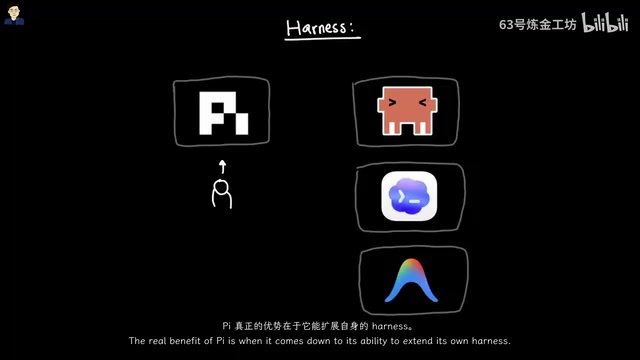
Pi Agent's minimalist, self-extending Harness architecture offers a sustainable alternative to bloated AI coding frameworks.
Pi Agent takes a radically minimalist approach in the crowded AI coding agent space. By deliberately omitting sub-agents, MCP support, and background tasks, and instead offering a self-extending Harness mechanism where the agent writes TypeScript to expand its own runtime, Pi positions itself as an ideal framework for building custom AI coding products—resilient against the constant architectural rewrites plaguing tools like LangChain and Manus.
When Every Coding Agent Is Adding More, Pi Chose to Subtract
Today's AI coding agent market is becoming increasingly homogeneous. Claude Code, Codex, Cursor, Antigravity… if you hide the logos, you'd struggle to tell them apart—much like how most people can't distinguish Pepsi from Coca-Cola in a blind taste test. Yet one framework has taken a radically different path: Pi Agent.
Pi is the core engine powering OpenClaw, but what makes it unique isn't what it offers—it's what it deliberately omits. This design philosophy is akin to "negative space" in art—defining form by focusing on the emptiness surrounding the subject, rather than trying to render every detail.

Pi Agent's Minimalism: What's Missing Matters More Than What's There
Pi's out-of-the-box "missing list" is striking:
- No sub-agents
- No MCP protocol support
- No background tasks
- No to-do list
This feels out of place in a coding agent landscape where the feature arms race is intensifying. Claude Code, Codex, Gemini CLI, and other mainstream tools are frantically stuffing more capabilities into their toolboxes, while Pi goes in the opposite direction.
But Pi's real killer feature is this: it can extend its own Harness.
The Self-Extending Harness: Pi Agent's Core Competitive Advantage
The Limitations of Traditional Coding Agents
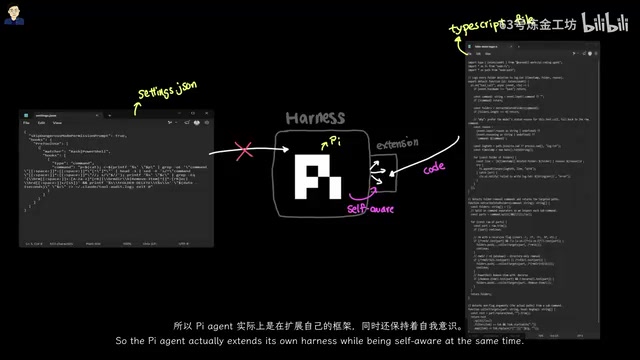
In traditional coding agents like Claude Code and Codex, you can configure their Harness settings, but you can't truly extend the Harness itself. Take the Hook mechanism as an example—Hooks let you insert custom operations before and after tool calls in the chain. Say you want the agent to write an audit log every time it deletes a folder; you can add a pre-tool-use Hook.
In Claude Code, adding a Hook means writing settings in a JSON configuration file for Claude Code to parse and consume—everything runs within the preset Harness framework.
Pi's Revolutionary Approach
Pi does things completely differently: instead of JSON config files, it directly writes TypeScript code as native extensions of its own Harness. In other words, Pi Agent can extend its own runtime framework while maintaining self-awareness.
After executing the /reload command in the terminal, Pi immediately incorporates the newly written code as a Hook into its runtime. This mechanism makes it possible to build complex applications around Pi—this is exactly how OpenClaw was born, by adding MCP support, messaging app integrations, hosted gateways, and other scaffolding on top of Pi to create a complete product. OpenClaw can selectively import Pi's components or use the terminal UI as a module.
Four-Layer Architecture: An Elegant Practice of Computer Science Principles
Pi's implementation follows classic computer science principles, componentizing the entire framework into four layers that embody Separation of Concerns and the Open-Closed Principle from SOLID—open for extension, closed for modification.
1. Pi AI Layer
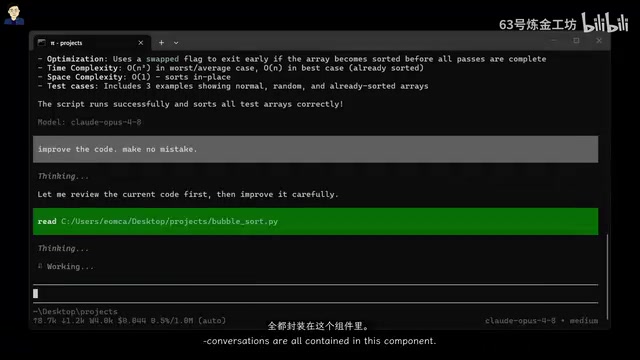
Handles all the complex logic of interacting with Completions APIs from various LLM providers. Whether it's Anthropic, OpenAI, Google, or OpenRouter, all the tedious work around token tracking, tool calls, reasoning, and streaming is encapsulated in this layer. Even switching providers mid-conversation is handled entirely by this component.
2. Agent Layer
Manages the Agentic Loop, handling validation, event streams, and tool execution.
3. Coding Agent Layer
The concrete implementation for coding scenarios, encapsulating programming-related core capabilities like code generation and file operations.
4. TUI Layer (Terminal User Interface)
The frontend users interact with directly, responsible for text rendering, session management, custom tools, and themes.
This architecture allows developers to use Pi as a framework to build their own specialized agents—such as a code review agent or a research agent—carefully crafting efficient, purpose-built tools rather than trying to guide a bloated general-purpose agent through prompts to accomplish specific tasks.
Why Minimalist Architecture Is the Best Long-Term Strategy
Some might question: if Pi has so few out-of-the-box features and requires building your own application layer on top, what's the point?
The answer lies in resisting the violent changes at the Harness layer.
Looking back at the history of AI tools, we can see alarming rewrite records:
- LangChain: architecture rewritten 4+ times
- Manus: rewritten 5 times
These cases reveal a harsh reality: as underlying models continuously improve their tool-calling capabilities, the agent's Harness layer is actually extremely fragile and volatile. Features that once required extensive engineering to work around model limitations may become completely redundant when the next-generation model ships.
This is the philosophy of "Build to Delete"—what we build today may soon become obsolete. By building as little as possible at the Harness layer and avoiding over-engineering, Pi positions itself optimally for long-term sustainability.
Pi Agent vs Mainstream Coding Agents: Not a Replacement, But a Complement
To be clear, Pi isn't trying to replace Claude Code, Codex, or Cursor. These cutting-edge coding agents may be mutually exclusive—you typically pick just one as your primary tool. But Pi is more of a framework than a pure coding agent.
If you are:
- A regular developer who needs an out-of-the-box coding assistant → Choose Claude Code, Cursor, etc.
- A tool builder who wants to create your own AI coding product → Pi is the ideal underlying framework
- A power user seeking ultimate control who wants to precisely customize agent behavior → Pi's extensible Harness is a unique advantage
Conclusion
In an era where everyone is adding more, Pi chose to subtract. This isn't laziness—it's a deliberate architectural philosophy that acknowledges change as the norm, embraces uncertainty, and achieves maximum long-term adaptability by minimizing uncontrollable complexity. When the next leap in model capabilities forces existing agent frameworks to face yet another rewrite, Pi's users may find they have the least code to change.
Related articles

AI Large Model Learning Roadmap Breakdown: Three Stages from Application Development to Model Fine-Tuning
Deep breakdown of a popular AI large model learning roadmap covering LangChain, RAG, Agent, and LoRA fine-tuning across three stages, with analysis of its strengths and limitations for career changers.
AI Agent Development: A Complete 6-Week Systematic Learning Roadmap
A 6-week systematic learning roadmap for AI Agent development, covering core architecture, ReAct principles, multi-agent collaboration, RAG integration, and deployment.
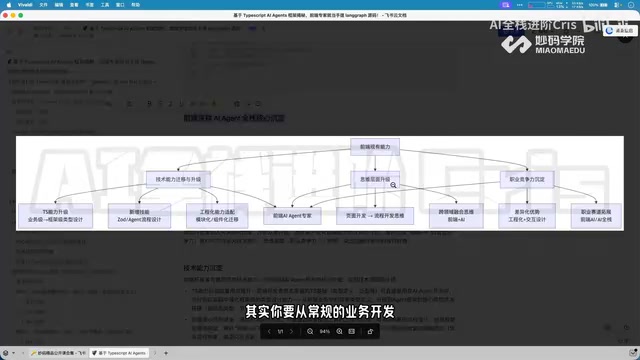
Four Core Advantages Frontend Developers Have When Transitioning to AI Agent Development
Frontend developers have key advantages for AI Agent development: TypeScript ecosystem fit, low-barrier full-stack bridging, and state management isomorphism. Learn the transition path here.