Practical Experience Building an Automated Development Pipeline with Multi-AI Agent Collaboration
Practical Experience Building an Autom…
Building an automated dev pipeline with three specialized AI Agents working as a virtual development team.
A developer shares their experience using three AI Agents as a complete development team — one for planning, one for backend, one for frontend. Key strategies include using Batch API to cut token costs by 50%, running agents overnight for 24/7 async development, and managing multi-million-line codebases through modular splitting. The approach transforms the developer's role from code executor to decision-maker.
One-Person Company: Replacing an Entire Dev Team with AI Agents
A Chinese content creator shared their experience building a complete development pipeline using multiple AI tools — simultaneously using three AI Agents responsible for different stages: one for planning, one for core business development, and one for frontend interfaces. In their words, it's like "three companies each doing their part, with the entire supply chain fully connected."
The core idea behind this approach is: assign the three traditional software development roles — planning, backend, and frontend — to different AI models or Agents, while you only need to play the "boss" role — just say what feature you want and you're done.
Technical Architecture: Three AI Agents Working in Collaboration
According to the creator, their tech stack combination is:
- Backend Architecture: Using an Ops management architecture (presumably some kind of orchestration tool)
- Backend Development: A dedicated AI model responsible for writing backend logic
- Frontend Development: Another AI Agent specifically handling frontend pages
The three AIs each have their own division of labor, similar to the organizational structure of a small software company. The planning Agent handles requirements analysis and feature planning, the core business Agent processes backend logic, and the frontend Agent handles the user interface — forming a complete development loop.
This multi-Agent collaboration model essentially upgrades the "AI coding assistant" from a single-point tool to a systematic automated development pipeline.
Technical Background of Multi-Agent Collaboration
Multi-Agent Collaboration is a cutting-edge direction in current AI application architecture. Its core concept originates from distributed systems and microservices architecture — decomposing complex tasks into multiple subtasks, each handled by different specialized Agents. The industry already has several mature frameworks supporting this pattern, such as Microsoft's AutoGen, CrewAI, LangGraph, and others. These frameworks allow developers to define multiple Agents with different roles and capabilities, enabling collaboration through message passing, shared memory, or workflow orchestration. Compared to a single AI assistant, the advantage of multi-Agent architecture lies in: each Agent can have independent System Prompts and toolsets, focusing on specific domains, thereby improving output quality and task completion rates. The creator's practice is precisely a personalized implementation of this concept — simulating a complete development team at minimal cost.
Cost Control: Batch API Saves Half the Token Costs
Regarding costs, the creator mentioned a key optimization strategy — using the Batch API (batch processing interface). This is a batch processing mode offered by major model providers, typically about 50% cheaper compared to real-time API calls.
They mentioned "burning through at least 1 billion tokens per day" — while this number is clearly exaggerated, it does reflect the reality of massive token consumption when multiple Agents work in parallel. By using the batch channel, costs are cut in half directly, which is a very practical money-saving technique for heavy AI development users.
Technical Principles of Batch API
Batch API is a batch inference interface provided by major model providers (such as OpenAI, Anthropic, Google, etc.). Unlike standard real-time APIs, Batch API allows users to submit a large number of requests at once, with the provider completing processing asynchronously within 24 hours. The reason for the price discount is: providers can schedule these requests during GPU idle periods, thereby improving hardware utilization and reducing marginal costs. Taking OpenAI as an example, their Batch API price is typically 50% of the standard API. Users submit a JSONL file containing multiple requests, the system returns a batch ID, and all results can be retrieved via the ID once processing is complete. This mode is particularly suitable for scenarios that are latency-insensitive but cost-sensitive.
Applicable Scenarios for Batch API
- Tasks that don't require real-time responses (e.g., code generation, document writing)
- Parallel processing of large batches of similar tasks
- Running tasks overnight unattended (autonomous scenarios)
Understanding Token Consumption at Scale
To understand what "1 billion tokens" means, you need to understand the basic concept of tokens. A token is the fundamental unit that large language models use to process text — roughly 1-1.5 tokens per English word, and about 1.5-2 tokens per Chinese character. In multi-Agent collaboration scenarios, token consumption grows exponentially for several reasons: each Agent needs to receive context information, communication between Agents itself consumes tokens, and code generation tasks typically produce very long outputs. Taking GPT-4o as an example, input token pricing is approximately $2.5/million tokens, and output is approximately $10/million tokens. If consuming 1 billion tokens per day (even as an exaggeration), the daily cost at standard prices could reach thousands of dollars — this explains why the Batch API's 50% discount is so important for heavy users — it directly determines whether this development model is economically sustainable.
24/7 Operation: AI Agents Working While You Sleep
The most impressive aspect is the work pattern the creator described: at night while sleeping, the Agent runs all night long, and by morning all the work is done.
This actually reveals an important advantage of AI programming — asynchronous execution capability. Human developers are limited by working hours and energy, while AI Agents can run 24 hours without interruption. Combined with the delayed processing characteristics of Batch API, tasks can be submitted during off-peak hours, saving money while not wasting time.
Using the creator's metaphor: "The boss is making money even while dreaming" — while exaggerated, it does depict the ideal state of AI-automated development.
This asynchronous work pattern is aligned with the CI/CD (Continuous Integration/Continuous Deployment) philosophy in DevOps. Traditional CI/CD pipelines automatically execute builds, tests, and deployments after code commits, while AI Agent async execution goes a step further — even the code writing itself can be automated. Developers make decisions and submit requirements during the day, AI executes implementation at night, and the next day is for acceptance and adjustments, forming an entirely new human-machine collaboration rhythm.
Project Scale: Real-World Challenges from Millions of Lines of Code
The creator mentioned that the project codebase has reached approximately two million lines, and candidly admitted "there's no way I can run through this number." This exposes a real bottleneck in current AI programming: when project scale expands to a certain degree, both context windows and code comprehension capabilities hit their limits.
Physical Limitations of Context Windows
The context window refers to the maximum number of tokens a large language model can process in a single pass. Current mainstream models have context windows ranging from 128K to 200K tokens (e.g., Claude's 200K, GPT-4o's 128K), which translates to roughly thousands to tens of thousands of lines of code. When a project reaches the million-line level, no single model can "see" all the code at once. This creates the so-called "Lost in the Middle" problem — even if the context window is large enough, the model's attention to information in the middle portion decreases. Solutions include: RAG (Retrieval-Augmented Generation) technology to retrieve relevant code snippets on demand, codebase indexing with semantic search, and the modular splitting strategy mentioned in this article.
AI-assisted development of large projects still requires reasonable architectural splitting and modular design — you can't expect AI to handle all the code in one shot. This is also where the multi-Agent division-of-labor architecture proves its value — reducing the cognitive burden on each individual Agent through modular splitting. Each Agent only needs to understand the module it's responsible for and its interface definitions, without needing to grasp every detail of the entire project.
Summary: A New Paradigm for Individual Developers with AI Agent Collaboration
While this creator's practice comes with clearly entertaining expressions, the core ideas deserve every developer's attention:
- Multi-Agent division of labor and collaboration, simulating team development processes
- Leveraging Batch API to significantly reduce token costs
- Asynchronous execution enabling 24/7 uninterrupted development
- The human role transforms from "executor" to "decision-maker"
Deeper Implications of the Role Transformation
This shift from executor to decision-maker reflects a deep transformation happening in the software engineering field. Traditional developers' core skill is writing code, but in the AI Agent era, core skills are shifting toward "Prompt Engineering," "Architecture Design," and "Quality Control." This is consistent with historical patterns of technological evolution: from assembly language to high-level languages, from hand-written code to framework development — each elevation in abstraction level frees developers from low-level details to focus on higher-level design decisions. Andrej Karpathy calls this new paradigm "Vibe Coding" — where developers describe their intent through natural language, and AI completes the specific implementation. Future developer competitiveness may no longer depend on coding speed, but rather on the ability to precisely define problems, design sound architectures, and effectively manage the output quality of AI Agents.
This is perhaps the new paradigm for individual developers in the AI era — no longer writing every line of code personally, but managing AI Agents like managing a team, redefining the software development process with an automated pipeline mindset.
Related articles

Claude Code for Test Development in Practice: An AI Programming Workflow That Doubles Your Efficiency
A practical guide to Claude Code for test development: auto-generating test scripts, Plan Mode workflows, MCP + Playwright integration, and Subagent parallel tasks to build systematic AI-assisted workflows.

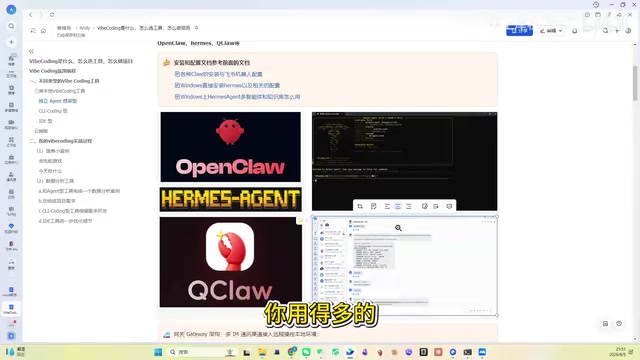
Hermes Agent Hands-On Review: An AI Efficiency Revolution for Indie Game Developers
Indie game developer reviews Hermes Agent vs OpenClaude: intelligent context compression, real-time Memory, remote control via Telegram, and practical use cases in game dev, social media, and email.
Vibe Coding Beginner's Guide: Tool Selection Across Three Categories with Practical Examples
A comprehensive guide to Vibe Coding's three tool categories: Agent frameworks, CLI Coding, and IDE tools, with practical examples including Snake game and data analysis workbench.