PySpur: A Deep Dive into the Open-Source Visual AI Agent Workflow Development Platform
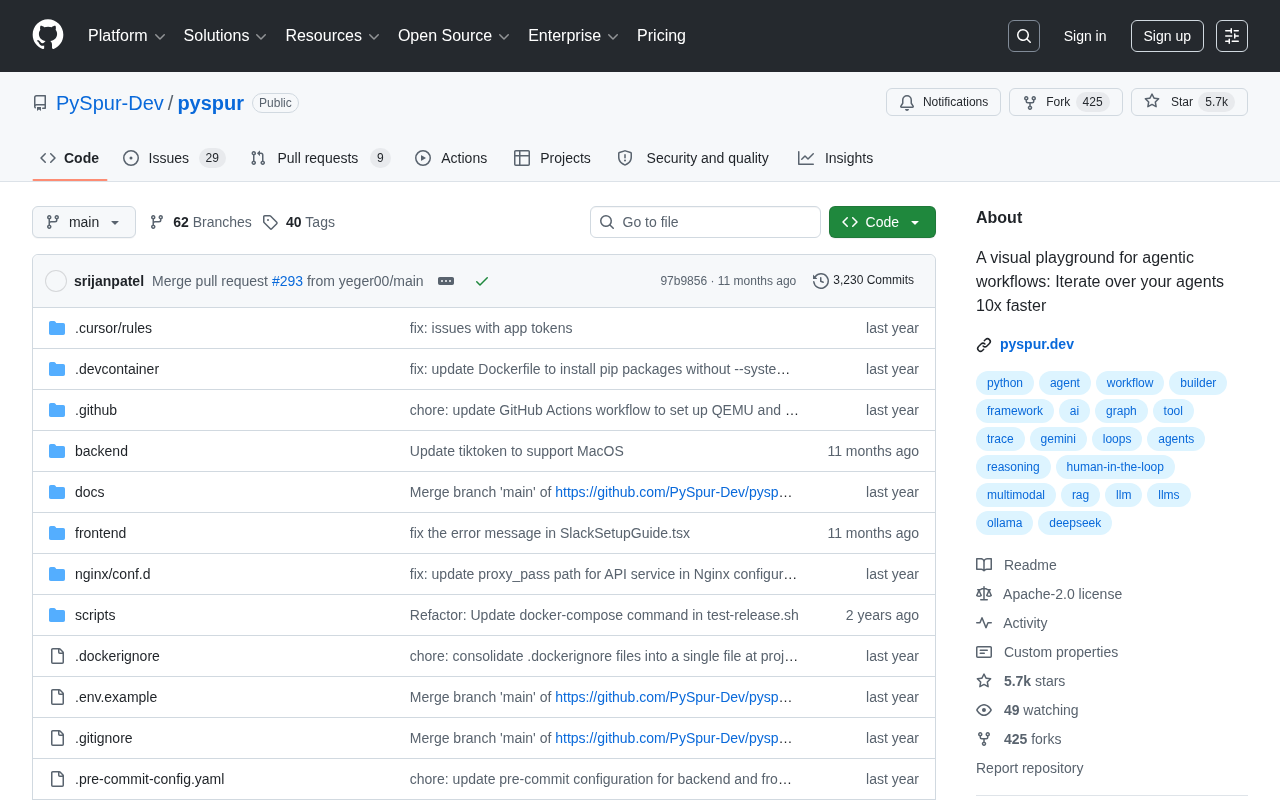
PySpur is an open-source visual platform for building and iterating AI Agent workflows at speed.
PySpur is an open-source visual AI Agent workflow development platform that lets developers drag-and-drop nodes to orchestrate complex agentic workflows. With 5,700+ GitHub stars, it differentiates from tools like LangFlow and Dify by focusing on autonomous Agent patterns including branching, loops, and multi-Agent collaboration, while maintaining code-level control for flexibility.
What is PySpur
PySpur is an open-source visual AI Agent workflow development platform, positioned as a "visual playground for agentic workflows." Its core goal is to help developers iterate and optimize AI Agents at 10x speed, transforming complex Agent orchestration from pure code into intuitive visual operations.
The project is built with TypeScript and has already earned over 5,700 stars on GitHub with 425 forks, demonstrating active community interest.
Why We Need Visual AI Agent Development Tools
Pain Points of Traditional Agent Development
In traditional AI Agent development workflows, developers face several typical challenges:
- Difficult debugging: Agents have complex multi-step reasoning chains, and debugging through pure code requires repeatedly printing logs and tracking state
- Slow iteration: Modifying the logic of a single node requires re-understanding the entire flow, making changes risky
- Collaboration barriers: Product managers or business stakeholders without technical backgrounds struggle to participate in Agent design discussions
- Lack of global perspective: When Agents involve branching, loops, and parallel calls, it's hard to see the full picture at the code level
PySpur's Approach
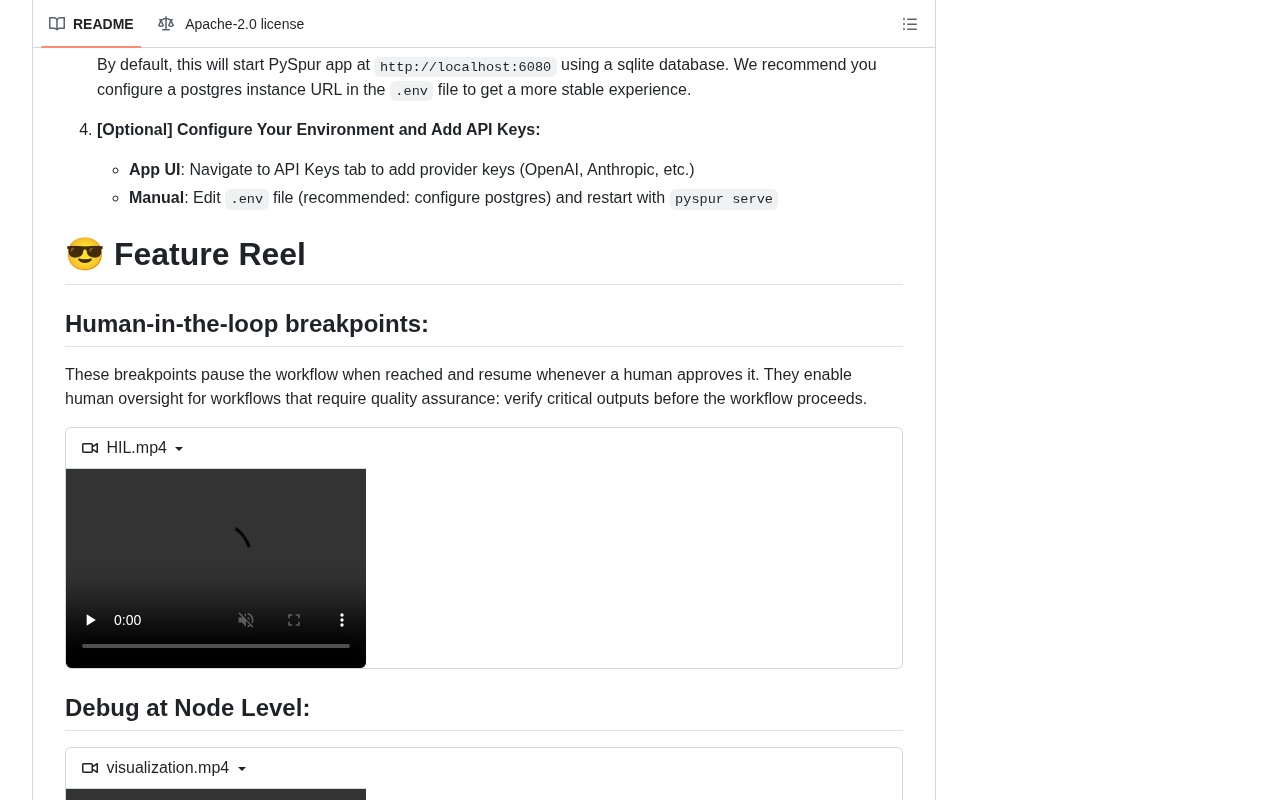
PySpur takes a hybrid "visual + code" path. Developers can drag-and-drop nodes and connect edges on a canvas to build Agent workflows, while retaining code-level control over the internal logic of each node. This approach balances intuitiveness with flexibility.
PySpur's Technical Positioning and Comparison with Similar Tools
Differences from LangFlow, Dify, and Others
The AI Agent development tool space already has several players:
- LangFlow: A visual tool in the LangChain ecosystem, focused on Chain orchestration
- Dify: An AI workflow platform oriented toward the application layer
- Flowise: A low-code LLM application builder
PySpur differentiates itself by explicitly focusing on "agentic workflows" — not simple Prompt chains, but orchestration of Agents with autonomous decision-making capabilities. This means it needs to support conditional branching, loops, tool calling, multi-Agent collaboration, and other complex patterns.
Technology Stack Choice
The project is primarily developed in TypeScript, indicating that the frontend visual experience is a key investment area. For a tool positioned as a "visual playground," this is a sensible technology choice — excellent interaction experience is one of its core competitive advantages.
Use Cases for PySpur
Based on the project's positioning, PySpur is suitable for the following scenarios:
- Agent prototype validation: Quickly build Agent workflow prototypes to verify whether the logic is feasible
- Multi-Agent system design: Visualize interaction relationships between multiple Agents
- Iterative optimization: Rapidly adjust node parameters, swap models, and modify prompts on the visual interface
- Team collaboration: Enable team members in different roles to understand how an Agent operates
Open-Source Community Development Observations
5,700+ stars is a solid achievement for an Agent development tool, indicating real demand from the developer community for visual Agent orchestration. The 425 forks also suggest that a considerable number of developers are building upon this project or using it for learning.
It's worth noting that AI Agent development tools are evolving from "good enough" to "experience-driven." As underlying model capabilities converge, the usability and efficiency of developer tools will become a key competitive dimension.
Summary
PySpur represents an important direction for AI Agent development tools: reducing the cognitive burden of Agent orchestration through visualization, allowing developers to focus their energy on Agent logic itself rather than debugging and understanding flows. For teams building complex Agent systems, it offers an open-source option worth trying.
Related articles
Claude Code Installation Guide & The Five Stages of AI Programming Tools Explained
Complete Claude Code installation guide with the five stages of AI programming tools, from manual coding to agents. Learn 0-to-1 project building and 1-to-100 iteration challenges.

Enterprise-Level AI Project Rules Files: 5 Hard Rules + 6 Writing Techniques
AI keeps messing up your code? Learn 5 hard rules and 6 writing techniques for enterprise-level Rules files in Claude Code, Cursor & more, with templates.

Building Cloud Computing Clusters from Old Phones: Google and UCSD Explore a New Path to Sustainable Computing
Google and UCSD explore building cloud clusters from old phones, leveraging ARM chip efficiency to cut e-waste and data center carbon footprints.