Quit My State-Owned Enterprise Job to Build a Mini Program with Cursor: A Regular Person's AI Monetization Story
Zero-coding entrepreneur uses Cursor to build a mini program, showcasing new possibilities for ordinary people in the AI era.
An entrepreneur with zero programming experience quit his state-owned enterprise job and used Cursor to build a "Probability of Finding Love Calculator" WeChat mini program. The article argues that AI tools are dramatically lowering software development barriers, and that ordinary people's core competitive advantage lies in product thinking and user insight rather than technical skills. It also warns against homogeneous competition and advises validating ideas through MVPs with clear monetization paths before going all-in.
From Quitting a State-Owned Enterprise to AI Entrepreneurship: An Ordinary Person's Choice
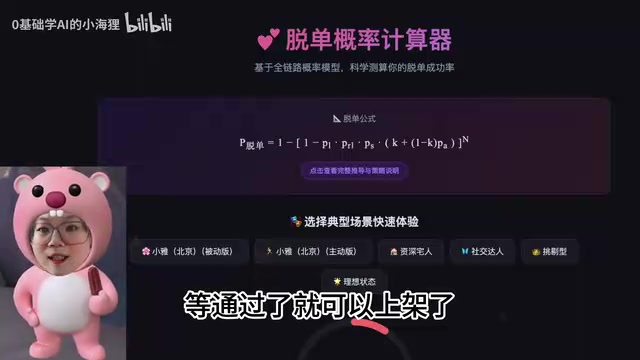
As the AI wave sweeps across every industry, more and more ordinary people are asking themselves: Can I also leverage AI to build something? Today's case study comes from an entrepreneur who quit his state-owned enterprise (SOE) job cold turkey — with zero programming experience, he used Cursor to build a "Probability of Finding Love Calculator" mini program that's currently in the ICP filing review stage and about to go live.
This story is worth paying attention to not because the product itself is groundbreaking, but because it represents a trend that's actively unfolding: AI programming tools are lowering the barrier to software development to unprecedented levels. As long as ordinary people have ideas, they can turn them into products.
Why Choose the "Probability of Finding Love Calculator" Niche
Demand Insight: Emotional Consumption in the Singles Economy
This entrepreneur's entry point is quite interesting — a probability of finding love calculator. At first glance it sounds like an entertainment tool, but think deeper and there's real user psychology behind it.
The "singles economy" has been a major topic in consumer research in recent years. According to data from China's Ministry of Civil Affairs, the country's single adult population has exceeded 240 million, with over 92 million living alone. This demographic has spawned a massive industry chain ranging from single-serving restaurants and mini appliances to emotional companionship apps. Emotional consumption, as an important branch, operates on the core logic that users pay for "self-awareness" and "social currency" — the explosive popularity of MBTI personality tests in 2022-2023 is a textbook example, with related mini program tests reaching peak daily UV in the millions.
The business model for quiz-type products typically has three layers: free basic tests for user acquisition, paid detailed reports for monetization, and ad network revenue sharing as a safety net. The core advantage of this model is its extremely low marginal cost — a single test logic can be reused infinitely, and users sharing their results naturally creates a viral distribution chain with acquisition costs far lower than traditional advertising. Specifically, this niche is attractive because:
- Massive singles demographic: China has over 200 million single adults — a huge potential user base
- Strong demand for emotional consumption: Products like horoscope readings and MBTI tests consistently dominate social sharing trends
- Strong viral sharing potential: Quiz-type mini programs inherently have sharing DNA — users who complete a test are highly likely to share their results
From a monetization perspective, these lightweight quiz tools can generate revenue through ads and value-added services. While per-user value isn't high, the advantage lies in low acquisition costs and high distribution efficiency.
Advantages of Mini Programs as a Platform
Choosing WeChat Mini Programs over a native app was also a pragmatic decision. Since launching in 2017, WeChat Mini Programs have become one of the most important light-app ecosystems in China's mobile internet, with over 3 million monthly active developers and more than 7 million published mini programs. For individual developers, mini programs offer significant advantages over native apps: no need to go through App Store/market reviews, well-documented development frameworks (WeChat native framework, Taro, uni-app, etc.), and direct access to WeChat Pay and user authorization systems — making them ideal for individual developers to quickly validate ideas.
Notably, the MIIT's 2022 mini program filing regulations require all published mini programs to complete ICP filing. Individual developers must provide identity verification and server credentials, with review cycles typically taking 15-30 business days. This is the context behind the entrepreneur being "in the filing review stage" — filing itself has become an unavoidable compliance hurdle before a mini program can go live, and for zero-experience entrepreneurs, this non-technical step often takes more time and effort than writing code.
The Core Advantage for Ordinary People in the AI Era: Ideas Over Technology
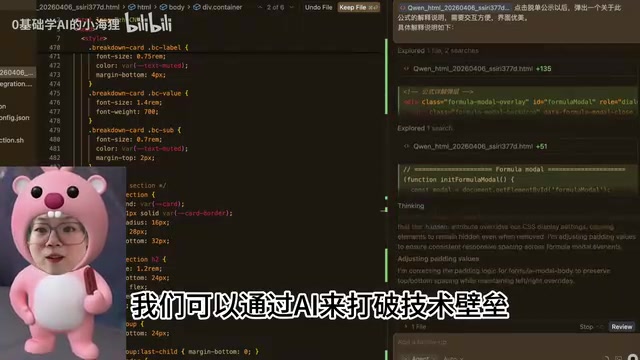
This entrepreneur repeatedly emphasizes one point: He's not a tech expert or a professional programmer — he simply uses AI as a tool.
This positioning is remarkably clear-headed. With AI programming tools like Cursor and GitHub Copilot becoming increasingly mature, technical implementation capability is being rapidly democratized. A mini program that previously required a development team several weeks to complete can now potentially be built by one person using Cursor in just a few days.
Key Mindset Shifts for Ordinary People Using AI for Development
- You don't need to master AI principles: You don't need to understand large model architecture, just like you don't need to understand engine mechanics to drive a car
- The core skill is "articulating requirements": Describe what you want in clear natural language, and AI will generate the code for you
- Focus on product thinking: What direction to choose, what problem to solve, how to acquire users and monetize — these are the real moats
As he puts it: "We ordinary people just need to have ideas, and we can use AI to bring them to life. Just tell AI what you want in plain words, and it will help you make it happen."
Cursor: A Powerful Tool for Zero-Experience Mini Program Development
Why Cursor Over Other AI Programming Tools
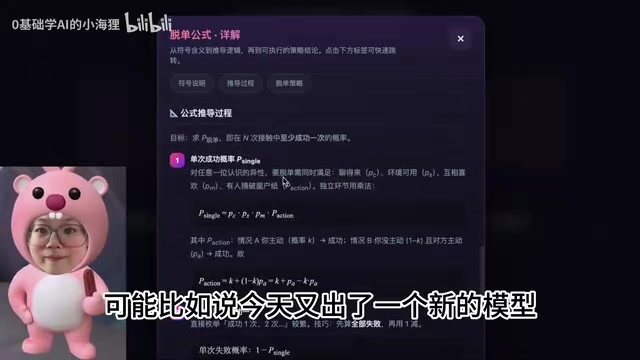
Cursor is an AI-native code editor developed by Anysphere, deeply rebuilt on VS Code's architecture. It entered the mainstream in 2023 and quickly became the benchmark product among AI programming tools. Unlike plugin-based solutions like GitHub Copilot, Cursor deeply embeds AI capabilities into the editor itself, supporting multi-file context understanding, codebase-level Q&A, and auto-completion. It leverages top-tier large language models like GPT-4 and Claude under the hood, making code generation quality far superior to earlier AI programming tools. In 2024, Cursor completed a $60 million funding round at a $400 million valuation on the back of explosive growth, becoming a unicorn candidate in the AI development tools space.
For zero-experience users, Cursor's biggest innovation lies in its "Chat" and "Composer" features — the former allows users to ask code questions in natural language, while the latter can generate and modify code across multiple files simultaneously, truly achieving a paradigm shift from "writing code" to "describing requirements." Specifically, Cursor is particularly suited for zero-experience users because:
- Conversational programming experience: Describe requirements directly in your native language, and Cursor generates the corresponding code and automatically inserts it into the editor
- Full-stack development capability: From frontend UI to backend logic, Cursor handles it all — especially suitable for mini programs which are integrated front-and-back-end projects
- Real-time error correction and debugging: When you encounter bugs, you can directly feed the error message to AI, and it will help locate and fix the issue
The Real Challenges of Zero-Experience Development with Cursor: Prompt Engineering is Key
Of course, "zero-experience development with AI" doesn't mean there's absolutely no barrier. In AI programming scenarios, "Prompt Engineering" is the key variable determining output quality. Unlike general conversation scenarios, code generation demands extremely high precision in prompts — vague descriptions often lead to AI generating functionally incorrect code, actually increasing debugging costs.
Effective programming prompts typically need to include four elements: tech stack specification (e.g., "use WeChat Mini Program native framework"), feature description (specific input/output logic), constraints (performance requirements, compatibility limitations), and reference examples (UI style or interaction pattern references). A 2023 Stanford University study showed that non-technical personnel trained in prompt optimization achieved a 47% higher code generation success rate with AI programming tools compared to untrained users. This means "how to ask AI" is itself a skill that requires deliberate practice.
In practice, you still need to:
- Understand basic project structure and file organization
- Learn how to accurately describe requirements (i.e., write good prompts)
- Have basic debugging ability — at minimum, be able to understand error messages
- Understand non-technical aspects like mini program publishing workflows and filing requirements
While these aren't "programming skills" in the traditional sense, they still require a certain learning investment. The good news is that this learning curve is much gentler than learning to code from scratch.
Sober Reflections on AI Entrepreneurship for Ordinary People

Opportunities Exist, But Require Rational Assessment
The insights from this case are positive, but we need to stay level-headed:
The optimistic side:
- AI has genuinely lowered technical barriers significantly, giving more people the opportunity to turn ideas into products
- Development cycles for lightweight products like mini programs and web apps have been dramatically compressed
- Individual developers can iterate quickly and validate business hypotheses at low cost
The cautionary side:
- Lower technical barriers mean intensified competition — homogeneous products will flood the market
- Development is only the first step; operations, marketing, and monetization are far bigger challenges
- Quitting your job to start a business is extremely risky — it's advisable to validate as a side project while maintaining stable income
Advice for Ordinary People Who Want to Try AI Entrepreneurship
The article's suggestion to "build an MVP first to validate market response" comes from the Lean Startup methodology popularized in Silicon Valley, systematized by Eric Ries in 2011. The core idea of MVP (Minimum Viable Product) is: validate your most critical business hypothesis with minimal development cost, avoiding over-investment in unvalidated directions. With AI tools, MVP development cycles are compressed even further — a mini program MVP that previously took 2-4 weeks can now be completed in 3-5 days by a developer proficient with Cursor.
But the key to MVP validation isn't "building fast" — it's "knowing what to test": whether users are willing to use it (retention rate), willing to share it (viral coefficient), and willing to pay (conversion rate). For quiz tools like the probability of finding love calculator, early validation metrics should focus on completion rate and share rate — these two data points directly reflect the product's viral potential and serve as the core basis for deciding whether continued investment is worthwhile.
Based on this, here's specific advice for ordinary people who want to try AI entrepreneurship:
- Learn the tools before quitting your job: Use your spare time to familiarize yourself with AI programming tools like Cursor, build an MVP, and validate market response
- Choose a domain you're familiar with: Your understanding of user needs matters more than technical ability
- Start with small projects: Don't try to build a platform-level product right away — start with a small tool that solves a specific problem
- Focus on the monetization path: Before you start building, think clearly about how this product will make money
Conclusion
The biggest dividend of the AI era may not be AI itself, but the "technological equity" it grants to ordinary people. When developing a mini program no longer requires tens of thousands in outsourcing fees, when an idea can become a usable product in just days, competition returns to its most fundamental level: Who can better understand user needs, and who can find product-market fit faster.
Whether this entrepreneur who quit his SOE job will succeed remains to be seen. But the step he's taken represents the exploration and experimentation of countless ordinary people in the AI era. Regardless of the outcome, this courage and bias toward action deserves respect.
Related articles
 Tutorials
Cursor + Codex Dual-IDE Collaboration: A Practical Methodology for Open-Source Project Customization
A complete methodology for open-source project customization based on real-world experience, detailing the Cursor+Codex dual-IDE workflow, seven-stage process, MVP validation, and AI source code reading techniques.
 Tutorials
Cursor Multi-Agent in Practice: Building a Full-Stack Next.js Blog in 50 Minutes
Build a full-stack blog in 50 minutes using Cursor IDE's multi-Agent mode with Next.js, Clerk auth, and Supabase. Learn the 4-phase AI Agent workflow and key integration pitfalls.
 Tutorials
Building an AI Software Factory from Scratch: A Cursor Engineer's Hands-On Experience with Multi-Agent Collaboration
Cursor engineer Eric shares practical insights on building an AI software factory: automation levels, guardrail design, parallel Agent management, and scaling to 1000+ Agents for 24/7 development.