Readdy AI Hands-On Review: How Well Does Style Cloning Work for Website Building?

Hands-on review of Readdy AI's style cloning feature and its effectiveness for AI website building.
This article provides a hands-on review of Readdy AI, an AI website builder offering three creation modes: prompt-driven generation, business card websites, and website style cloning. The review focuses on the style cloning feature that addresses AI-generated design homogeneity, evaluates editing capabilities, built-in CRM features, and analyzes the credit-based pricing model's value for different use cases.
Introduction: Pain Points and Needs in AI Website Building
Building a professional website traditionally means either spending big on outsourcing or investing massive time in learning to code—and even then, the final result heavily depends on your personal design sense. While numerous AI website builders have emerged in recent years, they share a common awkward problem: the AI aesthetic is too obvious, designs look cookie-cutter, and the overall quality feels unprofessional.
Traditional website building has evolved from hand-coding HTML/CSS, to CMS platforms (like WordPress), to no-code platforms (like Wix and Squarespace). AI website building is the latest link in this evolutionary chain, with its core technology relying on Large Language Models (LLMs) for code generation and multimodal understanding capabilities. Early AI website builders primarily relied on template matching and rule engines, producing highly homogeneous results. The new generation of tools has begun incorporating visual understanding models (similar to GPT-4V technology), capable of parsing the design language of reference websites and performing style transfer—which is why recent AI website building products have shown noticeable improvements in design quality.
A truly useful AI website builder needs to meet at least three conditions: controllable costs, low learning curve, and professional design quality. Recently, a platform called Readdy AI has attracted considerable attention, claiming to reduce website building and operation costs by 90%. This article provides an in-depth analysis of the tool's core features and real-world performance, based on a hands-on review by a Bilibili content creator.
Readdy AI's Three Website Building Modes Explained
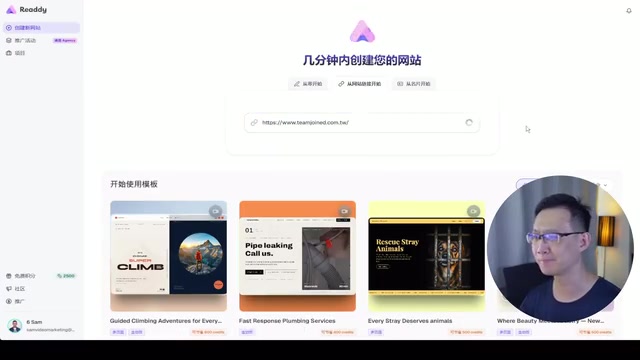
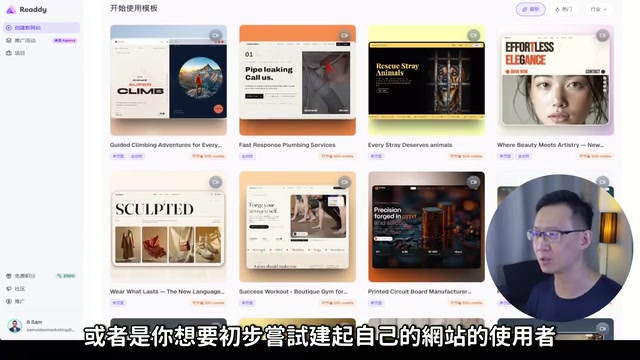
One of Readdy AI's biggest highlights is offering three distinctly different entry points for website creation, catering to different user scenarios.
Mode 1: Prompt-Driven, Generate a Website from Scratch
The most basic approach is generating a website through natural language descriptions. Users simply describe the website's purpose, style, and content requirements in the input field, and Readdy AI generates a complete web page accordingly. It supports voice input and allows uploading reference images or documents to make the generated results more precise and personalized. Users can also choose whether to simultaneously generate a mobile version, which is extremely practical for responsive design needs.
Responsive Design refers to web pages that automatically adjust their layout and content presentation based on the user's device screen size, resolution, and orientation. Its technical implementation primarily relies on CSS Media Queries, flexible grid layouts (Flexbox/Grid), and fluid images. In the AI website building context, simultaneously generating a mobile version means the AI needs to understand layout logic across different breakpoints, automatically handling navigation bar collapsing, image scaling, text reflow, and other adaptation issues—which is significantly more technically complex than simply generating a desktop page.
Mode 2: Business Card Website, Quick Personal Brand Launch
This is a rather creative feature—upload a business card, and Readdy AI automatically generates a professional Landing Page based on the information on the card. For freelancers and personal brand operators, this is virtually the fastest zero-barrier way to establish an online presence. From business card to webpage, the entire process requires almost no additional input.
A Landing Page is a core concept in digital marketing, referring to the first page users arrive at after clicking through an ad, search result, or social media link. Unlike regular web pages, Landing Pages typically have a clear single conversion goal (such as registration, purchase, or booking), with designs that intentionally minimize navigation distractions and emphasize the visual weight of CTA (Call to Action) buttons. A high-converting Landing Page needs to communicate its core value proposition within 3 seconds, which places high demands on both design quality and information architecture—precisely the challenge that AI website builders need to tackle.
Mode 3: Website Style Cloning, Solving the Design Quality Problem
This was the feature highlighted in the review and represents Readdy AI's most differentiated competitive advantage. Users can input the URL of an existing website, and Readdy AI analyzes that site's design style, layout structure, and visual language, then combines it with the user's provided content to generate a website with similar style but entirely new content.
Website style cloning technically involves parsing at multiple levels: the visual layer includes color schemes, font choices, spacing ratios, and image styles; the structural layer includes information hierarchy, module arrangement, and interaction patterns. The AI uses computer vision technology to take screenshots of the target website and extract design tokens (such as primary color HSL values, font size ratios, border-radius parameters, etc.), then applies these parameters to new content. It's worth noting that website visual design receives limited copyright protection in most jurisdictions—typically only complete copying constitutes infringement, while borrowing layout styles and design language is common industry practice.
In the review, the creator used a fitness brand's official website as a reference, pasted the target site's URL into Readdy AI, filled in their own brand information, and quickly generated a page that closely matched expectations in terms of layout quality and design composition. This "style cloning" capability effectively addresses the widespread "lack of design quality" problem in AI website builders.
Page Editing Capabilities: Fine-Tuning After Generation
An AI website builder that can only "one-click generate" without supporting subsequent fine-tuning would have severely limited practicality. Readdy AI performs well in terms of editability.
Real-Time Text Content Editing
A chat window is built into the right side of the page. After clicking the "Select to Edit" button, users can directly click on any text block they want to modify for real-time editing. The entire process requires no technical background—what you see is what you get.
WYSIWYG (What You See Is What You Get) editors trace back to word processing software in the 1970s. In the web domain, from early Dreamweaver to modern Webflow, WYSIWYG editors have evolved from generating redundant code to outputting semantic, maintainable code. Readdy AI combines WYSIWYG editing with AI conversational interaction, representing a new editing paradigm: users can make precise modifications through direct clicking or have the AI make batch adjustments through natural language descriptions. These two interaction methods complement each other, significantly lowering the barrier for non-technical users.
Image Processing and Replacement
Image editing also uses a click-to-select approach. After selecting a target image, a function menu appears supporting the following operations:
- Replace Image: Upload a new image for direct replacement
- Background Removal: One-click background removal
- Background Regeneration: AI generates a completely new background after removal
- Add Hyperlink: Bind a redirect link to the image
Text Effects and Color Tools
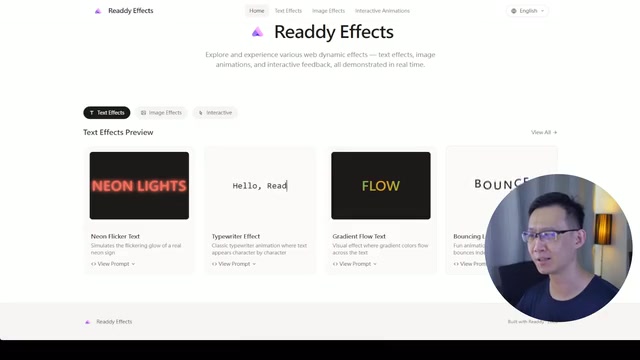
Readdy AI also provides dynamic text effects, allowing users to add visually impactful text animations to their websites. Users can directly copy prompt templates provided by the platform and paste them into the chat box for AI to automatically apply. Additionally, the platform offers free color design tools to assist users with overall page color scheme adjustments.
Built-in Smart Assistant and Customer Management Features
Readdy AI includes a 24/7 AI assistant whose functionality extends beyond website editing. It also supports:
- Automated Appointment Management: Helps users handle booking requests
- Information Retention and Management: Submitted user information can be viewed and organized centrally
- Customer Data Management: Convenient for business users to archive and utilize customer information
Integrating CRM (Customer Relationship Management) functionality into a website builder reflects the SaaS industry's "All-in-One" product trend. In traditional workflows, businesses need separate website builders (like WordPress), form tools (like Typeform), CRM systems (like HubSpot), and scheduling tools (like Calendly), with high costs for data integration between systems. Readdy AI consolidates these functions into a single platform, reducing the tech stack complexity for small and medium businesses. This model is similar to China's mini-program ecosystem or Notion's All-in-One workspace philosophy—solving multiple workflow problems with one tool.
This means Readdy AI isn't just a website builder—it's also attempting to cover some customer management needs in website operations, creating a closed loop from site building to operations.
Readdy AI Use Case Analysis
Based on the review, Readdy AI is suitable for a wide range of scenarios:
- Corporate Websites: Small and medium businesses quickly building brand websites, saving expensive outsourcing costs
- Campaign Pages: Landing Pages for short-term marketing campaigns, with the ability to batch-produce an entire season's pages in a single day
- Personal Branding: Freelancers and entrepreneurs establishing a professional online presence
- Product Showcase Pages: Quickly building display pages when new products launch
Pricing Strategy and Value Assessment
Readdy AI offers a free trial, with paid plans using a credit-based system that provides high flexibility:
- Annual plans distribute all credits for the year at once, allowing users to freely allocate their usage pace
- Long-term plans offer significant discounts: 40% off for one year, 50% off for two years, 60% off for three years
- Promo codes can be stacked with plan discounts
Credit-based Pricing is an increasingly popular pricing model in the AI tools space, fundamentally different from traditional monthly subscriptions. Under subscription models, users pay regardless of whether they use the service, while credit systems tie costs to actual usage. This model is particularly sensible for website building scenarios: the initial phase may require heavy AI generation and iteration (high credit consumption), while after launch the site enters a maintenance phase with much lower modification frequency (low credit consumption). Compared to usage-based billing models from developer tools like Vercel and Supabase, credit-based pricing essentially packages the "pay-as-you-go" concept into a more easily understood consumption format.
The advantage of this credit-based design is that during the initial building phase when heavy generation and content adjustment is needed, credits can be consumed intensively. Once the website stabilizes, maintenance requires very few credits, keeping overall costs controllable.
Conclusion: Is Readdy AI Worth Trying?
Readdy AI demonstrates several clear differentiating advantages among AI website builders: website style cloning capability solves the problem of cookie-cutter AI-generated pages; multimodal input (text, voice, images, documents, business cards, URLs) lowers the usage barrier; strong editability ensures room for fine-tuning after generation.
Of course, as an AI generation tool, it's better suited as a starting point for website building rather than the final destination. For large enterprise websites with highly customized requirements, professional teams may still need to be involved. But for small and medium businesses, personal brands, and fast-iterating marketing scenarios, Readdy AI genuinely provides a solution that's low-cost, high-efficiency, and delivers acceptable design quality.
If you're considering building your own website, why not try it out with the free credits first and see whether the AI-generated results meet your expectations.
Related articles
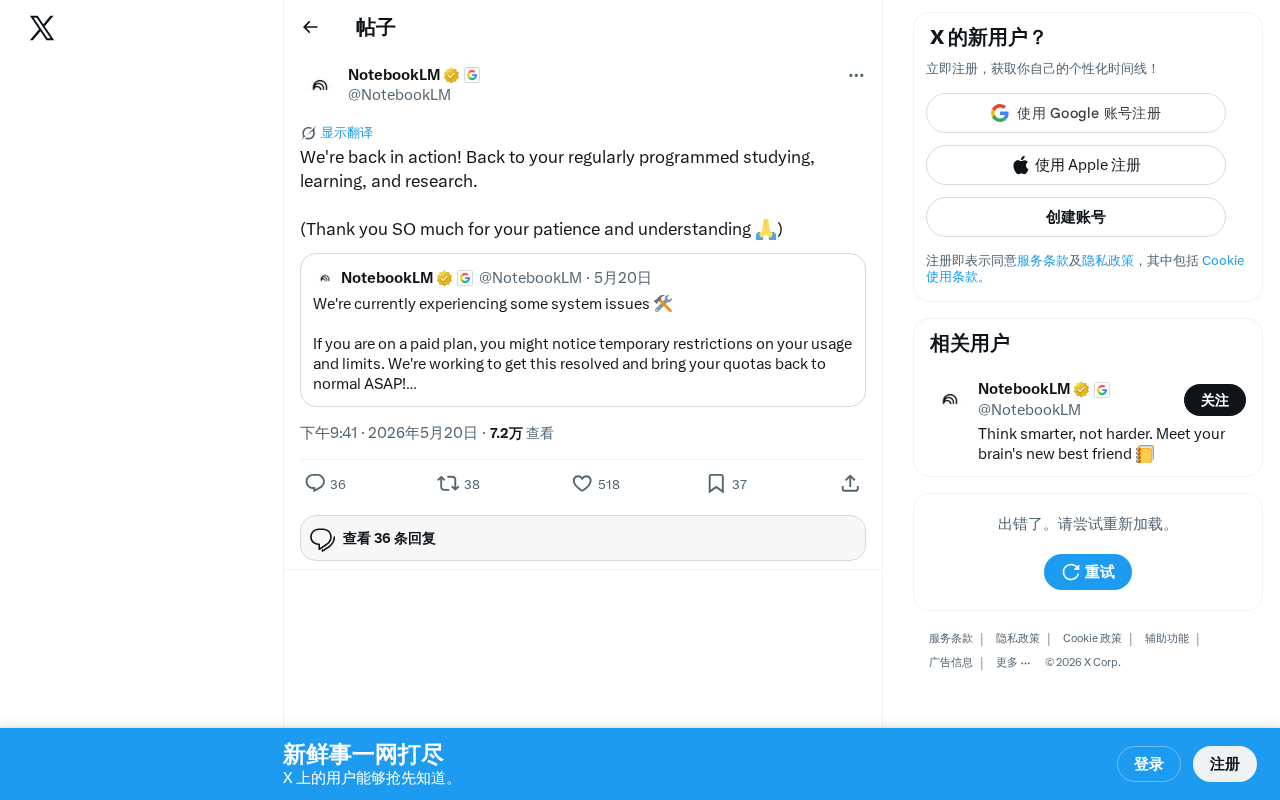
NotebookLM Service Restored: Google's AI Research Assistant Back Online
Google NotebookLM is fully back online after a service outage. Learn about the incident details, NotebookLM's core features, and backup tips for AI-dependent researchers.
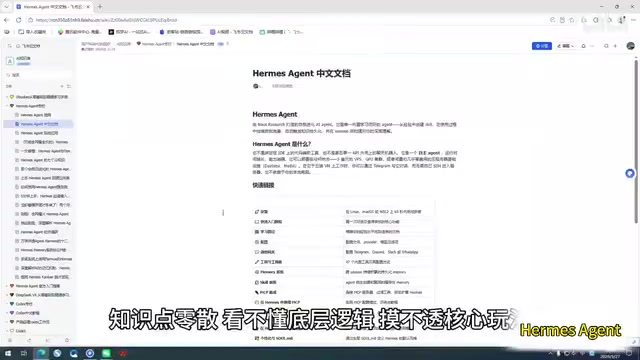
Claude Code Chinese Tutorial: A 100-Page Systematic Learning Guide on Feishu Docs
A detailed look at the Claude Code Chinese learning resource on Feishu Docs, covering AI agent learning, memory systems, and task decomposition with a systematic path from beginner to advanced.

Claude Code Enterprise E-commerce in Practice: A Methodology for Taking AI Programming from Demo to Industrial-Grade
A deep dive into engineering methodology for enterprise e-commerce development with Claude Code and Harness AI, covering architecture, code quality, and CI/CD practices.