Claude Code Enterprise E-commerce in Practice: A Methodology for Taking AI Programming from Demo to Industrial-Grade
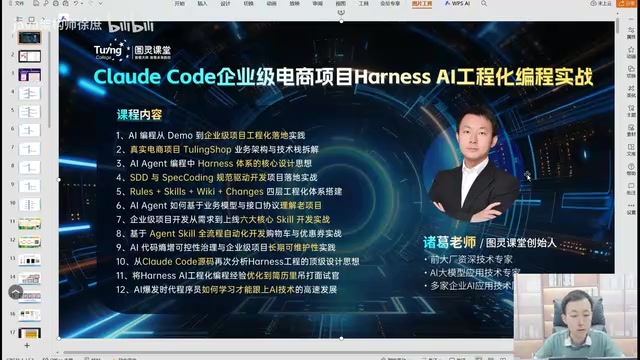
A methodology for elevating AI programming from demo-level to industrial-grade enterprise e-commerce development.
This article explores how to bridge the gap between AI-generated demo code and production-ready enterprise systems using Claude Code and Harness AI. It covers the "1/3 code" problem, engineering-grade methodology including standards-first and layered generation approaches, CI/CD quality gates, and practical architecture patterns for e-commerce microservices, offering developers a roadmap to industrial-grade AI programming.
Introduction: AI Programming Is Moving from Toy to Productivity Tool
AI programming tools are emerging in abundance, but one pointed question persists: Can AI-generated code really be used in production environments? Many developers have tried various AI coding assistants only to find that the generated code is suitable for demos at best—still far from enterprise-level deployment.
Current mainstream AI programming tools include GitHub Copilot, Cursor, Claude Code, Amazon CodeWhisperer, and others. They are built on Large Language Model (LLM) technology, trained on massive code corpora to acquire code generation capabilities. However, production environments demand far more than functional correctness—they require security (SQL injection prevention, XSS attack defense), observability (structured logging, distributed tracing), fault tolerance (circuit breaking, retry mechanisms), and compliance (data privacy protection, audit logging). These non-functional requirements often account for 40%-60% of enterprise-grade code, yet AI rarely generates this defensive code proactively without explicit instructions.
This article is based on a hands-on course about building an enterprise-level e-commerce project with Claude Code + Harness AI. It distills the core principles of engineering-grade AI programming and explores how to elevate AI coding from "toy-level" to "industrial-grade."
Why Most AI-Generated Code Can't Go to Production
The Root Cause of the "1/3 Code" Problem
There's a widely circulated claim that only about one-third of AI-generated code is truly usable. The root causes of this problem include:
- Lack of engineering constraints: AI doesn't know your project's architectural standards, coding style requirements, or team collaboration norms
- Limited context understanding: A single conversation can rarely cover the full picture of complex business logic
- Missing quality assurance processes: No code reviews, test coverage, or performance benchmarks—all enterprise-level requirements
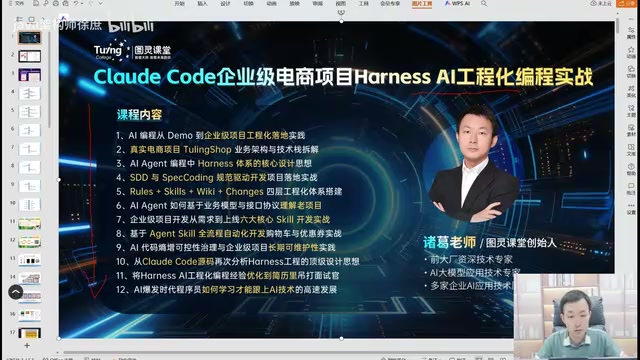
The course makes it clear that with the right methodology and toolchain, AI-generated code can absolutely meet enterprise standards—the key lies in "how you use it" rather than "whether it can be used."
The Chasm Between Demo and Production
Taking an e-commerce project from demo to production requires bridging gaps beyond just feature implementation:
- Architecture design: Microservice decomposition, database design, caching strategies
- Code quality: Exception handling, logging standards, security protections
- Engineering practices: CI/CD pipelines, automated testing, monitoring and alerting
- Performance optimization: High-concurrency handling, database optimization, API response times
Microservice architecture splits a monolithic application into multiple independently deployable service units, each built around a specific business capability. In e-commerce scenarios, typical decomposition includes user service, product service, order service, payment service, inventory service, and more. This architecture introduces complex engineering challenges such as inter-service communication (REST/gRPC/message queues), distributed transactions (e.g., the Saga pattern for handling order-deduct inventory-payment consistency), service discovery and load balancing, and API gateways. If AI doesn't understand these distributed system constraints when generating code, it can easily produce code that works correctly in a monolithic architecture but causes data inconsistency or performance issues in a microservice environment.
The Engineering Methodology of Claude Code + Harness AI
What Is Harness AI Engineering-Grade Programming
Harness AI isn't simply about having AI write code—it's about embedding AI into the complete software engineering workflow. Harness is an enterprise software delivery platform offering CI/CD, Feature Flags, cloud cost management, chaos engineering, and more. Harness AI (also known as AIDA) embeds AI capabilities throughout the DevOps lifecycle, including intelligent pipeline generation, deployment failure root cause analysis, and automated remediation suggestions. In this course's context, "Harness AI engineering-grade programming" refers to a methodology—deeply integrating AI code generation with the complete software delivery process, rather than using AI to write code in isolation. This approach ensures that AI output always operates under the constraints and validation of an engineering framework.
Its core principles are:
- Standards first: Define architectural standards and coding conventions before having AI generate code
- Layered generation: Generate code layer by layer following enterprise project architecture
- Continuous verification: Every piece of generated code undergoes automated testing and manual review
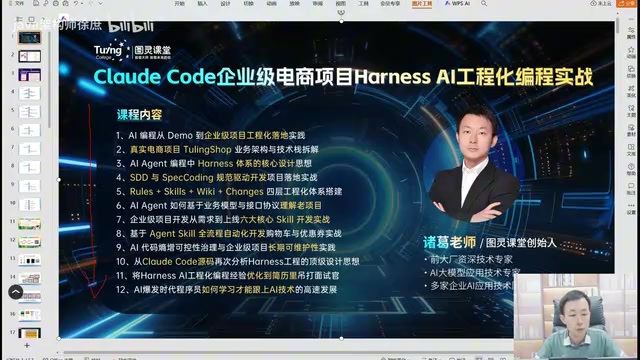
In the continuous verification phase, CI/CD (Continuous Integration/Continuous Deployment) pipelines serve as the "quality firewall" for AI-generated code. Continuous integration requires developers to frequently merge code into the main branch, with each merge triggering automated builds and tests; continuous deployment automatically releases code that passes all quality gates to production. Through automated stages including static code analysis (SonarQube), unit test coverage checks (JaCoCo typically requiring ≥80%), security vulnerability scanning (Snyk/OWASP), and performance benchmark testing, AI-generated code is ensured to meet enterprise standards before merging. This "AI generation + automated verification" pattern is the core paradigm of engineering-grade AI programming.
Claude Code's Unique Advantages in Enterprise Scenarios
Compared to other AI programming tools, Claude Code has several notable advantages in enterprise development scenarios:
- Ultra-long context window: Can understand an entire project's code structure and dependency relationships
- Strong reasoning capabilities: More accurate understanding of complex business logic, reducing rework
- Code consistency: Generated code maintains uniform style that meets engineering standards
The context window refers to the maximum number of tokens a large language model can process in a single interaction. Claude Code, based on Anthropic's Claude model, features an industry-leading 200K token context window, meaning it can simultaneously "see" approximately 150,000 characters of code and documentation. For enterprise projects, a single microservice might contain hundreds of files, complex dependency injection relationships, and cross-module call chains. AI tools with short context windows can only see the current file, easily generating code inconsistent with the overall project architecture. Long context capability allows Claude Code to understand conventions like Service layer calling Repository layer, DTO-to-Entity mapping rules, and global exception handling strategies, thereby generating new code that is highly consistent with the existing codebase.
TulingShop E-commerce Project Architecture in Practice
The course uses the complete TulingShop e-commerce project as its vehicle, covering core e-commerce system modules:
- User system (registration, login, permission management)
- Product system (categories, search, detail display)
- Order system (ordering, payment, logistics tracking)
- Marketing system (coupons, promotional campaign management)
This is not a simplified teaching demo but an industrial-grade project with a complete business loop, suitable for developers to practice and accumulate real-world experience. In actual e-commerce systems, these modules have complex interactions: placing an order requires inventory verification, discount calculation, inventory freezing, and payment order creation—failure at any step requires proper rollback. This kind of cross-service business orchestration is precisely where AI programming is most error-prone, and where engineering methodology demonstrates its greatest value.
The Practical Value of AI Engineering Programming for Job Interviews
Resume Differentiation
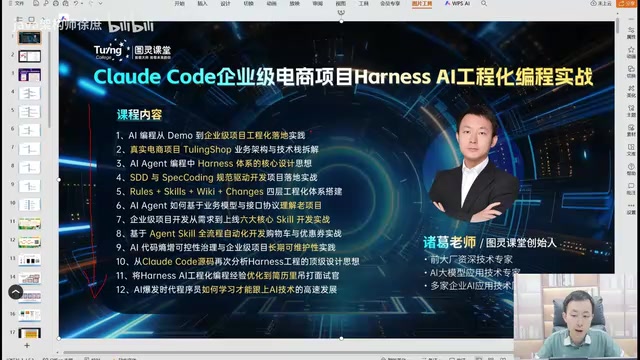
In today's job market, simply knowing how to use AI tools is no longer a differentiator. What's truly competitive is:
- Being able to articulate AI programming engineering methodology: Not "I used AI to write code," but "I used AI to build enterprise-grade systems"
- Having complete project experience: End-to-end practice from architecture design to production deployment
- Understanding AI's boundaries: Knowing which scenarios are suitable for AI assistance and which require human judgment
Understanding AI's boundaries is particularly important. Current AI programming tools excel in scenarios like: CRUD operation generation, design pattern application, unit test writing, documentation generation, code refactoring, and other highly structured tasks. However, human leadership is still needed for: complex distributed consistency design, performance bottleneck identification and optimization, security architecture decisions, boundary condition handling in business rules, and progressive refactoring strategies for legacy systems. Candidates who can clearly articulate this understanding demonstrate engineering maturity far beyond that of a mere "AI tool user" in interviews.
A Qualitative Leap in Coding Efficiency
After mastering the right AI programming methodology, coding efficiency undergoes a qualitative transformation. This improvement isn't simply about faster code generation speed—it manifests throughout the entire development lifecycle:
- Architecture design phase: AI assists in rapidly generating design proposals and evaluating feasibility
- Implementation phase: AI generates code frameworks and business logic that conform to standards
- Testing phase: AI automatically generates unit tests and integration test cases
- Documentation phase: AI automatically generates API documentation and technical specifications
According to industry practice data, developers who have mastered AI engineering programming methods can improve overall development efficiency by 2-5x while maintaining code quality. The key to this efficiency gain isn't the speed at which AI generates code, but the reduction in rework cycles—through standards-first and layered generation approaches, AI-generated code achieves a high usability rate on the first attempt, avoiding the time consumed by repeated modifications and debugging.
Conclusion: Key Recommendations for Mastering AI Engineering Programming
The future of AI programming isn't "AI replacing programmers" but "programmers who can use AI replacing those who can't." To truly leverage Claude Code's enterprise development capabilities, the key points are:
- Don't stay at the stage of having AI write simple scripts
- Systematically learn engineering-grade AI programming methodology
- Practice with real projects to accumulate enterprise-level development experience
- Master quality control and review methods for AI-generated code
For Java developers, the combination of Claude Code + enterprise e-commerce projects is currently an efficient path to improving AI programming capabilities and achieving the leap from demo to industrial-grade. It's worth noting that AI engineering programming is not a static skill point but a continuously evolving capability system. As model capabilities improve (longer context, stronger reasoning, multimodal understanding) and toolchains mature (smarter CI/CD integration, more precise code review), developers need to continuously update their methodology to find the optimal balance between efficiency and quality in human-AI collaboration.
Related articles
Coze Workflow in Practice: Complete Tutorial for AI One-Click Product Promo Video Generation
Step-by-step guide to building a Coze workflow for AI product promo videos, integrating HappyHours and Jimeng across 12 nodes with nine-grid storyboards and polling loops.
Getting Started with Claude Code: 5 Key Differences from Traditional AI Chatbots
Explore 5 key differences between Claude Code and traditional AI chatbots like ChatGPT, covering interaction, context, execution, memory, and tool integration.

Your Pension Forced to Buy AI Bubble Stocks: The Truth Behind Nasdaq's Rule Changes
Nasdaq's fast-track rule changes may force your 401K and pension funds to buy SpaceX, OpenAI, and Anthropic stock. Analysis of the $4T valuation bubble and what investors can do.