Replit Canvas: An AI Multimedia Creation Canvas Combining Image, Video, and Audio
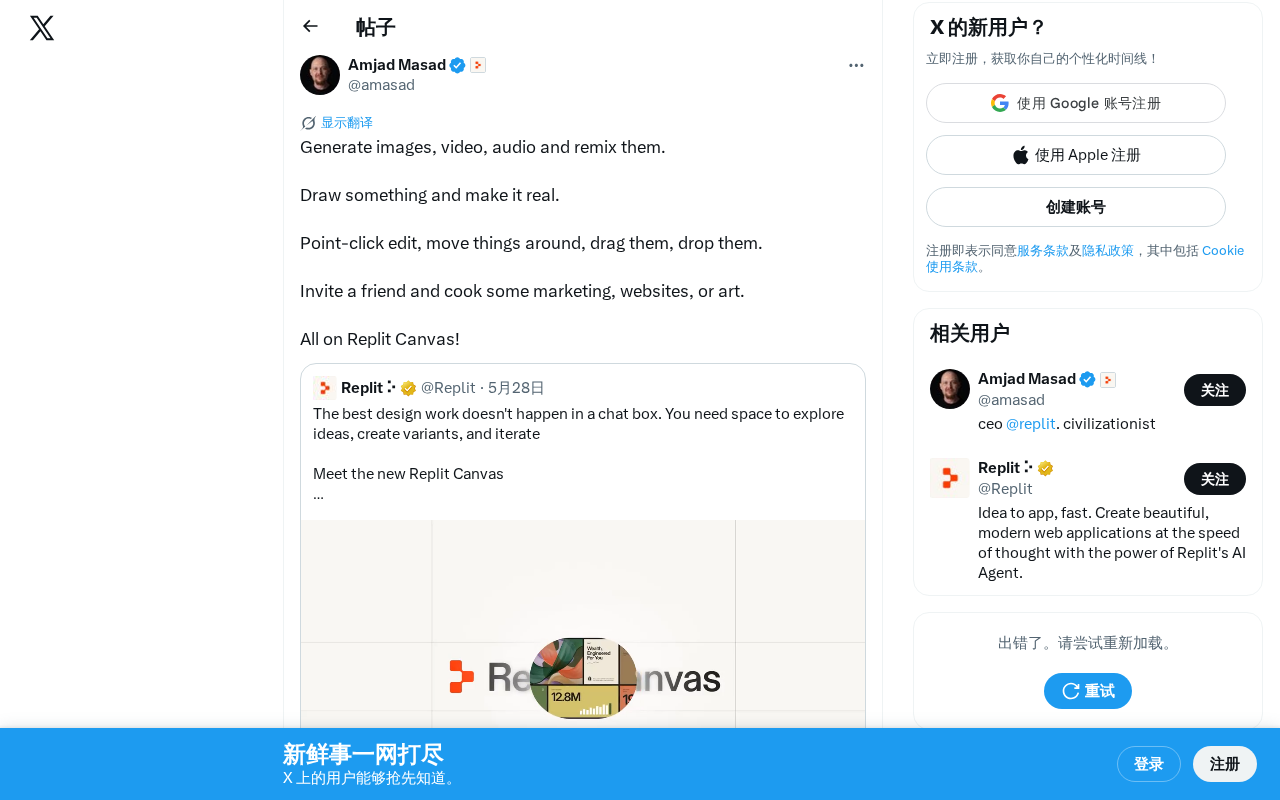
Replit Canvas unifies AI image, video, and audio generation into one collaborative creative workspace.
Replit has launched Canvas, a multimedia creation workspace that integrates AI-powered image, video, and audio generation with intuitive visual editing and real-time collaboration. Key features include multimodal content generation, sketch-to-real-image conversion, WYSIWYG canvas editing, and multiplayer collaboration. The product signals Replit's strategic expansion from a developer IDE to a broader creator platform.
What Is Replit Canvas?
Replit, the platform renowned for its online programming environment, recently launched a remarkable new feature — Replit Canvas. This isn't just a simple code editor upgrade; it's an entirely new creative canvas that integrates image generation, video production, audio creation, and multimedia mixed editing into one unified workspace.
Founded in 2016 by Amjad Masad, Replit was originally positioned as a browser-based online Integrated Development Environment (IDE), enabling developers to write, run, and deploy code without local setup. Its core philosophy is to lower the barrier to programming, supporting over 50 programming languages with built-in real-time multiplayer collaboration. Since 2023, Replit has invested heavily in AI capabilities, launching the AI coding assistant Ghostwriter (later upgraded to Replit AI), which can auto-complete code, explain code logic, and assist with debugging. As of 2024, Replit has over 30 million users and a valuation exceeding $1.1 billion, making it one of the leading players in the AI coding space. The launch of Canvas marks a significant leap from a pure code tool to a multimedia creation platform.
Based on the official release, Replit Canvas has a clear positioning: deeply integrating AI generation capabilities with an intuitive visual editing experience, allowing creators to handle AI-generated multimedia content as easily as working with Figma or Canva.
Replit Canvas Core Features Explained
Multimodal AI Content Generation
Replit Canvas supports AI generation across three major media types: image, video, and audio. Users no longer need to switch between different AI tools — no more going to Midjourney for images, Suno for music, or Runway for video. One canvas handles all multimedia asset generation.
To understand the technical foundation of this feature, it helps to know the development trajectory of Multimodal AI. Multimodal AI refers to artificial intelligence systems capable of simultaneously processing and generating multiple data types (such as text, images, audio, and video). This field experienced explosive growth in 2023-2024: OpenAI's GPT-4o achieved unified understanding of text, images, and audio; Google's Gemini natively supports multimodal input and output; and Meta's ImageBind explored a unified embedding space across six modalities. On the generation side, Stable Diffusion and DALL-E 3 dominate image generation, Sora and Runway Gen-3 are pushing video generation forward, while Suno and Udio have emerged in the music generation space. However, most of these tools operate in silos, requiring users to switch between multiple platforms. Replit Canvas aims to solve precisely this fragmentation problem by consolidating multimodal generation capabilities into a single workspace.
Even more noteworthy is its remix capability. Users can combine and recreate AI-generated content across different modalities — a type of cross-modal mixed editing that remains quite rare in the current AI tool ecosystem. The remix concept originates from music production, referring to the rearrangement and recreation of existing works. In the AI context, cross-modal remix means users can use AI-generated images as video assets, synchronize audio with visual elements, or layer multiple generated results together. The technical challenge lies in semantic alignment across modalities — the system needs to understand whether the scene in an image matches the mood of the audio, or whether the video rhythm syncs with the music beat. Currently, RunwayML's Multi Motion Brush and Pika's Scene Composition offer partial cross-modal editing capabilities, but achieving truly high-freedom cross-modal remix remains a frontier challenge in the industry.
Sketch-to-Real-Image Conversion
"Draw something and make it real" — this feature is reminiscent of the viral "make it real" feature from tldraw that took social media by storm. tldraw is an open-source online whiteboard drawing tool. In November 2023, its founder Steve Ruiz released an experimental feature called "make it real" that caused a sensation on social media. The feature allowed users to draw UI sketches on the whiteboard, then used GPT-4V (the vision version of GPT-4) to recognize the sketches and convert them into runnable HTML/CSS/JavaScript code, generating real interactive web interfaces. This demo attracted widespread attention because it intuitively demonstrated the potential of multimodal AI in real workflows — instant conversion from hand-drawn sketches to code, dramatically compressing the time from idea to prototype. Since then, multiple companies have begun exploring similar sketch-to-code/design pathways.
Users can casually doodle on the canvas, and AI will transform the sketches into realistic images or design elements. This instant conversion from sketch to finished product dramatically lowers the creative barrier, enabling users without professional design skills to quickly visualize ideas in their heads. For product managers, marketers, and other non-design roles, this feature offers particularly outstanding practical value.
WYSIWYG Canvas Editing Experience
Click to select, drag to move, place to position — these seemingly basic interactions carry significant meaning in the context of AI-generated content. Most current AI generation tools deliver a "one-shot deal": input a prompt, get a result, and regenerate if unsatisfied. Replit Canvas instead provides a post-generation editable workflow, where users can make fine-grained position adjustments and compositional arrangements to AI-generated elements.
This shift in interaction paradigm essentially moves AI generation from a "conversational" model to a "canvas" model, creating an interesting parallel with products like Anthropic's Claude Artifacts and OpenAI's Canvas, though Replit's version clearly emphasizes multimedia creation scenarios.
Canvas-based interaction paradigms have a deep tradition in product design. From Adobe Photoshop's layered canvas to Figma's infinite canvas for collaborative design to Miro's online whiteboard, the canvas has always been the most natural digital workspace for creative professionals. In 2024, this paradigm began deeply merging with AI: Anthropic launched Claude Artifacts in October 2024, allowing users to preview AI-generated code, documents, and visualizations in real-time alongside conversations; OpenAI subsequently launched ChatGPT Canvas, providing an AI-assisted document and code editing canvas; and Google's NotebookLM combined AI with a notebook-style knowledge management canvas. These products collectively point to a trend: AI output shouldn't be trapped in chat bubbles but should be placed in spaces where users can freely manipulate it. Replit Canvas takes this a step further by extending the canvas's operational objects from text and code to multimedia content.
Real-Time Multiplayer Collaborative Creation
"Invite a friend and cook some marketing, websites, or art" — Replit Canvas supports real-time multiplayer collaboration. This feature elevates it from a personal creation tool to a team collaboration platform. The official announcement specifically highlighted three core use cases:
- Marketing content production: Teams collaboratively create social media assets, ad graphics, and more
- Website building: Combined with Replit's existing code capabilities, complete the entire process from design to deployment in one place
- Art creation: Multiple people brainstorm and create together on the canvas
Industry Significance and Trend Analysis
The "Canvas-ification" of AI Tools Is Accelerating
The launch of Replit Canvas confirms an accelerating industry trend: AI tools are moving from single dialog boxes to multidimensional canvas spaces. Whether it's Anthropic's Artifacts, Google's NotebookLM, or now Replit Canvas, leading players are all exploring how to make AI output more actionable and composable.
This canvas-based interaction approach gives users stronger control over AI-generated results and evolves AI tools from mere "generators" into true "creative environments."
Strategic Transformation from Developer Tool to Creator Platform
This move by Replit also signals an important shift in its strategic positioning. It's no longer just an online IDE for developers — it's advancing into the broader creator economy.
The creator economy refers to the commercial ecosystem formed around independent content creators, encompassing social media content, online courses, digital art, podcasts, short-form video, and more. According to a 2024 Goldman Sachs report, the global creator economy market has reached $250 billion and is projected to grow to $480 billion by 2027. Over 50 million people worldwide consider content creation a full-time or part-time income source. However, one of the core pain points creators face is tool chain fragmentation — producing a single marketing video might require simultaneously using Canva (design), CapCut (editing), ChatGPT (copywriting), Midjourney (illustrations), and other tools. Replit is targeting this pain point, attempting to provide a one-stop solution through Canvas and thereby enter this high-growth market.
By combining AI generation capabilities with visual editing, Replit is trying to cover a larger user base spanning from professional developers to everyday content creators.
Challenges and Uncertainties to Watch
Of course, the specific technical details and actual user experience of Replit Canvas remain to be verified. Several key questions deserve ongoing attention:
- Can the quality of multimodal generation compete with specialized tools like Midjourney and Runway?
- How smooth is real-time collaboration when multiple users operate simultaneously?
- Is the commercial licensing policy for generated content clearly defined?
Among these, the copyright issue surrounding AI-Generated Content (AIGC) deserves particularly close attention. The core controversy centers on two levels: first, the copyright compliance of AI training data — multiple AI companies face lawsuits for using copyrighted works to train models, such as The New York Times v. OpenAI and Getty Images v. Stability AI; second, the copyright ownership of AI-generated works — the U.S. Copyright Office stated clearly in 2023 that purely AI-generated content is not eligible for copyright protection, but AI-assisted works with substantial human creative contribution can obtain copyright. The EU's AI Act and China's Interim Measures for the Management of Generative AI Services are also gradually establishing relevant frameworks. For a multimodal generation platform like Replit Canvas, the commercial compliance of content generated by users — such as marketing assets and website designs — will directly impact the product's commercialization prospects.
These questions can only be answered after the product is officially opened at scale.
Conclusion
Replit Canvas represents an important direction in the evolution of AI creation tools: consolidating dispersed AI generation capabilities into a unified visual canvas while empowering users with intuitive editing and collaboration abilities. It combines four core capabilities — multimodal AI generation, sketch-to-image conversion, canvas-style editing, and real-time collaboration — in an attempt to create a one-stop AI multimedia creation experience.
If executed well, Replit Canvas could become a critical bridge connecting AI capabilities with real-world creative needs. For practitioners and content creators following AI application deployment, this is a product worth tracking closely.
Key Takeaways
Related articles

Claude Code for Test Development in Practice: An AI Programming Workflow That Doubles Your Efficiency
A practical guide to Claude Code for test development: auto-generating test scripts, Plan Mode workflows, MCP + Playwright integration, and Subagent parallel tasks to build systematic AI-assisted workflows.
Hermes Agent Hands-On Review: An AI Efficiency Revolution for Indie Game Developers
Indie game developer reviews Hermes Agent vs OpenClaude: intelligent context compression, real-time Memory, remote control via Telegram, and practical use cases in game dev, social media, and email.
Vibe Coding Beginner's Guide: Tool Selection Across Three Categories with Practical Examples
A comprehensive guide to Vibe Coding's three tool categories: Agent frameworks, CLI Coding, and IDE tools, with practical examples including Snake game and data analysis workbench.