sakana-mcp: Driving AI Scientist Autonomous Research Cycles via MCP Protocol
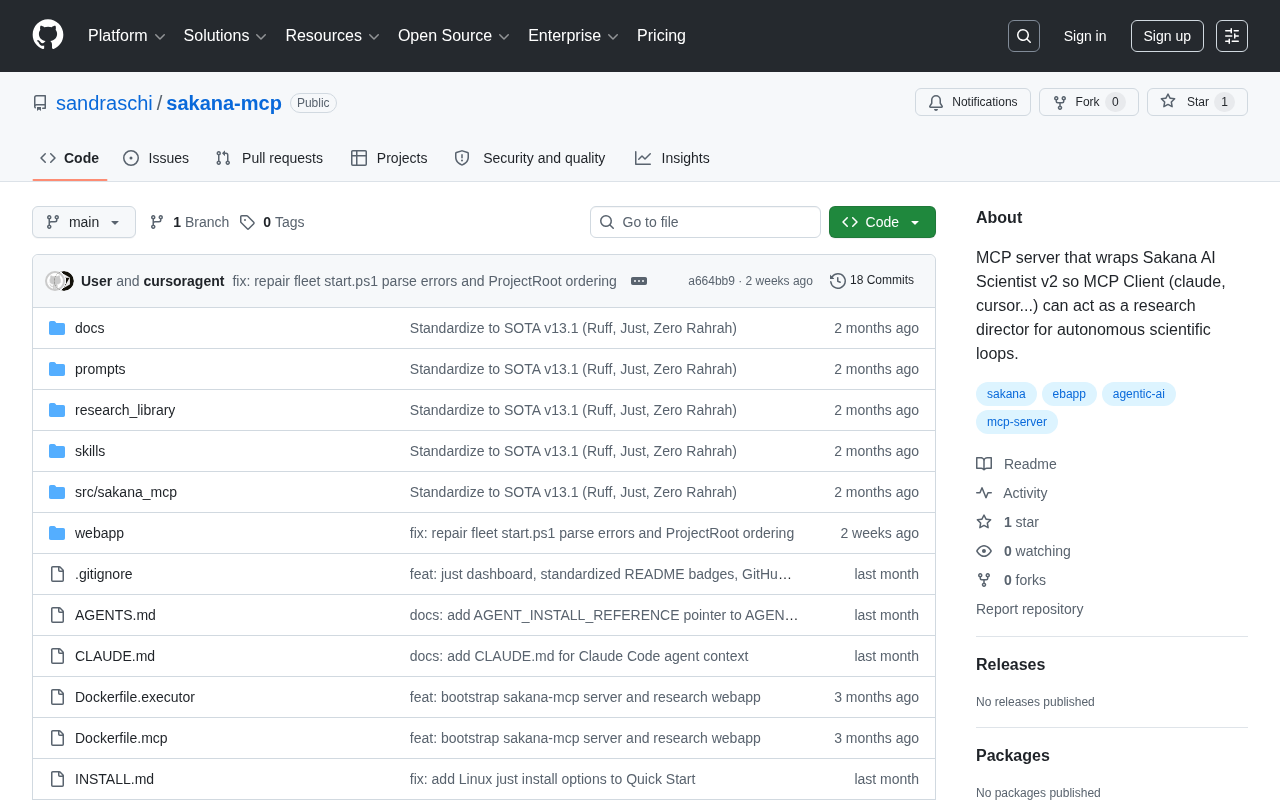
sakana-mcp bridges AI Scientist v2 with MCP protocol, enabling AI-directed autonomous research cycles.
sakana-mcp is an early-stage open-source project that wraps Sakana AI's AI Scientist v2 as an MCP server, allowing clients like Claude and Cursor to act as "research directors" orchestrating autonomous research workflows. Built in TypeScript, it bridges specialized AI research systems with general-purpose AI assistants through Anthropic's standardized Model Context Protocol, pointing toward a future of modular, composable AI collaboration in scientific research.
Project Overview: sakana-mcp Connects AI Scientist to the MCP Ecosystem
Recently, a forward-looking open-source project appeared on GitHub — sakana-mcp — which wraps Sakana AI's AI Scientist v2 as an MCP (Model Context Protocol) server, enabling MCP clients like Claude and Cursor to act as a "research director" orchestrating autonomous research cycles.
Although this project currently has only 1 Star and is in a very early stage, the technical direction it represents — connecting autonomous research systems with general-purpose AI assistants through standardized protocols — is worth exploring in depth.
Core Concepts: AI Scientist, MCP Protocol, and the Bridge Role
What Is Sakana AI Scientist v2?
Sakana AI Scientist is an autonomous research system developed by Japanese AI company Sakana AI. Its v2 version can automatically complete the entire research workflow — from literature review, hypothesis generation, experiment design, and code writing to paper drafting. This system is already one of the benchmark projects in AI-driven research automation.
Sakana AI was co-founded in Tokyo in 2023 by former Google Brain researcher David Ha and Llion Jones (one of the co-authors of the Transformer paper "Attention Is All You Need"). The company name comes from the Japanese word for "fish" (魚), symbolizing solving problems through collective intelligence like a school of fish. Sakana AI focuses on nature-inspired AI research methods, including evolutionary algorithms and swarm intelligence, with the AI Scientist project being their flagship product applying these concepts to research automation. AI Scientist v2 shows significant improvements over the first generation in experiment design autonomy and paper quality, capable of handling more complex multi-step experimental workflows and generating complete papers that meet academic standards.
The Role of MCP Protocol
MCP (Model Context Protocol) is an open protocol standard introduced by Anthropic, designed to provide AI models with a unified interface for tool invocation and contextual interaction. Through the MCP protocol, different AI clients (such as Claude Desktop, Cursor IDE, etc.) can seamlessly connect to various external tools and services without writing custom integration code for each tool.
From a technical implementation perspective, MCP was officially released and open-sourced by Anthropic in late 2024, using JSON-RPC 2.0 as the underlying communication format and supporting both stdio and HTTP+SSE transport methods. The protocol defines three core primitives: Tools (tool invocation, allowing AI to perform specific operations), Resources (resource access, providing data and context), and Prompts (prompt templates, encapsulating reusable interaction patterns). MCP's design philosophy is similar to what USB-C is for hardware devices — providing a universal standard that lets any AI model plug-and-play with external capabilities without custom integration development for each tool. Before MCP, every AI application needed to write specialized adapter code for each external tool, creating N×M integration complexity; MCP simplifies this to N+M linear complexity.
sakana-mcp's Bridge Role
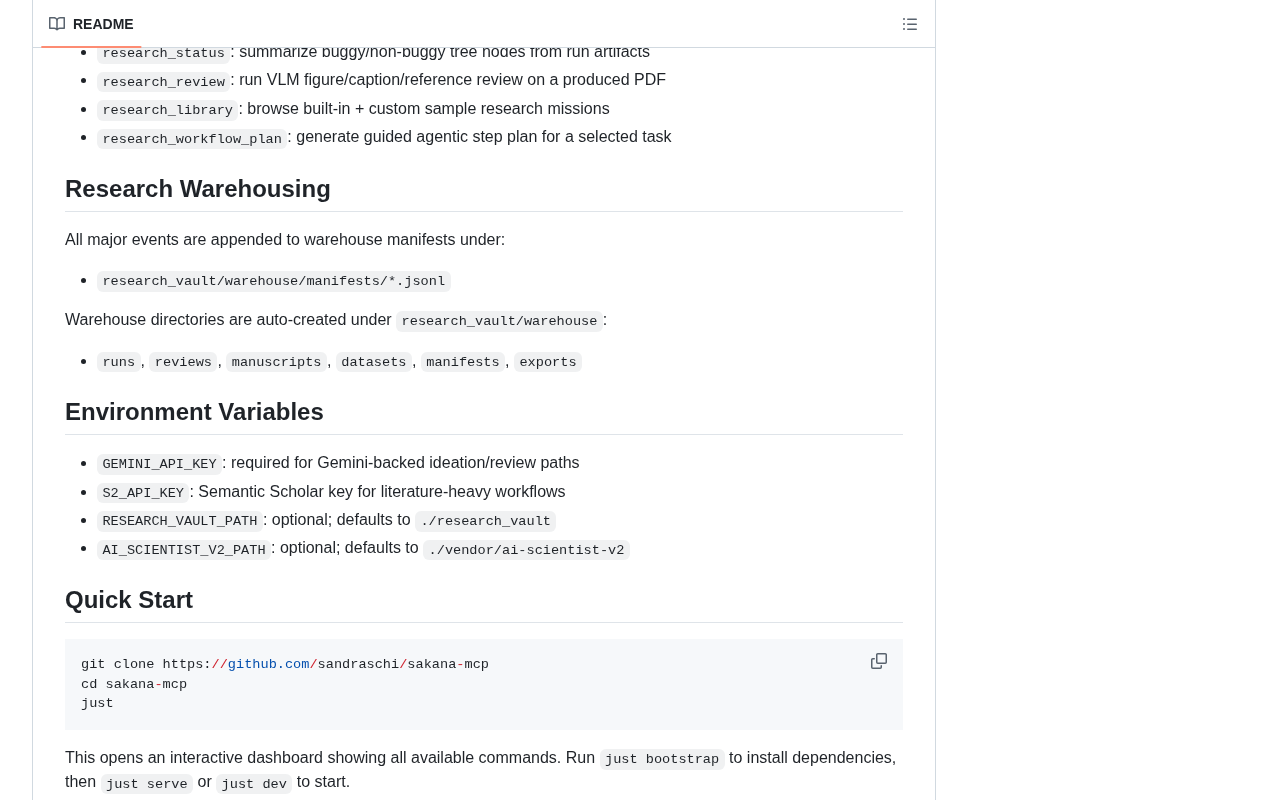
The core value of this project lies in building a bridge: it exposes AI Scientist v2's capabilities as standard MCP tool interfaces, allowing any MCP-compatible client to invoke these capabilities. In other words, you can launch a complete research experiment workflow directly within a Claude conversation, or have AI Scientist help validate scientific hypotheses while writing code in Cursor.
Technical Architecture and Research Director Mode Analysis
Lightweight Wrapper in TypeScript
sakana-mcp is written in TypeScript and can easily run in a Node.js environment with a low deployment barrier. As an MCP server, it is essentially a middleware layer — receiving requests from MCP clients, translating them into instructions that AI Scientist v2 can understand, and returning results in MCP protocol format.
Choosing TypeScript as the implementation language has its technical rationale. Anthropic officially provides MCP SDKs in both TypeScript and Python, with the TypeScript version being particularly suitable for building MCP servers because Node.js's asynchronous I/O model is naturally suited for handling concurrent tool invocation requests, and TypeScript's type system can catch type errors in protocol interactions at compile time, reducing runtime failures. Additionally, the rich tool libraries in the npm ecosystem lower the development cost of integrating with various external services. This lightweight wrapper pattern means developers don't need to deeply understand AI Scientist v2's internal implementation — they only need to complete integration through MCP interface definitions.
Why the "Research Director" Mode Matters
The project description mentions that MCP clients can act as a "research director," and this design philosophy is crucial. It means:
- Humans or higher-level AI retain decision-making authority: Research direction, priorities, and quality control are determined by the MCP client side (possibly human users interacting through Claude)
- AI Scientist focuses on the execution layer: Specific experiment design, code execution, data analysis, and other heavy lifting are handled by the autonomous system
- Hierarchical AI collaboration structure: This effectively builds an "AI managing AI" hierarchy, with the upper layer responsible for strategic decisions and the lower layer for specific execution
This design philosophy aligns closely with Principal-Agent Theory in organizational management. In traditional research teams, the PI (Principal Investigator) is responsible for determining research direction and quality control, while PhD students and postdocs handle specific experiment execution. sakana-mcp maps this human organizational structure to AI systems, with the MCP client playing the PI role and AI Scientist playing the executing researcher role, balancing autonomy and controllability through clear division of responsibilities. This layered architecture also brings an additional advantage: when the underlying execution system (such as AI Scientist) is upgraded or replaced, the upper-level decision logic and interaction methods don't need to change, achieving separation of concerns.
Application Scenarios: From Academic Acceleration to Automated Experiment Pipelines
Academic Research Acceleration
Researchers can guide AI Scientist through natural language conversations for literature reviews, experiment reproduction, or new hypothesis validation, significantly reducing the time cost and technical barriers of research.
Cross-Disciplinary Exploration
Since MCP clients (like Claude) possess broad knowledge bases, they can propose research directions from cross-disciplinary perspectives that AI Scientist might overlook, creating complementary capabilities.
Automated Experiment Pipelines in Industrial R&D
In industrial R&D scenarios, this architecture can build continuously running experiment pipelines — the AI research director constantly proposes new experimental plans, AI Scientist automatically executes them and feeds back results, forming a closed-loop iteration. This pattern is particularly valuable in fields requiring extensive trial and error, such as drug discovery, materials science, and algorithm optimization, potentially compressing traditional experiment-analysis-adjustment cycles that take weeks into hours or even minutes.
Current Limitations and Future Outlook
As a project just getting started (0 Forks, 1 Star), sakana-mcp is clearly still in the proof-of-concept stage. The following points are worth noting:
- Project maturity: Stability, error handling, and documentation completeness remain to be observed
- AI Scientist v2 access restrictions: The availability and API openness of the underlying Sakana AI Scientist v2 directly impacts this project's practical value
- Safety and controllability: Autonomous research cycles involve code execution and resource consumption — ensuring safety boundaries is an unavoidable critical issue
Regarding safety and controllability, this issue spans multiple dimensions: code execution sandbox isolation (preventing malicious or erroneous code from affecting the host system), computational resource consumption limits (preventing infinite loops from consuming GPU/API quotas), verifiability of experimental results (preventing AI from producing seemingly reasonable but actually incorrect scientific conclusions), and legal issues such as intellectual property ownership. The industry currently employs mechanisms like containerized isolation (e.g., Docker), budget caps, and human-in-the-loop review checkpoints to mitigate these risks. For projects like sakana-mcp, implementing fine-grained permission control and operation auditing at the MCP protocol level will be a necessary step toward production environments.
Nevertheless, sakana-mcp represents an important trend: modularizing and composing various AI capabilities through standardized protocols. In the future, we'll likely see more similar MCP wrapper projects connecting various specialized AI systems into a unified interaction ecosystem. This trend is highly similar to the evolution path of microservice architecture in software engineering — moving from monolithic applications to distributed service networks interconnected through standard APIs.
Summary
Although sakana-mcp is small, it points to an important evolutionary direction in AI research automation — no longer end-to-end automation by a single system, but collaborative work among multiple AI systems through the MCP protocol standard. As the MCP ecosystem matures, this "AI directing AI to do research" model may become the new normal for research workflows.
Key Takeaways
Related articles
Sakana AI Launches RSI Lab: The Path to Recursive Self-Improvement Where AI Builds AI
Sakana AI launches RSI Lab for recursive self-improvement, letting AI autonomously improve its own architecture. Explore their four-stage roadmap and key breakthroughs.
The Clotilda: Underwater Archaeological Discovery of America's Last Slave Ship
The Clotilda, America's last slave ship, was discovered by underwater archaeologists in Alabama nearly 160 years after sinking. Learn about the search, key evidence, and other slave trade shipwreck discoveries.
Sakana AI in Practice: Reshaping Banking Lending Operations with AI Agents — Technology and Strategy
Deep dive into how Sakana AI applies AI Agents to banking lending operations, covering end-to-end support from information gathering to approval document generation, plus technical challenges and human-AI collaboration design.