Skill and MCP: The Two Pillars of Agent Engineering Architecture
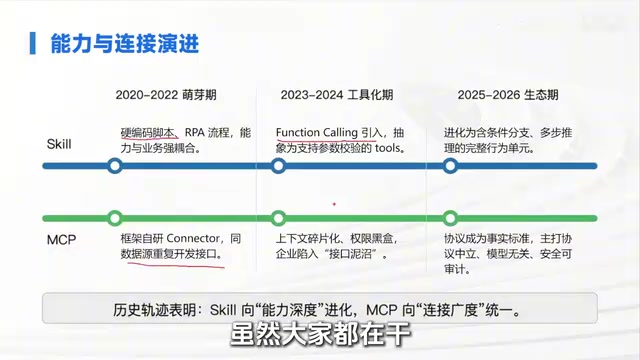
Skills handle business logic depth; MCP handles connection breadth—together they form production-grade Agent architecture.
This article explains why Agent engineering requires separating business logic (Skills) from connection standards (MCP). Skills are closed-loop intelligent units with triggers, logic, and fallbacks, while MCP provides standardized interfaces for tools, data, and templates. Together they form a four-layer architecture—Planner, Skill Engine, MCP Hub, and External Systems—delivering high reusability, security, ecosystem interoperability, and low-cost migration for enterprise AI deployments.
Introduction: The Core Challenge of Agent Engineering
Why can some teams get an Agent project running in production within a month, while others spend three months refactoring code only to have the system break at every change? The difference usually isn't about how well the model is tuned—it's about whether you've truly separated business logic from connection interfaces.
Many people ask: if we already have Skills, why do we need MCP? This question seems simple, but it touches the foundational logic of Agent architecture design. Understanding this is what separates a real engineering-grade product from a prototype.
Technical Evolution: From Isolated Efforts to Convergence
Rewind to 2020—Skill and MCP were essentially on separate tracks. Back then, most Skills were hard-coded scripts with business logic tightly coupled to the code. On the MCP side, developers often had to write custom integration tools for each data source, and switching to a new source meant starting from scratch—extremely inefficient.
By 2023, with the rise of Function Calling, Skills finally had a proper toolset. But MCP, despite everyone working on it, lacked a unified standard—like having different outlet specifications in every room, requiring rewiring every time you plugged in a new appliance.
Only now has the landscape truly opened up: Skills are evolving in depth, capable of handling complex tasks with branching logic; MCP has finally become a universally recognized standard. Skills evolve toward depth, pursuing finer-grained business execution; MCP evolves toward breadth, pursuing unified connectivity. These two dimensions have finally converged.
Architectural Understanding: The Engine and the Chassis
Skill: The Logic Package That Gets Things Done Right
Many people think writing a Skill is just calling an API. It's not. A real Skill is a closed loop that includes:
- Trigger conditions: When should it activate
- Input/output specifications: What data comes in, what goes out
- Business logic: The core processing workflow
- Context continuity: How to hand off to subsequent steps
- Fallback strategies: What to do when things go wrong
It's an independent, self-sufficient intelligent unit—not merely an API wrapper for a large model.
MCP: The Standard Specification That Connects Systems
MCP takes a completely different approach. If Skills handle business, MCP handles the rules of connection. It provides three fundamental capability channels: tools, data sources, and interaction templates.
MCP's core value lies in standardization. Think of it like electrical outlets—no matter what brand of appliance you buy, the outlet follows a national standard. Plug it in and it works, with no worries about voltage mismatches or incompatible connectors. For enterprises, MCP provides a unified security foundation for Agents—what permissions to grant, what data to access—all defined here.
The Home Appliance Analogy: Architecture Logic Made Intuitive
We can use a household electricity analogy to make this crystal clear:
- MCP = Standardized outlets: Unified voltage, stable current, with circuit breaker protection
- Skill = Smart appliances: Built-in business logic—like an AC unit that knows when to cool and when to dehumidify
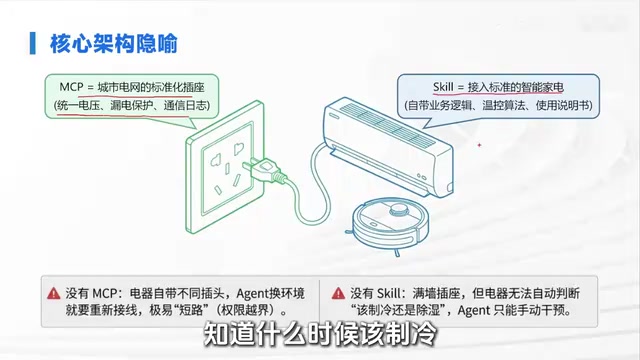
Without MCP as the standard outlet, every environment change means rewiring and swapping plugs—or even frying equipment due to voltage mismatches. But without Skills as smart appliances, even a wall full of outlets is useless—the machine doesn't know what to do, and humans still have to manually intervene.
What we're pursuing is precisely this collaborative architecture: standardized outlets providing foundational guarantees, while smart appliances deliver complex business functionality.
Why You Can't Take Shortcuts by Mixing Them Together
Some people think: for simple tasks like checking the weather or converting currencies, can't you just hard-code a script to call an API? Or for an internal chatbot or a weekend prototype, why not dump all the logic into a single Skill to save time?
Sure, that's fast—but it's an illusion. When we oversimplify tasks, we end up swallowing connection logic that should be handled by MCP, or strategy logic that should live in Skills. It looks efficient on the surface, but you're just hiding problems.
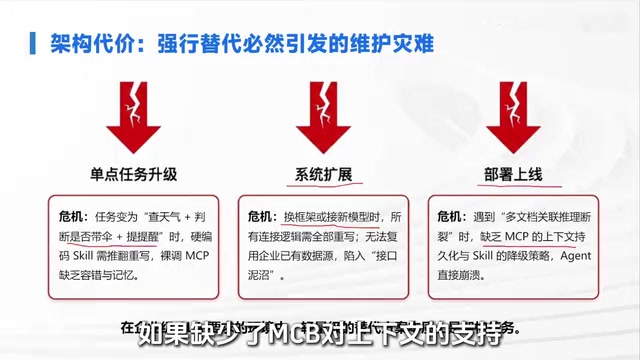
What happens next?
- When tasks grow complex: Checking the weather is no longer a simple query—now it needs to determine whether to bring an umbrella and set a reminder. The previously tangled logic becomes impossible to reuse, forcing a complete rewrite.
- When the system scales: Want to integrate a new model or switch data sources? Because connection logic and business logic are too tightly coupled, the entire refactoring process becomes painful.
- When going to production: Without MCP's context support or Skill's degradation logic, the system runs unstably.
In enterprise environments, compressing architectural layers for speed is essentially accumulating architectural debt. That flexibility comes at the cost of dramatically increased future maintenance.
Four-Layer Division: The Complete Modern Agent Architecture
Now that the division of labor is clear, how do we put it all together? It's just four layers with very clear responsibilities:
| Layer | Role | Responsibility |
|---|---|---|
| Layer 1 | Agent Planner (Brain) | Decides what needs to be done |
| Layer 2 | Skill Orchestration Engine (Executor) | Breaks instructions into step-by-step actions |
| Layer 3 | MCP (Hub) | Prepares all interfaces, data, and templates |
| Layer 4 | External Ecosystem | Enterprise data sources, business systems |
Real-World Scenario: Booking a Business Travel Flight with an Agent
Let's walk through this architecture with a real scenario. A user says: "Help me book a flight to Shanghai next Wednesday."
- The Agent Planner decomposes this into a task list
- MCP's discovery layer kicks in, pulling together the booking API, travel policy documents, and reimbursement templates
- The Skill Orchestration Engine takes over, executing the booking with strategies like "economy class preferred"
- What if there are no tickets? The Skill engine already has a fallback plan—switch to high-speed rail
- Finally, operation results and status are passed back to the Agent through MCP
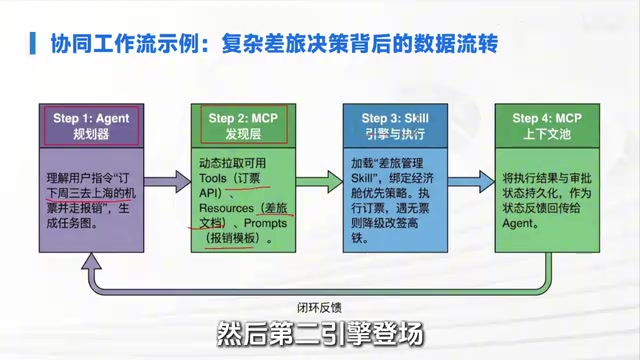
The entire process forms a complete closed loop: decisions stay with the decision-maker, execution stays with the executor, connections stay with the connector—each fulfilling its role.
Four Core Benefits for Enterprise Deployment
For enterprise engineering teams, this layered architecture delivers four tangible benefits:
- High reusability: Develop one MCP service, and it can be called directly whether you're coding in VS Code, using an Agent on the web, or running a private model system—no redundant development needed
- Security and control: MCP handles the tedious work of permissions and logging, so business code doesn't need to wrestle with authentication logic
- Ecosystem interoperability: Skills developed on unified standards can be traded and composed like components across different platforms—true plug-and-play
- Low-cost migration: If you need to switch the underlying LLM, resources and prompt templates prepared under MCP standards can be carried over directly, without reconstructing all context
Conclusion: Making Agents True Digital Employees
Building Agents really can't rely solely on model capabilities. Many people starting out with Agents want the model to do everything, thinking the more you stuff in the better—only to end up with nothing done well.
This layered architecture ultimately solves one thing: making Agents more like true digital employees.
- You need MCP because you need to give it a standardized work environment—where to get materials, what permissions to use—all governed by rules
- You need Skills because you need to give it clear business processes—when to escalate, when to degrade gracefully
When you clearly separate standards from strategies, all those headaches—changing interfaces, fixing bugs, swapping models—are no longer major problems. Let MCP handle connections, let Skills handle business—that's the key to making AI work in the enterprise.
Related articles

AI Agent Systematic Learning Path: From Zero to Independent Development
A systematic AI Agent learning path covering core principles, Prompt engineering, RAG, multi-Agent collaboration, and hands-on projects for beginners.
Kimi K2.7 + Hermes Agent Real-World Test: Generate Complete Applications with a Single Sentence
Hands-on test of Kimi K2.7 integrated with Hermes Agent: generate complete 3D games and web OS apps from a single sentence, with benchmark data vs Claude 3.5.

Build a Personal Website with One Prompt Using Lovable: A Zero-Code Free Deployment Guide
Learn how to use Lovable AI to generate a professional personal website with one prompt and deploy it for free. Complete walkthrough from writing prompts to one-click publishing — no coding required.