Spring AI vs LangChain4j: How to Choose a Java AI Framework
A comprehensive comparison of Spring AI and LangChain4j to guide Java developers in AI framework selection.
This article provides a deep comparison between Spring AI and LangChain4j, the two leading Java AI development frameworks. It covers Spring AI's six core capabilities (Prompt Engineering, Advisors, Chat Memory, Tools, RAG, and MCP/Agent), compares feature completeness, ecosystem support, and usability, and offers practical selection guidance: choose Spring AI for Spring-based projects, LangChain4j for non-Spring environments.
Introduction: The AI Framework Dilemma for Java Developers
As LLM application development continues to heat up, two major AI development frameworks have emerged in the Java ecosystem — Spring AI and LangChain4j. For Java developers, choosing between these two has become a critical decision that directly impacts project implementation.
This article provides an in-depth analysis of the similarities and differences between Spring AI and LangChain4j across multiple dimensions including framework features, functionality comparison, and ecosystem support, helping you make a more informed technology choice.
Spring AI Core Features: A Complete Breakdown
Why Do We Need Spring AI?
To understand Spring AI's value, we first need to recognize two core limitations of foundation models:
- Lack of enterprise private data: Foundation models are trained on publicly available internet data and don't possess internal business data or domain-specific knowledge. Even top-tier models like GPT-4 and Claude only cover public internet information — they know nothing about a company's customer data, business processes, product documentation, or other proprietary knowledge.
- Inability to call enterprise system APIs: LLMs cannot directly interact with internal system interfaces. A model is essentially a text generator — it cannot proactively initiate HTTP requests, query databases, or call microservice endpoints. An external framework is needed to bridge this gap.
Spring AI was born to solve these two pain points — it enables Java developers to rapidly build generative AI applications using the familiar Spring technology stack, deeply integrating LLM capabilities with enterprise business systems.
Six Core Capabilities
1. Prompt Engineering
Prompts are the key entry point for communicating with LLMs. Prompt Engineering refers to the technique of carefully designing text instructions fed to large language models to guide them toward desired outputs. It includes various strategies such as Zero-shot prompting (asking directly without examples), Few-shot prompting (providing a few examples to help the model understand the task pattern), and Chain-of-Thought (guiding the model through step-by-step reasoning). In enterprise applications, prompt quality directly determines the reliability and consistency of AI output, making framework-level template support crucial.
Spring AI supports multiple types of prompt configurations and provides rich prompt templates and tuning techniques to help developers guide model output more precisely. Developers can use the PromptTemplate class with Thymeleaf-like template syntax to inject dynamic variables into prompts, enabling parameterized prompt management.
2. Advisors (Conversation Interceptors)
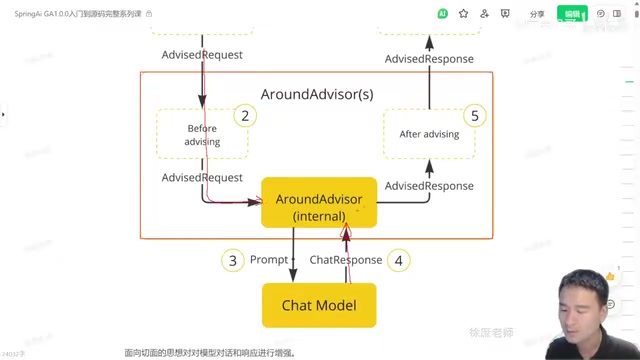
This is a particularly elegant design in Spring AI, essentially borrowing from AOP (Aspect-Oriented Programming) principles. AOP is one of the core programming paradigms in the Spring framework, allowing developers to handle cross-cutting concerns — such as logging, transaction management, and permission validation — on method calls without modifying business code. Spring AI's Advisor mechanism brings this mature concept into the AI interaction pipeline, enabling developers to flexibly insert custom logic into the AI request/response pipeline, much like configuring Spring AOP aspects.
During interactions with LLMs, both outgoing requests and incoming responses can be captured by interceptors to implement logging, conversation history storage, RAG augmentation, sensitive information filtering, and more. This design allows different concerns in the AI interaction pipeline to be developed, tested, and composed independently, greatly improving code maintainability.
3. Chat Memory
This gives LLMs human-like memory capabilities, maintaining contextual coherence across multi-turn conversations. Since LLMs are inherently stateless (each request is independent), implementing multi-turn conversations requires sending historical conversation content as context along with each request. Spring AI encapsulates this capability very concisely — developers need only minimal configuration to enable multi-turn conversation memory. The framework includes multiple memory strategies, including window memory (retaining the most recent N turns), token-limited memory (truncating history based on token count), and summary memory (compressing long conversations into summaries), while also supporting persistence of conversation history to Redis, databases, and other storage media.
4. Tools (Function Calling)
When you need the LLM to invoke enterprise system methods, the Tools mechanism comes into play. The working principle of tool calling (Function Calling) is: developers describe available tools' names, functions, and parameter formats to the model; when the model determines it needs to use a tool, it generates a structured tool call request (rather than executing directly); the framework receives this request, executes the corresponding Java method locally, and returns the result to the model, which then generates the final answer based on that result.
Through Spring AI's tool registration mechanism, Java methods can be exposed to the LLM, enabling "LLM-driven business logic." Developers simply annotate methods with @Tool and provide clear functional descriptions to complete tool registration — the entire process is highly consistent with Spring's dependency injection style.
5. RAG (Retrieval-Augmented Generation)
Addressing the lack of domain-specific knowledge in foundation models, RAG (Retrieval-Augmented Generation) technology essentially provides the LLM with an external knowledge base. Proposed by Meta AI in 2020, RAG's core idea is combining information retrieval with text generation. The complete workflow includes: document chunking (splitting long documents into appropriately sized segments), vector embedding (converting text into high-dimensional vector representations), storing in vector databases (such as Milvus, Pinecone, PgVector, etc.), performing semantic retrieval on user queries (matching the most relevant document segments via vector similarity), injecting retrieval results as context into prompts, and finally having the LLM generate answers.
Compared to fine-tuning, RAG's advantages include no need to retrain the model, real-time data updates, and clear information source traceability — particularly important for explainability and compliance requirements in enterprise applications. Spring AI provides complete RAG pipeline support, including document loaders (supporting PDF, Word, HTML, and other formats), text splitters, embedding model integrations, and multiple vector database connectors.
6. MCP (Model Context Protocol) and Agents
MCP (Model Context Protocol) is an open standard protocol proposed by Anthropic in late 2024, aimed at standardizing communication between LLMs and external tools/data sources. It's similar to a "USB port" for AI, allowing different AI applications to discover and invoke external tool services in a unified manner. MCP adopts a client-server architecture, supporting tool discovery, resource access, and prompt templates, and is becoming critical infrastructure for AI application interoperability.
MCP allows tools to be externalized for invocation by external AI applications — a very hot technology direction right now. Spring AI's native MCP support means developers can easily publish their Java services as MCP Servers, or act as MCP Clients to call tool services from other AI ecosystems.
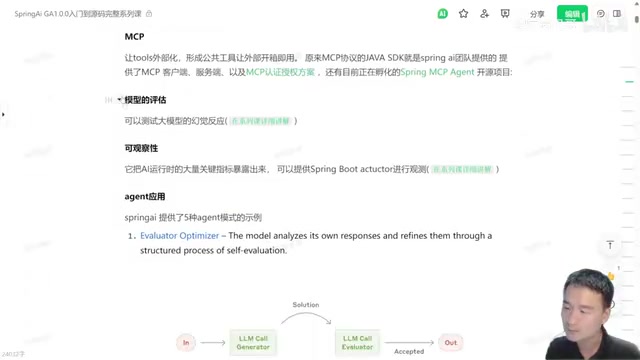
Additionally, Spring AI supports development of multiple Agent patterns. AI Agents are AI systems capable of autonomously perceiving their environment, making decisions, and executing actions. Compared to simple Q&A interactions, Agents possess autonomous planning and iterative execution capabilities. Common Agent architecture patterns include: ReAct (reasoning + action loop, where the model alternates between thinking and tool calling), Plan-and-Execute (creating a complete plan first, then executing step by step), Multi-Agent (multiple specialized agents collaborating on complex tasks), Reflexion (self-reflective improvement, optimizing subsequent decisions by evaluating historical actions), and Tool-Use Agent (focused on selecting and calling appropriate tools). Spring AI's support for these five typical Agent architecture patterns means developers can build AI applications of varying complexity, from simple single-step tool calls to complex multi-agent collaboration systems.
Spring AI vs LangChain4j: Comprehensive Feature Comparison
Ecosystem Background and Development Trajectory
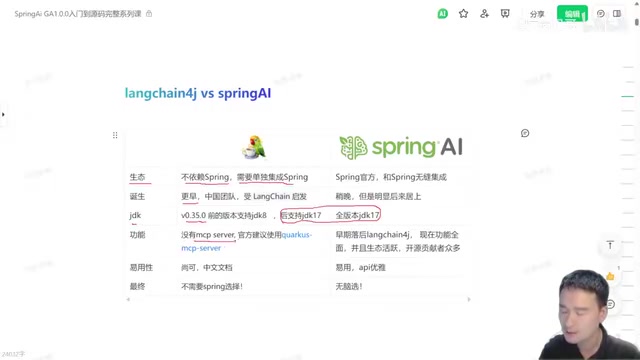
LangChain4j doesn't depend on the Spring framework — if Spring integration is needed, it requires separate integration (though the official team provides Starter dependencies to simplify this process). It was born earlier, inspired by the famous LangChain in the Python ecosystem. LangChain was originally created by Harrison Chase in October 2022 and quickly became one of the most popular frameworks for LLM application development. Its core philosophy is composing multiple AI operations through "Chains" to form complex workflows. LangChain4j is its Java port, led by Dmytro Liubarskyi. While it borrows LangChain's core concepts (such as Chain, Agent, Memory abstractions), its API design has been extensively adapted and optimized for Java language characteristics, employing Builder patterns, interface abstractions, and other design paradigms familiar to Java developers.
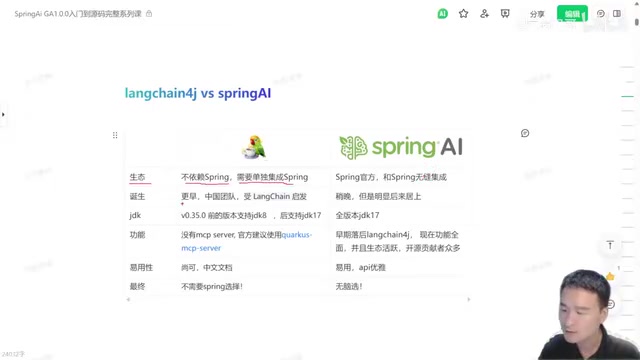
Spring AI started slightly later (initiated in the second half of 2023, with the GA version officially released in 2024), but has gained rapid momentum thanks to Spring's global user ecosystem — millions of Spring developers worldwide, mature enterprise application experience, and VMware/Broadcom commercial support — clearly overtaking its predecessor. It integrates seamlessly with Spring Boot, offering virtually zero learning curve for Spring stack developers. Core Spring Boot features like auto-configuration, dependency injection, and configuration properties can be directly applied to AI development scenarios.
JDK Version Requirements
Both frameworks currently require JDK 17 for their mainstream versions. This requirement aligns with the overall evolution of the Java ecosystem — JDK 17, as a Long-Term Support (LTS) version, introduced modern language features like Sealed Classes, Pattern Matching, and Records, and has become the de facto standard baseline for new projects. It's worth noting that LangChain4j supported JDK 8 in earlier versions (before 0.35), but those early versions had incomplete functionality and are no longer recommended for production use. For legacy projects still on JDK 8, upgrading the JDK version may be a technical debt that needs to be addressed before introducing an AI framework.
Feature Completeness Comparison
This is the dimension where the gap between the two is most apparent:
| Feature Dimension | Spring AI | LangChain4j |
|---|---|---|
| Prompt Engineering | ✅ Complete | ✅ Complete |
| Chat Memory | ✅ Complete | ✅ Complete |
| Tools/Function Calling | ✅ Complete | ✅ Complete |
| RAG | ✅ Complete | ✅ Complete |
| MCP Server | ✅ Native Support | ❌ Requires third-party alternatives |
| Agent | ✅ Multi-pattern support | ✅ Basic support |
| Model Evaluation | ✅ Built-in | ⚠️ Limited |
Regarding model evaluation, Spring AI includes a built-in evaluation framework supporting quality assessments such as relevance scoring, factual accuracy verification, and harmful content detection for AI outputs — crucial for quality assurance in enterprise applications. LangChain4j's support in this area is relatively limited, typically requiring external tools (such as Ragas, DeepEval, etc.) to complete evaluation work.
In short: What LangChain4j has, Spring AI essentially has too; but what Spring AI has, LangChain4j doesn't necessarily have.
Usability and Documentation Quality
LangChain4j's API design is adequate — the experience is decent once you're familiar with it, and it provides Chinese documentation, which is friendly for developers in China. Its AiServices interface proxy pattern allows developers to declare AI services by defining Java interfaces, with the framework automatically handling underlying model calls and response parsing.
Spring AI's API design is more elegant, consistent with the Spring ecosystem's programming style, offering a very comfortable experience for developers familiar with Spring. It fully leverages Spring Boot's auto-configuration mechanism — extensive configuration can be done through application.yml, while also supporting fine-grained customization via @Bean definitions. Spring AI's official documentation is high quality, providing rich example code and best practice guides, though it's currently primarily in English.
Technology Selection Recommendations: Which Framework Should You Choose?
Based on the comprehensive analysis above, here are our recommendations:
-
If your project uses the Spring/Spring Boot stack (which is the case for the vast majority of Java enterprise projects): Choose Spring AI first. High ecosystem integration, comprehensive features, and elegant APIs make it the top choice for Java AI development today. Spring AI's natural integration with Spring Security, Spring Data, Spring Cloud, and other components makes introducing AI capabilities into existing microservice architectures very natural.
-
If your project doesn't use the Spring framework (e.g., using lightweight frameworks like Quarkus or Micronaut, or pure Java SE applications): Choose LangChain4j. It doesn't depend on Spring, offers more flexible integration, and Quarkus officially provides LangChain4j extension support.
-
If time permits, learn both. In real enterprise environments, you can't predict which framework your team will choose. Mastering the core concepts and usage patterns of both gives you more authority in technology selection discussions. More importantly, the underlying concepts of both frameworks (Prompt, Memory, Tool, RAG, etc.) are shared — the cost of switching from one to the other after learning one is very low.
Conclusion
In the competition among Java AI development frameworks, Spring AI has demonstrated a clear leading advantage through the powerful backing of the Spring ecosystem, more comprehensive feature coverage, and more elegant API design. Meanwhile, LangChain4j, as the pioneer, still holds irreplaceable value in specific scenarios such as non-Spring projects.
For most Java developers, the technology combination of Spring AI + RAG + Agent will be the mainstream approach for building enterprise-grade AI applications. Mastering this technology stack is undoubtedly an important investment in enhancing your personal competitiveness. As 2025 sees AI applications moving at scale from the proof-of-concept (PoC) stage into production deployment, Java developers with hands-on AI framework experience will hold a significant advantage in the job market.
Related articles
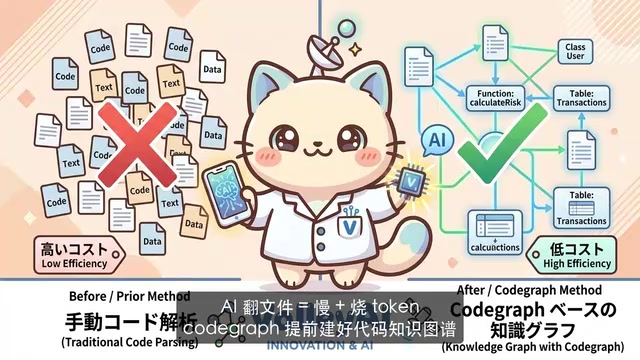
CodeGraph: The 50K-Star Open-Source Tool That Cuts AI Coding Token Usage in Half
CodeGraph is a 50K-star open-source tool that builds a code knowledge graph so AI coding assistants can locate code instantly—cutting Token usage by 47%, boosting speed by 22%, all running 100% locally.
VibeCoding Beginner's Guide: A Complete Guide to Building Software with Natural Language from Scratch
VibeCoding lets anyone build software through natural language conversations with AI. Learn the core concepts, learning path, and practical methods to get started.

Using UU Accelerator to Speed Up Cursor: A Compliant Solution for Stable AI Coding in China
Learn how to use NetEase UU Accelerator to speed up Cursor AI coding tool in China, with step-by-step setup including node selection and launch configuration.