Swimlane: A Deep Dive into the Coding Agent Workflow CLI Tool Built on Sakana AI Fugu
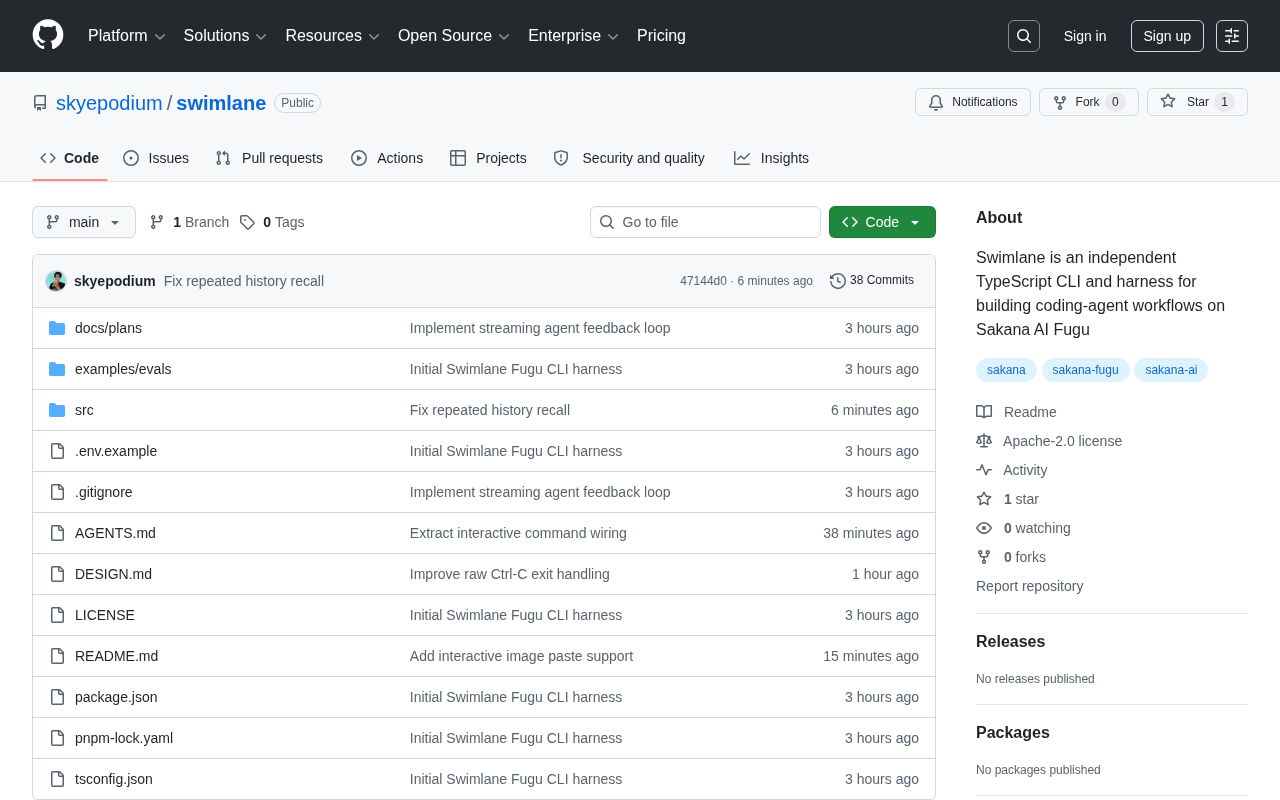
Swimlane is a TypeScript CLI tool for orchestrating coding agent workflows on Sakana AI's Fugu platform.
Swimlane is an early-stage TypeScript CLI tool and runtime framework built for orchestrating coding agent workflows on Sakana AI's Fugu platform. It features type-safe design, a harness architecture for controlled agent execution, and swimlane-based workflow orchestration that enables parallel and sequential agent task coordination across code generation, testing, and review.
Project Overview
Swimlane is a standalone TypeScript CLI tool and runtime framework designed specifically for building coding-agent workflows on the Sakana AI Fugu platform. Created by developer skyepodium, the project is still in its early stages, but its design philosophy and technology choices are worth paying attention to.
What is Sakana AI Fugu?
Sakana AI is a company focused on nature-inspired AI research, co-founded in Tokyo in 2023 by former Google Brain researcher David Ha and former Google DeepMind researcher Llion Jones (one of the co-authors of the Transformer paper "Attention Is All You Need"). The company name "Sakana" comes from the Japanese word for "fish," reflecting its research philosophy of drawing inspiration from collective behaviors found in nature. Sakana AI's research directions span evolutionary algorithm-driven model merging, multimodal foundation models, and AI agent systems.
Its Fugu platform provides infrastructure for building AI agents ("Fugu" means pufferfish in Japanese, continuing the company's marine life naming tradition). Swimlane, as an independent third-party tool, offers developers a structured way to orchestrate and manage coding agent workflows built on Fugu.
The name "Swimlane" itself hints at its core design philosophy—dividing complex agent workflows into multiple parallel or sequential "lanes," with each lane responsible for a specific task phase, similar to the swimlane diagram pattern in flowcharts. Swimlane Diagrams originally emerged from the business process modeling domain as a variant of UML activity diagrams, clearly showing parallel execution paths and responsibility boundaries by grouping process steps according to responsible parties or functional modules. This pattern is widely adopted in microservice orchestration and workflow engines (such as Apache Airflow and Temporal). Applying this concept to AI agent workflows means: different agent capabilities (such as code generation, test verification, and code review) can be assigned to independent lanes, enabling parallel execution for improved efficiency while coordinating through well-defined interfaces.
Core Technical Features
TypeScript-First Type-Safe Design
The project is built entirely in TypeScript, giving developers full type safety, IDE intellisense, and compile-time error checking. For building complex agent workflows, the type system effectively reduces runtime errors and improves code maintainability.
TypeScript has formed a mature ecosystem in the CLI tool development space, with commonly used frameworks including oclif (maintained by Heroku/Salesforce), Commander.js, yargs, and others. TypeScript's type system is particularly important for CLI tools: type validation of command parameters, schema validation of configuration files, and type safety when interacting with external APIs can all catch errors at compile time. Additionally, TypeScript projects can run via tsx, ts-node, or be compiled to JavaScript and run through Node.js, and can also be packaged as standalone executables using tools like pkg or nexe for easy distribution.
Integration Advantages of CLI Tools
As a command-line tool, Swimlane can be easily integrated into existing development workflows, whether in local development environments or CI/CD pipelines. The CLI design makes automation and scripting straightforward, lowering the barrier to entry for workflow orchestration.
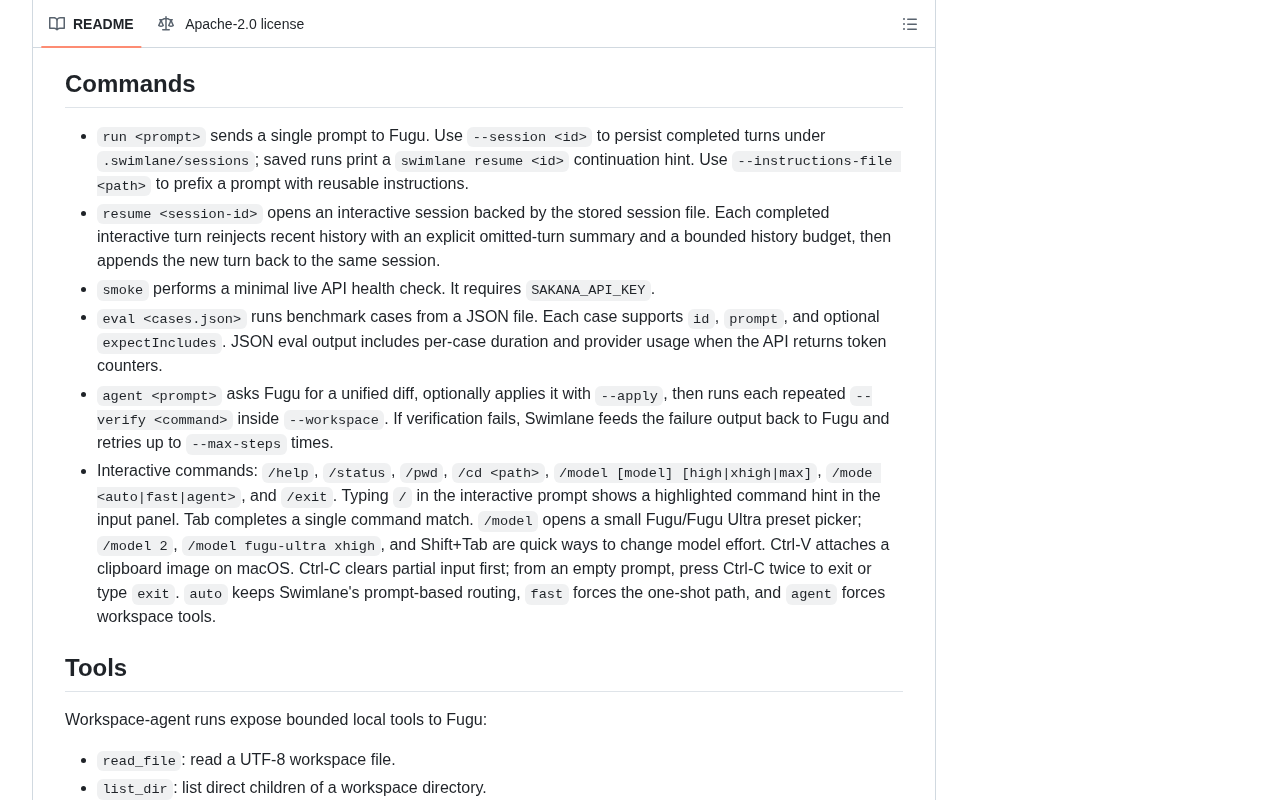
Harness Runtime Framework Architecture
Swimlane is not just a simple CLI—it also provides "harness" (runtime framework) capabilities. In software engineering, a "harness" is an external framework that controls and monitors the execution of a system under test, responsible for providing a controlled execution environment, injecting dependencies, capturing output, and verifying results. In the AI agent domain, the harness concept is particularly critical because agent behavior is non-deterministic—the same input may produce different outputs. A good agent harness needs to handle timeout control, resource limits (preventing agents from consuming tokens in infinite loops), sandbox isolation (preventing agents from executing dangerous operations), and replayable execution logs. Well-known coding agent evaluation benchmarks like SWE-bench also employ similar harness architectures to standardize the evaluation process.
This means Swimlane can serve as a testing and execution environment for coding agents, helping developers:
- Verify that agent behavior meets expectations
- Manage the complete agent lifecycle
- Provide standardized input/output interfaces
- Support workflow debugging and iteration
Practical Value of Coding Agent Workflows
Coding Agents represent an important direction in the current AI development tools landscape. Their evolution has gone through several key stages: from early code completion (such as GitHub Copilot's single/multi-line completion based on the Codex model), to conversational programming assistants (such as ChatGPT and Claude's code generation capabilities), to today's autonomous coding agents (such as Devin, SWE-Agent, and OpenHands). The core breakthrough of autonomous coding agents lies in introducing the ReAct (Reasoning + Acting) paradigm—agents not only generate code but can also autonomously execute commands, observe results, and correct errors, forming a complete "think-act-observe" loop.
Unlike simple code completion, coding agents can:
- Understand complete project context
- Autonomously plan and execute multi-step coding tasks
- Perform code review and refactoring
- Handle test writing and debugging
By providing workflow orchestration capabilities, Swimlane allows developers to combine these abilities into more complex automated processes, achieving automation from single tasks to end-to-end development workflows. Workflow orchestration tools further chain multiple agent capabilities on top of the ReAct paradigm, enabling complete automated pipelines such as "requirements analysis → architecture design → code implementation → test writing → code review."
Current Status and Future Prospects
The project is still in a very early stage (only 1 Star, 0 Forks), but it represents a technical direction worth watching: building dedicated workflow orchestration tools for specific AI platforms. As the AI coding agent ecosystem gradually matures, demand for this type of middleware tooling is likely to continue growing.
For developers interested in exploring the Sakana AI Fugu platform or coding agent workflow orchestration, Swimlane provides a worthwhile open-source project starting point to follow.
Key Takeaways
Related articles
Sakana AI Launches RSI Lab: The Path to Recursive Self-Improvement Where AI Builds AI
Sakana AI launches RSI Lab for recursive self-improvement, letting AI autonomously improve its own architecture. Explore their four-stage roadmap and key breakthroughs.
The Clotilda: Underwater Archaeological Discovery of America's Last Slave Ship
The Clotilda, America's last slave ship, was discovered by underwater archaeologists in Alabama nearly 160 years after sinking. Learn about the search, key evidence, and other slave trade shipwreck discoveries.
Sakana AI in Practice: Reshaping Banking Lending Operations with AI Agents — Technology and Strategy
Deep dive into how Sakana AI applies AI Agents to banking lending operations, covering end-to-end support from information gathering to approval document generation, plus technical challenges and human-AI collaboration design.