Deep Dive into Tencent's Open-Source WeKnora: An All-in-One Knowledge Platform with RAG + Agent + Wiki
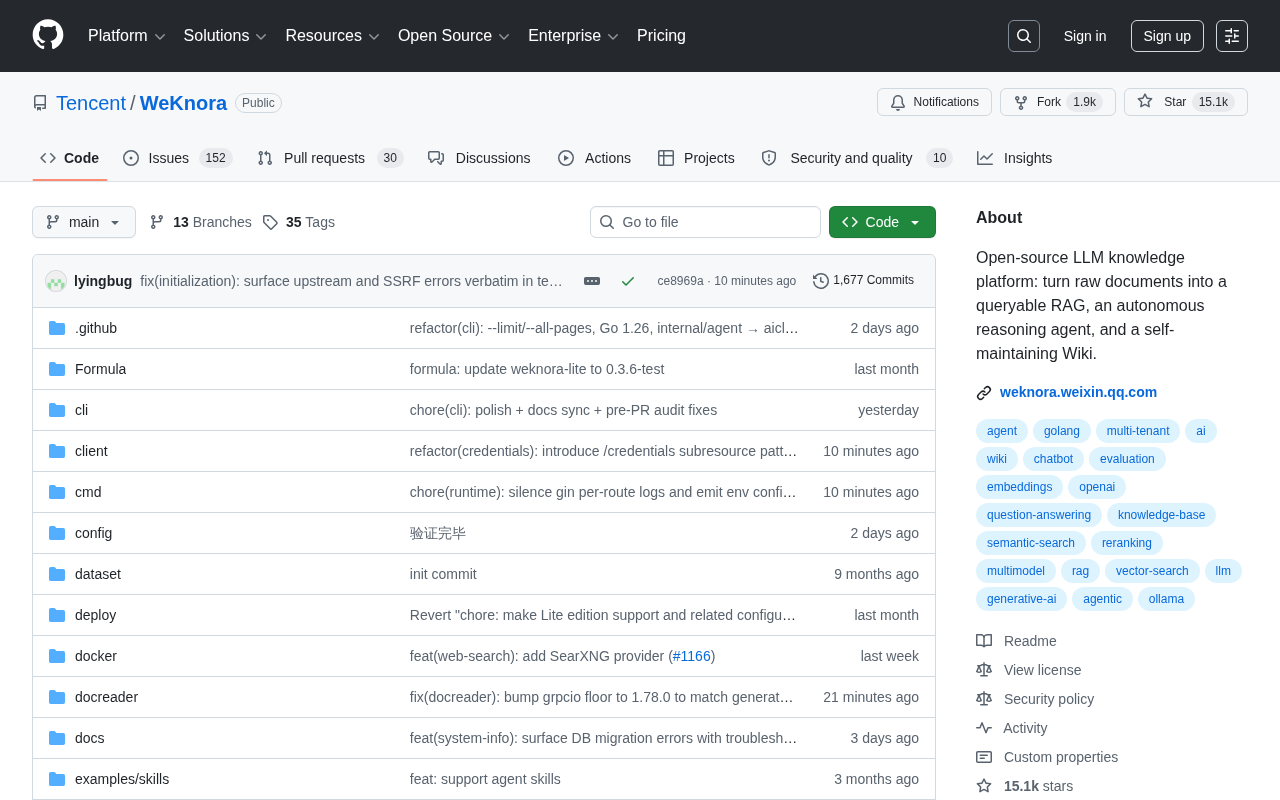
Tencent open-sources WeKnora, integrating RAG, Agent, and self-maintaining Wiki into one LLM knowledge platform.
Tencent has open-sourced WeKnora, a Go-based LLM knowledge platform that has already earned 14,700+ GitHub Stars. The project integrates three core capabilities — RAG retrieval-augmented generation, autonomous reasoning Agent, and self-maintaining Wiki — into a single platform, delivering a complete closed loop from document ingestion to knowledge querying, reasoning, and maintenance. The Go language choice reflects a focus on high-concurrency performance and deployment efficiency. Compared to competitors like Dify and FastGPT, WeKnora differentiates itself through its three-in-one end-to-end integration and official Tencent backing.
WeKnora Project Overview
Tencent recently open-sourced an LLM knowledge platform called WeKnora on GitHub. As of now, it has garnered over 14,700 Stars and 1,800+ Forks, with momentum continuing to build. WeKnora's core positioning is crystal clear: transform raw documents into a queryable RAG system, an autonomous reasoning Agent, and a self-maintaining Wiki. The integration of these three capabilities makes it one of the most competitive solutions in the open-source knowledge management space today.
The project is built with Go, which stands out as quite unique in an AI tooling ecosystem dominated by Python — hinting at Tencent's deeper considerations around performance and deployment efficiency.
Breaking Down the Three Core Capabilities
Queryable RAG (Retrieval-Augmented Generation) System
RAG (Retrieval-Augmented Generation) has become the standard architecture for enterprise-grade LLM applications. WeKnora provides a complete RAG pipeline from document ingestion to vector-based retrieval to answer generation. Users simply upload raw documents (PDF, Word, Markdown, etc.), and the system automatically handles document parsing, chunking, vector storage, and all other preprocessing tasks.
The RAG architecture was formally introduced by Meta AI (formerly Facebook AI Research) in a 2020 paper. Its core idea is to retrieve relevant document fragments from an external knowledge base as contextual references before the LLM generates an answer. This architecture addresses two inherent LLM limitations: the knowledge cutoff problem (training data has a temporal boundary) and the hallucination problem (models may generate plausible-sounding but factually incorrect content). A complete RAG pipeline typically involves five key stages: document loading and parsing, text chunking, vector embedding, vector database storage and retrieval, and finally context-augmented generation. Among these, the chunking strategy and choice of embedding model have a significant impact on retrieval quality. Common chunking methods in the industry include fixed-length chunking, semantic chunking, and recursive character chunking.
At the vector storage layer, text processed through an embedding model is converted into high-dimensional vectors (typically arrays of 768 or 1536 floating-point numbers). The distance relationships between these vectors in semantic space reflect the semantic similarity of the original text. Vector databases (such as Milvus, Pinecone, Weaviate, Qdrant, etc.) are specifically designed for storing high-dimensional vectors and performing approximate nearest neighbor (ANN) searches. Common indexing algorithms include HNSW (Hierarchical Navigable Small World), IVF (Inverted File Index), and PQ (Product Quantization). Notably, Tencent itself has open-sourced a vector database product called Tencent Cloud VectorDB, and WeKnora likely integrates deeply with it at the infrastructure level.
Unlike many RAG tools on the market, WeKnora builds its RAG capability as platform-level infrastructure rather than a standalone feature module. This means retrieval results can be reused by the upper-layer Agent and Wiki modules, forming a unified knowledge foundation.
Autonomous Reasoning Agent
WeKnora's second core capability is its autonomous reasoning Agent. Building on top of RAG, the Agent can perform multi-step reasoning, task decomposition, and tool invocation to handle more complex knowledge query scenarios.
The concept of AI Agents originates from classical artificial intelligence theory but has found entirely new implementation paths in the LLM era. The dominant Agent architecture today is represented by the ReAct (Reasoning + Acting) paradigm, proposed by Google DeepMind in 2022. Its core principle is to have the LLM alternate between reasoning (Thought) and acting (Action), adjusting subsequent strategies based on environmental feedback through observation (Observation). More sophisticated Agent frameworks also incorporate planning capabilities, such as step-by-step reasoning based on Chain-of-Thought and multi-path exploration based on Tree-of-Thought. Tool use (Tool Use / Function Calling) is another core Agent capability, enabling LLMs to invoke external APIs, database queries, code executors, and other tools to accomplish tasks beyond pure text generation.
Here's a practical example: when a user poses a question requiring cross-document correlation analysis, the Agent can autonomously plan a retrieval strategy, extract information from multiple knowledge sources, and deliver a comprehensive answer after logical reasoning. This capability far surpasses the traditional "retrieve-concatenate-generate" pattern and more closely resembles how a human expert thinks.
Self-Maintaining Wiki Knowledge Base
The third highlight is the self-maintaining Wiki feature. The biggest pain point of traditional enterprise knowledge bases is the high maintenance cost — after documents are updated, the knowledge base often lags behind, and information gradually becomes outdated. WeKnora solves this through automation: when source documents change, the system can automatically detect and update the corresponding knowledge entries, keeping Wiki content consistent with source documents.
The core technical challenge of a self-maintaining Wiki lies in change detection and incremental updates. When a source document is modified, the system needs to precisely identify the scope and nature of the change — whether it's a partial content revision, paragraph additions or deletions, or a restructuring of the document. Common technical implementations include: hash-based change detection, diff algorithm-based content difference analysis, and semantic similarity-based knowledge entry association matching. The key problem that incremental update mechanisms need to solve is how to precisely update affected knowledge entries and their corresponding vector embeddings without rebuilding the entire vector index. Additionally, version management and conflict resolution are important engineering challenges — when multiple source documents contain different descriptions of the same knowledge point, the system needs a reasonable strategy for handling information conflicts, typically involving confidence scoring and timestamp priority mechanisms.
This "living document" philosophy transforms knowledge management from a one-time build into continuous operations, dramatically reducing long-term maintenance costs.
Technology Choice: Why Go?
In a landscape where AI tools overwhelmingly use Python, WeKnora's choice of Go as its primary development language is backed by clear technical reasoning:
- High concurrency performance: Go's goroutine mechanism is naturally suited for handling large volumes of concurrent document processing and query requests
- Simple deployment: Compiles to a single binary with no complex dependency management, lowering the barrier for enterprise deployment
- Memory efficiency: Compared to Python, Go is far more efficient in memory management, making it suitable for processing large-scale document collections
- Production stability: Tencent's internal infrastructure heavily relies on Go, and a unified tech stack facilitates internal adoption and maintenance
Go's goroutines are user-space lightweight threads scheduled by the Go runtime rather than the OS kernel. A goroutine's initial stack space is only about 2-8KB (compared to the default 1-8MB for OS threads), meaning a single server can easily create hundreds of thousands or even millions of goroutines. Go's concurrency model is based on CSP (Communicating Sequential Processes) theory, using channels for safe communication between goroutines, avoiding the complex locking mechanisms of traditional multi-threaded programming. Go's scheduler uses the GMP model (Goroutine-Machine-Processor), efficiently multiplexing goroutines across multiple OS threads to achieve true parallel computation. This design makes Go particularly well-suited for I/O-intensive and high-concurrency scenarios, such as simultaneously processing thousands of documents through parsing, chunking, and vectorization tasks in a document processing pipeline.
Of course, this also means that for model inference, WeKnora most likely interacts with model services in the Python ecosystem through API calls or CGO bridging. CGO is Go's official mechanism for interoperating with C, allowing Go code to directly call C function libraries. In AI application scenarios, since most machine learning frameworks (such as PyTorch, TensorFlow) are implemented in C/C++ at the bottom layer with Python bindings, Go projects typically need to call these underlying libraries through CGO, or more commonly, communicate with independently deployed Python model inference services via network protocols like gRPC or HTTP APIs. The latter architecture is more loosely coupled: the Go service handles business logic, concurrency control, and request routing, while the Python service focuses on model inference, with the two exchanging data through efficient serialization protocols (such as Protocol Buffers). This microservice architecture also facilitates independent scaling — for example, scaling up inference service instances alone during query peak periods.
WeKnora vs. Competitors: A Comparative Analysis
The open-source knowledge platform space is fiercely competitive, with projects like Dify, FastGPT, and RAGFlow each having their own strengths.
Before diving into the comparison, it's worth understanding the technical positioning of these competitors: Dify positions itself as an LLM application development platform, with its core advantage being a visual workflow orchestration engine that supports building complex AI application flows through drag-and-drop, built on a Python+Flask architecture. FastGPT is community-driven, developed as a full-stack TypeScript application, focusing on quickly building knowledge-base-powered chatbots, with its workflow orchestration capabilities continuously improving. RAGFlow, developed by the Infiniflow team, focuses on deep optimization of the RAG process, particularly in document parsing (supporting OCR recognition of complex tables and charts) and chunking strategies, leveraging proprietary document understanding technologies like DeepDoc. These projects each occupy different ecological niches: Dify leans toward a general-purpose AI application platform, FastGPT toward lightweight conversational scenarios, RAGFlow toward deep optimization of document understanding, while WeKnora aims to differentiate through the three-in-one integration of RAG + Agent + Wiki.
WeKnora's differentiated advantages are primarily reflected in the following areas:
| Comparison Dimension | WeKnora | Dify | FastGPT | RAGFlow |
|---|---|---|---|---|
| Core Capabilities | RAG+Agent+Wiki | Workflow+Agent | RAG+Chat | RAG-focused |
| Development Language | Go | Python | TypeScript | Python |
| Self-maintaining Wiki | ✅ | ❌ | ❌ | ❌ |
| Official Tencent Support | ✅ | ❌ | ❌ | ❌ |
WeKnora's core competitive advantages include:
- End-to-end integration: Combining RAG, Agent, and Wiki capabilities in a single platform, eliminating the complexity of stitching together multiple tools
- Tencent backing: As an official Tencent open-source project, it offers stronger guarantees in code quality, long-term maintenance, and enterprise-grade features
- Performance-oriented: The choice of Go signals that the project prioritizes production-environment performance over rapid prototyping
The 14,700+ Star count also demonstrates strong community recognition. The evolution of its ecosystem and community activity will be the key factors determining its long-term competitiveness.
Use Cases and Implementation Recommendations
Based on WeKnora's capability matrix, the following scenarios are particularly well-suited:
- Enterprise internal knowledge bases: Unify scattered documents under a single management system with intelligent Q&A services
- Technical documentation centers: Automatically maintain frequently updated content such as API documentation and product manuals
- Research assistance platforms: Help researchers perform cross-literature correlation analysis across massive paper collections
- Customer service knowledge support: Provide customer service teams with real-time, accurate knowledge retrieval and reasoning capabilities
For teams planning to implement WeKnora, it's recommended to first evaluate the following: the scale and format diversity of existing documents, expected concurrent query volumes, whether multi-step Agent reasoning is needed, and the team's familiarity with the Go tech stack.
Conclusion and Outlook
Tencent's open-sourcing of WeKnora marks another significant move by a major Chinese tech company in the LLM knowledge platform space. It's not just a RAG tool — it aims to build a complete closed loop from document ingestion to knowledge querying, reasoning, and maintenance. The Go language choice reflects a commitment to production-environment performance, while the integration of three core capabilities demonstrates platform-oriented product thinking.
For teams seeking enterprise-grade knowledge management solutions, WeKnora is undoubtedly an option worth evaluating in depth. We recommend following its GitHub repository for future updates, particularly regarding documentation completeness, plugin ecosystem, and community support progress.
Related articles
 Deep Dives
Deep Dive into How OpenClaw (Open-Source Crayfish) AI Agent Works
Deep analysis of OpenClaw AI Agent internals: System Prompt, tool calling, SubAgents, Skill system, memory, and Context Engineering explained.
 Deep Dives
Demystifying Transformer: A Word-Continuation Function, Deconstructed
Understand Transformer through the lens of word continuation. Breaking down language generation into Embedding, Transformer Block, and Probability output modules for intuitive understanding.
 Deep Dives
Five Core Differences Between Claude Code and Regular AI Chat
A detailed comparison of Claude Code vs regular AI chat across five dimensions: interaction, context understanding, execution, memory, and tool integration.