The Absurd Parable of AI Economics: How the Capital Bubble Gets Inflated
A sharp parable exposes how AI capital bubbles are inflated through circular investment logic.
Andrew Singleton's satirical parable on McSweeney's brilliantly exposes the absurd capital dynamics in today's AI industry. Through a story about a crematorium and a propane company, it reveals how investment money circulates back as revenue, valuations are conjured from thin air, and media complicity enables the narrative — mirroring real patterns between major tech companies and AI startups.
A Biting Satire of AI Economics
Andrew Singleton published a short piece on McSweeney's titled AI Economics for Dummies, using an ingenious parable to skewer the capital games of today's AI industry with devastating precision. McSweeney's is an independent literary publishing house founded by American author Dave Eggers in 1998, renowned for its sharp satirical writing and experimental literature. Its "Internet Tendency" column has long featured short satirical pieces targeting the tech industry and social phenomena, making it a highly influential cultural commentary platform among American intellectual circles. This article — widely shared by tech figures like Simon Willison, co-creator of the Django framework and an active independent developer and commentator in the AI space, whose retweets often signal that a piece has struck a real nerve in the tech community — is barely a paragraph long, yet cuts like a scalpel, precisely dissecting the absurd logic behind the AI investment frenzy.
The Heart of the Parable: A Perfect Capital Loop
The story goes like this:
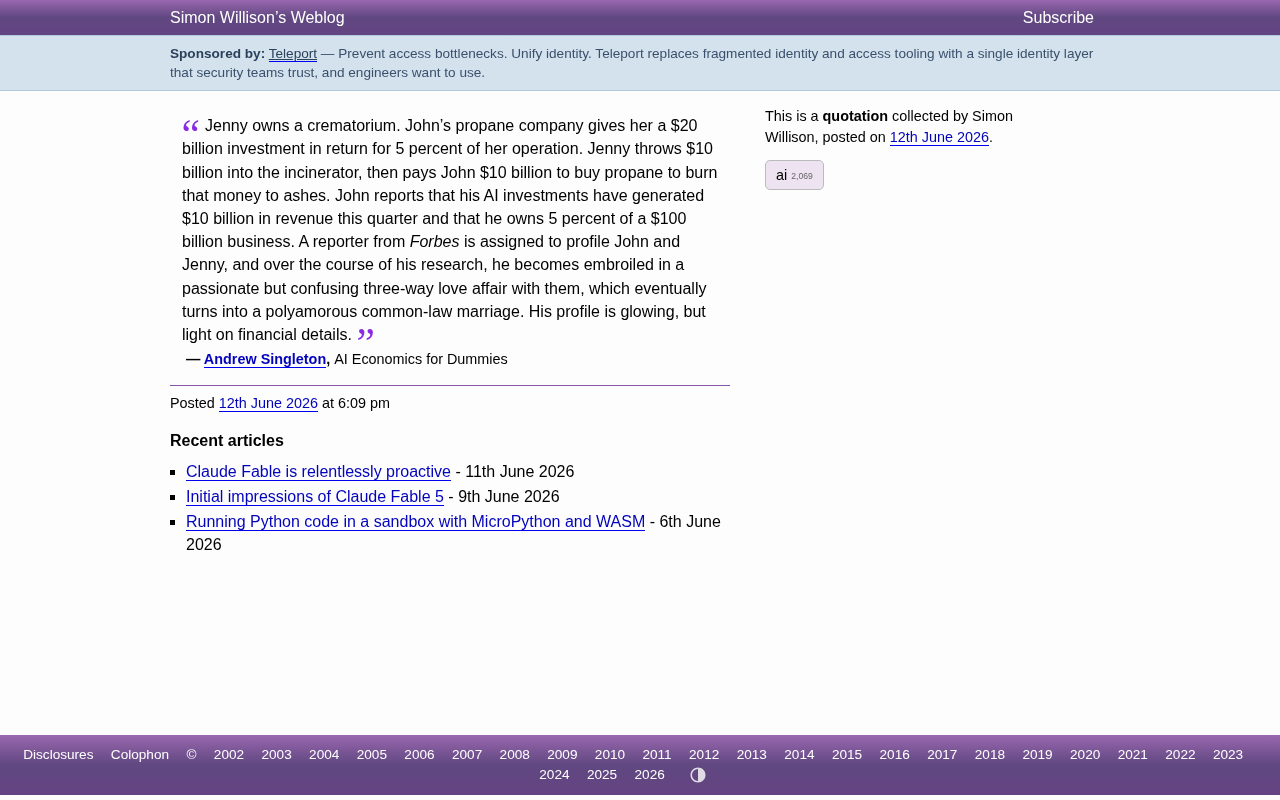
Jenny runs a crematorium. John's propane company gives her $20 billion in investment in exchange for 5% of her company. Jenny throws $10 billion into the incinerator, then pays John $10 billion for propane to burn the money to ash. John announces that his AI investment generated $10 billion in revenue this quarter, and that he owns 5% of a company worth $100 billion. A Forbes reporter is assigned to cover John and Jenny, and during his investigation, he falls into a passionate but confusing love triangle with both of them, which eventually evolves into a polyamorous common-law marriage. The resulting article is glowing but light on financial details.
Every detail of this passage is worth savoring.
Deconstructing the Absurd Logic: Where Does AI Investment Money Actually Go?
The Magic of Valuation
John invested $20 billion for a 5% stake, which implies Jenny's crematorium is valued at $400 billion — no, wait, the story says John claims he owns 5% of a "$100 billion company." The number itself is made up on the spot. In venture capital, this valuation method is called "post-money valuation," calculated by dividing the investment amount by the equity percentage acquired to reverse-engineer the company's total valuation. But this figure only reflects what the last round of investors was willing to pay — it doesn't represent the company's true value on the open market. In the real AI industry, this kind of valuation logic is far from uncommon: OpenAI reached a valuation of $157 billion in 2024, while its annualized revenue was only about $3.4 billion, yielding a price-to-sales ratio exceeding 46x — by comparison, even the most aggressively valued tech stocks typically have price-to-sales ratios in the 10-20x range. Investors buy in at a certain price, then use that to reverse-engineer an astronomical valuation that has never been truly tested by the market.
The Illusion of Revenue
John reports that his "AI investment" generated $10 billion in revenue. But where did that $10 billion come from? Jenny used his investment money to buy back his own propane. It's a perfect closed loop — the investor's money ultimately returns to the investor's own pocket in the form of "revenue," then gets packaged as "strong growth in AI business."
This inevitably calls to mind the reality of today's AI infrastructure landscape: major cloud computing companies provide massive investments or credit lines to AI startups, and those startups turn right around and spend the money on GPU compute from the very same cloud company. Investment becomes revenue, revenue validates the investment, forming a self-reinforcing cycle.
The most direct real-world parallel to this parable is the capital relationship between Microsoft and OpenAI. Microsoft has invested over $13 billion in OpenAI, and OpenAI is one of the largest customers of Microsoft's Azure cloud services — a substantial portion of the investment flows back to Microsoft in the form of cloud service fees. Similar patterns appear between Amazon and Anthropic (Amazon invested $8 billion; Anthropic heavily uses AWS compute) and between Google and its AI startup investments. This "invest-then-procure" closed loop means that cloud computing revenue growth figures on earnings reports need to be interpreted with greater caution, since a significant proportion doesn't come from organic demand by independent third-party customers.
Media Complicity
The story's final stroke is particularly brilliant: the Forbes reporter develops a "passionate but confusing" intimate relationship with his subjects, ultimately producing coverage that is "glowing but light on financial details." This is a pointed critique of the tech media ecosystem — when journalists become too close to their subjects, when the industry narrative is too seductive, rigorous financial scrutiny often gives way to glamorous storytelling.
This metaphor touches on a long-standing structural problem in tech journalism. In today's media ecosystem, tech reporters face multiple conflicts of interest: media organizations themselves may depend on advertising revenue from tech companies; journalists need to maintain relationships with sources to secure exclusive stories; some tech media outlets' parent companies even directly invest in AI enterprises. This model of "access journalism" causes critical financial analysis to yield to enthusiastic narratives about technological vision. When the boundary between reporter and subject blurs, the public loses not just the accuracy of information, but the last line of defense for independent oversight of capital operations.
The Real Concerns Behind the Parable: How Big Is the AI Bubble?
This satire resonates because it touches on a core question facing the AI industry today: Amid the flood of massive capital, how much of the "growth" represents real value creation, and how much is merely money circulating within a closed system?
Of course, the value of AI technology itself is beyond question. Large language models, computer vision, autonomous driving, and other fields are genuinely producing real economic benefits. But Singleton's parable reminds us that in a frenzied market, distinguishing "real value" from "accounting magic" is becoming increasingly important.
Historically, every technological revolution has been accompanied by capital bubbles — the dot-com bubble was no exception, nor was the mobile internet era, and AI will most likely follow suit. The question isn't whether a bubble exists, but who's still dancing when the music stops. It's worth noting that the dot-com bubble era (1995–2000) shares striking structural similarities with the current AI boom. During that period, telecom companies engaged in massive "swap revenue" arrangements — two companies would purchase each other's network capacity, both recording the transactions as revenue growth, without actually creating any new economic value. The collapses of WorldCom and Global Crossing were rooted in precisely this kind of accounting maneuver. The current AI industry's "investment-as-revenue" model, while entirely legal, is economically similar in substance to those swap revenue schemes. Of course, after the dot-com bubble burst, truly valuable companies (like Amazon and Google) ultimately rose to prominence, and the value of the technology itself was never negated — what was negated was only the valuation mania divorced from fundamentals. This is perhaps the path the AI industry will ultimately follow as well.
Conclusion
Great satire derives its power from using absurdity to illuminate reality. Singleton's parable, in fewer than 200 words, reveals the underlying logic of the AI capital game more clearly than many lengthy essays. In an era when everyone is talking about AI, perhaps what we need most is precisely this kind of mirror — one that makes you laugh first, then leaves you deep in thought.
Key Takeaways
Related articles

Claude Code Installation Guide & The Five Stages of AI Programming Tools Explained
Complete Claude Code installation guide with the five stages of AI programming tools, from manual coding to agents. Learn 0-to-1 project building and 1-to-100 iteration challenges.

Enterprise-Level AI Project Rules Files: 5 Hard Rules + 6 Writing Techniques
AI keeps messing up your code? Learn 5 hard rules and 6 writing techniques for enterprise-level Rules files in Claude Code, Cursor & more, with templates.

Building Cloud Computing Clusters from Old Phones: Google and UCSD Explore a New Path to Sustainable Computing
Google and UCSD explore building cloud clusters from old phones, leveraging ARM chip efficiency to cut e-waste and data center carbon footprints.