The Complete Evolution of RAG: A Six-Generation Journey from Naive Retrieval to Multimodal
A systematic walkthrough of RAG's six-generation evolution from basic retrieval to multimodal intelligence.
This article traces the complete evolution of RAG technology across six generations: Naive RAG, Advanced RAG (hybrid search + reranking), Agentic RAG (autonomous retrieval decisions), Graph RAG (knowledge graph reasoning), and Multimodal RAG (OCR + vision language models). Each generation's core techniques, the pain points it addresses, and corresponding real-world scenarios are explained in detail to help readers build a holistic understanding of the RAG technology stack.
Introduction: Why RAG Is Essential Knowledge in the LLM Era
RAG (Retrieval-Augmented Generation) has become one of the most critical technologies for deploying large language models in production. Whether you're looking to break into the LLM industry or integrate AI capabilities into your current work, RAG is an inescapable keyword.
The fundamental reason RAG matters so much is that large language models (LLMs) have two inherent limitations: a training cutoff date and the hallucination problem. A model's parametric knowledge is frozen once training is complete, making it unable to access the latest information. At the same time, when faced with questions outside its training distribution, the model tends to generate responses that sound fluent but are factually incorrect. RAG addresses both issues at relatively low cost by dynamically injecting external knowledge during inference, avoiding the steep expense of frequent fine-tuning. This is why virtually every production-grade LLM application—from OpenAI's ChatGPT plugins to enterprise AI assistants—employs some form of RAG architecture.
However, RAG is far from a static technology. Over the past two years, it has undergone multiple generations of evolution, with each generation addressing pain points left by its predecessor. This article systematically traces the complete evolution of RAG—from naive retrieval through Agentic RAG, Graph RAG, and Multimodal RAG—paired with six representative real-world scenarios, to help you build a comprehensive understanding of the RAG technology stack.
Generation 1: Naive RAG — Simple and Direct, but Problematic
The earliest RAG approach was remarkably straightforward: chunk documents → generate embeddings → retrieve the most similar chunks → concatenate them into the prompt and let the LLM generate an answer.
Embedding is the foundational technology of the entire RAG system. Embedding models (such as OpenAI's text-embedding-ada-002, BGE, E5, etc.) map text into points in a high-dimensional vector space, so that semantically similar texts are closer together. These vectors are typically stored in specialized vector databases (such as Pinecone, Milvus, Weaviate, Chroma, etc.) that support efficient Approximate Nearest Neighbor (ANN) search. ANN algorithms (such as HNSW, IVF) build index structures that reduce search complexity from O(n) to O(log n) at the cost of minimal precision loss, making real-time retrieval over millions or even billions of documents possible.
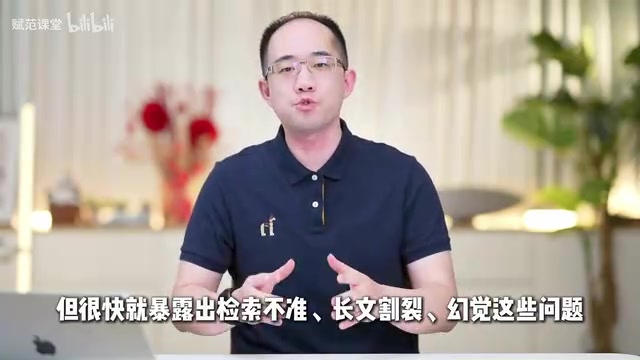
This pipeline looks complete on paper, but in practice it quickly exposed three core problems:
- Inaccurate retrieval: Simple vector similarity matching tends to recall content that is semantically similar but actually irrelevant
- Broken context from chunking: Fixed-length chunking strategies cut coherent semantic paragraphs in half, causing context loss
- Hallucination: When retrieved chunks are low quality, the model tends to "fabricate" answers that seem plausible but are factually wrong
These problems are especially fatal in enterprise applications—if a knowledge base Q&A system frequently delivers wrong answers, user trust collapses rapidly.
Generation 2: Advanced RAG — Hybrid Search and Reranking as a One-Two Punch
To address the retrieval quality issues of Naive RAG, the industry introduced a series of optimization techniques, forming what's known as "Advanced RAG."
Hybrid Search
Instead of relying solely on vector retrieval, this approach combines sparse retrieval (e.g., BM25 keyword matching) with dense retrieval (vector semantic matching). Keyword search excels at exact matching of proper nouns and technical terms, while vector search excels at understanding semantic intent. Together, they significantly improve recall.
BM25 (Best Matching 25) is a classic ranking algorithm in information retrieval, an improved version of TF-IDF. It calculates relevance scores between queries and documents using three factors: term frequency (TF), inverse document frequency (IDF), and document length normalization. BM25's strength lies in its sensitivity to exact keyword matches—when a user query contains specific product model numbers, legal clause references, or specialized terminology, BM25 is often more accurate than semantic vector search. In hybrid search implementations, methods like Reciprocal Rank Fusion (RRF) or weighted linear combination are typically used to merge results from BM25 and vector retrieval.
Reranking
After the initial retrieval of candidate chunks, a dedicated Cross-Encoder model performs fine-grained scoring on each "query-document" pair to reorder the results. This step acts as a "quality control gate" for retrieval results, effectively filtering out noise that appears similar on the surface but is actually irrelevant.
Cross-Encoders differ fundamentally from standard Bi-Encoders (dual-tower models). Bi-Encoders independently encode queries and documents separately, using vector similarity for fast matching—ideal for large-scale initial screening. Cross-Encoders, on the other hand, concatenate the query and document into a single input sequence and perform deep interaction modeling through the Transformer's full attention mechanism, capturing more fine-grained semantic relationships. Representative models include Cohere Rerank, BGE-Reranker, and ms-marco-MiniLM. Since Cross-Encoder computational complexity is O(n) (where n is the number of candidate documents), reranking is typically applied only to the Top-K results (e.g., Top-50) from initial retrieval, not the entire corpus.
Query Rewriting and Expansion
Users' original queries are often vague or incomplete. Using an LLM to rewrite, decompose, or expand queries can dramatically improve retrieval precision.
The quintessential project for this generation is the enterprise knowledge base Q&A system—through the combination of hybrid search and reranking, internal document retrieval accuracy jumps from around 60% to over 85%.
Generation 3: Agentic RAG — Letting AI Autonomously Decide Retrieval Strategy
While Advanced RAG improved retrieval quality, it still performs "blind retrieval"—triggering the retrieval pipeline regardless of what the user asks. In real-world scenarios, many questions don't require external knowledge at all (such as casual chat or common-sense questions), and forcing retrieval actually introduces noise.
The core breakthrough of Agentic RAG is the introduction of an Agent mechanism, giving the system autonomous decision-making capabilities:
- Whether to retrieve: Determine if the current question needs external knowledge support
- Where to retrieve from: Select the most appropriate data source from multiple knowledge bases
- Whether the results are good enough: Evaluate the quality of recalled content and, if necessary, perform a second retrieval or switch strategies
An Agent is an architectural paradigm that gives LLMs autonomous planning and tool-calling capabilities. Its core idea originates from the ReAct (Reasoning + Acting) framework: the model first reasons (Thought), decides on the next action (Action), executes it, observes the result (Observation), and then decides whether further action is needed. In Agentic RAG, retrieval is treated as one of the tools the Agent can invoke. The Agent can choose different retrieval strategies based on question complexity, call different knowledge bases, or even autonomously adjust queries and retry when retrieval results are unsatisfactory. Representative frameworks include LangChain's Agent module, LlamaIndex's Router Query Engine, and Microsoft's AutoGen.
This "think before you act" paradigm elevates RAG systems from passive retrieval tools to proactive problem solvers. Agentic RAG's advantages are especially pronounced in complex multi-turn dialogue and multi-step reasoning scenarios.
Generation 4: Graph RAG — Understanding Entity Relationships with Knowledge Graphs
Traditional RAG has a fundamental limitation: it can only retrieve text chunks but cannot understand the structured relationships between entities.
For example, if you ask "Who is Zhang San's direct supervisor, and what projects does that person manage?", traditional RAG needs to find "Zhang San's supervisor" and "the supervisor's projects" across separate document chunks, then hope the LLM correctly connects the dots. But as relationship chains grow longer, this "hit-or-miss" concatenation approach becomes increasingly error-prone.
Graph RAG's solution is to build an additional Knowledge Graph layer on top of vector retrieval:
- Automatically extract entities (people, organizations, projects, etc.) and relationships (reports to, manages, collaborates with, etc.) from documents
- Store entities and relationships as a graph structure
- During retrieval, match not only text semantics but also traverse graph edges for relational reasoning
Knowledge graphs store structured knowledge using triples (entity-relationship-entity) as the basic unit, with typical storage engines including graph databases like Neo4j and Amazon Neptune. In Graph RAG, knowledge graph construction typically relies on Named Entity Recognition (NER) and Relation Extraction (RE) techniques. In recent years, LLMs themselves have been widely used to extract triples from unstructured text. Microsoft Research's 2024 GraphRAG paper proposed a community detection-based approach: first use an LLM to extract entities and relationships from documents to build a graph, then apply the Leiden algorithm for community partitioning, and finally generate summaries for each community to support answering global questions. This method is particularly well-suited for summarization questions that require synthesizing information across multiple documents.
Knowledge graph construction is the core component of Graph RAG. Corresponding real-world projects include automatically extracting organizational structures, product relationships, and other structured information from enterprise documents, then performing multi-hop reasoning Q&A based on the graph.
Generation 5: Multimodal RAG — Breaking Beyond Pure Text
Real-world documents are far more than plain text. Financial reports contain complex tables and charts, technical manuals include flowcharts and diagrams, and contracts feature stamps and signatures. Traditional RAG is virtually helpless when facing these mixed text-and-image PDFs.
Multimodal RAG addresses this through the following technologies:
- OCR + Layout Analysis: Identify text, table, and image regions within documents and understand their spatial layout relationships
- Multimodal Embedding: Map text and images into a unified vector space, enabling cross-modal retrieval
- Vision Language Models (VLMs): Directly "see and understand" chart content rather than relying solely on OCR-extracted text
The core idea behind multimodal embedding is mapping data from different modalities (text, images, audio, etc.) into a unified vector space. Representative work includes OpenAI's CLIP model, which aligns images and text into the same space through contrastive learning. In RAG scenarios, models like ColPali can directly encode document page images without prior OCR text extraction, thereby preserving layout information. Vision Language Models (VLMs) such as GPT-4V, Qwen-VL, and InternVL go even further, capable of directly understanding data trends in charts, numerical relationships in tables, and even logical structures in flowcharts. In practice, a two-stage "retrieve then understand" approach is typically adopted: use multimodal embeddings to retrieve relevant pages, then use a VLM for deep understanding and Q&A on the retrieved pages.
Combined with OCR capabilities from models like DeepSeek, Multimodal RAG can handle complex scenarios such as financial report image-text retrieval and architecture diagram comprehension in technical documentation. This holds enormous application value in industries like finance, legal, and manufacturing.
Mapping Six Real-World Projects to the Technology Stack
Here's how the technology evolution maps to actual projects:
| Generation | Core Technology | Project Scenario |
|---|---|---|
| Naive RAG | Chunking + Vector Retrieval | Basic Document Q&A |
| Advanced RAG | Hybrid Search + Reranking | Enterprise Knowledge Base Q&A |
| Agentic RAG | Agent-based Autonomous Decision Making | Intelligent Customer Service / Multi-source Q&A |
| Graph RAG | Knowledge Graph + Graph Reasoning | Knowledge Graph Construction & Reasoning |
| Multimodal RAG | OCR + VLM | Financial Report Image-Text Retrieval |
| Integrated Application | DeepSeek OCR | Complex Document Parsing |
Summary and Learning Recommendations
The evolution of RAG technology is essentially a process of continuously patching gaps: Naive RAG solved the basic problem of "letting LLMs use external knowledge," and each subsequent generation targeted specific shortcomings of its predecessor with focused optimizations.
For developers looking to enter the field or boost their competitiveness, here's a recommended progressive learning path:
- Build a solid foundation first: Understand the complete Naive RAG pipeline—it's the bedrock for everything that follows
- Focus on mastering Advanced RAG: Hybrid search and reranking are the most widely adopted approaches in enterprise applications today
- Pay attention to Agentic RAG: This is currently the hottest direction and a frequent topic in technical interviews
- Dive into Graph RAG and Multimodal RAG as needed: These two directions are more vertically specialized—study them selectively based on your target role
Understanding the trajectory of technological evolution is far more valuable than memorizing individual techniques. When you can clearly articulate "what problem each generation of RAG solved and what new challenges it introduced," you'll already be ahead of most candidates in an interview.
Related articles
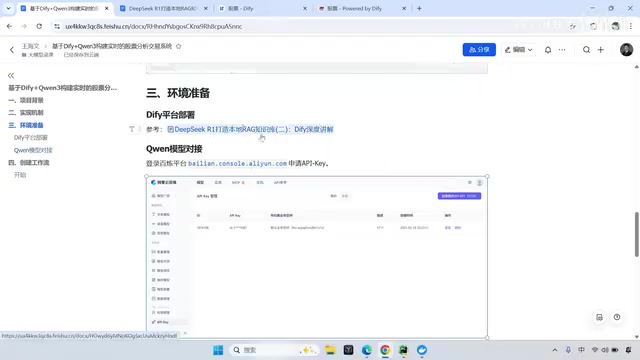
Building an AI Stock Analysis System with Qwen3 + Dify: A Hands-On Tutorial
A hands-on guide to building a real-time AI stock analysis system using Dify workflows and Qwen3. Covers deployment, technical indicators (RSI/MACD/Bollinger Bands), and trading strategy generation.
Deep Dive into Cursor Refill Plugins: Pay-Per-Use Billing and Account Pool Scheduling Mechanisms
Deep analysis of Cursor refill plugin architecture: how clean account pool scheduling replaces cracking tools, the business logic of 35% pay-per-use pricing, and compliance risks developers should consider.
Ubisoft Co-Founder Claude Guillemot Dies in Plane Crash at Age 69
Ubisoft co-founder Claude Guillemot has died in a plane crash at age 69. He co-founded Ubisoft with his four brothers, creating iconic IPs like Assassin's Creed and Far Cry.