The Complete Guide to Vibe Coding: Turn Ideas into Products with AI — No Coding Required
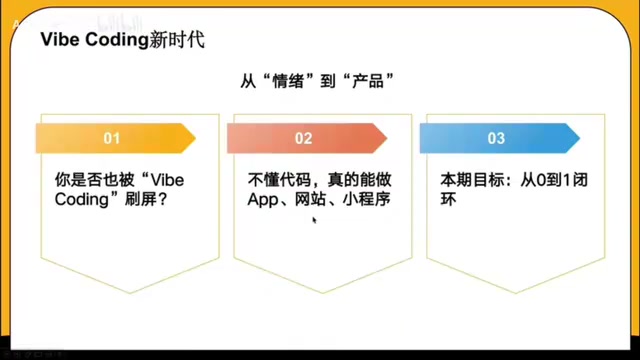
A step-by-step guide to building products with AI using Vibe Coding — no programming required.
Vibe Coding is a new AI-driven development paradigm where you use natural language instead of code to build products. This guide walks through the full workflow — from generating a PRD with Gemini, to creating UI designs with Figma Make, to producing working code with Cursor — enabling anyone with an idea to ship real applications and monetize them.
What Is Vibe Coding? A Revolution in Development Paradigms
If you still think "building an app requires six months of learning to code," you might already be behind. Vibe Coding is completely rewriting the rules of software development — you don't need to write a single line of code. All you need is an idea and clear logic to turn the product in your mind into reality.
The concept of Vibe Coding was first coined by OpenAI co-founder Andrej Karpathy in February 2025. On social media, he described an entirely new way of programming: fully immersing yourself in the "vibe," embracing the exponentially growing capabilities of AI, forgetting that code even exists, and simply describing your intent in natural language while AI transforms it into a working program. The concept quickly took the tech community by storm because it precisely captured the fundamental shift in human-AI collaboration following the capability leap of large language models (LLMs).
Vibe Coding isn't a new programming language — it's an entirely new product mindset and development paradigm. Its core logic is: drive AI with natural language, let AI understand your intent, and have it handle all the technical work of design, development, and testing. Your role shifts from "head-down coder" to "commander" and "product owner."
A noteworthy case: a designer overseas used Vibe Coding to build a minimalist AI tool app called "Screenshot to Code" in just one afternoon, requiring Apple-level premium color schemes and smooth scrolling. The product now generates thousands of dollars in monthly revenue. The entire chain from idea to product to monetization has been compressed to an unprecedented degree.
Traditional Development vs. Vibe Coding: A World of Difference in Barriers to Entry
The High Walls of Traditional Development
In the past, building an application required mastering multiple programming languages — HTML, CSS, and JavaScript for the frontend; Python, Java, Go, and others for the backend — with completely different tech stacks for each side. A "tech stack" refers to the complete set of technologies needed to build a software project, including programming languages, frameworks, databases, server environments, and more. For example, a typical modern web application might use React (frontend framework) + Node.js (backend runtime) + PostgreSQL (database) + AWS (cloud services), with each layer having its own learning curve and best practices. Add in lengthy development cycles and constant iteration, and for non-technical people, this was an almost insurmountable barrier.
The New Logic of Vibe Coding
Now the logic is completely different: drive AI with natural language, let AI understand your intent and logic, and direct it through conversation to handle design, development, and testing. Development has become unprecedentedly efficient and intuitive. You don't need to write a single line of code — what you need is creativity and imagination.
Put simply, if you can send messages on a chat app and articulate pain points about a product, you already have the foundational skills for Vibe Coding.
Who Benefits Most from Vibe Coding? Four Types of Super Beneficiaries
While theoretically anyone can do Vibe Coding, these four groups stand to gain the most:
1. Entrepreneurs Validating Ideas
Previously, entrepreneurs needed to find technical co-founders and invest heavily in development costs just to validate a business idea. Now with Vibe Coding, you can independently build an MVP (Minimum Viable Product) in an extremely short time, rapidly validate market demand, and dramatically reduce the cost of experimentation.
MVP (Minimum Viable Product) is a core concept in lean startup methodology, systematically articulated by Eric Ries in The Lean Startup. The core idea is: use minimal resources to build a product version containing only core features, quickly launch it to validate business hypotheses, then iterate based on real user feedback. This approach avoids the massive waste in traditional waterfall development where teams "build behind closed doors for months only to discover the direction was wrong after launch." Vibe Coding is a natural fit for the MVP philosophy — it reduces the cost and time barrier of building MVPs to historic lows, making "fail fast, iterate fast" truly possible.
2. Professionals Looking to Cut Costs and Boost Efficiency
Within your company, you can use Vibe Coding to quickly build automated management systems, data dashboards, and other internal tools that significantly improve team productivity. A dashboard is a tool that displays key business metrics in centralized visual charts, helping managers monitor business operations in real time and make data-driven decisions. In the past, building a customized dashboard required coordination across frontend development, backend API integration, and database queries. Now with Vibe Coding, you simply describe "I want to see daily sales trends, regional conversion rate comparisons, and inventory alerts," and AI can generate a complete dashboard application for you. Mastering this skill makes you an indispensable versatile talent on your team.
3. Freelancers Monetizing Their Skills
Treat Vibe Coding as a service capability — provide AI solutions for businesses by helping them develop applications and optimize workflows, earning service fees in return. This is a clear path to skill monetization. In fact, overseas markets have already seen a wave of freelancers and small studios specializing in Vibe Coding as a core skill, offering "AI rapid prototyping" services on platforms like Upwork and Fiverr, with project quotes ranging from hundreds to thousands of dollars and delivery timelines typically measured in days.
4. Creators with Ideas
Even without any technical background, as long as you have a unique product idea, you can easily bring it to life. In the AI era, the most valuable asset is no longer coding ability — it's ideas and logic.
Vibe Coding Workflow Breakdown: From Idea to Product Launch
The entire Vibe Coding workflow can be divided into three core stages, each supported by corresponding AI tools:
Stage 1: Idea → Product Requirements Document (PRD)
Recommended Tool: Google Gemini
The goal of this step is to transform the vague idea in your head into an actionable product document. A PRD (Product Requirements Document) is one of the core documents in software engineering, detailing what the product should do, who it's for, and how it should work. A complete PRD typically includes a product overview, user personas, feature requirements list, non-functional requirements (such as performance and security), information architecture, user flow diagrams, and priority rankings. In traditional development, writing a PRD is a product manager's core responsibility, often requiring days or even weeks of research and refinement.
The specific approach is to have an in-depth conversation with Gemini, telling it:
- What are your core features?
- Who is your target user group?
- What problem are you trying to solve?
Gemini acts as a top-tier project manager and product manager, deeply deconstructing your requirements, analyzing the product's core value, and generating a complete PRD — including feature lists, priority rankings, and a project roadmap. This instantly makes your project transparent, giving you a clear picture of what needs to be built and in what order. The reason for choosing Google Gemini is its ultra-long context window (supporting million-level token input), which allows it to process massive amounts of requirement information in a single conversation without losing context — critical for generating structurally complete PRD documents.
Stage 2: Product Document → UI Design Mockups
Recommended Tool: Figma Make
With the product document in hand, the next step is generating design mockups. Figma is the world's most popular cloud-based collaborative design tool, with core advantages in browser-based real-time multi-user collaboration and a powerful component system. Figma Make is Figma's AI-native design feature launched in 2025, capable of generating UI interfaces, components, and complete page layouts directly from natural language descriptions.
Pass the Gemini-generated product document along with your design preferences as instructions to Figma Make. Figma Make can understand natural language instructions and directly generate corresponding UI components and layouts in Figma.
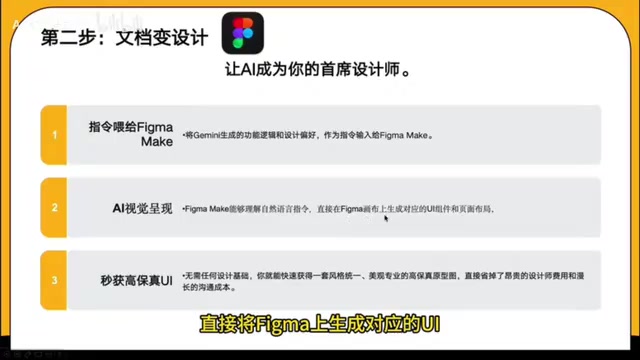
You don't need any design background to get a set of stylistically consistent, professionally polished high-fidelity prototypes. A high-fidelity prototype (Hi-Fi Prototype) refers to a design mockup that closely resembles the final product in visual effects, interaction details, and content presentation. In contrast, a low-fidelity prototype (Lo-Fi Prototype) is typically just simple wireframes and functional sketches. The value of high-fidelity prototypes is that they allow all stakeholders to reach consensus on the product's final form before development begins, dramatically reducing rework later. The key to this step is: clearly describe your visual expectations for the product in natural language, such as "the color scheme should be as clean and premium as Apple's website."
Stage 3: Design Mockups → Working Code
Recommended Tools: Figma MCP + Cursor / Augment Code
The final step is converting design mockups into actual working code. Figma MCP (Model Context Protocol) is a standardized protocol interface opened by Figma that allows external AI tools to directly read structured information from Figma design files — including layers, styles, spacing, component properties, and more — enabling seamless design-to-code conversion. Through Figma MCP, design file information is read and then fed into AI development tools to automatically generate code.
Cursor is currently the most representative AI code editor in the Vibe Coding ecosystem. Built on the VS Code open-source core, it deeply integrates LLM capabilities. Unlike traditional code completion tools, Cursor can understand the entire project's context — including file structure, dependencies, and existing code logic — then perform cross-file code generation, refactoring, and debugging based on the user's natural language instructions. Augment Code is another emerging AI programming assistant focused on understanding and operating within large codebases.
Throughout the entire process, your role remains that of a "commander" — confirming direction and making fine adjustments at key checkpoints, without writing any code by hand.
Key Takeaway: Don't Wait Until You're "Ready" to Start
Many people think learning development takes six months or more, but in the AI era, going from zero to one only takes one project's worth of practice. The essence of Vibe Coding isn't turning you into a programmer — it's turning you into a product creator who can harness AI.
Here are a few key mindset shifts to make:
- Code is no longer a shackle: Code is AI's job. What you need is creativity and imagination.
- Ideas are the core asset: In the AI era, people who can ask good questions and think with clear logic are more valuable than those who can write code.
- Action matters more than preparation: Don't wait until you're "ready" to start. Once you get moving, you'll discover your creativity far exceeds what you imagined.
Of course, Vibe Coding currently has its limitations — for complex enterprise-grade systems, high-concurrency scenarios, and low-level architecture optimization, professional developers are still needed. High-concurrency scenarios refer to situations where a system needs to handle massive numbers of simultaneous user requests, such as flash sales on e-commerce platforms or trending events on social media. These scenarios require fine-tuned load balancing, caching strategies, database optimization, and distributed architecture design. Low-level architecture optimization involves OS-level performance tuning, memory management, network protocol optimization, and other deep technical work. These areas require developers to have a profound understanding of computer systems, and current AI tools cannot fully replace human judgment in these complex decisions. Additionally, software development in safety-critical domains such as financial transactions, medical devices, and aerospace still requires rigorous manual code review and compliance verification processes.
But for the vast majority of small-to-medium applications, MVP validation, and internal tool development, Vibe Coding is already powerful enough.
This revolution in development paradigms has only just begun — the earlier you get in, the greater your advantage.
Related articles
Claude Code + Firecrawl MCP Tutorial: One-Click Install with No Registration or API Key
Complete guide to connecting Firecrawl MCP to Claude Code with no registration or API Key. Get 1,000 free monthly searches to boost your coding productivity.
A Beginner's Guide to Vibe Coding: The New Way to Build Software with AI — No Coding Required
What is Vibe Coding? Learn the core philosophy, three key traits, and boundaries of this AI-powered approach. Get a complete beginner's learning path with tools like Cursor and Bolt.new.

Anthropic's 400,000 AI Coding Sessions Reveal: Domain Expertise Is What Really Matters
Anthropic's study of 400K Claude Code sessions reveals that domain expertise, not coding ability, determines AI coding effectiveness. Experts produce 5x more output than novices.