The Evolution of AI Coding Tools: Five Stages from Manual Coding to Claude Code
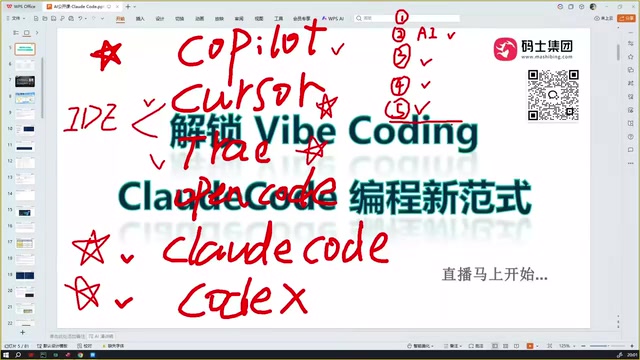
Tracing AI coding tools through five evolutionary stages from manual coding to Claude Code's intelligent programming era.
This article examines the five stages of AI coding tool evolution — from traditional manual coding through AI chat assistance, IDE plugins like Copilot, AI-native IDEs like Cursor, to today's intelligent tools like Claude Code and Codex. It explores the core tension between "0 to 1" (building from scratch) and "1 to 100" (scaling complex projects), discusses emerging trends like interrogative programming, and offers practical guidance for developers navigating this transformation.
The Evolution of AI Coding Tools
The AI coding landscape is undergoing an unprecedented transformation. From the earliest days of manual coding to today's intelligent programming tools like Claude Code and Codex, the industry has passed through five distinct stages of development. Understanding the evolutionary logic behind these stages is crucial for choosing the right coding tools and staying ahead of technology trends.
Stage 1: Traditional Coding
The most traditional approach — programmers manually writing code in an IDE, relying entirely on personal technical skills and experience. This stage lasted for decades and remains the foundational skill for all programmers.
Stage 2: AI-Assisted Conversations
With the emergence of large language models like ChatGPT, programmers began obtaining code snippets through AI chat interfaces, then copying and pasting them into development tools for debugging. While primitive, this approach already significantly boosted coding efficiency.
The reason these large language models can generate code lies in the Transformer architecture's powerful ability to model sequential data. During training, these models digested billions of lines of open-source code from GitHub, Stack Overflow Q&As, technical documentation, and other massive corpora, thereby learning programming language syntax rules, design patterns, and common problem-solving paradigms. Code is essentially a highly structured language that follows stricter syntactic constraints than natural language — which actually makes large models excel at code generation tasks.
Stage 3: The IDE Plugin Era
Coding plugins like Copilot emerged, installable directly in IDEs to provide code completion, comment inference, and code modification features. Various domestic plugins also appeared during this stage. However, these capabilities remained at the level of fragmented assistance.
From a technical standpoint, GitHub Copilot is based on OpenAI's Codex model (a code-fine-tuned version of GPT-3) and communicates with IDEs through the Language Server Protocol (LSP). It reads the current file's context in real time — including cursor position, existing code, comments, and file names — sends this information as a prompt to the cloud model, and presents the generated results as inline suggestions. This "ghost text" completion mechanism lets developers get AI assistance without leaving the editor, but its context window is limited, typically only perceiving the current file and a small number of adjacent files, making it difficult to understand the overall architecture of an entire project. This explains why Stage 3 tools remained at the level of "fragmented assistance."
Stage 4: The Rise of AI-Native IDEs
AI-native IDEs like Cursor and Trae entered the scene, allowing users to code directly through conversation. These tools are essentially Deep Agents capable of manipulating code within a project for debugging and modification. However, in their early stages, context understanding capabilities were still limited.
The term Deep Agent here refers to a concept contrasted with simple API calls. Traditional AI assistance is purely "Q&A-style" — the user asks, the model answers. Deep Agents, however, possess multi-step reasoning, tool invocation, and environment interaction capabilities. Take Cursor as an example: it can not only generate code but also understand the entire codebase structure through a built-in code indexing system (semantic retrieval based on vector databases), automatically locate files that need modification, and even invoke the terminal to execute commands to verify changes. The core of this Agent paradigm is the ReAct (Reasoning + Acting) loop: the model first reasons about what to do next, executes the action, observes the result, and then decides on subsequent actions. It's precisely this paradigm shift from "passive answering" to "proactive action" that fundamentally distinguishes Stage 4 tools from previous generations.
Stage 5: The Current State of Intelligent Programming
Claude Code, Codex, and the continuously iterating Cursor and Trae can now directly debug and run code, commit and test according to requirements, support multi-turn interactions, and deliver correct code on the first attempt with significantly higher probability.
The Core Tension Between "0 to 1" and "1 to 100"
The most notable characteristic of current AI coding tools is: "0 to 1" works remarkably well, while "1 to 100" still has clear shortcomings.
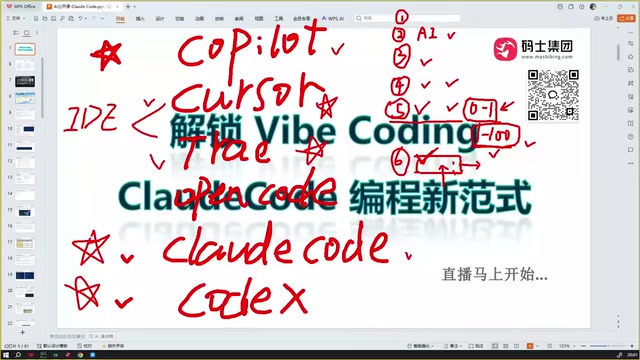
"0 to 1" refers to giving AI a detailed requirements description and having it build a complete project framework from scratch. Whether it's Claude Code, Codex, Cursor, or Trae, performance at this stage is already quite impressive.
"1 to 100," on the other hand, is the process of continuously filling in business logic within an existing technical framework, handling multi-module development, and performing complex debugging. Specific challenges include:
- Code management in multi-person collaborative development
- Dependencies and debugging across multiple modules
- Precise implementation of business details
- Architecture control as project scale grows
This stage still requires technically skilled people to "steer" the AI and ensure it's heading in the right direction. The core difficulty here is that as project scale grows, the codebase can balloon to hundreds of thousands or even millions of lines, with coupling relationships between modules forming complex dependency graphs. While current large models' context windows have expanded to the million-token level, the ability to effectively leverage long contexts is still developing. More critically, enterprise projects are filled with vast amounts of "tacit knowledge" — why a particular technical approach was chosen over another, why seemingly redundant code actually exists for backward compatibility with legacy systems — information that often doesn't exist in the code itself but in the minds of team members.
Future Trends: Interrogative Programming and the Reshaping of Technical Barriers
Interrogative Programming Is Already Emerging
The next stage of programming may be "interrogative programming" — where AI proactively asks users questions during the coding process to confirm requirement details. Claude Code's Plan mode already demonstrates this capability, and Alibaba's Coder is experimenting with similar interaction patterns.
Claude Code is a terminal-native programming tool from Anthropic, and its Plan mode represents the cutting edge of Agentic Coding practice. In Plan mode, Claude Code doesn't immediately start writing code. Instead, it first generates a detailed execution plan — including which files need modification, the modification strategy for each file, and potential risk points — then waits for user confirmation before executing step by step. This "plan first, execute later" approach draws from the design review process in software engineering, significantly reducing the probability of AI going off track in complex projects. Meanwhile, Claude Code runs directly in the terminal, with access to the file system, the ability to execute shell commands, and run test suites, forming a complete development loop. The essence of interrogative programming is shifting the critical "requirements clarification" phase in software development from human-led to AI-driven — this may be the key step in bridging the gap between "0 to 1" and "1 to 100."
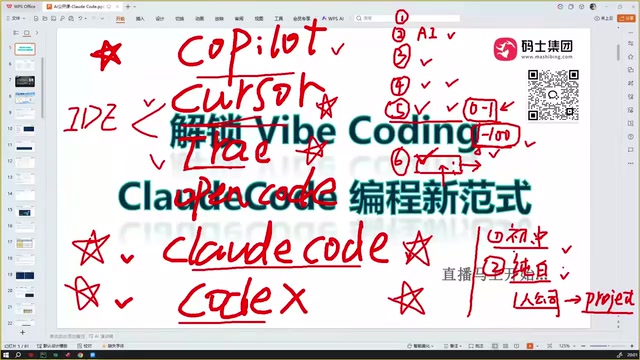
Can Complete Beginners Independently Deliver Enterprise-Level Projects?
A widely discussed question is: can people without technical backgrounds use AI coding tools to complete complex projects?
In the short term, the answer is no. The reasons are:
- The "1 to 100" process requires technical judgment
- When AI makes mistakes, humans need to identify and correct the direction
- The complexity of enterprise-level projects far exceeds that of personal small tools
However, the capability requirements for developers will change in the future:
- Technical breadth becomes more important than depth
- Knowledge across frontend, backend, cloud-native, data analytics, and other domains is needed
- The core competency shifts to "knowing which technology framework to use" and "judging whether AI is heading in the right direction"
Cloud Native mentioned here refers to applications designed from the ground up for cloud environments, with a core technology stack including containerization (Docker), container orchestration (Kubernetes), microservices architecture, CI/CD pipelines, and Infrastructure as Code (IaC). The reason developers need to understand these concepts in the AI coding era is that AI-generated code ultimately needs to be deployed and run in real environments, and deployment, scaling, monitoring, and troubleshooting still heavily depend on human architectural judgment. A developer capable of steering AI needs a "T-shaped skill structure" — deep expertise in one area, combined with basic knowledge of frontend frameworks, backend services, database design, DevOps processes, and more — to make correct technology selections and quality judgments when AI generates code.
Token Costs Keep Dropping, but Technical Expertise Is the Real Dividing Line
The cost of AI coding is dropping rapidly. Take DeepSeek as an example — its token prices have seen dramatic reductions. DeepSeek V4 Pro performs excellently in Claude Code coding scenarios with exceptional cost-effectiveness. This means the economic barrier to AI coding is disappearing, and technical understanding is the real dividing line.
To understand the technical logic behind this trend, you need to grasp the basic concept of Token Economics. A token is the fundamental unit by which large language models process text — an English word typically corresponds to 1-2 tokens, and Chinese characters roughly 1-2 tokens. AI coding costs are primarily determined by input tokens (code context and instructions sent to the model) and output tokens (code and explanations generated by the model). In complex projects, a single coding session may consume tens of thousands or even hundreds of thousands of tokens. Models like DeepSeek V4 Pro have dramatically reduced inference costs through MoE (Mixture of Experts) architecture — this architecture activates only a subset of parameters during each inference rather than the entire model, thereby reducing computational overhead by an order of magnitude while maintaining performance. This shift in cost structure means AI coding is transforming from a "pay-per-use luxury" into "on-demand infrastructure." When economic barriers are no longer an obstacle, the technical understanding needed to effectively leverage these tools naturally becomes the real dividing line.
Practical Advice for Developers
Junior and Mid-Level Programmers Need to Proactively Transform
It's foreseeable that demand for purely junior and mid-level programmer positions will decrease significantly. But this doesn't mean programming skills are becoming useless — on the contrary, people who understand technical principles, possess architectural thinking, and can effectively wield AI tools will become more valuable.
Embrace Tools Without Becoming Dependent on Them
Looking back at the pace of development over the past six months: half a year ago, Copilot and Cursor's results were still unsatisfactory, with many people calling it "1/3 code" (producing large amounts of useless code). Today, the code quality from conversational programming is already excellent. At this rate, AI coding capabilities will see another qualitative leap in the next six months to a year.
Choose the Right AI Coding Tool Combination
Current mainstream AI coding tools each have their own strengths:
| Tool | Strengths | Best For |
|---|---|---|
| Claude Code | Terminal interaction, strong Plan mode | Complex project development |
| Cursor | Great IDE experience, strong context understanding | Daily development |
| Trae | Domestic product, Chinese-friendly | Projects in China |
| Codex | OpenAI ecosystem | Deep integration with GPT |
It's worth noting that these tools aren't simply substitutes for one another — they can form complementary toolchains. For example, you can use Claude Code in the terminal for project-level refactoring and complex debugging, while using Cursor for everyday feature development and code review. When choosing tools, beyond feature sets, you also need to consider your team's technology stack preferences, project security and compliance requirements (especially whether code is uploaded to the cloud), and the difficulty of integrating with existing CI/CD workflows.
Conclusion
AI coding is at a critical juncture transitioning from Stage 5 to Stage 6. Current tools are already excellent in "0 to 1" scenarios, and "1 to 100" capabilities are catching up rapidly. For developers, the most important thing right now is: broaden your technical horizons, learn to collaborate with AI, and find the optimal human-AI collaboration model through practice. The future of programming isn't "humans vs. AI" — it's the co-evolution of "humans + AI."
Key Takeaways
Related articles

Codex VS Claude Code: The Token Economics Behind a 10x Price Gap
Same coding task: Codex costs $15, Claude Code costs $155. Deep dive into the real reasons behind the 10x gap — it's not pricing, it's token volume, output style, and context strategy.
Gemma 4 Open-Source Model Local Deployment Guide: Ollama Installation & Mobile Setup
Step-by-step guide to deploying Google's Gemma 4 open-source model locally with Ollama and running the lightweight version on mobile with tool calling support.
The Decline of Tokenmaxxing: Why Selling Outcomes Matters More Than Selling Tokens
The Tokenmaxxing craze is fading as enterprise AI procurement shifts from chasing Token counts to focusing on actual business outcomes. Learn why outcome-based AI evaluation is the right approach.