The New Builder Mindset in the AI Era: How the Developer Role Is Evolving

OpenAI's 'new builder mindset' signals a fundamental shift from code writing to AI-powered product building.
OpenAI's developer experience team declares that developers have evolved, highlighting a paradigm shift from manual coding to AI-orchestrated product building. As tools like GitHub Copilot, Cursor, and Replit Agent compress development cycles from months to hours, the developer role is expanding beyond traditional programmers to include product managers, designers, and entrepreneurs. The competitive landscape among AI platforms is shifting from model performance to developer experience, while trends like software supply explosion, creativity-driven differentiation, and the rise of full-stack individuals reshape the industry.
From Idea to Software: A Fundamental Shift in the Developer Role
OpenAI recently posted a teaser on social media featuring a deep conversation between Romain Huet, Head of Developer Experience, and 0xmts about the "new builder mindset." The core message cuts straight to the point — "The developers we serve have evolved."
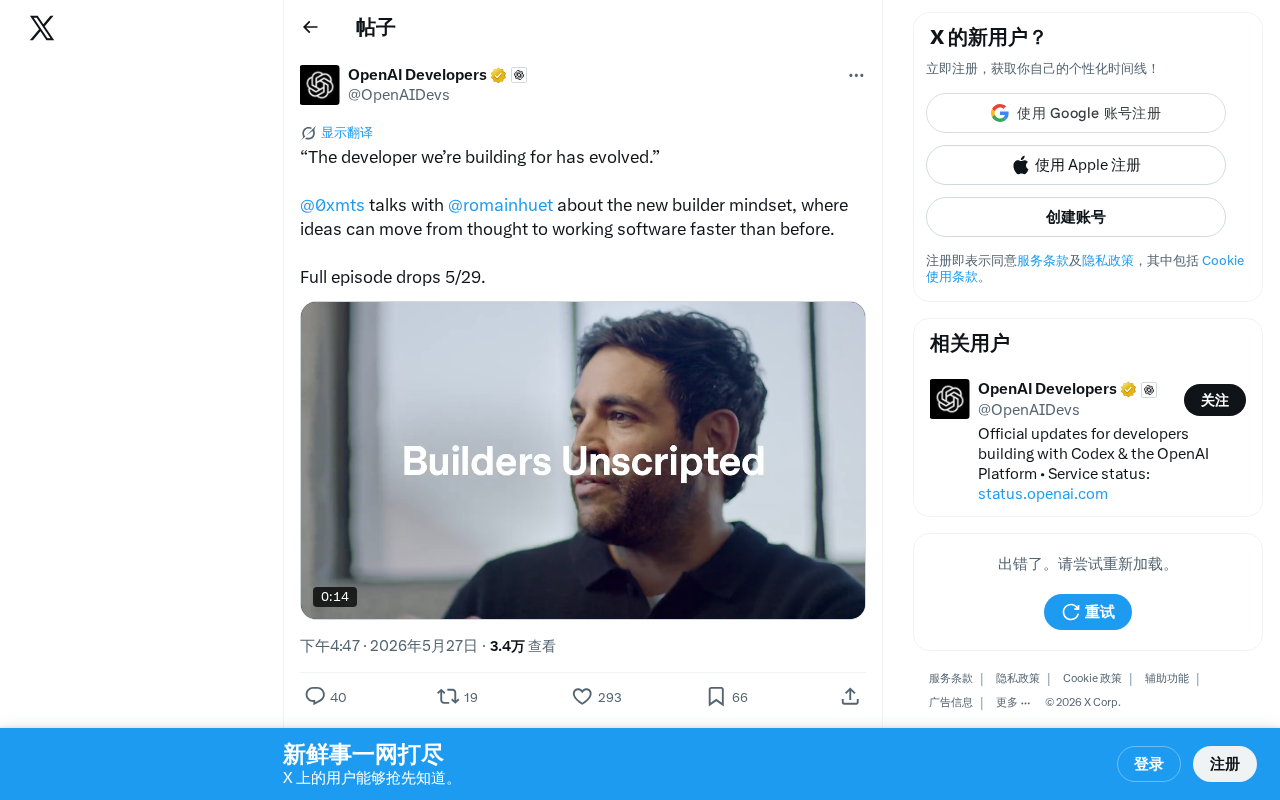
Though brief, this statement reflects a profound transformation sweeping through the entire software development industry. As AI coding tools continue to mature, the distance between an idea and a working software product is being compressed like never before.
What Is the "New Builder Mindset"?
A Qualitative Leap in Speed, Not Just a Quantitative One
Traditional software development follows a linear process: requirements analysis → architecture design → coding → testing and deployment. Each stage demands specialized skills and significant time. The traditional Waterfall Model, first systematically described by Winston Royce in his paper in the 1970s, has long been the dominant methodology in software engineering. Even as Agile development and DevOps philosophies gradually gained traction, the core chain of software development — from requirements to code to deployment — remained heavily dependent on professional developers' manual coding abilities. A moderately complex web application typically takes weeks to months to go from scratch to a launched MVP (Minimum Viable Product). Under the new paradigm of AI-assisted development, this entire process is being redefined.
The emergence of AI coding tools like GitHub Copilot, Cursor, and Replit Agent is compressing development cycles to hours or even minutes. These tools represent different technical approaches and evolutionary stages of AI-assisted programming: GitHub Copilot, built on the OpenAI Codex model, uses a Code Completion paradigm, providing context-aware suggestions in real time as developers write code; Cursor goes further by deeply integrating large language models into the IDE, supporting multi-file context understanding, cross-file code refactoring, and natural language-driven editing operations; Replit Agent represents the most radical direction — a fully autonomous AI Agent capable of independently completing the entire workflow from project initialization, dependency installation, and code writing to deployment, all based on natural language descriptions. These three correspond to three levels of AI-assisted programming: completion-level, conversation-level, and agent-level, reflecting a gradual evolution of human-machine collaboration from "human-led, AI-assisted" to "AI-led, human-reviewed." This change isn't simply about "writing code faster" — it's a paradigm leap from "manual weaving" to "intelligent orchestration" in the entire development process.
The essence of the "new builder mindset" is that the path from thought to product has been dramatically shortened. Developers no longer need to hand-write every line of code from scratch. Instead, they can leverage AI coding assistants, code generation tools, and intelligent APIs to focus more energy on creative ideation and product design. This isn't merely an efficiency gain — it's a fundamental repositioning of the developer's role, evolving from "code writer" to "product builder."
Redefining the Developer Profile
When OpenAI states that "developers have evolved," it implicitly signals a redefined understanding of its target user base. Today's "developers" are no longer limited to traditional programmers:
- Product managers can rapidly generate prototypes through natural language descriptions
- Designers can directly translate visual concepts into interactive interfaces
- Entrepreneurs can validate business ideas without assembling a full technical team
- Traditional developers can free themselves from repetitive coding to focus on system architecture and core logic
This means the barrier to entry for "builders" is lowering, but the ceiling is rising. The ability to harness AI tools, decompose complex requirements into clear instructions, and effectively evaluate and iterate on generated results is becoming the core competency of the new-era developer. This capability is sometimes called "Prompt Engineering," but its scope extends far beyond that — it's closer to a systematic "AI collaboration mindset" that requires developers to simultaneously possess domain knowledge, product intuition, and an accurate understanding of AI's capability boundaries.
Industry Trends: The Strategic Pivot of AI Developer Platforms
From Providing Models to Empowering Builders
The timing of OpenAI's release of this conversation is worth noting. Recently, major AI platforms have been accelerating their developer ecosystem strategies: Anthropic launched tool-use capabilities for Claude, Google showcased Gemini's developer toolchain at I/O, and OpenAI itself has been continuously refining its API and SDK ecosystem.
Notably, Romain Huet's role as Head of Developer Experience at OpenAI itself reflects the company's strong emphasis on developer relations. This position in tech companies typically bridges the "last mile" between product capabilities and developers' real-world use cases, encompassing SDK design, documentation experience, sample applications, and developer community building. OpenAI's developer platform has gone through several key evolutionary stages: from releasing the GPT-4 API in 2023, to launching the Assistants API, to continuously refining capabilities like Function Calling, Structured Outputs, and the Realtime API — each step lowering the barrier for developers to use AI capabilities.
Among these, Function Calling is a key capability introduced by OpenAI in June 2023. It allows large language models to identify user intent during conversations and generate structured function call parameters, thereby connecting AI's language understanding capabilities with external systems' execution capabilities. For example, when a user says "Check tomorrow's weather in Beijing for me," the model doesn't generate a potentially inaccurate text response directly. Instead, it outputs a structured API call request, and the application executes the actual weather query before returning the results to the model for natural language organization. Structured Outputs further ensures that model output strictly adheres to a predefined JSON Schema, eliminating uncertainty in output formatting. The combination of these two capabilities allows developers to embed LLMs as a reliable "intelligent routing layer" within complex application architectures, rather than using them solely for text generation — this is the key technical leap from AI as a "chatbot" to AI as "application infrastructure."
The focus of this competition has shifted from "whose model is stronger" to "who can help developers turn ideas into reality faster." The current AI developer platform competition has formed a multipolar landscape: Anthropic's Claude not only offers Tool Use capabilities, but its Model Context Protocol (MCP) is attempting to define an open standard for AI-to-external-tool interaction. MCP is an open protocol designed to standardize interactions between AI models and external data sources and tools — before MCP, every AI application needed custom integration code for each external tool, creating an N×M complexity problem; MCP reduces this complexity to N+M by defining a unified communication protocol and resource description format, similar to how the USB protocol standardized hardware device connections. Google's Gemini leverages its deep strengths in cloud computing (GCP), mobile (Android), and search ecosystems to provide a one-stop development experience through Vertex AI and AI Studio; Meta's Llama series of open-source models and European players like Mistral are also actively competing for developer mindshare. The essence of this competition has shifted from pure model performance benchmarks to who can provide the most complete, lowest-friction developer experience loop.
OpenAI's emphasis that "developers have evolved" is essentially a declaration of its core platform strategy — not just providing AI capabilities, but reshaping the entire software building experience.
Far-Reaching Impact on the Developer Ecosystem
As the barrier to building software continues to drop, several trends will become increasingly apparent:
-
Software supply will surge: More people being able to build software means an explosive growth in the number of products on the market. This could trigger an "app explosion" similar to the early days of mobile app stores, but it also means discovery and distribution will become the new bottleneck — when everyone can build products, helping target users find your product will become more challenging than building the product itself.
-
Competitive differentiation shifts to the creative layer: When technical implementation is no longer the bottleneck, true competitive advantage will come from user need insights and product creativity. This aligns with the economic logic of "commoditization" — when capabilities at a certain level become universally accessible, value creation shifts upstream (creativity and insight) or downstream (distribution and operations).
-
Iteration speed becomes a core competitive advantage: The ability to fail fast and iterate quickly will matter more than meticulous craftsmanship. The Build-Measure-Learn cycle from Lean Startup methodology will be further compressed, enabling data-driven product decisions to be made within shorter time windows.
-
The rise of the full-stack individual: A single developer armed with AI-assisted development tools can now accomplish work that previously required team collaboration.
The rise of the Solo Full-Stack Developer isn't an entirely new phenomenon of the AI era, but AI tools are pushing this trend to unprecedented heights. Before this, the Indie Hacker movement had already demonstrated the possibility of individual developers building profitable products using SaaS tools and cloud infrastructure. This movement originated in the mid-2010s, with Courtland Allen's IndieHackers.com community as a landmark milestone. Its core philosophy: by leveraging modern SaaS tool stacks (such as Stripe for payments, AWS/Vercel for hosting, Tailwind CSS, etc.), individual developers can build sustainably profitable internet products without external funding. Iconic figures like Pieter Levels (@levelsio) have single-handedly operated multiple products like NomadList and RemoteOK, each generating millions of dollars in annual revenue.
With AI coding assistants in the mix, the capability boundaries of individual developers expand even further: from frontend interfaces to backend logic, from database design to deployment and operations, AI can provide assistance at roughly a junior-to-mid-level engineer level at every stage. This means a single individual with product thinking can potentially match the output of what used to require a 5-10 person development team. More importantly, AI tools are redefining the possibilities of "side projects" — the cycle from proof of concept to market validation is compressed from months to days, enabling individual entrepreneurs to explore multiple directions simultaneously and find Product-Market Fit at a much lower cost.
The Full Conversation Worth Anticipating
The full version of this teaser is set to be released on May 29. Based on the information revealed so far, the conversation will delve into the evolution of developer tools and workflows in the AI era. For practitioners following AI-assisted programming and the developer ecosystem, this will be a deep discussion worth paying attention to.
At a time when AI capabilities are growing exponentially, "developers have evolved" is not just an observation — it's a signal: the golden age of software building may have only just begun.
Key Takeaways
Related articles

Claude Code for Test Development in Practice: An AI Programming Workflow That Doubles Your Efficiency
A practical guide to Claude Code for test development: auto-generating test scripts, Plan Mode workflows, MCP + Playwright integration, and Subagent parallel tasks to build systematic AI-assisted workflows.

Hermes Agent Hands-On Review: An AI Efficiency Revolution for Indie Game Developers
Indie game developer reviews Hermes Agent vs OpenClaude: intelligent context compression, real-time Memory, remote control via Telegram, and practical use cases in game dev, social media, and email.
Vibe Coding Beginner's Guide: Tool Selection Across Three Categories with Practical Examples
A comprehensive guide to Vibe Coding's three tool categories: Agent frameworks, CLI Coding, and IDE tools, with practical examples including Snake game and data analysis workbench.