The Positive-Sum Game of Enterprise AI: How to Make AI Create Value for Everyone
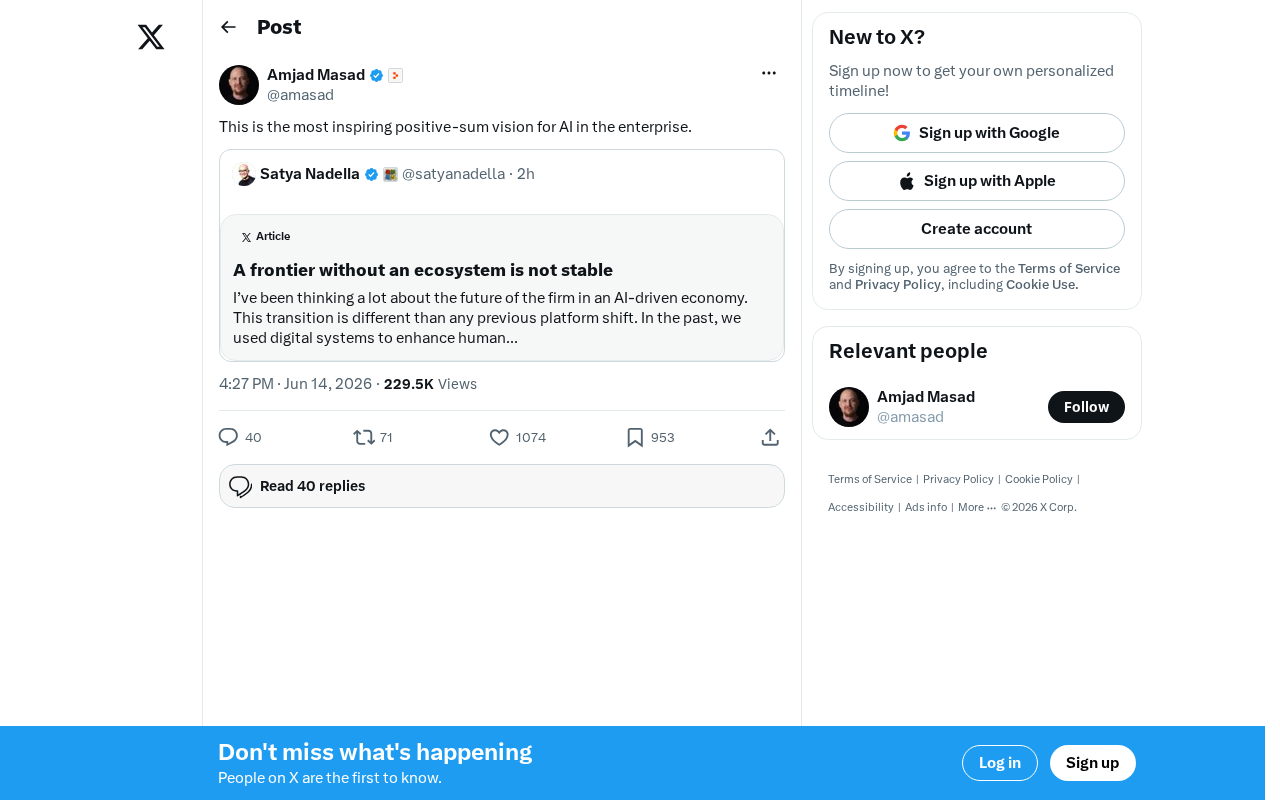
Enterprise AI can be a positive-sum game that creates shared value for businesses, employees, and customers.
This article argues that enterprise AI should be approached as a positive-sum game rather than a zero-sum competition. It explores three core dimensions — empowering employees through augmented intelligence, exponentially enhancing customer value via tools like predictive maintenance, and fostering ecosystem-wide prosperity through spillover effects — while addressing key implementation challenges including skill transformation and fair value distribution.
From Zero-Sum to Positive-Sum: Enterprise AI Needs a Mindset Shift
AI is rapidly penetrating every industry, but the conversation around it often falls into a trap — treating AI as a zero-sum game, as if one party's gain must come at another's expense. In reality, a growing body of evidence shows that AI adoption in enterprises can absolutely be a positive-sum game, where all participants benefit.
The core idea behind a "positive-sum vision" is straightforward: AI isn't introduced to replace one party for another's benefit. Instead, it creates incremental value that can be shared among the enterprise, employees, customers, and the entire ecosystem.
Why Enterprise AI Needs Positive-Sum Thinking
Zero-Sum Anxiety Is Slowing Down AI Adoption
The biggest source of anxiety around AI in the corporate world stems from zero-sum thinking — the narrative that when AI arrives, people must leave. This narrative not only breeds fear but also triggers internal resistance within organizations, ultimately slowing down AI implementation.
To understand the roots of this anxiety, it helps to revisit some foundational concepts from game theory. The zero-sum game was systematically articulated by mathematician John von Neumann in his 1944 classic Theory of Games and Economic Behavior, describing scenarios where the total gains and losses among participants always sum to zero — one party's gain is exactly another's loss, like a poker game. A positive-sum game, by contrast, means that through cooperation or institutional design, the total payoff for all participants can increase. The classic example is the theory of comparative advantage in international trade. Nobel laureate Robert Aumann's research further demonstrated that in repeated games, cooperative strategies tend to outperform adversarial ones — providing solid theoretical support for enterprises crafting long-term AI strategies.
The positive-sum vision offers a fundamentally different framework: AI isn't here to divide the pie — it's here to make the pie bigger. When enterprises use AI to boost efficiency, the freed-up human resources can be redirected to higher-value creative work. When AI lowers the cost of service delivery, enterprises can reach customer segments that were previously inaccessible.
Technology History Repeatedly Validates Positive-Sum Logic
Looking back at past technological revolutions, the truly successful transformations have almost always been positive-sum:
- Spreadsheets didn't eliminate accountants — they gave rise to an even larger financial analysis industry
- The internet didn't destroy retail — it created a multi-trillion-dollar e-commerce ecosystem
AI's role in the enterprise will most likely follow a similar trajectory — not replacement, but expansion.
Three Core Dimensions of the Enterprise AI Positive-Sum Vision
Dimension One: AI Empowers Employees Rather Than Replacing Them
The most inspiring positive-sum AI practices position AI as an "augmentation tool" rather than a "replacement solution." This concept is known in academia as "Augmented Intelligence" or "Intelligence Augmentation (IA)," tracing back to Douglas Engelbart's pioneering research in the 1960s. Unlike AI that pursues full autonomy, augmented intelligence emphasizes human-machine collaboration — AI handles data processing, pattern recognition, and repetitive computation, while humans handle creative judgment, ethical decision-making, and emotional communication. Gartner has repeatedly highlighted in its Hype Cycle that augmented intelligence is the most practically valuable direction for enterprise AI today. McKinsey's 2023 research also shows that enterprises adopting human-machine collaboration models achieve approximately 60% higher success rates in their AI projects compared to fully automated approaches.
Specifically:
- Knowledge workers leverage AI to handle repetitive tasks, freeing their energy for judgment, creativity, and interpersonal communication
- Frontline employees gain real-time decision support through AI, improving work quality and job satisfaction
- Management uses AI-driven insights to make more precise strategic decisions, rather than simply cutting headcount
When employees feel that AI is helping them rather than threatening them, their acceptance and willingness to use AI increases dramatically, creating a virtuous cycle.
Dimension Two: Exponential Enhancement of Customer Value
Under the positive-sum framework, AI is not just an internal efficiency tool — it's a multiplier for customer experience:
- Personalized services give every customer a tailored experience
- 24/7 intelligent support eliminates the constraints of service hours
- Predictive maintenance proactively resolves issues before they occur
Among these, predictive maintenance is one of the most mature application scenarios in industrial AI and deserves a closer look. The underlying technology works by continuously collecting equipment operational data (such as vibration frequency, temperature, and pressure) through IoT sensors, then using machine learning algorithms to build equipment health models that predict potential problems before actual failures occur. Compared to traditional scheduled maintenance (replacing parts on a fixed timetable) and reactive maintenance (fixing things after they break), predictive maintenance can reduce equipment downtime by 30%-50% and maintenance costs by 20%-40%. GE's Predix platform and Siemens' MindSphere are representative industrial AI platforms in this space. For customers, this means dramatically improved product reliability. For enterprises, it means shifting the service model from passive response to proactive care, fundamentally transforming the nature of customer relationships.
Customers receive unprecedented levels of service, and enterprises earn higher customer loyalty and lifetime value in return — a textbook example of a positive-sum game.
Dimension Three: Shared Prosperity Across the Ecosystem
A truly positive-sum vision extends beyond the boundaries of a single enterprise. When one company improves its efficiency through AI, its suppliers, partners, and even competitors can benefit from the overall elevation of industry standards. This spillover effect is the most powerful proof of the positive-sum game.
The spillover effect is an important concept in industrial economics, and in the AI domain, it primarily occurs through three pathways: First, knowledge spillover — methodologies and best practices accumulated through enterprise AI initiatives spread across the industry via talent mobility, academic publications, and open-source communities. Second, technology spillover — for example, Google open-sourcing TensorFlow and Meta open-sourcing the LLaMA model directly lowered the barrier to AI adoption industry-wide. Third, demand spillover — when leading enterprises raise service standards through AI, consumer expectations for the entire industry rise accordingly, compelling other companies to follow suit and upgrade. Research from Stanford University's Digital Economy Lab shows that the social return on AI technology is typically 2-3 times the private return, meaning the positive-sum effects of AI investment far exceed the value any single enterprise can capture.
Implementing the Positive-Sum AI Vision: Challenges and Pathways
Three Obstacles That Must Be Overcome
Translating the positive-sum vision from concept to reality is no easy feat. Enterprises must confront several key challenges:
- Balancing short-term costs with long-term returns: AI deployment requires significant upfront investment, while positive-sum effects often take time to materialize
- The growing pains of employee skill transformation: Learning new skills for AI collaboration requires systematic training and support
- Designing fair value distribution mechanisms: How the incremental value created by AI is fairly distributed among all parties requires careful deliberation
Among these three obstacles, employee skill transformation is often the most underestimated challenge. In organizational behavior, this issue is known as the "Skills Gap." The World Economic Forum's Future of Jobs Report 2023 predicts that by 2027, 44% of workers' core skills will change globally. Successful AI skill transformation typically involves three layers: The first layer is AI Literacy — understanding AI's basic principles, capability boundaries, and ethical issues. The second layer is AI Collaboration Skills, including Prompt Engineering, AI output validation, and human-machine workflow design. The third layer is AI Development Skills, targeting technical teams with model training, deployment, and operations capabilities. Amazon has committed $1.2 billion to employee AI skills training, and JPMorgan Chase requires all new asset management hires to learn AI tools — these cases demonstrate that leading enterprises already treat AI skill transformation as a strategic investment rather than a simple training program. In terms of change management methodology, John Kotter's Eight-Step Change Model is widely applied to such transformations, emphasizing the importance of establishing urgency, building a guiding coalition, and consolidating short-term wins.
Incremental Approaches Are More Likely to Succeed
Successful enterprises typically adopt an incremental strategy: first validating the positive-sum effect in localized scenarios, then gradually expanding after accumulating experience. The key is to incorporate "multi-party win-win" into AI project evaluation metrics from the very beginning, rather than focusing solely on cost savings or efficiency gains.
A practical approach is to answer three questions at the launch of every AI project:
- How does this project benefit employees?
- How does this project benefit customers?
- How does this project benefit partners?
If you can only answer one of these, it means positive-sum thinking hasn't truly taken root.
Conclusion: Positive-Sum or Zero-Sum — It's Your Choice
Whether AI in the enterprise turns out to be zero-sum or positive-sum largely depends on the choices decision-makers make. Technology itself is neutral, but deployment strategies, organizational culture, and values determine the ultimate outcome.
Enterprises that choose the positive-sum path will not only gain more sustainable competitive advantages but also earn the trust of their employees and the respect of society in the AI era.
This is perhaps the most important idea worth spreading in enterprise AI today — it's not about how much money AI can save you, but how much new value AI can help create for everyone.
Related articles
Claude Code Installation & Setup Guide: Low-Cost Vibe Coding with Chinese AI Models
Step-by-step guide to installing Claude Code and configuring it with Chinese models like DeepSeek for low-cost vibe coding, including Node.js setup and CCSwitcher usage.

Keyroll: An In-Depth Look at a Stability-Focused Claude Refill Tool
In-depth review of Keyroll, a stability-focused Claude refill tool. Analyzing its core strengths, security implications, and compliance considerations for developers facing usage limits.

OpenLLMVTuber: A Deep Dive into the Open-Source AI Virtual Character Framework
Deep dive into OpenLLMVTuber, a 10K-star open-source AI virtual character framework integrating ASR, LLM, TTS, and Live2D with voice interruption, visual perception, and modular architecture.