The Same Question Behind Six Claude Projects: Why Not Give It a Try?
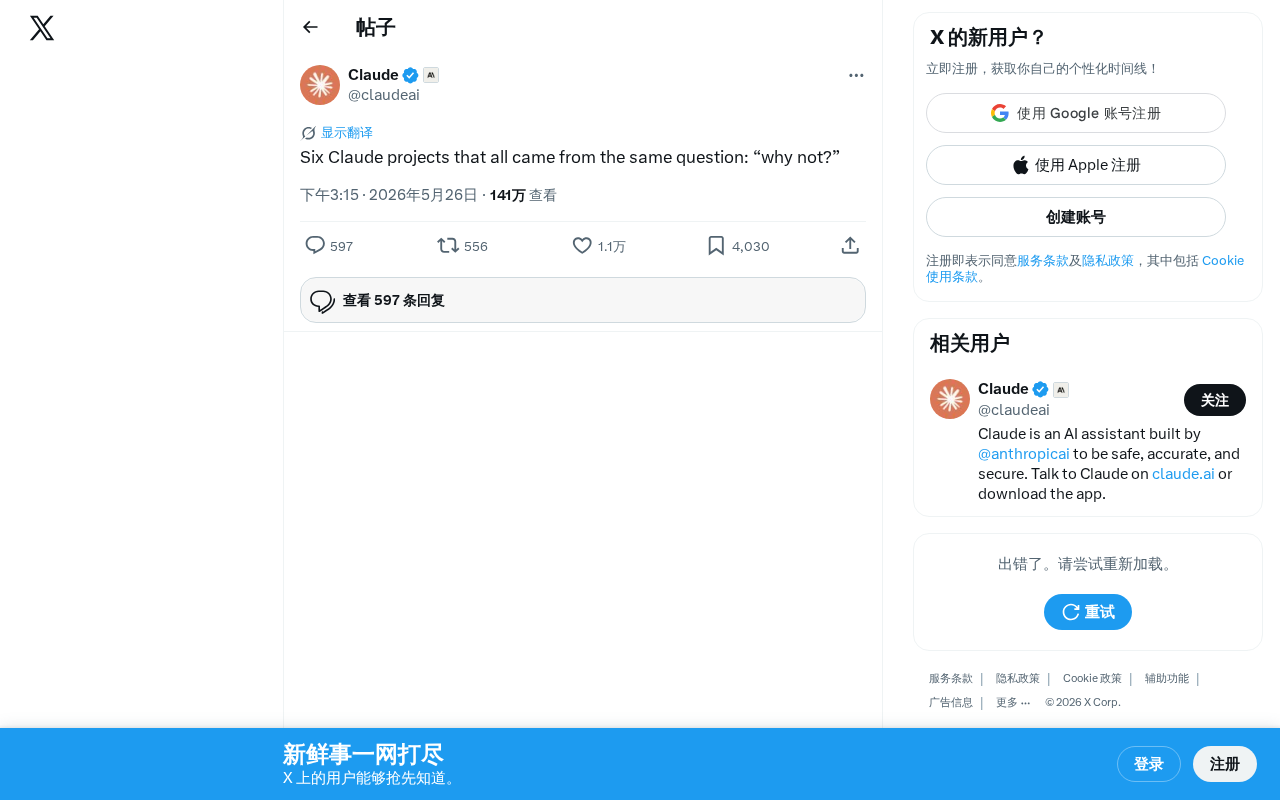
Six Claude projects, one mindset: "Why not?" — embracing AI-era creativity through action.
A developer shared six projects built with Claude, all sparked by a simple question: "Why not?" This article explores how AI tools like Claude dramatically lower the cost of experimentation, enabling a shift from hesitation to action. It examines Claude's strengths as a development partner, the progression from using AI to using it well, and practical habits developers can adopt to amplify their creativity in the AI era.
Introduction: A Simple Question That Sparks Creativity
In an era where AI tools are becoming increasingly accessible, many people still hesitate at the question "Can I do this?" — while true creators tend to ask just one thing: "Why not?"
Recently, a developer shared on Twitter six projects they completed using Claude, all of which started from the same simple question — "why not?" This shift in mindset may well be the key to unlocking personal productivity in the AI era.
The "Why Not" Mindset: A Creator's Mentality for the AI Era
A Paradigm Shift from Hesitation to Action
In traditional software development, launching a project means extensive upfront planning, technology selection, and team coordination. But in the age of AI-assisted programming, these barriers have been dramatically lowered.
AI-assisted programming refers to leveraging large language models to support various stages of software development, including code generation, debugging, refactoring, and documentation. This field took off rapidly after GitHub Copilot launched in 2021, and models like Claude and GPT-4 have since pushed the boundaries from code completion to full-scale project architecture design and system-level development. Unlike traditional IDE auto-completion, modern AI programming assistants can understand requirements described in natural language, generate complete cross-file code logic, and even autonomously debug based on error messages. The fundamental change here is that the developer's role shifts from "writing code line by line" to "describing intent and reviewing output," dramatically transforming the productivity model of software development.
When an idea strikes, developers no longer need to evaluate "Is this worth spending three months on?" Instead, they can simply ask themselves: "Why not spend a few hours and give it a try?"
The core of this mindset lies in:
- Extremely low cost of experimentation: AI drastically shortens the time from idea to prototype
- Flat learning curve: Even without familiarity with a particular tech stack, AI can help you get things done
- Rapid iteration: If you're not satisfied, you can quickly pivot
Lessons from Six Projects
The idea that one person could complete six different projects in a short period was nearly unimaginable just a few years ago. This reflects not just the advancement of tools, but an entirely new creative philosophy — one that closely aligns with the MVP (Minimum Viable Product) concept from Lean Startup methodology. The core idea of MVP, proposed by Eric Ries in 2011, is to build a product version with minimal resources that can validate core assumptions, then use real user feedback to determine the next steps. AI tools have compressed the cost of building an MVP from "weeks to months" down to "hours to days," fundamentally changing the economics of innovation. When the cost of experimentation approaches zero, the bottleneck of innovation shifts from "ability" to "willingness." This explains why the "why not" mindset is so crucial in the AI era.
This creative philosophy can be distilled into three core principles:
- Don't chase perfection — chase completion — Build it first, then optimize
- Don't fear failure — embrace experimentation — Every project is a learning opportunity
- Don't set limits — stay curious — Every idea is worth trying
Claude as a Creativity Amplifier
Why Choose Claude as a Development Partner?
Claude is a family of large language models developed by Anthropic, built on the Transformer architecture and employing alignment techniques such as RLHF (Reinforcement Learning from Human Feedback) and Constitutional AI. In programming scenarios, Claude's advantages stem from several key technical features: first, its ultra-long context window (Claude 3.5 supports 200K tokens), meaning it can "read" an entire medium-sized project's codebase at once and understand inter-module dependencies; second, its training data includes a vast amount of high-quality open-source code and technical documentation, giving it deep understanding of mainstream programming languages and frameworks. Anthropic has also launched developer-focused tools like Claude Code, which supports direct terminal interaction with Claude for file operations, running tests, and other development tasks, further shortening the distance from conversation to runnable code.
Building on these technical foundations, Claude demonstrates the following advantages in real-world development:
- Strong contextual understanding: Able to grasp a project's overall architecture and intent, thanks to its ultra-long context window
- High code quality: Generated code is typically well-structured and maintainable, reflecting the influence of high-quality code in its training data
- Conversational development experience: Progressively refine a project through ongoing dialogue, like pair programming with an experienced colleague
The "pair programming" analogy here has deep roots in software engineering. Pair Programming is a core practice in Extreme Programming (XP) methodology, proposed by Kent Beck in the late 1990s. It involves two developers sharing one computer — one writes code (the Driver) while the other reviews and thinks strategically (the Navigator). Research shows that while pair programming seemingly "wastes" one person's coding time, it significantly reduces defect rates and improves code quality. What makes AI unique as a pair programming partner is that it can play both roles simultaneously — rapidly generating code while also reviewing and optimizing existing code when asked. However, unlike a human partner, AI won't proactively question the reasonableness of requirements or raise business considerations for alternative approaches, so the developer needs to take on more of the "Navigator" responsibility, steering the project's overall direction and decisions.
The Path from "Using AI" to "Using AI Well"
People who truly use AI programming tools effectively tend to share these traits:
- They're skilled at breaking large problems into smaller tasks, letting AI tackle them step by step. This divide-and-conquer strategy not only reduces the complexity of each interaction but also makes it easier for developers to verify the quality of each output
- They know when to let AI take the lead and when to steer things themselves. Generally, pattern-based code generation and boilerplate writing are well-suited for AI, while architectural decisions, security considerations, and core business logic judgments require human leadership
- They maintain critical thinking about outputs and don't blindly trust results. AI-generated code may contain subtle logic errors, security vulnerabilities, or performance issues that appear perfectly correct on the surface
- They treat AI as a collaborative partner rather than an omnipotent tool, understanding its capabilities and limitations
Practical Takeaways for Everyday Developers
Lower the Barrier to Entry — Just Start
If you've had projects you've always wanted to build but never did, now is the best time. AI tools make "weekend projects" more feasible than ever before. You don't need to be a full-stack engineer. You don't need to master every technology. All you need is an idea and the courage to say "why not."
It's worth noting that a low barrier doesn't mean low quality. The real value of AI-assisted development lies in letting developers focus their energy on what matters most — defining problems, designing user experiences, and making critical product decisions — while delegating repetitive coding work to AI. This division of labor enables individual developers to produce output that approaches or even surpasses the level of small teams.
Build Your Own AI-Assisted Development Habits
Here are some suggestions you can put into practice immediately:
- Maintain an "idea list" and capture every moment of inspiration. Use tools like Notion or Obsidian — the key is to minimize the friction of recording ideas
- Set aside a few hours each week to pick an idea and quickly validate its feasibility with Claude. Set a time-box — say 2-4 hours — and see how far you can get
- Don't obsess over whether a project has "commercial value" — enjoy the creative process first. Many successful open-source projects and startups originally began as developers' personal hobby projects
- Share your results with the community — external feedback often leads to unexpected new directions. GitHub, Twitter/X, and indie developer communities like IndieHackers are all great platforms for sharing
Conclusion
"Why not" isn't just a question — it's an attitude toward possibility. In a world where AI tools are within arm's reach, what holds us back from creating is often not technical ability, but the psychological barrier of taking the first step. Behind those six projects is one person's loyalty to curiosity and commitment to action.
We're at a unique moment in history: AI tools are already powerful enough to multiply individual creativity several times over, but most people haven't truly adapted to these new possibilities. Those who embrace the "why not" mindset first are defining a new paradigm for individual creators in the AI era.
The next time you have a new idea, why not ask yourself: Why not give it a try?
Related articles

Claude Code for Test Development in Practice: An AI Programming Workflow That Doubles Your Efficiency
A practical guide to Claude Code for test development: auto-generating test scripts, Plan Mode workflows, MCP + Playwright integration, and Subagent parallel tasks to build systematic AI-assisted workflows.

Hermes Agent Hands-On Review: An AI Efficiency Revolution for Indie Game Developers
Indie game developer reviews Hermes Agent vs OpenClaude: intelligent context compression, real-time Memory, remote control via Telegram, and practical use cases in game dev, social media, and email.
Vibe Coding Beginner's Guide: Tool Selection Across Three Categories with Practical Examples
A comprehensive guide to Vibe Coding's three tool categories: Agent frameworks, CLI Coding, and IDE tools, with practical examples including Snake game and data analysis workbench.