The Truth About Windsurf Refill Plugins: Account Pool Mechanics, Risks, and Compliant Alternatives

Exposing Windsurf refill plugins' shared account pool risks and recommending compliant AI coding alternatives.
This article analyzes the Windsurf "refill" plugin scheme that uses shared account pools to bypass free tier limits. It explains the technical mechanics of token rotation, highlights serious risks including code theft, legal liability, and account bans, and recommends compliant alternatives like Cursor, GitHub Copilot, Cline with API keys, and local deployment with Ollama.
Disclaimer
This article is for informational and risk analysis purposes only and does not encourage any behavior that violates software service terms. Using shared account pools carries account security risks and legal risks. Readers should exercise their own judgment.
What Are Windsurf Refill Tools
Recently, a Windsurf "refill" scheme has been circulating on Bilibili, claiming to bypass official free quota limits through a plugin combined with a shared account pool, enabling continued use of Pro-level AI coding features.
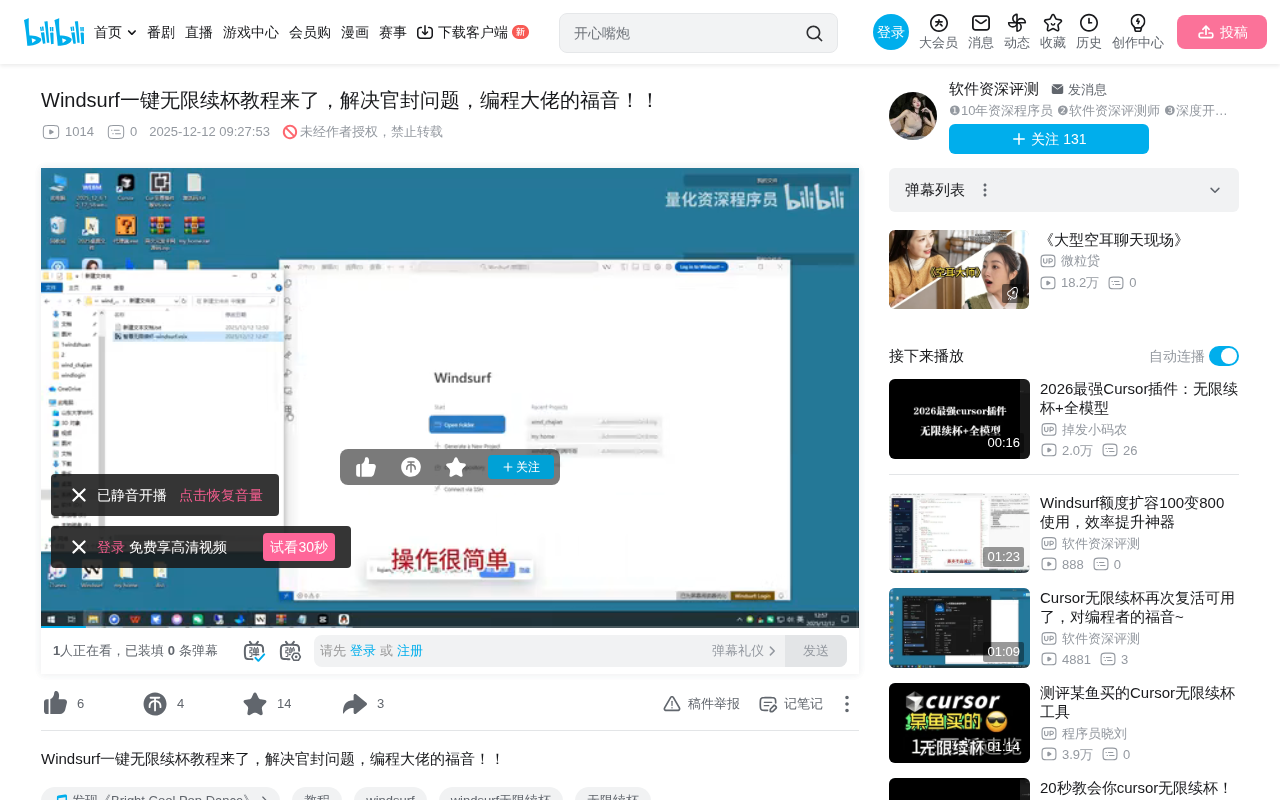
Windsurf is an AI-native integrated development environment (IDE) developed by Codeium, deeply customized on VS Code's open-source core. Unlike traditional AI coding plugins, Windsurf embeds AI capabilities directly into the editor core, offering an intelligent agent feature called "Cascade" that understands project context and automatically executes multi-step programming tasks. Its Pro version (approximately $10-15/month) provides unlimited AI conversations, access to advanced models (such as GPT-4o, Claude 3.5 Sonnet), and larger context windows, while the free version has strict daily call limits. It's precisely this gap between free and paid features that has spawned the so-called "refill" gray market.
The core idea of this scheme is: through a VSCode/Windsurf extension plugin, connect to a third-party maintained "account pool" service, automatically obtain available accounts and log in, thereby gaining Pro or Free-tier usage quotas. Simply put, it means using someone else's account to consume someone else's quota.
How the Windsurf Refill Plugin Works
Plugin Installation Steps
According to video demonstrations, the entire process involves the following steps:
- Open the Windsurf editor
- Navigate to the Extensions panel
- Drag the corresponding
.vsixplugin file to install
The nature of .vsix files deserves special explanation here. VSIX is the standard packaging format for Visual Studio Code extensions, essentially a ZIP archive containing JavaScript/TypeScript code. Normally, developers publish and install plugins through the official VS Code Extension Marketplace, which performs basic security reviews and malicious code scanning. Installing by manually dragging in a .vsix file (i.e., "sideloading") completely bypasses the official marketplace's review process. This means the code inside the plugin can access the local file system, make network requests, and read key information from environment variables without restriction — users have virtually no awareness of this. This installation method itself is a major security red flag.
Activation Codes and Obtaining Accounts
The workflow after installation:
- Click the "Account Pool" button in the bottom-right corner of the editor
- Enter a card number (similar to an activation code, usually requires purchase)
- Click "Initialize Login" to complete activation
- Click "Get New Account" to automatically switch logins
From a technical implementation perspective, the so-called "account pool" is essentially a centralized account management service. Operators obtain large numbers of Windsurf accounts through bulk registration (possibly using temporary emails, virtual phone numbers, etc.) or other means, storing these accounts' authentication credentials (typically OAuth Tokens or Session Cookies) on remote servers. When a user clicks "Get New Account," the plugin sends a request to the pool server, which allocates an available account credential, and the plugin injects that credential into Windsurf's authentication module to complete the identity switch. This token rotation mechanism is similar to how proxy IP pools work — when one account's quota is exhausted or banned, it automatically switches to the next available account. The "card number" is the pool operator's monetization mechanism, essentially an authorization key used to control user access permissions and usage duration.
According to the demonstrator, the pool contains a mix of Pro and Free accounts that are updated daily. When you get a Pro account, you enjoy full features; when you get a Free account, you can still use basic features normally.
Risk Analysis of Using Windsurf Refill Tools
Account Security and Privacy Risks
- Unknown source of shared accounts: These Pro accounts may come from stolen accounts, credit card fraud registrations, or other illegal channels. Some pool operators use stolen credit card information to bulk-subscribe to Pro services, which itself constitutes part of a credit card fraud chain. Even if users are merely "consumers" rather than "creators," they may legally be deemed knowing beneficiaries.
- Personal information leakage: When logging in through third-party plugins, your code and project information may be uploaded to unknown servers. Since the plugin needs to operate Windsurf's authentication system, it necessarily has elevated system privileges. Technically, the plugin is fully capable of silently uploading your project source code, Git commit history, environment configuration files (which may contain database passwords, API keys, and other sensitive information) to third-party servers in the background — all without the user's knowledge.
- Questionable plugin security: Unofficial plugins may contain malicious code, posing risks of local file theft
Legal and Compliance Risks
- Clearly violates Windsurf's terms of service; accounts may be permanently banned
- Using others' accounts may violate computer security protection regulations. Additionally, under Articles 285 and 286 of the Criminal Law of the People's Republic of China regarding "illegal intrusion into computer information systems" and "destruction of computer information systems," unauthorized use of others' accounts to access computer systems may carry criminal liability in serious cases. While the probability of individual users being prosecuted is relatively low, there are precedents of pool operators being investigated by law enforcement.
- The claim of "solving official ban issues" itself indicates that the platform is actively cracking down on such behavior
Stability and Reliability Issues
- Account pool accounts can be banned and invalidated at any time
- The platform continuously updates detection mechanisms; such schemes typically have a lifespan of only a few weeks. SaaS platform anti-abuse systems typically employ multi-dimensional detection strategies, including but not limited to: device fingerprinting (generating unique identifiers through browser/client characteristics), IP geolocation anomaly detection (same account logging in from different regions within a short time), usage pattern analysis (whether a single account's API call frequency and time distribution matches normal user behavior), and token sharing detection (whether the same authentication credential is being used concurrently across multiple client instances). As practitioners in the AI security field, the Windsurf team's technical reserves in this area far exceed the counter-capabilities of pool operators.
- Mid-project disconnections may lead to code loss or work interruptions
Compliant Alternatives for AI Programming Tools
If you're on a limited budget but need AI programming assistance, here are safer and more stable options:
| Solution | Cost | Best For |
|---|---|---|
| Windsurf Free Tier | Free | Light users |
| Cursor Free Version | Free | Developers with modest monthly usage |
| GitHub Copilot | Free/Paid | Students and open-source maintainers can get it free |
| Cline + Own API | API costs | Developers with some technical background |
| Continue + Ollama | Free | Local users with high-performance hardware |
These solutions represent three main technical architectures for AI programming assistance tools. Cloud-hosted mode (Windsurf, Cursor, GitHub Copilot) deploys AI models on the vendor's cloud servers, with user code context sent to the cloud via encrypted channels for inference. The advantage is no local computing power needed; the disadvantage is code privacy concerns. API relay mode (Cline + own API Key) is a decentralized approach — Cline, as an open-source VS Code plugin, doesn't provide AI models itself but allows users to configure their own OpenAI, Anthropic, or other compatible API keys to directly call large model services. In this mode, users have full control over data flow and cost, paying per actual token consumption, typically ranging from a few to a dozen dollars per million tokens. For moderate-intensity programming assistance, monthly costs can be kept between $5-20. Local deployment mode (Continue + Ollama) moves the entire AI inference process to the local machine. Ollama is a lightweight local large model runtime framework supporting models like CodeLlama, DeepSeek Coder, and Qwen2.5-Coder. Continue is a VS Code plugin that interfaces with local models. This approach keeps code entirely local with the strongest privacy, but has higher hardware requirements — models with good performance (such as 34B parameter level) typically require at least 16GB of GPU VRAM.
Among these, Cline paired with your own API Key offers the best value — the open-source plugin is free, and you only pay for actual API usage, making costs controllable and fully compliant.
Conclusion
While the Windsurf refill plugin is indeed simple to operate, from a comprehensive evaluation of security, stability, and compliance, it is not a reliable long-term solution. For professional developers, the monthly investment of a few dozen dollars for legitimate tools is far less than the potential losses from code leaks or security incidents. We recommend choosing the most suitable AI programming assistance tool from the compliant options above based on your needs and budget.
Key Takeaways
Related articles

Claude Code for Test Development in Practice: An AI Programming Workflow That Doubles Your Efficiency
A practical guide to Claude Code for test development: auto-generating test scripts, Plan Mode workflows, MCP + Playwright integration, and Subagent parallel tasks to build systematic AI-assisted workflows.

Hermes Agent Hands-On Review: An AI Efficiency Revolution for Indie Game Developers
Indie game developer reviews Hermes Agent vs OpenClaude: intelligent context compression, real-time Memory, remote control via Telegram, and practical use cases in game dev, social media, and email.
Vibe Coding Beginner's Guide: Tool Selection Across Three Categories with Practical Examples
A comprehensive guide to Vibe Coding's three tool categories: Agent frameworks, CLI Coding, and IDE tools, with practical examples including Snake game and data analysis workbench.